

Oscar winning documentary maker Alex Gibney has a reputation for doggedly pursuing the truth — about government-sanctioned torture (“Taxi to the Dark Side”), government-connected business crooks (“Enron: The Smartest Guys in the Room”) or the Catholic Church’s cover-up minded response to its pedophile priests scandal (“Mea Maxima Culpa: Silence in the House of God”).
So when the filmmaker decided to invest his time and efforts in an inspiring tale of cyclist Lance Armstrong’s “comeback” in the 2009 Tour de France, he felt betrayed when the whispers about Armstrong’s cheating turned into official sanctions and condemnation. Gibney, it seems, took it personally.
“Well, lookit, it may have been the best story in the history of sports,” Gibney says. “It was certainly the most inspiring. The idea of a cancer survivor who WILLS himself back to life, and goes on to not just return to competition, but to be much better that he ever was before. Lance knew how inspiring that story was, and so did his sponsors and so did the Tour de France and everybody else.”
So did Gibney. But as a Federal investigation of Armstrong’s cheating and lying about it was announced, as fellow cyclists came forward and admitted what they were doing and that they’d seen Armstrong doping, too, Gibney had to do something he rarely does — give up on a project. “The Road Back” was shelved.
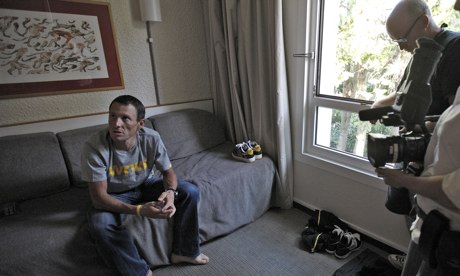
But as Armstrong “came clean” to Oprah Winfrey, Gibney figured he had a different movie he could make, using footage from the 2009 project and fresh interviews and a fresh approach. “The Armstrong Lie” would be the title. All he had to do was talk the disgraced cyclist “and more importantly, his lawyer,” into letting it happen.
“Post ‘Oprah,’ this film wouldn’t help him on the PR front. And doing interviews with me certainly didn’t help him on the legal front. Over time, I think he came to decide he wanted to influence the story and after all we’d done with him in 2009, I think he felt he owed it to me.”
“The Armstrong Lie” is, like most Gibney projects, earning universal praise for its doggedness and its big questions. Slate Magazine called it a “tormented” film from a filmmaker who always makes movies about “truth, lies and power.”
For this film, Gibney, who just turned 60, turned the Armstrong lie around and pointed it at his adoring public.
“How do we receive and accept these broad myths that are presented to us? How much do we want to believe in them, even if often we’re very badly fooled? To understand this one was to understand this amazing character and his story, but also how a big lie works. It was hiding in plain sight.”
We all remember the defiant Nike ads, Armstrong declaring “I’m on my bike. What are YOU on?” to his accusers. Gibney sees the man’s hubris and tragic flaws as “Shakespearean.” And he knew that would make a good movie.
“The problem for Lance was that he made the lie too big. He didn’t just say to people, ‘Look, I’ve never tested positive.’ He said ‘How DARE you say that I, a CANCER survivor, would ever use performance enhancing drugs?’ In that way, he implicated millions of cancer survivors around in the world in his lie. They believed him right to the very end, right to the moment he went on ‘Oprah.'”
Gibney’s own opinion of Armstrong changed as he finished his film. His two hour-plus movie exposed how the one true thing Armstrong said, that literally “everyone” was using drugs in his sport, should impact how we finally judge Armstrong, who was stripped of seven Tour de France titles from the Golden Age of Doped Cycling.
“People like to assign white hats or black hats to people. I think he had real affection and concern for people who were going through (the cancer) what he’d been through. He did a lot of good for a lot of people for a long time. That doesn’t balance or excuse the other stuff he did. But it does make him more complicated.
“I had a greater appreciation of his athletic talent at the end than I did, even at the beginning. He was the best of that blood doping era. But I was disappointed in his inability to reckon with his failings off the bike. Still am.”


 Movie Nation