
It’s not unusual for a documentary filmmaker to keep herself out of the story he or she is telling, even if the filmmaker is asking questions of the subject of the movie.
But there’s something special about Laura Poitras’s self-omission from “Citizenfour.” Her documentary is about Edward Snowden, the man who revealed the extent the National Security Agency (NSA) was electronically spying on Americans and the world after the 9/11 terrorist attacks.
Poitras was a key figure in getting Snowden’s story out, and her film is an “as it happens” account of Snowden’s bombshell. She was in his Hong Kong hotel room with him, helping tell his story on video, capturing Snowden as he was questioned by journalist Glenn Greenwald and others for the stories that would rattle the U.S. security establishment and startle those Americans concerned with issues of Internet and cell-phone privacy.
Everybody else is on camera here, but no glimpse of Poitras. Snowden tells her and Greenwald that the moment the first words of his tale are published, he and they will be found. The paranoia is palpable throughout “Citizenfour,” in every encrypted email exchange between Snowden and Poitras, in every meeting with the lawyers who rushed to Snowden’s aide, in every Snowden warning about “the greatest weapon for oppression in the history of the world” and the ways this data gathering is “the wronging of the American people.”
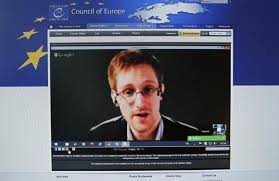
Snowden, sitting down here for the longest series of video interviews he’s given, comes off as less the reckless crackpot that he was painted as being by the mainstream media. He’s calm, resigned he says, again and again, to his fate. He expects to go to prison, he claims, again and again. He has the peaceful countenance of a martyr.’
Of course, he didn’t go to prison, he fled to Russia, which has been working to revive the Cold War that drove U.S. intelligence gathering for over 30 years. And for all the impact Greenwald and others unleashing Snowden’s revelations on the world has had, it’s hard to say much has changed. But that’s a discussion better left to experts on security, terrorism and Constitutional matters.
Poitras has delivered an important filmed argument, made by Snowden and Greenwald, that what we used to call “freedom” is now more narrowly defined as “privacy.” And it’s gone as the Intelligence State has evolved into a Kafka-esque nightmare of surveillance, bulk data collection and spying, much of it aided by phone companies and web operations.
But important as “Citizenfour” is, as sane as Snowden comes off and as sober-minded as the sometimes shrill Greenwald is presented here, the movie is never more than quietly chilling background noise. The soft-spoken Snowden drones on and one to Greenwald and Poitras, and the filmmaker does little to illustrate, underline or breathe life into the charges Snowden is making and their real-life consequences. Other experts pop up, mostly on panel discussions, as if Poitras was afraid to ID herself to everyone and anyone connected to this subject.
She fled to Berlin during the filmmaking — so concerned was she that her footage would be seized. If nothing else, we get a taste for how paranoid — perhaps justifiably — people covering the NSA and its misdeeds can get.
The precautions ensured that Snowden’s story got out, and that he slipped from the reach of American justice, which had notions of trying him through dated sedition and state secrets theft statutes. But the idea that these people feared for their lives seems melodramatic.
Greenwald, living on the edge of the Brazilian jungle, Snowden hiding out in Moscow and Poitras, wherever she is now that her movie is done, may be right to worry about how our electronic trails can be used against us by people paying more attention to that than we’d realized. They never come off as naive for fearing the consequences of their actions.
But this somewhat dull and seriously context-free film (this practice began as an effort to thwart the next 9/11) isn’t much more interesting than the original data dump itself. It needs less wonky analysis and more dramatic representations of what this wide surveillance net means and what it could mean if used by a government with a more zealous interest in suppressing dissent.

MPAA Rating: R for language
Cast: Edward Snowden, Glenn Greenwald, Jacob Appelbaum, Julian Assange, William Binney
Credits: Written and directed by Laura Poitras. A Radius/TWC release.
Running time: 2:04



