
The writing and directing duo who brought “The Madness of King George (The Madness of George III),” “The History Boys” and “The Lady in the Van” first to the London stage, and then to the screen skip the whole West End part of the equation for “The Choral,” a World War I homefront drama about art transcending politics and nationality and sexuality.
Playwright and screenwriter Alan Bennett’s script grapples with a lot more than that in this quaint and overreaching but sometimes quite moving story.
It’s about a (fictional) working town’s chorus and the choirmaster that The Choral’s sponsor, an industrialist who fancies himself a better baritone than he is, hires to take over for their next oratorio.
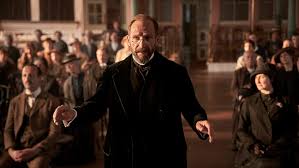
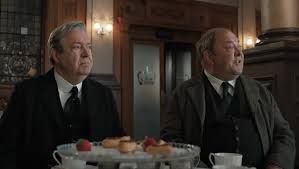
That choirmaster is the exacting Dr. Guthrie, played with sympathy and almost self-destructive resolve by Ralph Fiennes. And what factory-owner/alderman Duxbury (veteran character actor Roger Allam) and his singing/politicking mate Fytton (funnyman Mark Addy) and the gossips of town fret about is the fact that Dr. Guthrie spent years of his career in Germany “by CHOICE!”
It’s 1916, and patriotism is still the dominant emotion in a populace not yet shocked and numbed by the horrendous human cost of World War I. Any man who celebrates German composers and culture and art is suspect.
The fact that he doesn’t prefer the company of women is another matter altogether.
But when the choirmaster who was to guide the troupe through Bach’s “The Passion of St. Matthew” enlists to “do my bit,” this chorus is in a fix. Guthrie, with a trusted pianist (Robert Emms) in tow, will have to do.
Bach was German, Guthrie points out in more than one argument with Duxbury & Co. Eventually, he turns their jingoism around on them to pursue permission to do a more modern and more British choral work, Sir Edward Elgar’s “The Dream of Gerontius.”
No, I’ve been to and recorded choral concerts and worked in classical music public radio for years and I’ve never heard or heard of it either.
The conceit Guthrie and his ensemble come up with is to alter the oratorio’s poetic and symbolic intent to one that suits the moment — a horrific war and its grim cost to those young men fighting it.
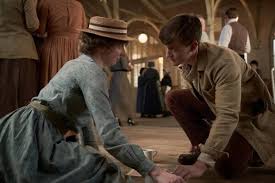
But first they’ve got to get through auditions, round up undrafted male factory workers as basses and baritones. They also contend with the very real but also melodramatic lives of working class folk who sing on stage or for the Salvation Army (Amara Okereke), pine (Emily Fairn) for a lover missing in action (Jacob Dudman) while aware of the attentions a fellow chorus member (Taylor Uttley) and the like.
Socialist politics, homophobic rumor-mongering, the dread of the draft or eagerness to “serve” and a small city sex worker with a patriotic heart of gold all enter the fray.
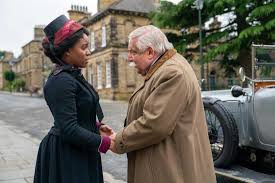
Simon Russell Beale steals his scene as the grand and “uniformed” Elgar, “the greatest living English composer,” who drops in to see how his least successful choral work is faring in this outing. He charms the lovely young Black soprano (Okereke) whose voice stands out in the cast, but also betrays his own myopia about how he wants his work produced.
The film’s oh-so-delicate treatment of what used to be poetically labeled “the love that dare not speak its name” (homosexuality) is emblematic of “The Choral’s” main shortcoming.
Bennett & Co. grapple with several subtexts, subplots, politics and “issues” and never get a grip on any of them. The treatment of the gay subtext is so delicate as to make this play like a film dancing around that subject back in the less “out” 1980s.
The story arc of building up to “The Big Show” is so formulaic as to feel trite. The delicate treatment of the assorted subplots dooms almost all of them to an unsatisfying conclusion.
Fiennes is fine, but even his performance leaves us craving more than the script has him give.
Charming romantic threads collide with dissonant ones and in the end, little seems resolved even in subjects as black and white as “War is Bad” and “Prejudice is ignorance.”
It’s a grand looking production and a well-cast, well-acted and high-minded film. But Hytner and Bennett have conjured up a Big Show and an Important Statement, and so cluttered the narrative that they lose track of which statements they’re serious about making.

Rating: R, profanity, sexual content
Cast: Ralph Fiennes, Roger Allam, Amara Okereke, Mark Addy, Roxanne Morgan, Emily Fairn, Alun Amrstrong, Jacob Dudman and Taylor Uttley.
Credits: Directed by Nicholas Hytner, scripted by Alan Bennett with contributions by Stephen Beresford. A Sony Pictures Classics release.
Running time: 1:53


 Movie Nation