
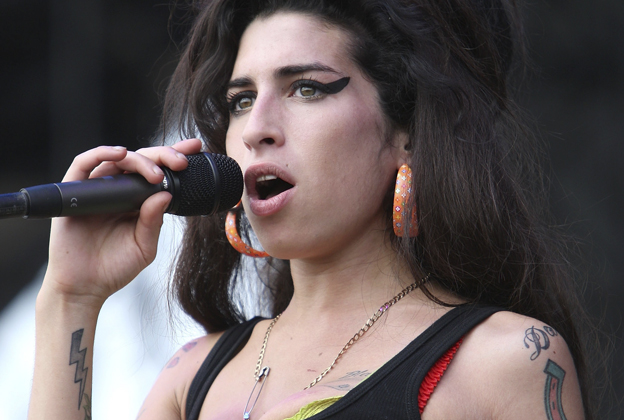
 The toughest question for “Amy” filmmaker Asif Kapadia is the most speculative one. Could Amy Winehouse have been saved?
Kapadia, who pulled no punches in his much-honored documentary about the tragic death of Formula One driver Ayrton Senna (“Senna,” 2010), pulls even fewer in “Amy,” about the mecurial, self-destructive singer-songwriter who died of alcohol poisoning right before our eyes in 2011.
“There seemed to be several clear-cut opportunities to save her, early on in her dependency,” Kapadia, a 43 year old Londoner, begins. “But real life is not like fiction. You can’t say, ‘That’s the moment when her life changed.’ Life is more complicated.
Still, “If she’d been urged into rehab earlier, her life could have turned out differently. That’s why that song ‘Rehab’ is so pivotal. A lot of people who knew her feel that the incident that inspired that song, when she was probably ready to seek help, but was let off, was key. Later on she was unreachable. She pushed people away who wanted to help her. But just before ‘Rehab,’ she knew she was in trouble, and for the reasons she gives in the song, she didn’t go.”
As Winehouse, the young Brit with an ancient Jazz chanteuse’s voice, the poet with a passion for autobiography, put it in her biggest hit, “Rehab,” “I ain’t got the time and if my daddy thinks I’m fine” she wouldn’t “go go go.”
As with “Senna,” Kapadia found villains in Winehouse’s life — the first the “daddy” in her biggest hit, Mitch Winehouse. Tabloids and gossip websites long ago zeroed in on those around Winehouse who wouldn’t let her clean up, dry out and step back from the storm of attention that seemed to fuel her addictions, the paparazzi hounding her, documenting her every misstep. But Kapadia “wanted to talk to everyone, give every person in her life a clean slate.”
That led to what the Daily Telegraph critic Robbie Collin calls “a Sherlockian reconstruction of Winehouse’s arcing path across the skies of superstardom,” a film that lets footage of Mitch Winehouse speak for itself, that finds her musician/junkie boyfriend and later husband Blake Civil-Fielder “charismatic…Not stupid, a clever guy, a wheeler dealer who knew how to survive. Girls fell for him. He was ‘the catch,’ and when they met, he was much cooler than she was. So that relationship was more complex than the press depicts.”
Kapadia found three under-reported culprits in Winehouse’s untimely demise. Her fellow Londoner figures her move to the Camden neighborhood was fatal.
“Camden became what Carnaby Street was in the ’60s or Notting Hill was later… a hip, edgy party scene…If you want something, ANYTHING, you can get it there. You could not walk down the street without someone coming up and whispering , ‘D’ya want to buy some drugs?’
“Nearby, you have all these amazing parks and restaurants and houses. But Camden was where all these bands were breaking out. And Amy wanted to be there.”
“Amy” is generating universally raptorous reviews, many of them, ironically, in the same (mostly British) newspapers that hounded her during her life. Kapadia sees the tabloids and the paparazzi and Winehouse’s inability to see a way to “travel, just get away from them abroad in places where she wasn’t famous,” as culpable in her death.
 And “there’s a moment in the film where the mirror turns on the audience. We all see what we did, and we know what we did. We all shared videos of her drunk, or commented on photos. I’ve yet to meet the person who realized she was brilliant and funny. Everyone thought she was a stupid drunk. That became the story. She was an object of fun. Imagine being the person seeing chat show hosts mocking her, reading all those comments, those newspaper stories, seeing those photos of herself at her worst.”
So Kapadia used home movies and early, pre-fame interviews and subtitles that reveal the depth of her lyrics, as he set out to alter the public perception of this public figure who died a very public death.
“I wanted to show how beautiful and funny clever and happy she could be.”
He knew he’d succeeded when he showed the film to some friends of his who are Amy fans.
“I asked them why they were crying at the end. And they said, ‘We’ve never seen her happy before.’ Most of the public hadn’t. That’s really awful, isn’t it? She never smiled in public, never seemed comfortable or happy on stage, once she became famous.”



 Movie Nation