Movie Review: Time traveling cruise ship assassins discover we’re all on the “Same Boat”

sameboat1

“Same Boat” is a little no-budget sci-fi comedy that walks that uneasy line between “deadpan” and “half-assed.”

It reaches for droll and dabbles in humanity. But the laughs are few and far between in this travelogue/cruise ship misadventure that seems more promising as the starting point for a remake.

In the future, time travel has been solved and time traveling assassins are sent back to this or that point from the past to prevent some calamity from visiting the planet by killing those most responsible for it.

“Results,” we are told in an opening credit, “have been mixed.”

Thus we find mop-topped James (director and co-writer Chris Roberti) and his apprentice Mot (Julia Schonberg) on a beach interrupting honeymooners. The killers whip out their little liquidation/mission-status gadgets — which look like ear thermometers — and commence to cleanse the future.

But but…”we work in TELEVISION!” the groom protests. Yes, it’s 1989 and the killers have come to snuff-out the inventors of “reality TV” and prevent the damage it does to civilization, culture, politics and the planet.

That’s as funny as this conceit gets, as the rest of the film is set on a cruise ship where an assignment goes terribly wrong.

Because Mot gets sea sick and is confined to her cabin. And James, who could take care of this on his own, no prob — is smitten by this flirtatious fellow passenger Lilly (Tonya Glanz).

She’s just heartlessly broken up with her dopey/needy boyfriend Rob (Evan Kaufman).  She, and it turns out James, have all this time to kill, all these buffets to gorge, shore trips to Key West and Cozumel to do and nobody to do them with.

Except each other. And there is, of course, a complication. Which you’ve already guessed.

The moral dilemma of the work of killing “nice people” is dismissed with a “They’re bad for humanity, not bad people. There’s a difference.”

No enough is made of James’ unique perspective — consoling the semi-suicidal Rob and others by urging them to enjoy “this golden age…the twilight of America!”

James knows.

The characters could be darker and more interesting, and the killers absolutely have to be more fanatically-committed to the mission for there to be a “journey” that they make towards redemption.

Nobody here has much of an arc. Lilly needs to be closer to beyond salvation for her journey to be engaging. She’s all, Key West? “It seems nice.”

“Yeah, until the oceans rise,” James prophesies. Which Lilly doesn’t buy.

sameboat2

Instead Roberti (pictured above being shady, an “officially-approved” still from the movie, if you can believe that) relies on cruise ship gags and supporting players to deliver the laughs.

The ribald, rude and randy crew, Rob in his manic post-breakup state, etc., put more effort into wringing a laugh from this than the leads.

The principals take their cue from the director-star, who is funny once or twice — a drunken karaoke duet on “House of the Rising Sun” — but mostly just a bland void around which the others and the movie revolve.

Funnier lines, more sharply-defined characters, higher stakes in the whole “Who lives/who dies?” game and darker twists would make “Same Boat” float instead of sink.

1half-star

MPAA Rating: unrated, some violence, profanity, sexual situations

Cast: Chris Roberti, Tonya Glanz, Julia Schonberg, Evan Kaufman

Credits: Directed by Chris Roberti, script by Josh Itzowitz and Chris Roberti. A Dark Star (VOD, streaming April 7) release.

Running time: 1:23

Posted in Reviews, previews, profiles and movie news | Comments Off on Movie Review: Time traveling cruise ship assassins discover we’re all on the “Same Boat”

Netflixable? A mother looks for answers about Long Island’s “Lost Girls”

“Lost Girls” is a moody, atmospheric but oddly unemotional mystery about exactly what the title implies — “lost girls.”

It’s a “true crime” missing persons police procedural seen almost wholly from the point of view of missing young woman’s mother, given a grounded, grim working class pragmatism by Amy Ryan (“Gone Baby Gone,” “Late Night”).

That’s because the police in this “police procedural” are revealed as disinterested, lazy, uncaring and occasionally lucky. Which is no way to solve a serial killer case.

Mari Gilbert (Ryan) is a single mom working two jobs to keep a nice roof over her teen daughters’ (Thomasin McKenzie of “Leave no Trace,” Oona Laurence of “Big Time Adolescence”) heads, happy on hearing that her third daughter, Sharon, is coming to dinner.

Only Sharon is a no-show. That’s not wholly out of character for the “diva,” and that odd call from a man claiming to be a doctor who says he tried to “help her” is dismissed, out of hand.

“She hasn’t lived here since she was 12,” her mother blurts out.

But Mari, showing just a hint of alarm, gets her back up at every police brush-off when she tries to file a missing persons report. And the Suffolk Co. detective (Dean Winters, “Mr. Mayhem” in those auto insurance commercials) who leaves no doubt that he’s judging “sex worker” Sharon and the mother who didn’t raise her really gets Mari’s goat.

She starts doing the cops’ work for them — grilling the “boyfriend” (pimp), tracking down the “driver” who delivered her to a client in a beachside gated community way down Long Island.

And Mari REALLY gets bent when the word “hooker” pops up, when the embattled police commissioner she leans on (Gabriel Byrne) lectures her about what happens “when girls like this go missing” in the “high risk environment” they’re working in. Sometimes they disappear without a trace.

“Luck” enters the picture when the cops stumble across shallow graves — young women buried. And even though Sharon wasn’t one of them, even though Mari assures her other daughters that “we’re not like them” when other parents of missing sex worker daughters start holding vigils, piling onto the no-answers-yet police in the media, a support group forms, amplifying all their voices.

Ryan makes Mari somebody who has all but choked-off emotions when it comes to Sharon. But her other daughters suffer from this treatment, too. They sense the backstory behind Mom’s double-edged warning — “The choices you make catch up to you.”

The screenplay drifts into docu-drama detail as a disgruntled local (Kevin Corrigan) fills her and us in on what’s “really” going on, and who the leading suspect must be in tony Oak Beach.

Another character, the sister (Lola Kirke) of another victim, is introduced to add details on “the life” to Mari and the story. Kim “got her” sister into prostitution, and knows the ropes and risks.

The emotionally available McKenzie occasionally reminds us of what director Liz Garbus left out of “Lost Girls,” the pathos and heartbreak. This isn’t just a story of a mother looking for answers. She’s looking to atone for whatever guilt she feels about her daughter’s fate, desperate to “bring her home,” lashing out at those who aren’t helping but smothering her grief, and the movie’s, in the process.

2half-star6

MPAA Rating: R for language throughout

Cast: Amy Ryan, Thomasin McKenzie, Oona Laurence,  Lola Kirke, Dean Winters and Gabriel Byrne.

Credits: Directed by Liz Garbus, script by Michael Werwie, based on the Robert Kolker book.  A Netflix Original.

Running time: 1:35

Posted in Reviews, previews, profiles and movie news | Comments Off on Netflixable? A mother looks for answers about Long Island’s “Lost Girls”

Best thing on Twitter? Actors reading Shakespeare’s sonnets — and not just Patrick Stewart

I like John Carroll Lynch’s cinematic (cell phone) takes on the sonnets.

Posted in Reviews, previews, profiles and movie news | Comments Off on Best thing on Twitter? Actors reading Shakespeare’s sonnets — and not just Patrick Stewart

Documentary Review: The world changed at “Crip Camp,” and Netflix has the movie that proves it

It was the summer of Woodstock, and just up the Catskills from the revolutionary Bethel (Saugerties) festival of art and music, Jim LeBrecht was encountering people just like himself, in large numbers, for the first time.

He was born with Spina Bifida, and “the barriers” to his life were “all over the place,” even in New York. But at this long-established summer camp, Camp Jened, which had found its true purpose just a few summers before, barriers disappeared, young people like himself experienced freedom, fun and the camaraderie of a shared struggle — being disabled.

They met, talked and played in a camp “filled with disabled people, run by hippies.”

And in this “Utopian” atmosphere, they fell in love, found common purpose and changed their outlook on what the world be could like.

“This camp changed the world,” declares LeBrecht, a veteran sound designer for theater and sound mixer for movies, co-director of “Crip Camp: A Disability Revolution.”

That’s a bold claim for a film you’re both in and co-directed. But damned if “Crip Camp” doesn’t prove that thesis in 100 upbeat, focused and outspoken minutes. It’s a feel-great movie arriving at just the time we could use one.

It was a project that spun out of “the social experimentation of the times,” then-director Larry Allison remembered (in an archival interview). Camp Jened was a place where polio survivors, “CP’s” (cerebral palsy) and assorted paraplegics, quadriplegic teens, deaf and otherwise “disabled” kids could be in a place where they weren’t “freaks.”

“At camp, everybody had something going on with their body. It was no big deal.”

And the realization that life didn’t have to be a losing struggle against unfriendly people and unfriendly buildings, streets without ramps and train stations without elevators, was Earth shattering for these young people.

Led by camp alumnus Judy Heumann, who sued first New York state and then led sit-ins across the country, they proceeded to “change the world.”

Doubt that phrase at your own peril, even if you’re too young to remember an America before The Americans With Disabilities Act of 1990, and the other laws and fiercely resisted progress that preceded it.

Judy is our tour guide through many of those years, here, but other alumni speak up and talk of how their lives changed, camp counselors speak of what they experienced at Camp Jened and how they “brought that home with me” to the Deep South, or wherever, after that touchstone summer.

LeBrecht was involved with videotaping (in black and white) the events of that summer, and the film uses that footage, along with other camp movies, and decades of archival TV news coverage of Disabled in Action activism — wheelchair-bound protestors shutting down streets, closing government buildings, getting their voices heard.

“Crip Camp” underlines and identifies the alumni, a tiny, dedicated and networked (pre-Internet) band who drove this movement for 20 years until ADA became the law of the land, “equal access” because the default position of America and the pro forma discrimination, segregation and even institutionalization of the “Differently-abled” was beaten back.

In these, America’s darkest days since the Vietnam War, “Crip Camp” is an inspiring, upbeat shaft of light and a sobering reminder that whatever conservatives want to say about the ’60s, every now and then, hippies changed America, and helped America change the world.

3half-star

MPAA Rating: R for some language including sexual references

Cast: Judy Heumann, Jim LeBrecht, Larry Allison, Lionel Woodyard, Denise Sherer Jacobson, many others

Credits: Directed by Jim LeBrecht and Nicole Newnham. A Netflix Original.

Running time: 1:46

Posted in Reviews, previews, profiles and movie news | Comments Off on Documentary Review: The world changed at “Crip Camp,” and Netflix has the movie that proves it

Movie Review: Girls bond over the boy they shared like a “Banana Split”


“April Love” roars out of the gate in “Banana Split,” a romance that begins, progresses sexually and socially through two years of high school and comes to a crashing halt — all of that encapsulated in the opening credits.

Because it’s what comes AFTER April (Hannah Marks) breaks up with surfer pinup boy Nick (Dylan Sprouse) that’s a lot more interesting. Life is what comes after graduation.

She’s prepping for a cross-country trip to Boston University — college. The film gives us countdowns, “84 Days Until Orientation,” to remind us of that.

And as quickly as Nick moved on, blond bro’s HEAD would spin if he saw how quickly April and his new girl, Clara (Liana Liberato) click. They collide at a house party, bond over “shots” and Junglepussy “Bling Bling” sing-alongs, and “Nick” stories.

“Did he always put his NOSE in your mouth?”

“I know, right? I had to GOOGLE it!”

Just like that, numbers are exchanged and “rules” are established for their friendship.

“Rule number one, no talking about ‘Nick.’ Rule number two, no TELLING Nick!”

“I feel like we’re in FIGHT Club!”

The title may be a tease, sexual slang for a lesbian relationship. But Clara and April click on a whole different level, a bond that may outlast this boy and could outlive every boy to come.

The corporate ethos of the production company American High” lays this vow on you right on their website. They want to “update” the sophisticated teen comedies of John Hughes (“Breakfast Club,” “Sixteen Candles”) and “embrace the R-rated reality of high school” today with their films.

“Banana Split,” like American High’s Hulu film, “Big Time Adolescence,” has teen drinking, teen smoking, modestly explicit teen sex and permissive parenting. The whole “drug” element of “Adolescence” is dispensed with. And the fresher, female-centric point of view makes the weary “coming of age” tropes play.

“Split” is also more charismatically-acted, wittier and funnier, closer to the Hughes films in laughs and the limited role parents play in this world. The only adult we meet is April’s “cool” Mom (Jessica Hecht) who ineptly referees fights between the graduating sister and her obnoxious, foul-mouthed 14 year-old sibling, Agnes (Addison Riecke).

“I am a three dimensional HUMAN BEING,” Mom complains, “who has had sex…and UTIs!” So, listen to your Momma. Right.

Marks co-wrote the script and packs Hannah with both deflated vulnerability about Nick moving on, and epic threats to their mutual friend Ben (Luke Spencer Roberts) so that she can get details about who her ex has taken up with.

“I am going to tell WEIRD stories about you at your funeral so that NO ONE accurately remembers you!”

We get how rare meeting someone compatible can be when you’re too-smart and 18.

“I’m an existentialist.”

“Cool! I love horses TOO!”

Cinematographer (“Safety Not Guaranteed”) turned director Benjamin Kasulke and the American High production team aren’t reinventing the genre so much as giving tried and true themes a fresh, frank edge.

There’s nothing deep in this “Banana Split,” nothing remotely moving or profound. But Marks (TV’s “Dirk Gently’s Holistic Detective Agency”) and Liberato (“If I Stay”) let us believe these two would connect, push each other’s buttons and bruise each other, and in just that way — just not in the way the title implies.

2half-star6

MPAA Rating: R for crude sexual content and language throughout, drug and alcohol use — all involving teens.

Cast: Hannah Marks, Liana Liberato, Dylan Sprouse, Luke Spencer Roberts, Addison Riecke and Jessica Hecht

Credits: Directed by Benjamin Kasulke, script by Hannah Marks and Joey Power. An American High/Vertical Entertainment release.

Running time:

Posted in Reviews, previews, profiles and movie news | Comments Off on Movie Review: Girls bond over the boy they shared like a “Banana Split”

Movie Preview: Mickey Rourke sends a lone Centurion for help in “The Legion”

There have been a lot of movies set in this “Fall of Rome/Beginning of the Dark Ages” era in recent years. They’re often about some lonely military outpost, some “lost legion” that is slow to get the word that order has broken down and their mission is pointless.

“The Lost Legion,” “The Last Legion,” “Centurion,” “The Eagle.”

I’ve seen’em all.

Here’s one coming out May 8.

Posted in Reviews, previews, profiles and movie news | Comments Off on Movie Preview: Mickey Rourke sends a lone Centurion for help in “The Legion”

Movie Review: Eisenberg takes on an iconic role in “Resistance”

resist1

The eternally boyish Jesse Eisenberg can almost get away with playing a 16 year-old Jewish Boy Scout helping to rescue orphans during World War II in “Resistance.” Sure, 35 is a tad long in the tooth (he’s 37 now) to pull off “idealistic teen.” But kids had to grow up fast during the war.

It’s the fact that he’s got to convince us that he’s the iconic French mime Marcel Marceau that proves to be the real overreach. Mastering “the silent art” this long past your “mime class” years (don’t think he ever had them), even when your mother performed as a clown, proves to be the big letdown in “Resistance,” a harrowing tale of Occupied France that has enough “true story” in it to make your jaw drop, enough suspense and derring do to do justice to its subject.

Marceau became famous the world over in the decades after the war, the most celebrated mime in history. But in France, he was a decorated war hero, one of that rare breed of heroes who desperately fought back — mostly by (according to the film) helping his fellow Jews survive.

The tale is framed — told by General George S. Patton (Ed Harris) — speaking to a huge Army gathered in Nuremberg just after the German surrender. “Courage,” he reminds his men, “is no more than ‘Fear holding on a minute longer.'” And this young man, whom he introduces, exemplifies that.

A child (Bella Ramsey) is orphaned when her parents (Edgar Ramirez plays her father), are grabbed and murdered by Nazis on Kristallnacht (1938). She is among a group of orphans bribed out of Germany to safety in the border city of Strasbourg, France, where young Marcel Mangel (Eisenberg) is learning to write, paint and perform despite the disapproval of his butcher-father and soldier-brother, who grouses “Marcel only thinks of himself.”

That view starts to change when the kid is enlisted by an activist Boy Scout friend, Georges (Géza Röhrig) to entertain the 123 orphans just freed by the Germans, to be cared for by Catholics in the town castle. Marcel takes to this work. And when the Germans overrun France in 1940, another of his artistic skills comes in handy.

Painters make the best document forgers. That’s when he changes his Jewish last name on his ID — inventing “Marceau.”

resist2

“I’m not a fighter,” he complains at efforts to recruit him for The Resistance. “I think, therefor I am.”

But the situation, and the entreaties of the pretty Emma (Clémence Poésy) draw him in. And that puts him in the line of fire of “The Butcher of Lyon,” Klaus Barbie, one of the most infamous German war criminals of World War II.

I’ve never read that Marceau confronted this “monster” directly. But writer-director Jonathan Jakubowicz gives his film an epic villain by pitting them against one another. Matthias Schweighöfer makes Barbie a cultured, ideologically pure sociopath — beating homosexuals to death to break up a gay underground gathering of queer Nazis, torturing and gunning down suspects in the empty pool of the belle epoch Hotel Terminus in Lyon, Gestapo headquarters for the region.

The subtext of “Resistance,” in light of the politics of Western Civilization today, is how people of the distant past whom we regard at “not human” in their treatment of others can seem awfully familiar in a climate of hate speech, rhetoric used to justify mistreatment of immigrants of other races.

And it’s a reminder that creative people — artists — play a role in resisting evil, preserving life, humanity and civilization itself.

“Resistance” is, in many ways, an old fashioned World War II movie. Most of those who fought as soldiers or resistors were very young, but Old Hollywood was forever casting Bogart, Savalas, Richard Burton, Gregory Peck and David Niven as its heroes — 40-50somethings.

Nobody in this is “Boy Scout” (it’s a coed organization in the film) age, and losing the impulse, fears and preoccupations of youth costs the film some of its pathos.

The action — daring rescues using street entertainment, fleeing Barbie through the Alps — is beautifully shot and edited. And this is an epic tale well worth telling (pity the French didn’t take a shot at it).

But when we’re meant to be moved, there’s a disconnect. And when we should be transfixed, something Marceau managed in mastering his art, we’re let down. Every time.

2stars1

MPAA Rating: R for some violence

Cast: Jesse Eisenberg, Clémence Poésy, Bella Ramsey, Matthias Schweighöfer, Edgar Ramirez and Ed Harris

Credits: Written and directed by Jonathan Jakubowicz. An IFC release.

Running time: 2:01

Posted in Reviews, previews, profiles and movie news | Comments Off on Movie Review: Eisenberg takes on an iconic role in “Resistance”

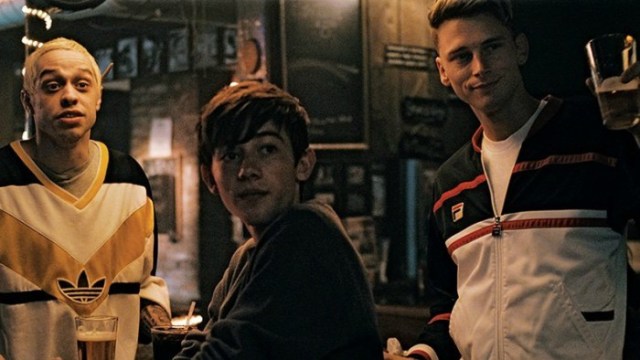
Movie Review: Pete Davidson celebrates never-ending “Big Time Adolescence”

big3

Hulu takes a stab at stealing some of Netflix’s thunder in the teen “coming of age” genre with “Big Time Adolescence.”

It’s a raunchy, drug-and-profanity fueled “Superbad” meets “Meatballs” of a kid who clings to his older sister’s ex-boyfriend long past the point of reason, the guy who gives the boy his first beer, his first trip to a bar, his first (kind of) girlfriend, first sex and first “hot box.”

And as a sidebar, it’s also about the clued-in-but-still-permissive parents that let all this go on. Remember Jon Cryer in “Two and a Half Men?” This is his character there ceding all control over his kid’s life to a Charlie Sheen-ish stoner/slacker/loser who cheated on his daughter when they were dating.

Pete Davidson of “Saturday Night Live” has the Bill Murray/”Meatballs” role here, an occasionally sweet, often wrong and far-less-benign “big brother” figure to young Monroe (Griffin Gluck).

Zeke used to date Kate (Emily Arlook). The older boy always included the younger one in their boardwalk arcade visits, movie dates. He took an interest. Here it is, seven years later, Kate has gone to college and moved on. But “Mo” still sticks to Zeke like a fanboy and bad-influence Zeke eats it up.

As the opening scene is the hammer being dropped on young Monroe, and his voice-over narration skirts the blame for the consequences of his Big Mistake with “not entirely my fault,” “Big Time Adolescence” is going to be about the slippery slope of hanging with “a man” who “made ME feel like a man,” only in the most adolescent sense.

Zeke is scattered, unrealistic, filled with “I could be an actor” talk or “I’m gonna be a TALK show host,” never doing a damned thing to make those delusions happen.

He picks up Mo in the same battered Volvo wagon he used to pick up sister Kate in, and out they go — to the bars, hanging out with Zeke’s fellow “Joe Rogan Show” bros.

Mo barely bothers to befriend anybody his own age, and the one kid who takes an interest (Thomas Barbusca) is the “Superbad” peer — the one who uses Mo to use Zeke to score liquor for a “Pimps & Ho’s rager” at a high school senior’s house.

The kids there won’t realize Zeke watered down the booze he bought with their money. And oh, by the way kid, take some of my weed with you to sell.

The kid’s dad is Mr. “All it takes is 10 seconds of stupid to ruin your whole life,” but Mo barely puts up a fight. “I feel like it’s going to become this whole thing.” He can see the future even if he is seemingly helpless at avoiding it.

Mo likes being “the Legend” who shows up with the goodies for his classmates. He gets the courage to flirt with the sassy “real” Sophie (Oona Lawrence of “The Beguiled”).

But we know how this is going to play out — the illusion of infallibility, the delusions of popularity, the blunders.

The female roles here are, to a one, barely sketched in. Gluck, from TV’s “Lock & Key,” registers — but only just. He’s playing a character that seems underdeveloped, like most of the others. Some of Mo’s actions seem abrupt and out of character, until we remember how little his “character” is fleshed out.

The actor-turned-writer-director Jason Orley cast Gluck, makes him a baseball player/baseball fanatic (he’s about 85 pounds, soaking wet). But the kid is so in Zeke’s thrall that he lets the never-amounted-to-anything Zeke give him baseball advice, in addition to love life pointers. And yeah, he talks him into selling drugs to teenagers.

It’s Davidson’s show, and he gives Zeke the attention span of a salmon, the morals of a jackrabbit and the sex appeal of the “cool guy” who most certainly wasn’t that cool in school. He needs younger acolytes to sell that myth. Meeting Zeke’s onetime guru, the Zeke back when Zeke was Mo’s age, could be sad or “Van Wilder” funny. It’s neither here.

Cryer’s years of practice playing the well-meaning but “What can you do?” ineffectual dad on TV mean more to his seemingly wise-to-Zeke’s-ways character than the screenplay. Why does Reuben allow this to go on? Cryer has the film’s one touching scene,  an adult chat with Zeke that has pathos, at attempt at getting across what “parenting” is and…not enough parenting.

Orley’s screenplay borrows from several sources and is never quite wrestled into the same shape as the legions of better movies on this boy-comes-of-age theme that preceded it.

But Davidson, in a bid to escape “SNL” just as Bill Murray did shortly after “Meatballs,” gives this guy every bit of charisma and kid-luring bravado that he can summon up. Davidson may know “Big Time” is strictly small time. But he never lets on that he does, never lets up and never lets us notice how thin the entertainment surrounding him is.

2stars1

MPAA Rating: R for drug content, alcohol use, pervasive language, and sexual references – all involving teens

Cast: Griffin Gluck, Emily Arlook, Julia Murney, Jon Cryer and Pete Davidson

Credits: Written and directed by Jason Orley. A Hulu Original.

Running time: 1:31

Posted in Reviews, previews, profiles and movie news | Comments Off on Movie Review: Pete Davidson celebrates never-ending “Big Time Adolescence”

Movie Critics During a Pandemic

egon2

Posted in Reviews, previews, profiles and movie news | Comments Off on Movie Critics During a Pandemic

Movie Review: “Space & Time”

space1

Maybe what the world needs now is a romance that surprises and delights, stings and hurts and hangs on that sense of longing the great ones get across.

Maybe it’ll be Canadian. But it won’t be “Space & Time,” a wan, waffling 90 minutes of cute (ish) romantic predictability.

The leads are almost likeable, the situations almost believable, the breakup totally pre-ordained and everything post-break-up pretty much what you’d expect.

Siobhan (Victoria Kucher) is a PhD candidate in experimental particle physics. Sean (Steven Yaffee) is a Toronto photographer. They’ve been together for years, and we meet them on their anniversary, taking the ferry over to Wards Island for a little fireside camp-out.

She broaches the idea of “multiverses,” and how there might be “badass” or hip or more-in-love versions of them in another universe. He’s fretting over “pushing 30.”

And he takes her picture, and our first real hint of trouble emerges.

“You think it’s been years since you’ve photographed me.”

She’s thinking of applying to a fellowship to CERN, the research super-collider in Switzerland. He’s leery. “What would I do there?”

The fact that her sister (Alex Paxton-Beesley) is getting married presses in as well. Where do we go from here?

“I want you to be with me while I figure this thing out!” That’s as romantic a proposal as a fella’s likely to get at 30. Right?

In a flash we go from that to the Big Fight and Big Bluff — which is, or course, called.

“Maybe we should just break up!”

space2

One conceit of writer-director Shawn Gerrard’s film is how grim the other couples are that Siobhan do dinner dates with. Sister Frances (Paxton-Beesley) and her fiance (Ish Morris) bicker over his cell phone addiction and her pushiness. And Sean’s pushy, flirtatious new protege, D.D. (Risa Stone) is a highhanded bully to her live-in lover, Hannah (Robby Hoffman).

Another conceit? Well, there isn’t one. Gerrard is content to show us the stereotypical “male” way of moving on from a breakup and the equally stereotypical female path.

And those play out in not-quite-surprising ways as we wander the primrose/thorny rose path to that inevitable finale.

Kucher makes a pretty but colorless lead, with her glasses the only signifier that she’s “the smartest ‘girl’ in my cohort” (of PhD candidates). Yaffee would need to spend two weeks in Florida to rise to the level of “colorless.”

Not that they have a lot of play with here. The only flashes of life are the more broadly drawn supporting characters D.D. — a narcissistic, psychic-consulting impulsive control freak and Alvin (Andy McQueen), Siobahn’s flaky flirt of a classmate who is discovering hip hop — late, and getting into it “chronologically.”

Very “Big Bang Theory.”

In life, even an ill-fated romance can leave traces, treasured traits and moments and scars, big or small, that you carry with you in memory. “Space & Time” takes up none of the former and too much of the latter to feel of any consequence.

MPAA Rating: unrated, profanity

Cast: Victoria Kucher, Steven Yaffee, Risa Stone, Alex Paxton-Beesley, Andy McQueen

Credits:Written and directed by Shawn Gerrard. A Head On Pictures release on Apple TV and streaming platforms.

Running time: 1:29


Posted in Reviews, previews, profiles and movie news | Comments Off on Movie Review: “Space & Time”