
George Orwell’s parable of totalitarianism earns a Trump era updating in a new animated “Animal Farm,” this one backed by Angel Studios and not the CIA.
Actor turned “Venom” sequel director and the one-and-only “Gollum” in J.R.R. Tolkienland Andy Serkis and screenwriter Nicholas Stoller “(“Bros” and TV’s “Platonic”) take a big swing at Orwell’s tale, and a big risk.
Their film is about the unjust trap of consumer capitalism, cult of personality politics and the same human foibles that Orwell always warned us about in our “leaders.” And releasing it on May Day just underscores that “Animal Farm” was never a condemnation of socialism, despite 75 years of conservative spin.
It doesn’t all work, and some key elements are lost any time you mess with a classic plot. But if there’s an agenda in this “Farm,” it’s that good but misguided people (animals here) have to admit they’ve been had before their deeply-flawed, criminally cruel idols can be brought down. And calling out their stupidity is no way to lead, either.
The trouble on Manor Farm isn’t just animal cruelty and animal enslavement by drunken abusive Farmer Jones (one of a couple of charaacters voiced by Serkis). The bank is seizing the property over the mortgage he can’t pay.
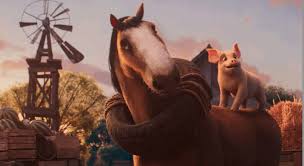
That’s the last straw for the animals there, with Snowball (Laverne Cox) the pig figuring out that the livestock are being rounded up for slaughter and not “a vacation,” as simple workhorse Boxer (Woody Harrelson) and the simpleton sheep (Jim Parsons voices one) believe.
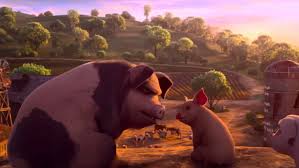
Snowball leads the revolt, with her promising pupil pig Lucky (Gaten Matarazzo) at her side. Porcine lout Napoleon (Seth Rogen) and his lacky Squealer (Kieran Culkin) sort of go along with the coup de critters, even if they didn’t figure any of this out on their own.
The animals rout the humans, embrace “freedom” and listen as idealist/agitator Snowball lays out new “rules” to live by.
“Four legs good, two legs bad” may not take into account the chickens and ducks, but it separates the livestock from those who prey on them — men.
“No animal shall sleep in a bed…wear clothes…or drink ‘naughty juice.”
Everything is to be shared — work, shelter and food. And above all else, “All animals are equal.”
If you remember the story arc, it doesn’t take some pigs long to cheat, steal, back-stab and sell-out on their way to “but some are more equal than others.”
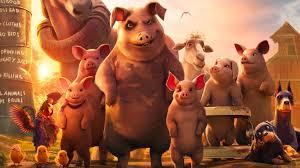
Rogen’s Napoleon is an imposing dunce who mocks those smarter than him as he preys on the most gullible. He recruits and grooms the farm’s Dobermans to be his enforcers. Pigs are a separate class under the regime he establishes when he deposes Snowball for insisting that they save grain for the winter to come rather than heedlessly eating and doing whatever you want and calling that “freedom.”
“You animals are all too stupid to understand” your shortsightedness is never going to win any converts.
Lucky is left behind to see every “rule” twisted or broken, every historical fact about Napoleon’s shortcomings and the peril he puts first one group and then another under is gaslit out of mind.
Cynical donkey Benjamin (Kathleen Turner) sees the unfolding disaster and shrugs it off as the natural, flawed way creatures look out for themselves and not their neighbors. Boxer just relishes the work and their collective, brotherly labor, with him taking on the lion’s share.
Little shots at the hype of commercialism are slipped in. Calling the eggs they sell “The best in the county” isn’t wrong. “It’s not lies, it’s hope,” Squealer rationalizes. Napoleon’s gaslighting and lying, laughing and coercing plays as very Evening News familiar in Rogen’s voice-acting. There’s even a hint of a faked assassination attempt, for those slow to pick up the analogy.
Glenn Close plays a self-serving capitalist robber baron in a Cybertruck-knockoff limo. Steve Buscemi voices a weasely banker who gets into business with the dictator class pigs, who lord over the farm in landlord class luxury, leaving the other animals to starve.
One thing that’s sorely missing in this alteration of the story arc is much of the optimism that comes after the workers of the farm unite and throw off their chains.
The first animated “Animal Farm” made overt Soviet references in how the critters look, speak, scheme and betray their people and their own alleged Marxist ideals. But the filmmakers gave the Stalinesque Napoleon Winston Churchill’s jowl and voice for a reason.
The story was never about socialism. It was about taking care who you allow to “rule” you, and understanding that race, class and heirarchy are all exploited to get you to give power often to the wrong people.
One thing the Serkis film makes clearest — “personalities” that flatter and pander to you while holding “them” in utter contempt aren’t rare. They’re human/animal nature. And the message here is that sooner or later, everybody — even their most ardent duped supporters — figures that out.

Rating: PG, animated violence, a fart joke
Cast: The voices of Gaten Matarazzo, Woody Harrelson, Laverne Cox, Seth Rogen, Kieran Culkin, Steve Buscemi, Andy Serkis, Jim Parsons, Kathleen Turner and Glenn Close.
Credits: Directed by Andy Serkis, scripted by Nicholas Stoller, based on George Orwell’s novel. An Angel Studios release.
Running time: 1:34



