
May 1…
“Mom’s…weird.”
“Mom’s always been weird.”
May 1…
“Mom’s…weird.”
“Mom’s always been weird.”


It’s easy to see why “Celebration,” an intimate working portrait of fashion designer Yves St. Laurent filmed over the last years of his life, was suppressed upon its completion in 2007.
It jumps out from the behind-the-scenes sketching, sewing, fussing over models, magazine and TV interviews, the birthday luncheon or the fete that honors “the last of the great couturiers,” Yves St. Laurent, and becomes clear long before the lingering image of Pierre Bergé fussily closing the film.
It was the portrayal of Bergé, the by-then former lover but still business partner, tycoon behind Yves St. Laurent Inc., that Bergé objected to.
Shy, soft-spoken and effeminate, St. Laurent (who died a year after the film was finished) is seen much as Bergé wanted him to be remembered, as a creator whose work seemed formed from his dreams, while he was dreaming.
Bergé ‘s mission? “I try never to wake him,” Bergé says to an interviewer.
Bergé is the one who snapped at suppliers on the phone, barked at the sea of publicists managing or mis-managing photo ops for shows and events, who took whatever awards were handed to St. Laurent at every fete, ensuring he’d never have to lug them about.
“Probably, I have a part of that,” he says (in French, with English subtitles), admiring a trophy.
Not invisible, never truly “behind the scenes,” Bergé managed their philanthropy, financed museums and museum restorations. We see him helping install a “pyramidion” (designer cap) on an ancient Egyptian obelisk installed in Paris, a St. Laurent flourish promoting some show or event.
St. Laurent chain smokes, draws, sits for a long magazine interview (in sequences shot in black and white) and reflects.
Bergé kept the designer’s final, fatal health prognosis from St. Laurent, not letting him know he was about to die — and married him in a civil union just before his death, stage-managing him to the end.
Director Olivier Meyrou had lots of access, but made a film more concerned with artful flourishes than with gritty details. Watching and listening to two former seamstresses as they eagerly talk over one another touring the empty House of St. Laurent (headquarters), we pick up on the theme of “Celebration.”
Yes, we’re celebrating the artist. But everybody wants a piece of the credit, wants to ensure her or his place in the legacy.
Feature films on St. Laurent and other fashion documentaries have flowed into theaters and streaming serves in the dozen years since “Celebration” was finished, making this film feel almost quaint — an artifact. Others’ works have surpassed it, in many ways.
But it remains an eye-opening and artful look at just what it took to create that couture, that image and that legacy and that brand — still vital and popular all these years after the shy dreamer’s death.

MPAA Rating: unrated, some nudity
Cast: Yves St. Laurent, Pierre Berge
Credits: Directed by Olivier Meyrou. A 1091 release.
Running time: 1:13

Imogen Poots and Jesse Eisenberg play a young couple trapped in a rabbit maze housing development, forced to raise a child dropped on their cookie-cutter house’s doorstep, in “Vivarium,” a quirky science experiment in drama form.
Like many a genre picture before it, there’s a sci-fi gimmick and little else to prop it up beyond repeating variations on “How do we escape this suburban hell?” ad infinitum.
Jemma and Tom are house shopping somewhere in Northern Ireland when they stumble into a home tour with no way out. The creepy/oily realtor (Jonathan Aris) may seem a trifle inhuman. But that’s not the dead give away you might think.
Describing the place as “near enough” from everything, “far enough” from everything else, as “ideal” and “forever” is just automaton real estate babble, right?
Ditching them at unit/house #9 in “Yonder,” the development they’ve driven into, leaving them only a welcome basket of champagne and strawberries after they spend hours trying to drive or parkour their way out? That’s not the worst of it.
A baby is dropped in their laps, packed in the sort of box Amazon might leave on your stoop. And the longer they have to “Raise the child and be released,” the more hellish their lot is.
The little creep (Senan Jennings) speaks in a disembodied adult voice, impersonating what his “parents” say, shrieking when he’s ready for bed, hungry, etc.

Poots gives us a lot of responses — fear, resignation, fury and hatred. Eisenberg’s Tom just hits a couple of notes — rage and madness. It would kill the love in any couple, much less one that hasn’t made that final leap to marriage.
And there’s another shriek. Let’s deal with this thing imposed on us because we dared to house shop.
The opening credits give away what the game will be. We see a cuckoo imposter hatch in a nest, and push other chicks out, forcing the hapless mama bird of another species to raise him instead.
Does that sound like a clever “Twilight Zone” episode? Sure. An entire 95 minute movie? Not so much.

MPAA Rating: R for language and some sexuality/nudity.
Cast: Imogen Poots, Jesse Eisenberg, Senan Jennings, Eanna Hardwicke and Jonathan Aris
Credits: Directed by Lorcan Finnegan, script by Garret Shanley. A Saban Films release.
Running time: 1:37


“Ultras” is a bloody-minded Italian melodrama that asks the eternal question, “Can this soccer hooligan be saved?”
For North American viewers, it answers a more important outsider-looking-in query. “What’s all this got to do with futbol (calcio, in Italian), anyway?”
“Ultras” are ultra-fanatical soccer fans, the ones who live, breathe and bleed for their local team, in this case, Naples, in the poor redneck south of Italy.
The Apaches long ago took their fandom to a new level. They’d rather spill the blood of fans of opposing teams, invade a stadium and start a riot, than weep at the cry of “Gooooolll!”
Francesco Lettieri’s film has as its bookends the biggest church events in any Italian’s life — a wedding, and a funeral. Both are rendered in Viking ritual by the presence of the Apaches, there to support this comrade as he weds, that one as he is buried.
Sandro (Aniello Arena of the Neopolitan thriller “Dogman”) still sports the tattoos and the cut-off jeans jacket (with a Confederate flag patch on the back), still gets around by motorbike, and still rumbles with the lads. He has a protege, young Angelo (Ciro Nacca), a thin, pretty teen who doesn’t look nearly tough enough for this life.
Sandro is high up in the hierarchy of the Apaches, there when they paint their DIY blue and white team banners, leading the songs where they bellow about their hearts being blue and white, these “sons of Vesuvius” who add, menacingly, that “maybe one day it’ll explode.”
They explode at the slightest provocation.
“Did you hear about Florence?” founder and ostensible leader Bara (Salvatore Pelliccia) bellows (in Italian with English subtitles). “We need to go kick the s— out of them!”
What’s telling in that question is the assumption that an ultra-Naples fan wouldn’t know the score and probably wouldn’t care. It’s the fight that the Apaches probably started, in an away game at the Florence stadium, that’s their only concern.
This isn’t about futbol in the least. The Apaches, with their Spartan “AAa-OOOOO” chant from “300,” their arm salutes, ink-covered skin and dead-end lives, are a fascist sports cult. And a changing of the guard is underway, with 30ish organizer Pechengo (Simone Borrelli) and hotheaded thug Gabbi (Daniele Vicorito) ready to take things to another level.
But as “the kids” are indoctrinated, smoke bombs sourced and smuggled into stadiums and brawls provoked, Sandro starts to wonder what we do.
Isn’t he getting “Too old for this s–t?”
Can he escape from this family, explain away “my past is a bit…unusual” to the pretty, rough and ready bar pick-up Terry (Antonia Truppo)? Is there life beyond soccer rioting?
Angelo has a mother furious that she’s about to lose another son (Angelo) to Sandro and this horrific lifestyle. There’s a hint of the working life outside of the Apaches, even though his every outing — pool hall to swimming picnics off the breakwater — involves his fellow neo-skinheads.
Our Neopolitan director knows this territory and immerses us in it, showing us far more than he has any character explain. It’s a beautiful but depressed and somewhat ruined place, the Dead End of Italy, where all the Italian films and TV shows that want to show crime emerging from a place with no opportunities set their stories.
And Lettieri takes us inside the riots, which seem planned but have little strategy other than smuggling a chain under that team scarf, and wearing a wide belt with a sharp buckle — for weapons.
Italian riot cops are overrun and pummeled because these rioters have more experience at these brawls than the guys with the shields. How there aren’t staggering body counts all through the endless soccer season is a miracle. Perhaps discouraging police shootings is the reason for that.
The film’s story, a hoary melodramatic parable long before “The Godfather” complained “Just when I thought I was out, they pull me back in,” is a simplistic necessity. Lettieri wants us to feel the pull of the “group,” the simple physics that drive these conflicts. No time for thinking, here.
Thus, we catch the occasional lapse in narrative logic.
When you’re telling a story about futbol that has nothing much to do with futbol, that’s just the way things play out.

MPAA Rating: violence, nudity, sex, drinking, smoking
Cast: Aniello Arena, Ciro Nacca, Simone Borrelli, Daniele Vicorito, Salvatore Pelliccia and Antonia Truppo
Credits: Written and directed by Francesco Lettieri. A Netflix release.
Running time: 1:48


The big moment of pathos in “Justine” comes courtesy one of the best character actors in the business — Glynn Turman.
He’s a supporting player, as he often is, the father of a Marine killed in the Middle East. His daughter-in-law hasn’t come to grips with that, and has utterly shut down — barely talking to her two grade school kids, brusquely leaning on “Papa Don” to do the child care, keep a roof over their heads and make their new life living with him work.
The widow won’t allow pictures of the deceased in the house, won’t let her kids even mention the man they call “you-know-who…’D.A.D.'”
And Papa Don is worried for her, the children and himself, concerned enough to take the kids with him for an impulse visit to a Veterans Administration grief counselor. It’s a subtle yet fraught scene, and Turman, 60 years into a career of making little moments click, sing or sting, gives us just a hint of tears and a tiny choked-up moment in his voice.
“Girl like a robot,” Don says to the counselor (Cleo King), explaining why Lisa (writer-director Stephanie Turner) isn’t here to talk, and let her kids talk to a mental health professional.
Movies can be a treasure trove of such riches, and if you watch a lot of them, you may find yourself rooting for a veteran player like Turman — who had too little to do in Ben Affleck’s “The Way Back” — to have a great moment.
He does, and “Justine” is the richer for it. The film isn’t about him, or for that matter the title character, a tween (Daisy Prescott) with spina bifida whose too-busy parents hire Lisa for the only job she can get in a tight California work market — nanny/caregiver to their special needs child.
It’s about Lisa, broken, chilly and shut-off from everything except the anger over her husband’s death, the “open investigation” the military is carrying out into that death.
The job is pushed on her, even though she’s looking for one of those rare-than-rare low-impact “receptionist” gigs. “I really don’t think I’m care-takerish,” she complains.
But the Greens have a lot of money, and are willing to pay top dollar to have somebody do what they, too-conveniently we think, are too busy to do themselves — raise their house-bound, home-schooled child.
Allison (Darby Stanfield) and Mike (Josh Stamberg) live in a McMansion, but speak only of Justine’s “needs” and “surgeries.” It takes a realtor (her) and a builder (him), working seven days a week, to pay for all this. Just keep Justine on her schedule. Oh, and by the way — don’t let her get too close to you.
And even if they give off a frosty vibe, even though Lisa is barely warm enough to have a pulse, the job is hers.
I don’t want to make too much of the movie writer-director-star Turner has cooked up, here. Kudos for not letting it lapse into “lonely/smart special-needs girl melts cold hearts” trap. “Justine” rarely touches us that way. And the confrontations — with mean kids and their “Are you like, retarded?” mouthing off at the park, Lisa vs the “What kind of people ARE you?” parents — are strictly pro forma.
But the performances are just winning enough to lead us down this familiar, formulaic path, one more time. And Turman, as he has pretty much every time the role is worthy of his talents, stands out, giving “Justine” that extra dose of humanity and heart that makes it worth your while.
MPAA Rating: TV-MA, profanity
Cast: Stephanie Turner, Daisy Prescott, Darby Stanfield, Josh Stamberg, Bridget Kallal, Ravi Cabot-Conyers and Glynn Turman
Credits: Written and directed by Stephanie Turner. A Netflix Original.
Running time: 1:46

The trouble with “big twist” thrillers is that you’ve got to have a lot more than twist going for you. Otherwise, the rest of the movie just feels perfunctory.
“We Summon the Darkness” is a Satanic murder cult tale that might have worked as a horror comedy. I mean, Johnny Knoxville‘s in it. And horror fans are known for laughing at inventively-staged slaughter.
But the emphasis is on formula and tedium in this “Weren’t things great in ’88?” bust.
Three heavy metal chicks, played by Alexandra Daddario, Maddie Hasson and Amy Forsyth, are road tripping through Indiana to a 1988 concert when they run into three svan bros (Logan Miller, Keean Johnson, Austin Swift) at the show.
It’s been established that the girls “can fend for ourselves,” that there’s a “Satanic murder cult” on the loose, that a TV preacher (Knoxville) is always inveighing against heavy metal in his sermons, and that these three stoners the girls have just met are boors.
But as they all banter about Ozzy and the death of Randy Rhoads, “hair metal” and how Metallica just isn’t the same “since Dave Mustaine was fired,” a bond is formed, a “Let’s party” vibe established.
And then? “You guys wanna play a GAME?” “Never Have I Ever” it is. That’s when it all goes down.

Daddario, the hardest working woman in show business, gives fair value as a leather vixen of the Big Hair era, and Hasson (TV’s “Mr. Mercedes”) makes a convincing Madonna-wannabe.
Nobody else in the cast stands out, even when the script sets them up to be.
The draw here, the element of the project that probably attracted Daddario, Knoxville, Johnson (“Alita: Battle Angel”) and the rest, was director Marc Meyers, of “My Friend Dahmer” and this month’s all-star drama “Human Capital.”
But “Darkness” plays like a quick paycheck picture in the Meyers canon. It sort of mopes along, a flatfooted formula film that never picks up the pace, amps up the action or finds the potential fun in the subject matter.
Every plot element is a way-past-expiration trope of the genre, with no new spin to make it fresh or new. Young people packed in a Jeep Cherokee for the obligatory stop at the creepy rural convenience store? The house party in a remote locale where no one can hear the screams or gunshots?
Yawn.
It’s not awful, not “so bad it’s good,” either. Take away the “twist,” which you’ve guessed and which anybody seeing the trailer or even the poster could figure out, and “We Summon the Darkness” only summons tedium.

MPAA Rating: R for bloody violence, pervasive language, some drug use and sexual references
Cast: Alexandra Daddario, Maddie Hasson, Amy Forsyth, Logan Miller, Keean Johnson, Austin Swift and Johnny Knoxville.
Credits: Directed by Marc Meyers, script by Alan Treza . A Saban Entertainment release.
Running time:


Nowadays, there’d be a credit at the beginning of the Ealing Studios classic, “Whisky Galore!”
But nobody’s needed that rider on this most Scottish of comedies. The people who know that true whisky is spelled without an “e” know that this Alexander Mackendrick farce “feels” true, hews close to the national identity as whisky inventors and whisky drinkers.
In short, If the stereotype fits, it must be wit.
I hadn’t seen this beloved comedy, beautifully restored for a new Blu-ray issue, since my grad school film society days. But it’s aging well, a gentle reminder of comedy before the coarseness that set in 20 years ago, a movie that inspired the likes of “Waking Ned Devine” and “A Fish Called Wanda,” “Local Hero” and quirky character romps the world over.
The story — freighter carrying 50,000 crates of fine Scottish whiskies to Allied troops fighting abroad shipwrecks off the Scottish Isle of Todday, so far north that “to the West, nothing but America” remains.
The locals, dry for four years of World War, no longer “The tightest little island in the world,” spring into action. They’ll row out and salvage the abandoned wreck.
But “Not on the Sabbath.” Oh now. Midnight Sunday it is, then.
The fly in the Scottish ointment? That would be Captain Waggett (Basil Radford), the scarred WWI vet who heads the local “Home Guard,” a drills-happy martinet who figures its his duty to guard the wreck and help the government recover the supplies, or contraband.
Come on, now. It’s 1943. The threat of German invasion is long past, the war has turned against Gerry. And the fishermen, shopkeepers, cranky doctor (James Robertson Justice) and momma’s boy teacher (Gordon Jackson) have been good — for so long.
Spare us a dram, man!
With a comedy this old, the laughs are comfort food, the giggles coming from the cheek-pinching adorability of the character “types,” officialdom “foiled” in its pursuit of “rules” and “orders.”
For a film fan, there aren’t many black and white comedies as beautifully shot as this, with gorgeous “day for night” shots, each a work of art.
Mackendrick went on to film “The Sweet Smell of Success,” one of the late glories of Hollywood black and white cinema, and “The Ladykillers,” another delirious romp from the first Golden Age of British comedy.

MPAA Rating: unrated, alcohol use and abuse.
Cast: Basil Radford, Joan Greenwood, James Robertson Justice, Henry Mollison and Gordon Jackson. Narrated by Finlay Currie.
Credits: Directed by Alexander MakKendrick, script by Angus MacPhail and Compton MacKenzie, based on Mackenzie’s book. A Film Movement release.
Running time:
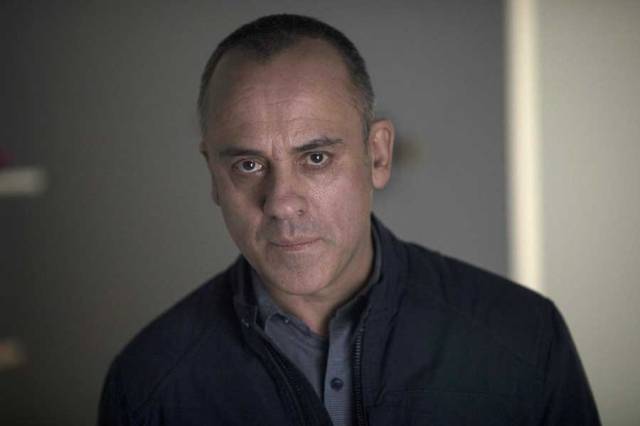
Two things we’ve been conditioned to expect from the “slow-burn thriller” is that it A) IGNITE at some point, and B) have a certain logic to it.
The Spanish drama “The Occupant” doesn’t want to play by those rules. It simmers towards a boil that takes an awful long time coming. And the motives in the beginning and bizarre leaps the plot takes make you wonder when we are ever going to get “there,” and when we abruptly arrive, how we got “here.”
It’s a genre piece, another story of what the newly-employed middle aged professional man does, in secret, when his family thinks he’s off restarting his career, working at a new job or at least taking classes.
Javier Gutiérrez (“Assassin’s Creed”) stars as a Javier Muñoz, a 50ish family man who has had a successful career in advertising, emphasis on “had.” He’s been out of work for a year, has a hard time finessing the reasons for that in job interviews.
And in the capture-the-youth-market world he’s made his mark in, he cannot hide the grey hair or hidebound nature of his portfolio.
If we think the final humiliation will be the offer of job that turns out to be three month “unpaid” internship, we aren’t reckoning on how life is shrinking back home.
Wife Marga (Ruth Díaz of “The Skin of the Wolf”) has to take a job in retail. She suggests they sell his BMW. He wants to reassure his teen son that he can keep going to the uniformed private school he attends. The kid is resigned to giving that up. They can move to an old family apartment in a more modest building, and give up the posh place with its stunning view of the city.
And then there’s the maid, who weeps at being let go, then turns furious. No night school class/motivational seminar is going to make all this go away.
But he still has the keys to their old place, still has access to the parking garage. Damned if Javier doesn’t start ducking into the old place — raiding the fridge, using the toilet, and hacking into the family computer.
The more he does this, the deeper into messing with their lives he gets. Poisoning a neighbor’s dog who barks every time he shows up tells us how far gone this guy is.
Does he get his jollies, discovering new “occupant” Tomás (Mario Casas of “The 33”) is a recovering alcoholic, that he had a bad car wreck, that he is probably on a short leash with his wife (Bruna Cusí) and little girl?

That’s a big question left unanswered in this Alex and David Pastor (“Carriers”) film. What is Javier’s game, and what — aside from the flimsy obvious motivation — is driving him?
Without having a handle on that, we’re disinterested observers in Javier’s schemes, his manipulations and those who might get wise to what’s going on and manipulate him.
You can appreciate how this or that piece of foreshadowing plays out, how he ingratiates himself into these new lives and how he avoids this trap or sets that one.
But the script and characterization never let us invest in this character, or any other. Maybe we fear for this or that hapless victim. Maybe we root for “The Occupant” to finish whatever his sinister scheme is.
But when the slow burn is this slow coming to a boil, it’s a lot easier to just shrug and move on to a thriller that makes more sense.

MPAA Rating: TV-MA, violence, sexual situations, profanity
Cast: Javier Gutiérrez, Mario Casas, Bruna Cusí, Ruth Díaz
Credits: Written and directed by David Pastor, Àlex Pastor. A Netflix original.
Running time: 1:43
No, Taraji doesn’t play the kid. She’s the foul mouthed child’s brassy mama. April 3 on Netflix.

“Same Boat” is a little no-budget sci-fi comedy that walks that uneasy line between “deadpan” and “half-assed.”
It reaches for droll and dabbles in humanity. But the laughs are few and far between in this travelogue/cruise ship misadventure that seems more promising as the starting point for a remake.
In the future, time travel has been solved and time traveling assassins are sent back to this or that point from the past to prevent some calamity from visiting the planet by killing those most responsible for it.
“Results,” we are told in an opening credit, “have been mixed.”
Thus we find mop-topped James (director and co-writer Chris Roberti) and his apprentice Mot (Julia Schonberg) on a beach interrupting honeymooners. The killers whip out their little liquidation/mission-status gadgets — which look like ear thermometers — and commence to cleanse the future.
But but…”we work in TELEVISION!” the groom protests. Yes, it’s 1989 and the killers have come to snuff-out the inventors of “reality TV” and prevent the damage it does to civilization, culture, politics and the planet.
That’s as funny as this conceit gets, as the rest of the film is set on a cruise ship where an assignment goes terribly wrong.
Because Mot gets sea sick and is confined to her cabin. And James, who could take care of this on his own, no prob — is smitten by this flirtatious fellow passenger Lilly (Tonya Glanz).
She’s just heartlessly broken up with her dopey/needy boyfriend Rob (Evan Kaufman). She, and it turns out James, have all this time to kill, all these buffets to gorge, shore trips to Key West and Cozumel to do and nobody to do them with.
Except each other. And there is, of course, a complication. Which you’ve already guessed.
The moral dilemma of the work of killing “nice people” is dismissed with a “They’re bad for humanity, not bad people. There’s a difference.”
No enough is made of James’ unique perspective — consoling the semi-suicidal Rob and others by urging them to enjoy “this golden age…the twilight of America!”
James knows.
The characters could be darker and more interesting, and the killers absolutely have to be more fanatically-committed to the mission for there to be a “journey” that they make towards redemption.
Nobody here has much of an arc. Lilly needs to be closer to beyond salvation for her journey to be engaging. She’s all, Key West? “It seems nice.”
“Yeah, until the oceans rise,” James prophesies. Which Lilly doesn’t buy.

Instead Roberti (pictured above being shady, an “officially-approved” still from the movie, if you can believe that) relies on cruise ship gags and supporting players to deliver the laughs.
The ribald, rude and randy crew, Rob in his manic post-breakup state, etc., put more effort into wringing a laugh from this than the leads.
The principals take their cue from the director-star, who is funny once or twice — a drunken karaoke duet on “House of the Rising Sun” — but mostly just a bland void around which the others and the movie revolve.
Funnier lines, more sharply-defined characters, higher stakes in the whole “Who lives/who dies?” game and darker twists would make “Same Boat” float instead of sink.
MPAA Rating: unrated, some violence, profanity, sexual situations
Cast: Chris Roberti, Tonya Glanz, Julia Schonberg, Evan Kaufman
Credits: Directed by Chris Roberti, script by Josh Itzowitz and Chris Roberti. A Dark Star (VOD, streaming April 7) release.
Running time: 1:23

 Movie Nation