
Presented without comment.
Presented without comment.

Pulling together lesser known ABBA songs and flinging the writer of “Love Actually” and “Four Weddings and a Funeral” at the script paid off for Universal as a somewhat played “Mamma Mia, Here We Go Again” isn’t going “Andante, Andante” at the box office.
A $40 million weekend, maybe just a smidge more, when all they expected by low to mid $30s is a great return on a movie they didn’t need Meryl Streep in (as much) after all. Reviews were either effusive or at least middling, but the lure of Cher and Andy Garcia was more than audiences could resist.
Thursday night was so so, but Friday was big for the musical. But when I went to a showing of “The Equalizer 2” Thursday night, there were a LOT more people there for that than ABBA fans. Denzel’s a pretty big draw himself, and the “I’ll make this wrong right” vigilante sequel to the movie based on the TV series is punching WAY over its weight. $36 million? It was widely tracked as being a $26 million hit, pre-opening. Reviews aren’t helping it, but they aren’t hurting it either. What works, works.
Similarly, when I saw “Unfriended: The Dark Web,” I was among maybe 4 people in the theater. And three were playing with their phones. It works as a piece of cyber-engineered horror, but the kids these days, they want haunted houses, haunted dolls, ghosts skittering over the ceilings and such. “Unfriended” won’t even hit $4 million, barely cracking the top ten.
“Hotel Transylvania 3” fell 50% in ticket sales and will finish third, with $22 million.
“Ant-Man and The Wasp” are together buzzing off screens — down another 45-50%, $15 million.
“Incredibles 2” is closing in on $575 million, domestic alone.
“Sorry to Bother You” spends one more weekend in the top ten, and will have cleared $10 million by midnight Sunday.
“Skyscraper?” It added screens (for some reason) and lost almost 60% of its weak opening weekend take. “The Purge,” from the same studio, cost far less and will clear $60 million by Tuesday or so.
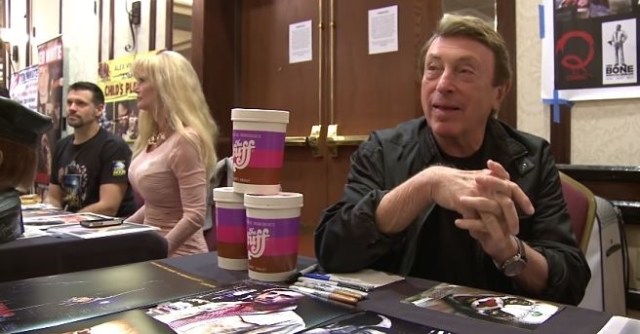
He didn’t like “getting permission,” signing up for filming permits.
So when writer/director/producer Larry Cohen needed a scene of comic Andy Kaufman in the company of a lot of cops, he dressed Kaufman as an NYPD uniform, shoved him into a parade of police and “stole a shot,” without permission from anybody, in a sea of New York’s finest.
He didn’t script much, hates the idea of “over-preparing” for a shoot, and used his locations as with as much innovation as any movie maker who ever lived.
Hollywood doesn’t like “hiring old,” be they actors, cinematographers, composers or grips? Larry Cohen would “find out whose mortgage was overdue, who needed to work,” and land Oscar winners, from Bette Davis and Broderick Crawford to composers Bernard Hermann and Miklós Rósza, lifting his no-budget “exploitation” pictures into at least the vicinity of “prestige” productions.
“King Cohen: The Wild, Wonderful World of Filmmaker Larry Cohen” celebrates the cinema of a the King of Cut-Rate, the Emperor of Exploitation, the writer, director and producer of “Black Caesar,””It Lives!,” “Q:,” “Best Seller” and the screenwriter of such recent genre novelties as “Phone Booth,” “Best Seller,” “Cellular” and “Captivity.”
The just-turned-77 indie icon may comically gripe, walking through a horror convention in the film’s opening, that he’s “unrecognized, unrewarded for my lifetime achievement.”
But the fans know. And after “King Cohen,” you will too.


“This is my epitaph,” Cohen bellows at one point in Steve Mitchell’s film. Maybe it is. But one thing you take away from the film is his eagerness to continue to work, and how foolish it is for a business he never really “joined” (he made his movies outside the system) to not find a use for him now.
Stars, from Fred Williamson and Yaphet Kotto to Tara Reid, Michael Moriarty, Robert Forster and Eric Roberts, sing his praises. Peers like Scorsese, Dante and Landis revel in the urgency, neorealism and grit in his work. And critics, historians and retired colleagues laugh and laugh at the nonsense that happened on the set because Cohen believed in making movies on the fly, with little prep and panic-stricken brio.
You’ll laugh, too, at him and Williamson swapping lies about who came up with what in “Original Gangstas,” who did or didn’t demonstrate the stunts to whom in “Hell Up in Harlem.”
Trust fund kids whisper about “guerrilla filmmaking” in tony film schools from coast to coast. Cohen, pre-9/11 mind you, would drag actors and stage shootings in front of Tiffany’s (“Black Caesar”), sneak into J. Edgar Hoover’s old house (“The Private Files of J. Edgar Hoover”) or park an un-permitted shootout in the baggage carousel at LAX.
Who has the guts to try any of that, nowadays? This is guerrilla filmmaking as taught by the Che Guevara of genre exploitation.
There’s always overstatement in such documentaries, and Cohen’s movies often were more memorably for their junk genre cheapness than their topicality, Big Themes or performances. But watching “King Cohen,” you can’t help but be dazzled by flashes of genius in future Bond villain Yaphet Kotto, in Michael Moriarty and Eric Roberts — flashes made possible by the seat-of-the-pants filmmaker’s free-wheeling style.
Larry Cohens don’t come around any more, and seeing J.J. Abrams introduce the picture just underlines that. Everybody playing exploitation games to come along afterward was just an imitation. Pity Mitchell didn’t interview Tarantino, but QT would probably have been too embarrassed to sit for it, anyway. All his “borrowing” would come home to roost.

MPAA Rating: unrated, nudity, fake violence, profanity
Cast: Larry Cohen, Traci Lords, Martin Scorsese, J.J. Abrams, Michael Moriarty, Fred Williamson, Yaphet Kotto, Eric Bogosian, Eric Roberts, Tara Reid, Robert Forster, Joe Dante
Credits: Written and directed by Steve Mitchell. A — release.
Running time: 1:43
Late getting to this. Am I the first to say, “Are they KIDDING?”
No Noomie, no Rooney, no Stieg Larrson original novel, no reason to exist. November, this hits the fan.
“Assassination Nation,” a little social media satire, generation gap satire, minority rule satire, what happens when the REST of the country gets guns satire.
Kind of where we’re headed. don’t ya think?
Sept. 21, we’ll see how politically loaded this mother is.

Mean headline, but after “Joe Dirt,” it’s no less than aged snarkling David Spade deserves.
Netflix’s ongoing “Saving Cinemas from Adam Sandler & Friends” project puts Spade in another “Joe Dirt” variation, as a bad dad in Deerfield, New Hampshire.
“Father of the Year” Wayne O’Malley is the Town Character (pronounced “cayeh-ac-TUH”) in a town of town characters, a drunk 40something who lives in a debris field of a trailer park, never shaves or cuts his hair, never has a job, “because of my disability.”
“Being color blind is not a disability,” his college graduate son (Joey Bragg of TV’s “Wet Hot American Summer”) Ben complains.
“I told a black joke to a black guy. It’s a disability.”
He’s Joe Dirt with a New England twang. Of course he’s named Wayne.
Ben’s home from school, ready to start a new life with a green energy company in New York. One last summer in New Hampshire can’t hurt.
But as we hang with his empty gene pool collection of high school buds, his reprobate Dad whose cleverest idea is making a pool out of a pickup truck bed (not his truck), where the Chinese restaurant changes its front door health code grade from C to D as you walk in, Ben starts to wonder. As do we.
We let these numbnuts decide who gets to run for president?
Ben and his bud Larry (Matt Shively) hit the local bar and commence to A) fail to impress that onetime high school hottie Meredith (Bridgit Mendler) and B) bicker about whose dad is tougher.
“Your dad looks like a big fifth grader.”
“YOUR dad gets startled by pop-up books!”
As Larry ‘s pop (Nat Faxon, almost funny) is a wimpy, smart provider, running his own test lab for Big Pharma, we think we know how that fight might go. The sons? Not so sure.
But Wayne? Realizing he’s an embarrassment to his kid and no longer his role model, and after a drunken night where he gets his son arrested and costs him his upcoming New York gig, Wayne is ALL about this “fight” — drunk dialing trash talk to poor Mardy (Faxon), who has enough grief, married to a harpy of a second wife with a teeny tween bullying terror of a step-son.
Dad can ask “Got any tuna on the hook?” of the son he’s nicknamed the “class clita-dic-torian,” but Ben has about as much chance with the fair Meredith as he does of finishing that pool he basically has to build for a little old lady whose patio he and dad trashed, which got them tossed in jail.
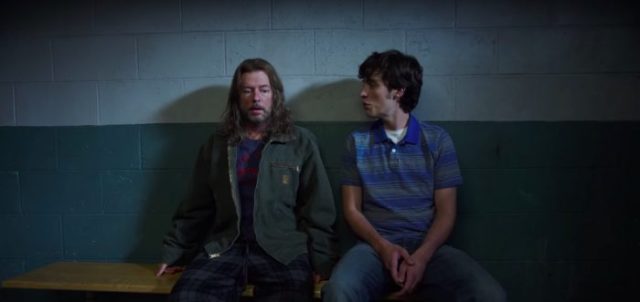
Old fashioned summer fun like skinny dipping, crashing the prom (Isn’t school out for the summer?) years after graduating, and sampling the local drug smorgasbord (Molly jokes are a regular fixture of Made for Netflix comedies) ensue.
Laughs? Hard to come by, rather like Spade’s take on the accent. A guys-piled-into-a-photo-booth gag, Postmates jokes, Dad put-downs based on driving a Miata — “Well, the body style in a Miata is not the MOST masculine. VERY unisex” don’t pay off.
One bit that would fit right in with the Sandler Happy Madison Productions house style? The “Deerfield Wife Carrying Competition,” an obstacle course run through a muddy mid-summer ski resort made even funnier by the presence of Dean Winters (Mr. Mayhem of the car insurance commercials).
That’s kind of a throw-away moment.
“Father of the Year?” A throw-away movie, and an utter waste of time, another make-work project for Sandler’s less and less funny stable of pals.

MPAA Rating: TV-14, profanity, sexual humor
Cast: David Spade, Joey Bragg, Matt Spively, Bill Kottcamp, Bridgit Mendler, Nat Faxon
Credits:Directed by Tyler Spindel, script by Brandon Cournoyer, Tyler Spindel. A Netflix/Happy Madison release.
Running time: 1:34
 None of the three wide releases opening this weekend moved the Metacritic meter well into positive (over 60%) territory. “Mixed” reviews for “Equalizer 2,” “Mamma Mia: Here We Go Again” (“Mamma Mia 2”) and “Unfriended: The Dark Web” (“Unfriended 2”)
But “Mamma Mia 2” at least sits at a dazzling grade of 61.
Yawn.
Of course, “Mamma Mia: Here We Go Again” will dominate the box office. Lots of ABBA fans out there, young and old. And Cher fans. Old. Very old.
It should earn $35-40 million, even if it’s a B-side version of the original. “Not the hit.”
Judging from Thursday night’s turnout at the theater where I caught “Equalizer 2,” Denzel could give “Mamma” a run for her money. A lot more people showed up at one of the busiest theaters the vast Regal chain to see “EQ2” than were there to sing along with the lesser titles of the ABBA catalog.
Box Office Mojo figures “EQ” could clear $25 million. Established brand vs. Established brand. Not great reviews for this one, but Denzel is riveting.
And then there’s “Unfriended: The Dark Web,” which didn’t quite clear the “fresh” mark on Rottentomatoes. Not awful, just kind of heartless. If it clears $5 million it’ll be lucky, “brand” or not.
“Hotel Transylvania 3” and “Ant-Man and The Wasp” will drop to third and fourth thanks to the new arrivals.

Denzel Washington may be in the Liam Neeson “man with particular skills” stage of his leading man carer, older, not so much “getting the girl” anymore as “getting his man.
But charisma and old-fashioned talent, what we glibly file under the label “chemistry” when actors click with every single co-star they share a movie with, carry him through in “The Equalizer 2,” a dawdling thriller that sacrifices thrills, surprises and at times coherence for the sake of character.
As Robert McCall, retired CIA agent and violent, all-knowing vigilante, Washington walks with his usual unhurried purpose, speaks with the sad wisdom of experience or righteous fury of the aggrieved and fixes one and all with a sizing-you-up stare that has been his trademark.
We meet McCall this time on a Turkish train disguised as a Muslim pilgrim, but really there to confront a Middle Eastern hood who kidnapped his daughter from her American mother. He warns his quarry, accompanied by armed henchmen, of the “two kinds of pain in the world; the pain that hurts, and the pain that alters.”
He’s giving the dude a choice, as he gives “everybody one last chance to do the right thing.” They never do. And that’s when the pain that hurts is administered. And the pain that alters.
Driving for Lyft in Boston, he sweetly undercharges the aged Holocaust survivor (Orson Bean, 90 years young and sharp) to the photocopy shop where he organizes more “evidence” for his endless case against those who stole a family portrait during World War II.
There’s the GI headed for his flight to Afghanistan, worried about his first deployment, whom McCall reassures during the ride.
“I’ll be right here to pick you up when you get back.”
The neighborhood hoodie-wearing teen, Miles (Ashton Sanders of “Moonlight”), is an unmotivated art student who acts awfully guilty at the gang graffiti covering the Muslim neighbor lady’s mural, the one on the wall overlooking her now-trashed vegetable garden.
Miles, who could go either way, the straight life or street corners selling drugs for gangs, is due a little “Fences” tough-love, some paid painting work by McCall to save him from bad influences.
“Money ain’t spelled ‘G.U.N., son. Stay off those corners!”
And there’s the former CIA boss (Oscar winner Melissa Leo) who still hooks McCall up with intel about this or that person of interest in his various do-gooding cases.
“I thought you were retired?”
“Oh, I am. Just like you’re dead!”
A piece of his past, “another life,” the one his faked death allowed him out of, is revealed. And that world sucks him back in to right a wrong, avenge a murder and give this downcast widower purpose.
Antoine Fuqua, Washington’s go-to action director, stages three top drawer shoot-outs/fights, one of them taking place in harrowing Lyft Ride from Hell. And there’s a bit of rough justice handed out to high-finance frat brothers who mistreat a hooker.
But more effort is put into McCall’s solitary life, the traits that give his character color. He buried his baker wife years ago. He’s plowing through “100 Books You Have to Read Before You Die,” and is up to Proust’s “In Search of Lost Time.”
He interacts with small children in a few scenes, and Washington takes delight in both those silly comic moments, and the dangerously comic one.
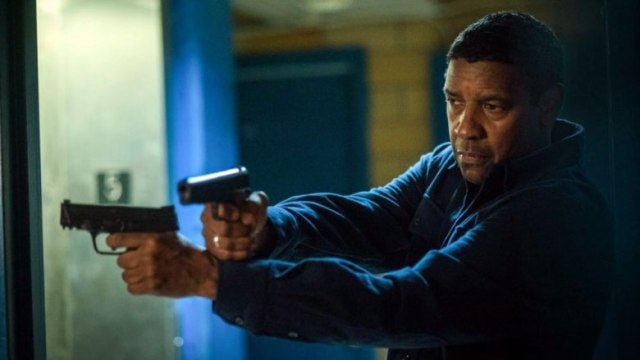
But if you can’t figure out who the bad guys are on first sight — hint, it’s NOT the 90 year old comic and game show veteran Orson Bean — you aren’t getting out enough.
If you can’t tell where this is going before Fuqua takes his sweet time getting us to the absurdly drawn-out Western-style finale (complete with a “Searchers” visual homage), you must have never seen another Fuqua picture (“Shooter,” “Training Day,” “Olympus Has Fallen”).
And if you can’t take enormous pleasure in seeing Washington, in fine, cool and man-of-purpose form and on his game, then you haven’t been paying attention these past 35 years.

MPAA Rating: R, violence
Cast: Denzel Washington, Melissa Leo, Pedro Pascal, Bill Pullman, Ashton Sanders, Orson Bean
Credits:Directed by Antoine Fuqua, script by Richard Wenk. A Columbia release.
Running time: 2:01

A tip of the top hat to Stephen Susco, writer-director of the squirm-inducing horror sequel “Unfriended: Dark Web.”
He’s engineered a real-time Facebook-era tale of tech-savvy yet hapless young people hacked, tormented and terrorized when one of their number comes across a used computer with files, links and passwords that drag them all into “The Dark Web.”
Susco, who has “The Grudge” movies and “Texas Chainsaw 3D” in his writing credits, conjures up a thriller which we in essence follow as they type, link, etc. on a laptop screen, along with six friends whose Skype “game night” is hijacked when one of them shows up online with a new PC.
If it wasn’t such a pitiless mash-up of horrors from other movies, if he’d let us feel something for any of them, Susco would have had something special.
Matias, played by Colin Woodell of Steven Soderbergh’s “Unsane,” is a guy we meet via screen. All we see is what we’d see on his screen. He’s trying to log into this “new” laptop he got…”off Craigslist.” Password after password attempt.
He needs a PC with enough computing power to run this app he’s developing to help people look up American Sign Language in mid video-call conversations so that they can talk to the deaf — like his girlfriend, Amaya (Stephanie Nogueras).
Matias is a multi-tasking fool, quick to get into the laptop, log into Facebook, chat up Amaya, who is frustrated by his unwillingness to learn ASL, and jump online with his assorted friends to play Cards Against Humanity online.
If only he wasn’t being bombarded with all these messages for “Erica,” these notes from “Charon,” or “Norah.C.IV,” flirtatious catfishing messages from young women asking for plane tickets and wondering where “she” has been. If only the computer’s hard drive wasn’t eaten up with encrypted files he can’t delete.
We smell a rat before he does. And even after he does, after the “owner” of the PC has made contact, made threats (“THIEF!”) and started swallowing data from his circle of friends and contacts, he doesn’t tell those online with him.
DJ Lexx (Savira Windyani) is no help with his computer problems, nor are the loving couple Serana (Rebecca Rittenhouse) and Nari (Betty Gabriel). But paranoid web-master AJ (Connor Del Rio) and Brit wit Damon (Andrew Lees) talk him through a few tricks.
Which get him even deeper into trouble, which the women start to figure out.
“Dark Web” skates through every Internet pitfall from “phishing” (scamming data) to “wardrobing” (prowling neighborhoods, capturing wifi signals and passwords to break into computers) and “swatting” (faking a call to police to get a SWAT team, armed and trigger happy, to come to your door).
Tirades about “YOU’RE the product” websites like Facebook and Twitter, and “Cambridge Analytica” give the picture a topicality that sizzles.
Because whatever else is going wrong online, whoever this laptop belonged to was into sick, deadly and illegal stuff, pay-per-view perversions financed with Bitcoin payments.

Once the fascinating stuff about solving this or that problem with the screen and the incredibly boring split-screen “game night” nonsense is dispensed with, “Dark Web” takes on the same plot as the 2014 original “Unfriended.”
And as appealing, on the surface, as the various young “types” might be — that’s all they are, “types.” Computer dork, “smart” English accent, Indonesian dance music DJ, lesbians wrestling with “coming out” to difficult parents.
With all the cyber-nightmare elements Susco packs into the script and onto the split, data and image-filled computer screen we watch this on, everything from online, computer (and person) killing traps and sabotage, sign language, back doors and hacker lore, it’s a shame he didn’t care enough about the characters to make us care about them.
And it’s a wonder the horror masters at Blumhouse didn’t send him back for one last rewrite over this ending.

MPAA Rating: R for some disturbing violence, language and sexual references.
Cast: Rebecca Rittenhouse, Chelsea Alden, Betty Gabriel, Colin Woodell, Andrew Lees, Savira Windyani
Credits: Written and directed by Stephen Susco. A Blumhouse/OTL release.
Running time: 1:28

 Movie Nation