Movie Review — “Mission: Impossible — Fallout”

mission1

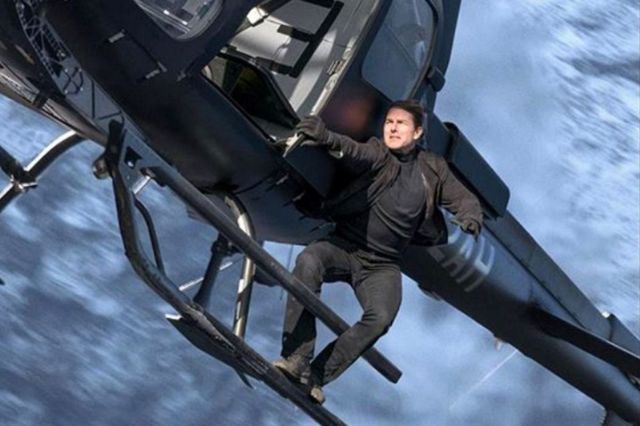
Someday, when Tom Cruise is using a walker or in a wheelchair thanks to the running, leaping motorcycle-crashing stunts he’s hurled himself into in these “Mission: Impossible” movies, you’re going to regret not giving the man his props when he was laying it all out there for your movie-going thrills.

Someday, just not today. Because “Mission: Impossible — Fallout” is, right now, everything a summer action pic should be — a delirious procession of stunning stunts, epic brawls, state-of-the-art car chases and ticking clock countdowns.

Throw a bunch of top drawer actors at a plot that’s as topical as the latest meltdowns in Washington, London and a world going mad and this is what you get — high tension, higher stakes, witty banter, pathos, pulse-pounding action beats and more “How in the HELL did they do THAT?” moments than you can count. It’s a robust blast of bullet-and-bloody-fisted machismo, delivered with a healthy dose of lens flare.

Ethan Hunt (Cruise) is summoned to retrieve missing plutonium and trade it for a nemesis (Sean Harris) he captured, but who still haunts his dreams. He and his team (Ving Rhames, Simon Pegg) dash from Paris to London and BFE Pakistan, keeping a testy CIA chief (Angela Bassett) at bay, their Impossible Mission Force boss (Alec Baldwin) on tenterhooks, an arms dealer named White Widow (Vanessa Kirby) on the line and assorted Apostles — anarchists bent on global destruction — on their heels.

Or so one would hope.

There’s a CIA sidekick (Henry Cavill) who might be a great ally or a deadly foe, an MI6 black widow (Rebecca Ferguson) who has “history” with Hunt, and some of the tastiest action film one-liners and exchanges you will ever hear.

Sure, we get lots of “I’m WORKing on it,” and “Just so I’ve got this clear,” “We’re going to have to go it alone” and “I need you to TRUST me.”

But how many movies give us a terrorist manifesto?

“There can never be peace without great suffering. The greater the suffering, the greater the peace.”

A favorite exchange — “HOPE is not a strategy.”

“You must be new here.”

Hitchcock always said “Great villains make great thrillers,” and writer-director Christopher McQuarrie of the last “Impossible” mission movie and “Jack Reacher,” found a lulu in Sean Harris. A ginger-haired staple of British films like “’71,” “24 Hour Party People” and “Harry Brown,” he makes a brooding monster of your nightmares.

His Solomon Lane is a messianic fanatic, sparing with his words, hissing his apocalyptic threats and pronouncements. Hunt isn’t the only one whose dreams he’ll haunt.

And Cavill, two-fisted, droll and revealing a sadistic side that his “Man of Steel” never shows, remakes his career with this turn. He’s one bad mutha-hushyourmouth.


I never cease to be amazed by how consistently amazing these movies and their durable star are. Directors change, storylines bend, and yet the dazzle shows up again, every couple of years. James Bond doesn’t have an M:I batting average.

McQuarrie re-connects the films with the action-packed, gadget-riddled 1960s-and-70s TV series this all came from, “Your mission, should you choose to accept it,” the works.

Hell’s bells, we were going to Paris this fall, but we may have to change our plans. Tom Cruise and McQuarrie have gone and torn the place apart.

And seriously, who could have guessed that Lalo Schifrin’s jazzy, Latin-flavored heart-thumping theme song would endure and delight in a movie 45 years after the TV show was canceled?

“Fallout” earns its pathos from the female leads and its stakes from the sense of mortality Cruise & Co. give it. They –he — let us know they can’t keep doing this forever.

But before he gets too expensive to ensure and too crippled to late-middle-age sprint as if his life — and the world — depends on him, you’d better show some love to Cruise.

The man puts on an action hero clinic every time he dons Ethan Hunt’s shades of black, and you can only hope everybody else who takes a shot at the genre is taking notes.

3half-star

MPAA Rating:PG-13 for violence and intense sequences of action, and for brief strong language

Cast: Tom Cruise, Angela Bassett, Henry Cavill, Rebecca Ferguson, Alec Baldwin, Ving Rhames, Simon Pegg, Sean Harris, Michelle Williams

Credits:Written and directed by Simon McQuarrie. A Paramount release.

Running time: 2:27

Posted in Reviews, previews, profiles and movie news | 2 Comments

Documentary Review: “Scotty and the Secret History of Hollywood” kisses and tells

scotty3.jpg

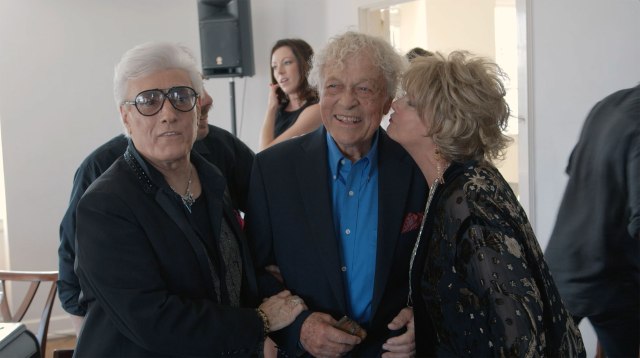
Scotty Bowers has lived quite the life. He grew up in rural (later Chicago) Illinois, served in the Marine Corps during the deadliest time in its history — fighting from Guadalcanal across the Pacific.

He just turned 95, and until very recently, he was clambering onto his roof, climbing ladders to trim trees and driving around, hauling his vast collection of memorabilia between his various houses and storage facilities that he rents in Los Angeles.

How’d he make his living? Well, right after the war, for over a decade, he pumped gas at the most popular service station in Hollywood, a Richfield at 5777 Hollywood Blvd. And he kept a corps of his fellow Marine vets (and a woman, here and there) employed “turning tricks” for the rich and Hollywood famous.

He kept this up for decades, recruiting (and participating) in orgies, “providing a service, being helpful” to everyone from Tracy and Hepburn to Edward and Mrs. Simpson. Cary Grant and Randolph Scott, Cole Porter and the Oliviers, Scotty facilitated sexual encounters for many of them in an era where homosexuality was illegal and the LAPD Vice Squad had a lot of time on its headline-hunting hands.

Bowers even wrote a book about it, “Full Service,” naming names and good-naturedly recounting the predilections of icons of The Golden Age of Hollywood.

“You couldn’t believe how busy I was,” he jokes in “Scotty and the Secret History of Hollywood,” the new documentary about his life and loves, that book and his place within Hollywood Babylon.

And many won’t — “believe” it, that is. “Maybe this is all a big secret to some square who lives in Illinois,” he cracks to filmmaker Matt Tyrnauer at one point. “It is hard to believe, unless you were there.”

As gay figures from novelist Gore Vidal to celebrated photographer Cecil Beaton vouched for his bonafides, as his surviving “tricks” show off autographed books and notes from the likes of Charles Laughton, as old index cards with the names and numbers of some of the (not famous) “regulars,” roll out, Scotty Bowers seems perfectly credible.

Add to that his coarse, crude (Marine, remember?) and casual attitude about all this “forbidden” sex he was facilitating, back when careers and indeed a person’s very liberty could be taken away by same-sex scandal, and he’s a star witness for just how gay Hollywood and the world have been, all along. We “squares” just didn’t know it.

Oh, the rumors were out there in the open — Rock Hudson, Pleshette and McCambridge, Garbo and Dietrich, Grant and Scott (“Roommates can be lovers too, you know.”). Books always popped up, right after this or that major figure died and could not sue. “Pathography,” such biographies were labeled.

Now, all these years later, with the Golden Age all but completely died out, Bowers lays it all out there. And a lot of that laying out there is repeated for the film.

A favorite phrase of Scotty’s — “I never took any money” to make all these arrangements. Not buying that. But he did take money for his own sexual favors, from Bette Davis and Grant and so many others — $20 at a time, for much of his “working” life.

Another favored phrase? “Word got around.” As in, he starts at the Richfield, Walter Pidgeon picks him up on the first day, George Cukor, the director and gay impresario gets word. Next thing you know, legions of “pretty boys” are being lined up for nude Sunday swim parties as Casa de Cukor, all arranged by Scotty Bowers.

Ramon Novarro to Porter, Tom Ewell to “that drunk” Paul Lynde, with tales of orgies and drag parties (J. Edgar Hoover made “a pretty homely woman”), with still photos and grainy home orgy movies provided as proof.

Granted, nobody famous shows up in any of those. Cameras were a lot less convenient and commonplace in the Age of Illegal Homosexuality. But Scotty tells their tales, again leaving out anybody who might still be alive. Not that any are.

A PMs he celebrates the publication of his book (in 2012), does birthday events and dabbles in bar-tending (his cover-job, once he left the service station) in the film, there’s something darker beneath the adorable re-connections with former “tricks” — old, old men hugging, kissing and calling each other “baby.”

Scotty’s a hoarder, a certifiable one. And a miser.

His amorality gets to be something of a put-off. His refusal to “judge” his clients extends to himself. It’s not a life that’s involved much self-reflection. Bragging about “turning tricks” before he hit his teens, the scores of Catholic priests who paid for his company in Depression Era Chicago, his tightwad tendencies (his many houses, a couple inherited from a former lover, are wall-to-wall junk), his boasting too of his work commitment — heading off to an orgy he’s organized right after learning his 23 year-old daughter has died — that speaks to compulsions, sickness.

Second wife Lois, a lounge singer, just shrugs it off and does a la-di-dah, I don’t want to know about any of THAT…

The film’s several parties — with penis-shaped cakes delivered by semi-nude waiters, reminiscing about “Big D— Strauss” and the sexual organs of this trick or that one — are crass, at best. Commonplace in gay America, but common.

His “Nothing wrong with that, any of it” about his own underage sexual history or those gay men who like it like that starts to grate.

The fact that he was a major provider of testimonials and “research” for Alfred Kinsey makes you wonder, if not about the sexual peccadillos documented in his books (People were into then what they’re into now, by and large), at least at Kinsey’s statistics.

His contributions to “My Buddy,” a gay nude photo book about “foxhole buddies” and homosexuality in the military of World War II is both touching and challenging. That would make another movie, more controversial than this one.

But as our understanding of sexuality and its “fluid” nature among much of the population changes, “Scotty and the Secret History of Hollywood” serves a larger purpose. By telling these tales now, he’s blunting the shock of the pace of changing mores and acceptance of the different.

It didn’t happen overnight. Hollywood sexcapades today are no different from what they were back then.

And Hollywood is now, as it was then, merely a reflection of what’s in the culture, not a bellwether for anything “new” and “shocking.”

You’ve been protected from “the truth” long enough, Scotty Bowers seems to say. What’s the big deal? Get used to it.

3stars2

MPAA Rating: unrated, graphic sexual material, profanity

Cast: Scotty Bowers, Liz Smith, Lois Bowers, Peter Bart, Stephen Fry

Credits:Directed by Matt Tyrnauer . A Greenwich release.

Running time: 1:37

Posted in Reviews, previews, profiles and movie news | Comments Off on Documentary Review: “Scotty and the Secret History of Hollywood” kisses and tells

Are female film critics grading female centered films and female filmmakers “on the curve?”

female.jpgThis story in the Times, based on a study by the Center for Study of Women in  Television and Film (note the error in the Times piece about the center’s name, the goobers), got a lot of people’s attention last week.

And I resisted the impulse to pop off about it to give it a little more thought. I mean, sure, the old saying I was taught in Semantics and Polling classes in college, “The terminology of the question determines the terminology of the answer,” comes into play. When a group dedicated to helping women succeed in TV and Film sets out to crunch numbers about female-directed/female starring films getting more harshly-reviewed than male ones, those numbers are going to jibe with that pre-conceived prejudice.

But as my headline notes, that stiletto cuts both ways. It is far easier, I would posit, to argue that women critics — fewer in number — are giving a pass to female-fronted/female-directed projects because of the messy fact that Hollywood still isn’t giving female filmmakers the opportunities that they’re giving male ones, that female-fronted movies from “Carol” to “Bridesmaids” to “Ocean’s 8” are still exceptional — rarer than they should be. So female critics are grading on the curve to make up for an actual shortcoming/injustice.

On the surface, at least, that’s how it looks. I’ve noticed that several times in recent years — pans, overall for “Ghostbusters,” but female critics by and large embraced it. “What’s up with that?” I scornfully said to myself.

The reality is the sample size is too small — for filmmakers and for critics — to make such generalizations. And the only way to rectify that is to go a LOT further than the Tomatometer, Ladies Championing Jobs for Ladies in TV and Film.

We need hard numbers of female filmmakers, which isn’t hard to come up with. They’re still an exotic thing in the cinema. I’ve reviewed a few female-directed films over the past month, and based on my memory of those, their success rate (a good or half-decent film, well-directed enough to note) is about the same as for male filmmakers.

Lots of middling to mediocre movies, and then there was Sydney Freeman’s cute and edgy “Deidra & Laney Rob a Train,” for Netflix. Or Claire Scanlon’s delightful rom com “Set It Up.” For, uh, Netflix. See a pattern here?

That’s two out of let’s say the last eight films directed by women I can recollect this summer.  Not a bad rate. And if you’re making an ad hominem swipe at male critics not cutting female filmmakers a break, there’s Exhibit A for my defense.

But it’s a tiny sample size, and to get at both the gender gap in reviewing and in filmmaking, you and I and San Diego State are going to need a MUCH larger sample from a much broader spectrum.

Why doesn’t San Diego State’s Center for the Study of Women in Television and Film get enrollment numbers at the nation’s film schools, for starters? Poll the top 25 (every college wants its own film school, for some reason), see what their ratio of males to females is.

I’ve judged student film competitions from several films schools in different states where I’ve worked. OVERWHELMINGLY male enrollment was my experience. Is that because the schools are cutting guys a break, or because male students are indulged (pricey tuition) more than female ones by their parents?  Or maybe it’s a testosterone-drenched profession, at least partially driven by a century of perception of the All Powerful Director/Auteur?

Directing is a very butch job.

The way Hollywood has devalued directors in recent years — disposable no-names headline even the biggest franchises — film school is no easy path to either employment or a career behind the camera. But enrollment numbers are a good place to start if you’re tracking down data to prove or disprove bias, Martha Lauzen of the Center for the Study of Women in Film and Television. You can’t do that just by counting Rotten Tomatoes scores for “Ocean’s Eight,” which plainly inspired this half-assed “take.” How Mindy Kaling of you. 

Yes, “Ghostbusters” got beaten up by male critics. And “Ocean’s Eight” didn’t get a break. But “Wonder Woman” did. And unlike the first two films, it was actually directed by a woman.  I wasn’t nuts about that one, and having watched Patty Jenkins direct “Monster” here in Orlando, I was not surprised that the Gal Gadot and FX spectacular wasn’t so much “directed” — credit Jenkins with its tone — as produced. That’s what I saw on the set of “Monster,” the soon-to-be-Oscar winning star Charlize Theron and a pushy producer or two ran that set.

Kathryn Bigelow enjoys good reviews for most of her films these days, “Detroit” included. Directors from Mira Nair to Sofia Coppola to Greta Gerwig, Lisa Cholodenko, Miranda July, Sarah Polley, Jodie Foster and on and on have made films that merited good reviews. And they got those good reviews.

I can’t remember ever panning a Nicole Holofcener film, and Nancy Meyer never gets anything other than a fair shake from me (Nora Ephron got the same courtesy) and I dare say most of the males reviewing her works treat her the same way. “Feminine” or not, it either works or it doesn’t.

wrinkle2Ava DuVernay made a lousy job of the probably unfilmmable “Wrinkle in Time,” and got called on it. Not all female filmmakers are created equal. Some are Friends of Oprah. Look at her credits and tell me she got entrusted with that expensive picture based on merit and accomplishments.

“Wrinkle” makes my “grade on the curve” point for me. Not every woman reviewing it praised it, but an amusingly disproportionate number did. We could shrug that off to differing sensibilities, narrative/action preferences between men and women. You know, the whole “Women are from Venus, Men are from Mars” thing.

But as the menfolk are being accused here, let’s just lay it out there. A lot of women reviewers packed their readers off to a stillborn, bloated bust of a fantasy. Is that how we build trust in our opinions, ladies? Cutting crap movies some slack because we buy into the Oprah-Ava-Reese-Mindy hype?

That’s unfair and glib of me, as unfair as the “conclusion” the “Center” (one woman, apparently) came to after a little Rotten Tomatoes/Metacritic perusing. When the data sample sizes are small enough, you can leap to any conclusion you like.

Reviewing movies and criticism in general is still something men — gay or straight, mostly white — feel compelled to pursue. Something like 3/4 of the reviewers aggregated on the movie review aggregation sites are male, and overwhelmingly white.

It’s changed a little over the decades I’ve been doing this, but only slowly and only in tiny increments.

That has something to do with background, opportunities, the desire to do something you’re passionate about overruling the need to make the most money in the shortest period of time, as well as “white privilege.” Let’s just say that in this culture, white males are anecdotally given a pass on any impulse to offer an opinion — editorially, politically, in sports and on music, TV and movies.

When I worked for newspapers, the pursuit of diversity was a necessary and yet never-ending struggle. Anybody with the gift of a decent education and the ambition to rise above his or her station would take those traits into a more lucrative field. Journalism thus is more of a calling. A few get rich, a few sell their souls to accomplish that, but most do it for the rush, the ego trip, curiosity, self-righteousness, what have you. Film reviewing is journalism, and it’s the same way.

Getting minority reporters to work in newspapers/websites, etc., spend years in small operations working up to Major Dailies, magazines in the Big Media Markets where TV and book deals lie, is a lot more of a grind than getting a business or law degree and billing your way to happiness. Prestigious journalism degrees can jump you through many of those hoops, just via college. Not all.

But why pursue a chancy/pricey  Ivy League education if low to middling pay journalism work is your goal? The cost-benefits ratio isn’t on your side.

Without that obvious upside, I never saw the thin ranks of minority writers at any paper I worked for change substantially. I didn’t see this as a shortcoming of the company (sometimes, sure) or in the education opportunities to Latin and African American students (sometimes, sure).

But the biggest reason you don’t see enough folks of color in newsrooms is obvious. Where are the Chinese-American, Japanese American, Indian-American reporters? The same place black and Latino reporters dwell — making a living somewhere with a better chance of financial success. Too smart to do it, too educated to waste that on reporting, too common-sense oriented in what their expensive education should give them in return.

By extension, that’s why you don’t see more female critics or critics of color.

To get more female critics, more women have to forgo the English, Art History, Women’s Studies or Latin degrees (analogous, I’d say) and pursue studies in something just as seemingly impractical — film and media criticism.

As the gatekeepers of reviewing, legacy media companies, shrink and shed critics and the web democratizes the platforms and possibilities of gaining an audience, there is no excuse for anybody with the passion and commitment and a computer to not start reviewing.

Get yourself into an online critics organization, maybe one dedicated to female critical voices. Get noticed. It’s easier to do if you’re a minority and regarded as a novelty in the vocation.

But saying there’s a “problem” and pointing to a culprit, when a look in the mirror is in order, is lazy. Ask yourself why more women aren’t setting out to do this, and sticking with it? And shouldn’t those women treat films as gender neutral as we expect the guys to?

For now, I say female critics are cutting female-centric films and female-directed films a break, not grading them as dispassionately as they do other movies. Prove me wrong.



Posted in Reviews, previews, profiles and movie news | 2 Comments

Preview, RZA’s New Orleans during Katrina thriller, “Cut Throat City”

I don’t think they have an opening date for this one, but with Kat Graham, Terrance Howard, Wesley Snipes, Isaiah Washington, Denzel Whitaker and T.I. in the cast, distribution for “Cut Throat City” should be a given.


Posted in Reviews, previews, profiles and movie news | Comments Off on Preview, RZA’s New Orleans during Katrina thriller, “Cut Throat City”

Preview, “The Public Image is Rotten” lets Lydon tell his post-Sex Pistols Story

John Lydon, aka Johnny Rotten, ended his Sex Pistols run with a decision to get out from under “the mockery,” and do a turnaround in his life, his music and his Public Image.

The UK is getting this one this summer. It reaches the US in mid-September.

Posted in Reviews, previews, profiles and movie news | Comments Off on Preview, “The Public Image is Rotten” lets Lydon tell his post-Sex Pistols Story

Netflixable? “Tab Hunter Confidential”

The recent passing of 1950s pinup, matinee and pop idol Tab Hunter is reason enough to revisit or take in, for the first time, this 2015 documentary, a film as sweet, discrete and lightly charming at the man himself.

“Tab Hunter Confidential” is an upbeat, revealing portrait of a man who spent his career and indeed most of his life in the Hollywood closet, by necessity in the beginning, by his own desire for privacy he insists in the film. And if director Jeffrey Schwarz goes easy on his in the questioning and tilts towards flattering in the discussions of Hunter’s talents, well, Tab’s longtime companion, producer Allan Glaser, rounded up the money and produced the picture.

It’s basically an autobiography, as in “My version told my way.”

A Santa Barbara native born Arthur Gelien to a single mom from Germany, Hunter had the chiseled blond good looks of the quintessential California surfer (he wasn’t, and only made one “surf” film). A gay talent agent specializing in “pretty boys” (Rock Hudson, most famously, Chad Everett and Guy Madison) cooked up the name — “We’ve got to TAB you something!”

Hunter, who died at 86, started his career at the tail end of the Hollywood long-term studio contract era, signing with Warner Brothers, making a few notable films for them (“Battle Cry,” “Damn Yankees”) before buying out that contract, starring in his own TV show, a quick failure, and watching himself quickly replaced by the next pretty boy (boys) to come along — Troy Donahue, among them.

Pre-Method, his acting was slow to come around, and critic Rex Reed notes how “not a hint of talent” turned up in his earlier movies.

But being “The Sigh Guy,” as he was nicknamed, opportunities kept dropping into his lap. Want to sing, Tab? Sure! He knocked Elvis off the top of the charts with his version of this one.

I’d forgotten that aspect of his career, because even though he was a chart staple, pre-Beatles, and cut many LPs, you almost never see that old vinyl at estate sales or flea markets.

Did you know he was a competition level figure skater, concurrent with his Hollywood career? He was, and his first true love was a fellow skater, he reveals in the movie.

Dating and competing with Paramount rival/lover Tony Perkins, fending off “Confidential” magazine accounts of his sex party arrest in the early ’50s (homosexuality was illegal then), befriending and frequently co-starring with Natalie Wood, Hunter ruled the roost as much as any guy getting by on mostly looks could back then. He was as shirtless as any star of the era, via posters, magazine covers and at least one scene in every movie. But he tackled tough work in the Golden Age of Live TV, too, taught himself to act and got better even as his star was fading.

Peers from Robert Wagner and Connie Stevens to Don Murray and Clint Eastwood set the scene and talk about Tab’s place in it. Women who were teeny-bopper fans recall his appeal, their infatuation and one remembers her “Win a date with Tab Hunter” evening.

And Hunter himself talks about his closeted life, the Catholic upbringing that he abandoned when he realized the Church condemned his sexual leanings, a fellow who “never confronted these things” until much later in life.

“If you were with a man, you would be sinning. If you were with a woman, you would be lying.”

He came closest to marrying a French co-star, eventually came back to the church, had to commit his mother to a mental institution and worked, largely he says, to ensure she had a comfortable life and never had to go back once he saw what she went through there.

And through it all, Hunter comes off as pleasant and guileless as he does in many of his films, and in one of the opening interview moments on camera in “Confidential.”

“What the heck? I’m an old man. This is my life.

John Waters brought his career back from the odd TV guest appearance with 1981’s “Polyester,” Hunter got “Lust in the Dust” a Divine romp in the same (non Waters) vein, met his longtime companion and got back to his first love — horses. The former hunky stable boy (“discovered” while doing that as a teen by actor/manager Dick Clayton) became a ribbon-winning equestrian and stayed on horseback much of the rest of his life.

Check him out in any of his Westerns — “Burning Hills,” “Gunmman’s Walk,” “They Came to Cordura.” The guy could ride.

Maybe it’s not as revealing as its teasing title suggests, but “Tab Hunter Confidential” makes a splendid history lesson and light, fun portrait of what you can only call a blessed life, one lived with a big, open secret that only old age convinced him he should let out.

3stars2

MPAA Rating: unrated

Cast: Tab Hunter, Connie Stevens, George Takei, John Waters, Robert Wagner, Don Murray, Rona Barrett, Clint Eastwood, Portia de Rossi, Rex Reed

Credits:Directed by Jeffrey Schwarz . A Film Collaborative release.

Running time:

Posted in Reviews, previews, profiles and movie news | Comments Off on Netflixable? “Tab Hunter Confidential”

Preview, Abbey Lee is the aptly-named “Elizabeth Harvest” in this new tale of terror

Ciaran Hinds is the aged creeper who has married somebody about one third his age, for we assume, nefarious purposes. Carla Gugino is his accomplice. Matthew Beard and Dylan Baker also star in this one, which nabbed an Aug. 10 release date. 


Posted in Reviews, previews, profiles and movie news | Comments Off on Preview, Abbey Lee is the aptly-named “Elizabeth Harvest” in this new tale of terror

Netflixable? Franco’s “The Adderall Diaries”

add1

Checking in on an artist’s work after a scandal is always problematic.

If you don’t look at the films of Roman Polanski, James Toback, Kevin Spacey or Brett Ratner differently after their public shaming, you’ve got a shorter memory than me.

Well, Ratner always sucked, kind of a general consensus all along.

If there’s one good thing — to be glib — about the #MetToo self-engineered takedown of workaholic/sexaholic James Franco, it’s that we finally have the chance to catch up on a vast body of indie work, movies that few people saw, now that he’s a lot less employable.

“The Adderall Diaries” doesn’t make you flinch at every young woman we see on the set with him (his predatory MO), because there aren’t any. Pairing him up with Amber Heard, giving Wilmer Valderama a supporting role just seems…tabloid appropriate.

It’s based on writer Stephen Elliott’s memoir about his troubled past, his “monster” father, his sins against veracity and the victimhood.

As a film, adapter-director Pamela Romanowsky’s take on its many themes and subtexts is cluttered, unsatisfying almost by design. It’s “Running With Scissors” and “The Great Santini” grafted onto “True Story,” with Franco recast as a version of the Jonah Hill character in that one — with Christian Slater as the murderer (Hans Reiser) that the grandiose Elliott figured he’d get his “In Cold Blood” out of.

Romanowsky has to do justice to three major threads — Elliott in the present, riding high with his editor/agent (Cynthia Nixon) calling him with one offer after another and Elliott in the past, the two-fisted, drug-abusing childhood (Oscar nominee Timothée Chalamet plays the younger Stephen). 

And then there’s the criminal trial that Elliott haunts, and which haunts him  — a father (Slater), even worse than his own father, accused of murder. That’s what triggers his descent back into drugs, and that’s the leg of the movie that Romanowsky gives short shrift to.

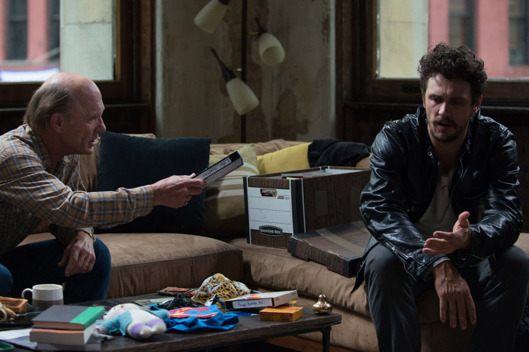
What sparkles here is the interaction between Franco and Ed Harris, playing Elliott’s “monster” of a father, Neil. The kid’s gotten published and famous writing about his “dead” abusive dad. Imagine how awkward it is when that dad interrupts the self-made star of the literary scene at a tony New York book reading.

“How convenient for you to have a dead monster for a father!” Neil scares the gathered glitterati almost as much as much as he “might” have scared the son, who lost himself in every drug under the sun, state custody, group homes, suicide attempts — all according to Stephen.

This revelation, that the “dead” father is still living, makes the whole fact-checking-impaired New York publishing community back away from him. At least he’s got this murder trial he can turn into a book, right?

Movie memoirs like this always make one wonder just how much was invented, and how trustworthy the narrator/hero is, shown to be self-absorbed and prone to seeing things his own dishonest, self-glorifying way. It’s not overwhelming, this fear of narrative dishonesty. But on a marginal film, it doesn’t help.

Heard plays an equally disturbed New York times reporter with a thing for his motorcycle, drawn into Elliott’s dark sexual practices and his “story,” which is probably more true than false.

Chalamet, a reason many will check into this after his breakout turn in the over-rated, over-ripe “Call Me By Your Name,” makes an impressive impact in flashbacks that feature little dialogue.

Franco holds his own with Harris, is utterly convincing in the kinky scenes (go figure) and makes us wonder just what the final penalty his predations will impose with regards to his career.

As his character starts to see his upbringing through the eyes of others, starts measuring the shades of gray that color his father’s “crimes” and his own  excesses and misdeeds, you can’t help but wonder if Franco’s off-camera life will benefit  from shades of gray. You wonder about the age-old Hollywood equation — “relationships” built on furthering careers — and wonder if his relative youth gives Franco room for a comeback that Kevin Spacey will likely never see.

In any event, he filled his IMDB page with too many credits like this one –– thoughtful, challenging dramas worth making, but underwhelming in execution, their stories and themes as over-familiar as the over-exposed Franco’s bearded, not-wholly-thought-out performances.

2stars1

MPAA Rating:R for language throughout, drug use, sexuality, and some aberrant and disturbing content

Cast: James Franco, Ed Harris, Amber Heard, Cynthia Nixon, Christian Slater, Timothée Chalamet

Credits: Written and directed by Pamela Romanowsky, based on the Stephen Elliott book. An A24 release.

Running time: 1:26

Posted in Reviews, previews, profiles and movie news | Comments Off on Netflixable? Franco’s “The Adderall Diaries”

Documentary Review: “Calling all Earthlings”

earth6

Roswell, New Mexico has nothing on Joshua Tree, California, when it comes to otherworldly weirdness.

Its exotic siren’s call was obvious years before U2 came to the place “Where the Streets Have No Name, decades before the singer Gram Parsons’ most devoted friends snatched his body and gave him the heroic cremation a future legend warranted. 

Blame it on the remoteness, the silence so close yet so removed from the cacophony of Los Angeles, the trees so hairy their name was Biblical, but seers and prophets, nature lovers and flakes have congregated there forever.

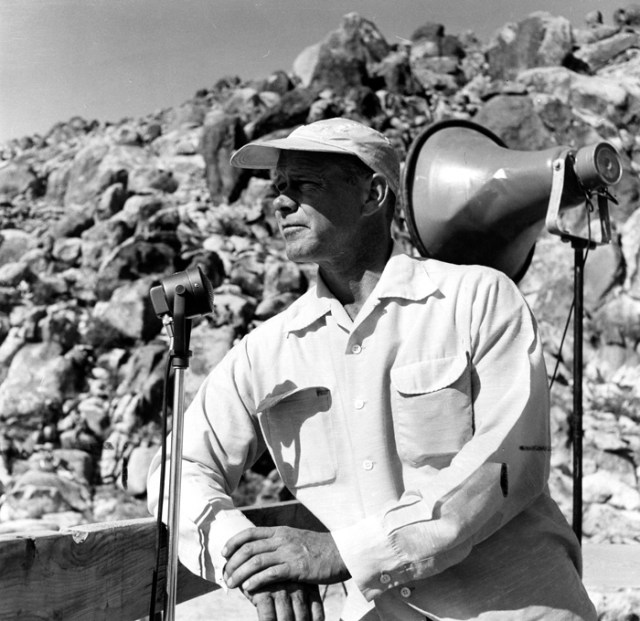
One of the flakiest had to be George Wellington Van Tassel, aeronautical engineer and later “contactee,” a man who said he’d been visited by aliens.

He founded a desert airstrip, burrowed a cafe under “Giant Rock,” started picking up on what the desert and the aliens were saying to him and became guru to followers who helped him realize his alien tech vision — a life-extending, health-curing, mind-expanding, time-traveling domed gadget called the Integratron. 

Van Tassel died in 1978, but his followers are still around, with young new recruits showing up in the unfinished dome to meditate and speculate on what it might have been capable of had he not died (“Mysteriously,” they suggest, a “stroke at 68,” the records show), his plans and some of his technology disappearing as he did.

“Calling all Earthlings” visits the Integratron, its caretakers (Nancy and Patty Karl), and many of those who knew Van Tassel. It plays snippets of interviews, including one long and in dept early ’60s TV chat with a West Coast station.

eart4.jpg

And filmmaker Jonathan Berman talks to those who knew him, those protecting his legacy, local cultists and the odd academic astrophysicist of historian who can place the man and the phenomenon within the context of California’s longtime allure to and tolerance of seekers, spiritualists and flakes.

“The currents…raise our consciousness” via Tesla science, the true believers declare. “I’ve seen some ghosts, but never no UFO” another local (Joshua Tree, 29 Palms and Yucca Valley are the locales) declares.

Berman finds them in parched, scorched trailer parks, taking a drink (and God knows what else) in the desert at night at Giant Rock, in the dome itself — built without nails, with a gigantic Tesla coil and split-ring resonator that would have given it, once it had its aluminum roof sheeted on, its oscillator and other gear operating, the appearance and sparks-jumping glow of an alien spaceship.

There’s no judgement here, so any laughs you have are of your own devising. They’re a funny lot, the devout and the doubters. Even the late USC historian Kevin Starr takes the subject seriously, parking it within ancient belief systems and modern California loopiness.

I couldn’t quite figure out why Eric Burden of “The Animals” is here. Perhaps Tom DeLonge of Blink-182 wasn’t available. The radio UFOlogist Art Bell was still living when this was filmed, and he is sorely missed as well.

But the people and the exotic places of “Calling all Earthlings” burn it into the memory. It reminds me of the desert dweller classic Plagues and Pleasures of the Salton Sea. If you’ve chosen to be there, that choice has some sort of oddball higher calling to it.

My only visit to Joshua Tree was after U2 and Parsons had given it pop culture currency. But that one trek made obvious its alien encounter allure. Strange lights in the night sky? Odd goings on? It’s no wonder Van Tassel started the first UFO believers conventions, holding them at Giant Rock all through the ’50s and ’60s.

A friend and I had just ascended a Joshua Tree National Monument peak when a roar and a blur of objects in camo green took our breaths away. A squadron of huge C-130 military transports were hurtling by, at treetop level, in the valley well below where we were standing — training for the Middle East, no doubt.

The huge Marine base at 29 Palms is probably responsible for some of the weirdness there, adherents of the dome admit. But even diving into Area 51 conspiracies don’t sugar coat it. Where’s the “mystery” in that, where’s the fun?

2half-star6

MPAA Rating: unrated, some profanity

Cast: George Wellington Von Tassel (archival footage), Dr. J.J. Hurtak, Nancy Karl, Patty Karl, Dr. Kevin Starr, Ted Quinn, Eric Burdon

Credits:Directed by Jonathan Berman. A Freestyle release.

Running time: 1:17


Posted in Reviews, previews, profiles and movie news | Comments Off on Documentary Review: “Calling all Earthlings”

Preview, “Aquaman” is cool enough to join Wonder Woman as Warners/DC’s comic book savior

We’ve known, from his first moments in character, that Jason Momoa was the wise cracking bad-ass Warner Brothers has been looking for in its DC comics universe films.

The first trailer for his stand-alone turn as “Aquaman” gave me a little chill, and several chuckles. And I’m not a fan of the genre. Watch them go and make it all about the digital brawls. Character is what works here. With Nicole Kidman as his mom, with Djimon Hounsou, Willem Dafoe, Patrick Wilson, Michael Beach, Randall Park and Dolph Lundgren in the supporting cast, this seems like a can’t-miss Christmas present for the fanboys and girls.

Posted in Reviews, previews, profiles and movie news | Comments Off on Preview, “Aquaman” is cool enough to join Wonder Woman as Warners/DC’s comic book savior