Preview, “The Long Dumb Road” gives the road comedy a little color

Put hotheaded, just-quit working class mechanic Jason Mantzoukas (“The Dictator,” “The House”) in a car with child of privilege Tony Revolori (“Grand Budapest Hotel,” “Spider-Man”)  and send them into desert Southwest America.

Laughs see sure to follow.

Pamela Reed, Taissa Farmiga (“The Nun”) and Ron Livington are in the supporting case.

“The Long Dumb Road” opens Nov. 16.


Posted in Reviews, previews, profiles and movie news | Comments Off on Preview, “The Long Dumb Road” gives the road comedy a little color

BOX OFFICE: “Smallfoot” gives “little man” Kevin Hart a run for his “Night School Money”–neck and neck

box

This box office prognostication thing, which for me is more reporting on what others are saying they’re finding out from studio tracking, IMDb searches, etc., has few hard and fast truths.

One is that EVERYbody doing it underestimates what will happen when parents want to  get out of the house with little kids on the weekend, and thus lowballs kids’ cartoons.

Another is that EVERYbody has troubling gauging what a comedy will do. Brand name leading man, brand name leading lady, unless it’s a franchise, you just don’t know.

Pre-weekend estimates for Kevin Hart’s latest, “Night School,” two hours, precious few laughs, were all north of $30 million dollars. Hart has successfully paired with everyone from Will Ferrell to Josh Gad, The Rock to Ice Cube. Safe bet, right?

Now, a so-so Thursday night and a middling Friday have dropped those guesses into the $25 million range. 

Comics tend to his their peak appeal, stay there and then fall out of favor and stay out of favor, save for Will Ferrell. Hart may not be falling off a cliff yet, but as he’s reached the producer’s credit/control of his (non concert) films stage of his career, with his ego showing everywhere (ESPECIALLY in those Elephantisis infected concert movies), when he’s pairing his short, struggling characters with runway model beauties as girlfriends, he loses his appeal. Look at Sandler’s slide — a schlub who started turning up in pictures with one absurdly pretty or ridiculously young co-star after another and grew less relatable (and more “star” delusional) in the process. We’re starting to see that with Hart, who has another year or two at the very top (ensemble pictures like “Jumanji” are where he excels), maybe. Maybe not. Co-star Tiffany Haddish is on the cusp of over-exposed.
“Smallfoot” was always figured, being a non-franchise from the less “brand name recognized” Warners Animation, to have $22-25 million in it. Deadline.com is saying $23.6 million, still. But Deadline is always 15-20% off on kids’ films. So it’s anybody’s race, as of Sat. AM.  And the movie? It’s cute. It works. 

“The House with a Clock in Its Walls” looked like a monster hit last weekend, but it has taken a steep dive — not precipitous, but not a sign that “everybody loved it and is telling his or her friends”) — and will clear $12 million, at this rate. It could have a big Saturday, too, but that’s a steep drop from weekend one.

“Hell Fest” can’t even better “The Nun” on the latter film’s fourth weekend of release, competing with for that same horror audience dollar. But even without any marketing at all from Lionsgate/CBS, even without a star (save for horror veteran Tony Todd), even with bad reviews, it’s headed towards $4 to 5 million.

“The Nun” is over $108 and still counting.

The movies with legs, holding audience week to week, are the under-served target audience comedy “Crazy Rich Asians” which is over $165 million, and the smart,  darkly funny “chick lit thriller” “A Simple Favor” ($43-45 and counting). The OTHER thing those two pics have in common, leading man Henry Golding. Wonder how far his quote is going up?

Posted in Reviews, previews, profiles and movie news | Comments Off on BOX OFFICE: “Smallfoot” gives “little man” Kevin Hart a run for his “Night School Money”–neck and neck

Preview, Peter Jackson’s “They Shall Not Grow Old” doc about “The Great War”

I’ve interviewed Peter Jackson a few times over the years, and often as the conversation was winding up, he’d talk of the war movie he wanted to make — a version of WWII’s “The Dam Busters,” about RAF pilots who trained and engineers who engineered a “bouncing bomb” mission that would destroy the dams in Nazi Germany’s Ruhr Valley, crippling the German war effort.

He talked about doing this for years.

What’s he’s gotten to first is “They Shall Not Grow Old,” this British documentary about WWI, a sort of Ted Turner colorization and speed correction, with sound, of footage of The Great War as the soldiers  — all dead and gone, now — experienced it.

One night only in the UK, but you can bet it’ll make BBC or Netflix or somebody else. Looks extraordinary.


Posted in Reviews, previews, profiles and movie news | Comments Off on Preview, Peter Jackson’s “They Shall Not Grow Old” doc about “The Great War”

WEEKEND MOVIES: Decent reviews for “Smallfoot,” pans for “Night School” and “Hell Fest,” “Little Women”

Film Title: Night School

TIFFANY HADDISH stars in “Night School,” the new comedy from director Malcolm D. Lee (“Girls Trip”) that follows a group of misfits who are forced to attend adult classes in the longshot chance they’ll pass the GED exam.

The bar has been set high for Kevin Hart comedies, and adding new star Tiffany Haddish to the mix should prove a boon for “Night School,” an indifferent star-comedy with little to recommend it — a few laughs, widely scattered over two rather leaden hours of running time.

Remember, Kevin got his first decent break on “Freaks and Geeks.” He’s Apatow trained to keep his comedies going and going and going, even when they’re not working.

Box Office Mojo looked at Thursday night’s numbers and hasn’t adjusted its $32 million predicted opening for this one. Average for a Hart comedy, but there’ll be trouble if Thursday’s $1 million and small change doesn’t pan out to a big Friday and bigger Saturday. Reviews overall were a lot like mine — “meh” to “ugh.”

Deadline.com figures $30 million is a safer bet. In any event, this one should win the weekend with ease.

The significant competition will come from the cartoon comedy “Smallfoot,” which I thought was cute, with a science-over-superstition message that’s logically hard to beat. Most critics agreed. Both Deadline and Mojo are predicting a $24-27 million weekend for this one, not being a “brand” name Pixar franchise or anything of the sort. I am guessing it will make a race of it with Mr. Hart’s farce — both of them coming in around $30.

I saw “Hell Fest” with a pretty good sized audience Thursday night, so the horror audience could lift this one out of the hole everybody predicts it will be digging out of ($3.5-4 million). It’s terrible. 

Pitiful reviewed greeted the Pure Flix version of “Little Women,” but it could manage as much as $4 million, Deadline.com figures.

“The House with a Clock in its Walls” should finish its second weekend in the $12-15 range,


Posted in Reviews, previews, profiles and movie news | Comments Off on WEEKEND MOVIES: Decent reviews for “Smallfoot,” pans for “Night School” and “Hell Fest,” “Little Women”

Documentary Review: “Studio 54” comes to life again in this remembrance

54two

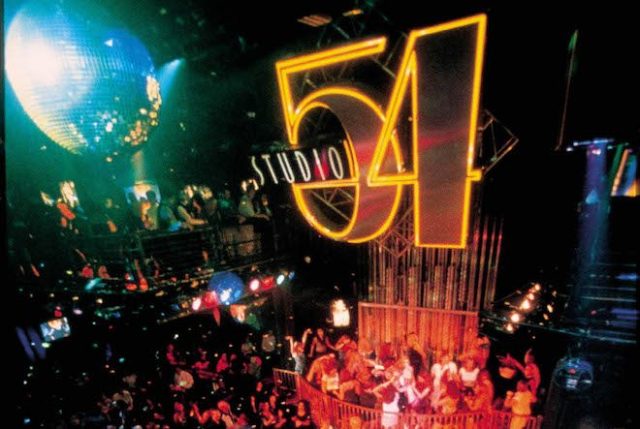
There’s been so much written, said and filmed about New York’s famed disco era icon Studio 54, that filmmaker Matt Tyrnauer was hard-pressed to find anything new for his documentary, “Studio 54” (Oct. 5).

What he settled on was the tactile glitz of the facility, the cultural watershed moment the discotheque represented and the fellows who ran it.

Nobody particularly famous is interviewed for the film, none of the survivors of the Liza/Bianca/Halston/Warhol/Liz/Michael set speak anew, they’re just seen in archival footage or in tiny snippets of vintage TV interviews.

The Fall of Rome hedonism is given its due — sex and sexuality, seeing and being seen — all that. But so is the mad rush to build in the joint, the genius “adult theme park” design, the stunning lighting and sense of “event” created there for $40-65,000 per night — wind machines and balloons, confetti and snow, ballet interludes and high-wire acts and not-quite-stripper performances.

An army of ex-employees, from the manager to the bouncer and on-call makeup and hair stylists, join surviving partner Ian Schrager in laying out the logistics of how the whole mad scene worked.

And it’s fascinating, even if the “revelations” are few and far between, even if the nostalgia seems a little misplaced for a club built on decadence, hedonism, cocaine and the premise of almost-accessible exclusivity.

Young college pals on the make Steve Rubell and Schrager “worked” their way up to the massive facility on 54th and Eighth by scouting the underground gay nightclubs where models would show up on the arms of their gay fashion designers. Rubell (closeted at the time) noticed that straight men wanted to go where the models were.

And after getting a start in Queens with the Palace Garden, they rounded up the cash to get hold of the art deco Gallo Opera House, later an abandoned CBS TV studio that they turned into Studio 54.

Tyrnauer, who did “Valentino: The Last Emperor” about the Italian fashion magnate, is the first filmmaker to lose himself in the glories of the building itself, its ornate, high done ceiling and vaulted entryways, and in the way competing club moguls blackballed Rubell and Schrager and kept club designers from helping them.

So Schrager, a lawyer by training, took on conceptualizing the place, and Tony winning stage and lighting designers came in with Broadway crews and created a permanent spectacle — using the gorgeous bones of the building, tapping into its opera and TV past, filling the place with lights, and pools of darkness, neon and mirror balls and accomplishing this in a mad “get ready for opening night” Broadway sprint

Rubell envisioned a club where gay and straight worlds would meet on equal, non-threatening footing, a club where the pre-AIDS/post-Pill and Vietnam promiscuity had a place, as did the sense of a “show” that the audience — “cast” each night — put on.

Rubell is seen, barking at folks behind “the velvet rope” — “You didn’t shave. Don’t come here if you can’t be bothered to shave.” “Go home and change your shirt.” Couples were broken up (beautiful women allowed in, their dates often refused entrance).

And from the chaotic, front-page news opening night in April of 1977, celebrities were courted, “wrangled” by publicists, giving the place both cachet and a chance for the not famous but good looking to mingle with the glitterati.

“You have to build a nice mousetrap to attract the mice” a glassy-eyed Rubell said in a TV interview at the time. As cub reporter Jane Pauley asks him another question, Michael Jackson strolls into the office in all his high-voiced pre-“Thriller” glory, making another Rubell dream come true.

Celebrities and others felt “free” there, Schrager and others declare. The paparazzi were let in, “but only the ones who played by our rules.” Closeted celebs and bankers could “be themselves” and gay and straight hookups and furtive couplings were the norm.

Schrager, the surviving partner, is here to define the business model — “A club is all about capturing the moment.” Never forget what you’re selling because “you have no discernible product except for the magic you create.”

And Schrager is here to accept his part in the sudden fall of the club and its leadership — tax and drug problems, jail time. He dodges questions if not responsibility.  “I don’t remember. All I know is I got the benefit and I was a co-conspirator.”

The flood of photographs and miles of film and video tape exposed in Studio provide ample proof of what made it special. And a lengthy third act gives us the film’s few revelations about that downfall, the greed, arrogance and unsavory practices that ended 54’s run after just 33 months.

The club is long gone — I’ve seen plays at the Roundabout Theatre Company there, and I recall seeing movies in the building (in a once-seedy neighborhood that the club helped bring back to life) in past decades.

But Tyrnauer makes a good case for this disco Parthenon’s place in American history, the role it played in moving gay lifestyles towards more mainstream acceptance and its status as cultural watershed — flaming out in the ’70s, with Reagan. AIDS and “Greed is good” pushing it into the dustbin of history in the ’80s.

Funny, few people have fond things to say about the decade that followed. But Studio 54 they want to remember, or hear about if they were too young to get a gander at it in its glory. “Studio 54” gives them their most thorough look back yet.

3stars2

MPAA Rating: unrated

Cast: Steve Rubell, Ian Schrager, Jack Dushey,

Credits:Directed by Matt Tyrnauer. A Zeitgeist release.

Running time: 1:39

Posted in Reviews, previews, profiles and movie news | Comments Off on Documentary Review: “Studio 54” comes to life again in this remembrance

Movie Review: “A Star is Born” again

star1

Musically sharp and dramatically flat, the latest version of “A Star is Born” starts impressively and falls off suddenly, a sudsy, overwrought remake that drowns in its abrupt, perfunctory emotional leaps.

All this hype around Lady Gaga’s big screen debut? She’s imitating previous “Star” Barbra Streisand (without the comic timing or pathos) for the first 40 minutes, going through the motions for the next 90.

Bradley Cooper displays solid musical chops and takes his best shot at acting smitten. But he’s the least convincing self-destructive drunk of any of the four versions of “A Star is Born.”  High-functioning? There’s barely a slur or stagger to him, and exceptong his looks, musical talent and a hint of courtliness, where’s the attraction for a hip, talented younger woman? Aside from “He’ll be good for my career?”

As a director, Cooper leans heavily on the 1976 “Star” with Streisand and Kris Kristoffersen, artfully capturing musical performances with the camera literally on stage and up close, contrasting the hard work and bedlam of making country rock in arenas with the lonely quiet of the limo ride with a bottle afterwards, the hotel rooms, which are for passing out in until the next show.

There are gimmicks and story beats from that sad Streisand “Star” revived here — bubble baths to make the ladies swoon. But the story jerks along, never quite convincing us that this jaded superstar would take all that interest in a 30ish big-voiced belter, the only “real” woman singing (“La Vie en Rose,” in French) at a drag bar lip-sync show he drops into after his own concert to wet his whistle.

We never can figure out why Jackson Maine puts the laid-back, drunken moves on Plain Jane Ally, or what triggers the fight she starts in the next bar they hit after the drag bar closes. Gaga isn’t a good enough actress to let us see her fall head over heels, though I did buy her impulsive quit-her-job-and-accept Jackson’s offer to join him at his next show. She doesn’t give that the mercenary “This could be good for my career” edge it needs, either. Not fashionable in our #MeToo era, I suppose.

But that first moment he drags her onstage works, as Gaga’s Ally strains to summon up the guts to sing a new song composed in a super market parking lot the night before to an audience of thousands. The clips of the film used in the trailers pre-sell the songs and those early moments, which are the best scenes in a movie that peaks far too early for its own good.

Cooper stages several comically intimate exchanges between Jackson and his older brother/manager (Sam Elliott), face grabbing, nose-to-nose chats that suggest not just brotherly love, but tough guys with issues and camera blocking that wants every shot to be an extreme closeup, whenever possible. Real Western brothers like their personal space, like everybody else.

Elliott is magnificent of course, but pushing them this close together is jarring, unnatural. Dave Chapelle has a single sequence, an old friend from “the old days” who somehow knew Jackson in childhood in Arizona and who now lives in Memphis. It plays sentimental enough, and the scene at least leads to a wedding with Eddie Griffin (Remember him?) officiating.


It’s a film of impressionistic sketches for scenes, and jolting transitions between them. There’s a brief, grudging warmth between older brother Bobby (Elliott) and Ally, whom he accepts after raising an eyebrow — “Think maybe he drinks a bit much?”

The “warmth” between Ally and her dad (Andrew Dice Clay) and his gang of elderly limo drivers is goofy, with an edge — “He’s a drunk,” she says of her new beau. “You know all about drunks.”

Cooper’s intensely likable in the early scenes, and meant to be a lot less so later on. Not really. I like his world weary “Take it all in” sermons to Ally as her solo career takes flight. He gives Jackson a clinical depression (and tinnitus) back story, but doesn’t play those in ways that point in the direction (dead-end rehab scenes) the film meanders into.

The script has Gaga’s Ally going all “ugly duckling” about her looks, with other characters (particularly Jackson) constantly reassuring her she’s beautiful. That’s the message in more than a few of Gaga’s pre-“Star” pop hits, but here it comes off as needy and pointless puffery, “contractually obligated.”

I expected to be dazzled by this thing, with all the hype surrounding it. But I lost heart in it as clunky scenes clunk together, and actors manfully (and womanfully) soldier on through blown lines to achieve a “natural” feel (Ally tells her dad “Eat your dinner” in one breakfast moment, and covers for it haphazardly. This happens a few times).

“A Star is Born” is supposed to be a great, tragic romance, a Hollywood opera. I didn’t believe them as a couple, didn’t fear for their future together and didn’t mourn the laughably abrupt climax that Cooper, finally remembering the movie he was remaking, forced into the finale.

Download the soundtrack, just don’t expect too much from the movie.

2stars1

MPAA Rating: R for language throughout, some sexuality/nudity and substance abuse

Cast: Bradley Cooper, Lady Gaga, Dave Chapelle, Sam Elliott

Credits:Directed by Bradley Cooper, script by Eric Roth, Bradley Cooper, Will Fetterman, based on the earlier “Star is Born” films. A Warner Brothers/MGM release.

Running time: 2:15

Posted in Reviews, previews, profiles and movie news | 30 Comments

Movie Review: Halloween goes off the rails at “Hell Fest”

hellfest1

“Hell Fest” falls on the “Why’d they even bother releasing this one?” end of the horror film spectrum.

Then you look around at the late Thursday preview audience and see a theater half-full for a movie that was so crappy it wasn’t previewed for critics, that arrives with so little marketing only the horror faithful know about it and will show up. For a day or two, anyway.

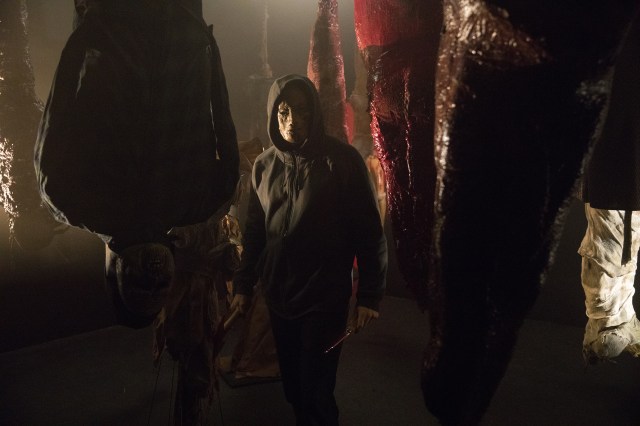
It’s a about a spree killer who shows up at a “Halloween Horror Nights/Howl-o-Scream/Haunted House” traveling expo, an impressively staffed and elaborately staged immersive horror experience.

The last thing you’d expect in a place with a Zombie Maze, Deformed School, Deadlands and other hellish hands-on frights is an actual nut with a knife stalking and killing people.

He did it a couple of years ago in a distant town, which we see in the opening credits. How he’s out to create more dead teenagers in this deathly dull “dead teenager movie.”

Three couples — Brooke and  Asher (Reign Edwards and Matt Mercurio), Taylor and Quinn (Bex Taylor-Klaus, Miss Tries Too Hard,and Christian James) and first-date crushes Nat and Gavin (Amy Forsyth and Roby Attal) get VIP passes for “Hell Fest.”

It’s a vast set-up (entirely too big to be a traveling troupe), and they’re not alone. Thousands have shown up. So has one guy in a hoodie. He brought his own mask, and he knows where to cadge a knife.

The stalk is on, the “What is WITH this guy?” questions, the taunting and then the one-by-one killings of characters so colorless describing them is pointless.

Horror-phobe Nat witnesses the first murder, and doesn’t believe it’s real. “Just DO it,” she says, getting into the spirit of things. “We came here to be SCARED.”

hellfest2.jpg

The killings aren’t particularly gripping, there’s little suspense in the earliest ones and the menace is pretty watered down for much of the movie.

There are two pretty tight sequences though — one involves a guillotine and an MC played by horror legend Tony Todd (“Candyman”). The other doesn’t. Don’t bother calling the cops, either.

“You came here to be scared. I can’t arrest people for doing their job.”

Aside from that, we have to get our jollies out of the detail in the various rooms (the grope-a-torium is a favorite). What must admission the admission price be, with all these buildings, all those employees and all that neon and technology?

1star6

MPAA Rating:R for horror violence, and language including some sexual references

Cast: Bex Taylor-Klaus, Reign Edwards, Amy Forsyth, Tony Todd

Credits:Directed by Gregory Plotkin, script by Seth M. Sherwood and Blair Butler. A CBS/Lionsgate release.

Running time: 1:27

Posted in Reviews, previews, profiles and movie news | Comments Off on Movie Review: Halloween goes off the rails at “Hell Fest”

Next Screening? “Hell Fest”

Here is Orlando, city of “Halloween Horror Nights,” home to “Phantasmagoria,” we know a thing or two about spooky live events.

We’ve never had a Halloween “get your fight on” invaded by a spree killer, but otherwise “Hell Fest” has the ring of the familiar, the chill of “What COULD go wrong?”

CBS and Lionsgate didn’t preview this one for critics, but ah — “Hell Fest” opens tonight. So let’s see if they were protecting its secrets or hiding a dog from those who would name it thus.

Posted in Reviews, previews, profiles and movie news | Comments Off on Next Screening? “Hell Fest”

Documentary Review: Will America go mad for “Go,” “The Surrounding Game?”

game1

They must teach this in schools where filmmakers learn the art of making documentaries.

While there are many subgenres of nonfiction film — historic, sport, art, nature, biographical profile — one can’t-miss shortcut to getting your film made and seen is “obsession.” Find something esoteric that a corner of the culture is fanatical about and try to figure out why. Let its adherents — Scrabble players or orchid thieves, snake–handling Christians or pop singer Tiffany or Rick Springfield fans, any kind of collector — articulate that obsession.

“The Surrounding Game” is an intriguing look inside the world of Go, an ancient board game whose mostly Asian adherents — it was born in China thousands of years ago, and took Japan by storm 1200 years ago — proclaim has aesthetic and competitive advantages over chess.

But for all its popularity in the East, Go has never taken hold of the West. “The Surrounding Game” is about American efforts to popularize the game and select America’s first-ever professional-level Go players, who’d be the first in the Western world.

“The Surrounding Game” introduces us to guys like Andy Liu, who play the game practically non-stop, tournament competitors, veteran players patiently waiting for the rest of the country to share their passion, and one 20ish fanatic who ventures to a Go Academy in Seoul to study “with little kids” (in Asia, players start training for professional careers at five or six) to polish his game.

“Yeah,” Ben Lockhart says. “I don’t have much of a choice.”

It’s a simple game played on a board covered with criss-crossed with lines. “Stones” are placed on intersections of those lines with two players, taking turns, playing their stones. A stone is placed once, and the object is to cut off your opponent’s stones by blocking every intersection around them.

Academics and other experts talking on camera speak of the game’s “aesthetic” in the ways it requires “a feel,” a board game where memorization and left brain mastery is important, but right brain “creativity” reigns supreme.

A famous endorsement from a chess grandmaster introduces “Surrounding Game” — “The rules of Go are so elegant, organic and rigorously logical,” Edward Lasker once said, “that if intelligent life exists elsewhere in the universe, they almost certainly play Go.”

We meet Terry Benson, president of the AGA, the American Go Association, and hear from him and others how close this small group has come to disappearing altogether over the years. They are Americans trying to “take something that is not a part of the culture and add it to the culture.” It’s an uphill climb.

Frank Lantz, professor of game design at NYU, discusses the “subtlety” of the game, with its myriad variations and outcome possibilities. Legendary pros from China and Japan talk of the years it takes to master it, and assorted Americans marvel at how reaching each level in the hierarchy of Go makes you realize “I know NOTHING.”

We glimpse Asian tournaments and take in the rituals — players bow, sit on knee chairs and play at a low game table made from a solid block of yew wood — and visit the craftspeople who cut and age the wooden tables, covering them with hashmarks, and others who drill out fossilized giant clam shells to make the most expensive “stones” high-end players play with.

The history is covered, we learn of the vast skills of the great Go Seigen, a Japanese master whose contemporaries said he “didn’t seem human.”

We check back in, now and again, on players like Andy Liu and Ben Lockhart (Go fanatic Will Lockhart co-directed the film) and gauge their progress toward their ultimate goal.

And we watch a 2012 tournament unfold, looking for the first Americans capable of reaching professional status, old men who have played a lifetime watching young men (all male, overwhelmingly Asian) battle to become America’s first certified pro.

game2

The various Asian experts, historians and masters do their best to give the game that
“inscrutable” quality that the East likes to imprint on Western interlopers. The game is like “the rings of the tree” you can see in the most valuable, hand-cut boards, one craftsman waxes philosophically. Legend has it that the simple game was a way of making sense of the infinite night sky in ancient China.

“The board is a window to the human mind. It reveals what’s inside us.”

And the Americans put their imprint on it — competitiveness, and our other national obsession, a yen to “follow your bliss,” even if you don’t measure up to the challenge.  Other Americans marvel at the way life’s cares, clutter and distraction melt away while playing it.

“Time just melts away,” one adherent notes. “You learn to come to terms with your own imperfections.”

Go is not being Westernized, it is Easternizing at least some of its Western fans.

The film has a lot of airline miles to it, and a lot of history and Asian aesthetics packed into its scenic 95 minutes. There’s a spare quality to the visuals, music and quiet of co-directors Will Lockhart and Cole D. Pruitt’s movie that seems to mimic the experience of playing the game, elegant ritual and minimalist design meeting in a mental contest.

Co-director Lockhart doesn’t acknowledge any connection to competitor Ben Lockhart, which seems a cheat (No relation? Brothers? Married?). And I can’t say I’m sold on the game itself, which seems fun but inherently less interesting than chess or poker.

Mastery of Go is made to seem particularly daunting.

But “The Surrounding Game” accomplishes what it set out to, explain the obsession its most enthusiastic adherents share. It’s playable on computer (computer programs can now beat the best players), and should real money get behind it, it’s hard to see it not catching on here. Eventually.

3stars2

MPAA Rating: unrated

Cast: Michael Chen, Terence Benson, Myungwan Kim, James Davies, Ben Lockhart

Credits:Directed by Will LockhartCole D. Pruitt. A Moyo/Netflix release.

Running time: 1:37

Posted in Reviews, previews, profiles and movie news | 2 Comments

Movie Review: Joey King lusts for “Summer ’03”

summer2.jpg

It’s taken a while for her to get there, but Joey King’s finally made a movie that cements her growing girl-who-wants-to-be-bad reputation.

No “Kissing Booth” this time. With “Summer ’03” she goes full Aubrey Plaza.

I’d say watching “Summer ’03” will send you straight to Hell, but who believes in that?

It’s one long “trigger warning” of a coming-of-age (sex) comedy, sexually charged (and explicit), virulently anti-Catholic and tone-deaf as only Hollywood can be.

“Wait, you mean throwing a ‘libidinous Jewess’ stereotype at a cute-young seminary student in a lose-your-‘mouth-virginity’ farce ISN’T mainstream? Huh.”

King (“Slender Man”) is pouty, pert Jamie, a 16 year-old Cincinnatan/Cincinnatite who, in 2003, was deep into Harry Potter, sexually curious and waiting for Grandma to die.

But before she does, Granny (June Squibb, funny enough in a hospital bed) wants to get a few things off her chest. Little cousin Dylan? She’s sure you’re a homosexual and could be “fixed.” Dad (Paul Scheer)? I never told you who your REAL father was.

And Jamie, even though your mother (Andrea Savage) is “a dirty Jew…I had you BAPTIZED without you knowing” so you won’t “go to Hell.”

OK. And one more thing, the secret to a happy life as a woman?

“Learn to give a good blow” you-know-what.

The whole family is hurled into a tailspin, with Dad dashing off to find who created him, foul-mouthed Mom having to plan a Catholic funeral for a woman she hated, who hated her very existence, troubled young Dylan (Logan Medina) acting-out a never-punished runaway fantasy (he is 12 and keeps stealing car keys and trying to drive off).

Jamie? She’s best-buds with new-student Emily (Kelly Lamor Wilson). “She came from Los Angeles, where the girls are MUCH faster,” thus she might be able to act on Grandma’s edict, drawing on Emily’s vastly-superior knowledge of all things sexual.

Movies of this teen sex genre have taken, in recent years, to giving us graphic oral sex demonstrations, and writer-director Becca Gleason knows a good “How to” idea “for you girls out there” when she steals it.

summer1But who will Jamie try out her new “power” with? Friendly neighbor boy March (Stephen Ruffin) or the priest-in-training (Jack Kilmer) whom she meets and has dirty Hogwarts fantasies about?

Which one would be more wildly inappropriate? Which one seems to have no trouble heading for trouble when he takes in Ms. Wear a Tight, Low-Cut little Black Dress to Sunday Mass? I mean, “No vows YET, right?”

Endless voice-over narration is a tried, true and trite cinematic device, and it’s trotted out here. No sense putting Jamie’s discovery that the very old “lose whatever filters they had” or “the control and power” she feels in acting on what granny was telling her to master when you can just have the star sit in a recording booth and read it.

Lazy. Cinema is a visual and active medium. If you can’t SHOW it, why include it? If you’ve shown it, why hammer the point home with voice-over?

For instance, when Jamie wonders why she hasn’t gotten a call, if she’s got the image of  “hard to get” when “I’m EASY to get,” we’ve already gotten that message. We don’t need it narrated.

Women are writing and directing a lot of today’s female-centric teen sex comedies, which lends the imprimatur of “empowerment” to what has traditionally been an objectifying, crude and sexist male-dominated genre quite-rightly labeled “horny teenager” movies.

Attempts to make “Summer ’03” transcend that genre are all over the place, flirting with serious subject matter (Kids have to learn about anti-Semitism somewhere, right?) but lapsing into genre conventions, letting story threads unravel.

While “Summer” is lightly amusing, here and there, it treads heavily on some pretty slippery ground. Gleason makes all the checkpoints that the plot passes through feel perfunctory. Of COURSE the young priest won’t hesitate in playing with fire. March? Totally undeveloped as a character, as is Emily. Only Savage’s intense, infuriated mother stands out in the rest of the cast.

When Jamie’s Mom lets slip “You’re not the only one this has happened to” re the unholy fooling around, she’s referencing the then-just-emerging Catholic sex abuse scandals that have since swept the planet. But is that really a suitable subject for a teen sex comedy?

The culture has shifted, and one way teen movies have reflected that in just the past couple of years is the profanity and frank-to-the-edge-of-crude sex talk parents and other adults in these films have in their conversations with teens. But even in church? And who Gleason has doing all this cursing and blowing is pretty tone-deaf, too.

King is an interesting young actress who is making the most of her emerged “lady shape,” as she called it in the Netflix summer phenomenon “The Kissing Booth.” She’s not limiting what she chooses to film, but she is staking a “new Chloe Grace Moretz/Bella Thorne” claim to a genre — sexing it up like there’s no tomorrow.

Aiming to be ogled seems like taking the low road. Sure, when you make sex your brand, the kids tune in by the score when this one hits Netflix (very soon, I’d guess).

But then what?

1half-star

MPAA Rating: unrated, sexual situations, teen drinking, profanity

Cast: Joey KingAndrea Savage, Paul Scheer, June Squibb, Kelly Lamor Wilson

Credits: Written and directed by Becca Gleason. A Blue Fox release.

Running time: 1:35

Posted in Reviews, previews, profiles and movie news | Comments Off on Movie Review: Joey King lusts for “Summer ’03”