
Young Hitler inveighs to any who will listen the evils of meat and the virtues of vegetarianism. The already-famous Freud answers every question with a question with all answers leading to “sex.”
Lenin and Trotsky snigger and giggle at the “unwashed simpletons” of the peasant class with Stalin and Tito waiting in the wings. An aged Everyman Aristocrat rails and whips anybody who questions “the system must live on,” the one that keeps rotting, greedy oligarchs and monarchs like him in charge and the masses in chains.
And Franz Kafka watches and listens and takes in the Kafkaesque nightmare that was Europe “The Year Before the War” to end all wars.
In this Latvian fantasia by director and co-writer Davis Simanis Jr., the continent was aboil in turmoil with revolutionary change in the air. If only one humble lad could travel, listen and learn from everyone and every movement and figure out what to do on the tinderbox of history.
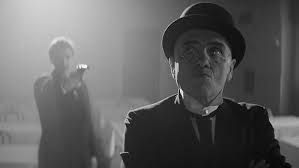

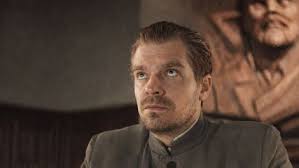
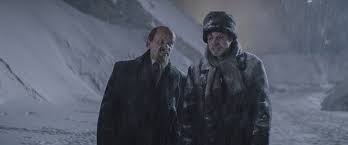
The young Latvian doorman Hans (Petr Buchta), whom everyone confuses for “Pyotr” or “Peter,” is a radicalized Forrest Gump, a witness to that final year before World War I in Riga (Latvia), Bern (Switzerland), Vienna, Paris, Prague and London — a traveling leftist-in-the-making haunted by the helmeted Hamlet’s ghost of his demented father, who cursed him with his final breaths.
“If a man hasn’t been to war, he’s lived an idiot’s life!”
Simanis, who co-wrote this brisk, dark and picaresque “history” with Tabita Rudzate and Uldis Tirons, gives us a modern take on the hoary Ticking Time Bomb theory of a Europe that was ready to blow. But this 2021 satire, in German, Latvian, French and Russian, isn’t a “Downton Abbey” end of the “gilded” Edwardian Era of Kings and Kaisers, Czars, Emperors and Sultans. This is from the point of view of the oppressed “masses,” young women and men in every country and every corner of the continent yearning for more than what generations before them had settled for.
Hans/Peter flees Czarist Latvia, struggles with which side to take (He tries to enlist in the Swiss Army, at one point), which will be the one to free the populace from class and its limiting horizons. He falls in love, gets treated by Freud and eventually picks up a pistol as one of a legion of possible assassins who stalked that era, looking for a shot that might change the world overnight.
He falls in with this beer hall crowd or that cafe agitator, listens to the assorted speakers who rail at this or that injustice, “beggars” who’re labeled “communist idiots,” and sees whole classes of people embrace or reject anti-Semitism, patriotism or existentialism. Some, like Pyotr, are ready to become the “blunt instrument” who trigger cataclysmic change.
Our anti-hero sees not only his deluded father, but a one-eyed version of his future self, a man who helps trigger the revolution and sits at a desk under a bust of Lenin and carries out its end game years later.
The film’s politics are as confused as they were in that roiled age, or in the current age of oligarchs, dictators, endless wars and last gasps of Soviet-styled empire building. Hitler (Edgars Kaufields) isn’t on screen enough to get across his emerging murderous dogma. But Lenin (Lauris Dzelzitis) and the Leninists speak in a hall with a Satanic pentangle painted on the floor.
Nobody comes off well, not even the leftist lover (Inga Silina) who helps “Peter” make up his mind which side he’ll take.
If the absurdity of it all is what we take away from this distant mirror held up to our own roiled times, so much the better. Even the passage of over a century hasn’t really answered what stance anyone held, what actions any labor agitator, suffragette or anarchist took or might have taken that could have been a help or a hindrance to “true democracy” unleashed.
The killing — assassinations to mass slaughter — didn’t in the end change as much as it was supposed to, fallen monarchies excepted. And “going to war” didn’t make a man out of anybody. It just got tens of millions killed.

Rating: unrated, violence, nudity, sexual situations
Cast: Petr Buchta, Lauris Dzelzitis, Inga Silina, Girts Getseris, Edgars Kaufelds, Gints Gravelis, Daniel Sidon and Eduards Johansons.
Credits: Directed by Davis Simanis Jr., scripted by Tabita Rudzate, Davis Simanis Jr. and Uldis Tirons. An IndiePix release.
Running time: 1:35



