Movie Review: “Once Upon a Deadpool”


dead1

You had to go and do it, didn’t ya?

Burn through ol’Deadpool’s pool of goodwill with a joke taken too far, a shameless money-grab for the holidays.

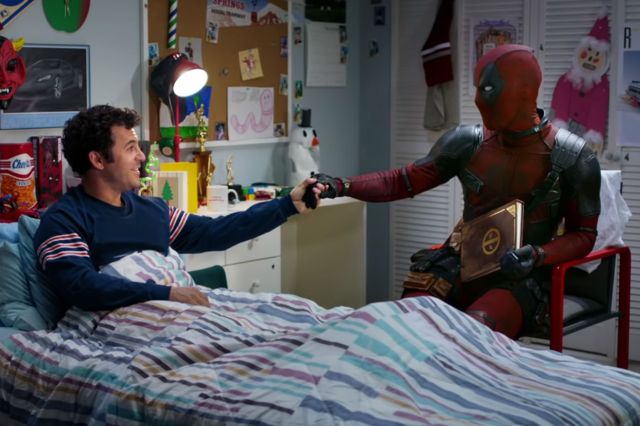
The trailers were the highlight of “Once Upon a Deadpool,” a “Princess Bride” re-cutting of the R-rated violence and vulgarity fest that is “Deadpool 2” into a less vulgar (somewhat) PG-13 Xmas season limited release.

They’re funny, and some of us (me included) can never get enough of Ryan Reynolds’ jokey, best-joke-on-set-wins take on the character and the way he promotes the Canadian daylights out of these pictures.

But as everybody EVERYBODY who reviews it is going to say, these little inserts — Deadpool kidnapping and reading the story to the adult (and funny) Fred Savage in bed on his childhood “Princess Bride” bedroom set — was never going to be anything other than a cute added feature for home DVD release.

The inserts are almost all funny, but they stop the picture dead in its tracks. Repeatedly. They ruin the flow, such as it was, and cleaning up the language and throwing alternate jokes (you can see, when Reynolds isn’t in the character mask, him mouthing “the f-word” and other profanities when we’re hearing “hell” overdubbed) doesn’t improve the viewing experience.

Maybe as a drinking game. Which is again, for home video viewers.

I’m going to keep this short as I’ve already reviewed (and liked) “Deadpool 2.” But as I am the professional in the (screening) room — I took notes. So, a few Dead/Kid “Princess” highlights, if you please.

Savage: “You KIDNAPPED me?”

Dead: “I call it unsolicited LOCATION enhancement!”

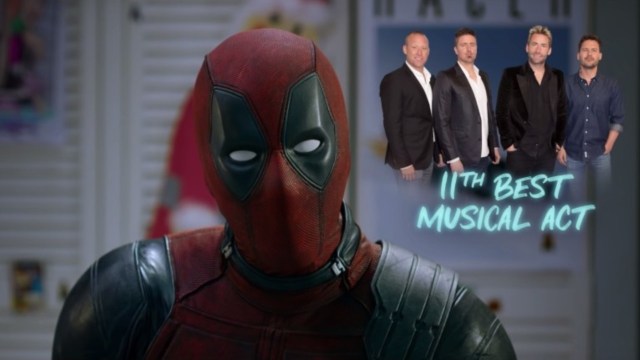
You’ve seen the “Yeah, but it’s not REALLY Marvel — Marvel licensed by Fox” joke. Which leads into the Nickelback vs. the Beatles riff that so tickled the Internet.

dead2

There’s funny deconstruction of the Marvel “multiverse” obsession, much of it provided by Savage (who holds his own with Reynolds, no mean feat). The “lazy writing” riffs that were already in the movie are expounded upon, especially the idea of “reducing the (love interest) to simple (formulaic comic book movie) plot devices.”

There’s a profane chorus singing a profane ode to the character Juggernaut in the third act, which I don’t think was in the original version of the film.

They give Deadpool control of the “bleep” button, because Savage is inclined to go over their “f-bomb” limit, thanks to being kidnapped, duct-taped to a kids’ bed and all.

“EASY there, Sugar Mouth! The only F-word we’re using around here is…FRED Savage!”

The framing device makes the whole thing play like a testier “Mystery Science Theater 3000” take on the movie.

Which is fine. For an added feature on your BluRay disc.

But if you want to bring the drunken party with your friends to the theater (Fudge Cancer gets a portion of the proceeds), be sure to pick a multiplex that serves alcohol. And designate a driver. Uber’s a business model that could crash and leave you stranded just as you’re exploiting the sucker-driver you’ve summoned to take you home.

2stars1

MPAA Rating: PG-13

Cast: Ryan Reynolds, Fred Savage, Josh Brolin, Morena Baccarin, Zazie Beetz, Leslie Uggams

Credits: Directed by David Leitch, script by Rhett Reese, Paul Wurnick and Ryan Reynolds. A Fox/Marvel release.

Running time: 1:59

Posted in Reviews, previews, profiles and movie news | Comments Off on Movie Review: “Once Upon a Deadpool”

Documentary Review: “Islam and the Future of Tolerance”

It’s a conundrum faced on many a political talking heads show.

How do you fight Islamic extremism without violence? How do you have a debate about a faith whose adherents have historically used it for violence (not that they were the only ones) when those adherents are inclined to trot out a “fatwa” or death threat to any “apostate” criticizing it?

“Islam and the Future of Tolerance” is a documentary about the ways debates, collaborations and friendship between a British born former Islamic extremist and an outspoken American atheist may be reshaping the rigid polarization this argument has settled into.

It’s a chatty, thoughtful and hopeful film featuring lots of experts, and centered on two extremely articulate “foes” arguing, thinking and paving the new middle ground upon the fraught intellectual quicksand this conflict has been trapped in forever.

Self-described British-born former Islamic extremist and author Maajid Nawaz and neuroscientist, philosopher and atheist Sam Harris had a testy first meeting in 2010, were chatting like respectful colleagues by 2014 and then produced the book that this documentary is based on and takes its title from — “Islam and the Future of Tolerance.”

The film profiles each man via interviews, clips of their various TV and public speaking appearances and shows how each came to the place where he could listen to the other, hear him out and find common cause — or at least directions for their dialogue to progress that wouldn’t end with them pummeling one another.

Nawaz, a polished public speaker since his days as an activist running for student body president at university and recruiting for Hizb Ut-Tahrir, a caliphate-reviving Islamist organization active worldwide, insists that Islam’s interpretation has been “hijacked by the Bin Ladens of this world,” and advocates debate and breaking “this blasphemy taboo…this idea that people don’t have the right to criticize our faith just like we criticize everything else.”

Harris, already a published author (“The End of Faith: Religion, Terror and the Search for Reason”) arguing against supernaturalism and religion in general, introduced himself to Nawaz after an Australian debate with “You have the hardest job in the room…Your job is to PRETEND Islam is a religion of peace, when in fact’s it’s not.”

He wasn’t done.

“Is this pretense the remedy, for you? Do you feel if you pretend this enough, that this will be the solution, this will be what modernizes Islam?”

They did not come to blows, though eyewitnesses in the film suggest it was within the realm of possibility.

As Harris says “We live in perpetual choice between conversation and violence,” and Nawaz insists that there is a way for “Islam to reform and adapt to the modern age,” the conversation begins.

An image of a man walking a tightrope accompanies these tentative first steps (a long 2014 recorded phone conversation is part of this process), and they seem to agree that “texts do not speak for themselves” and that “Islam is not Islamists” and “Islamists are a tiny minority” in a religion that yes, has a seriously conservative and intolerant streak towards women, gay rights and other religions built into it.

Nawaz tells a short version of his life story — growing up in Essex, encountering bigotry and outright “Paki bashing” from an early age, radicalized, recruiting for the group he joined far and wide.

On 9/11, he was in Egypt on such a recruiting trip. Within days, he was imprisoned with other jihadists and members of other religious groups. During his four years in jail, the fact that Amnesty International labeled him “a prisoner of conscience” and took up his cause moved him.

In earlier days, he would use the Left’s knee-jerk defense of “tolerance” refusing to consider the extremism that was spreading, with Islam, worldwide, against it.

He echoes Kruschev’s “We will bury you” when he remembers “We would exploit the multi-culturalist tendencies of the left,” free speech “above all,” and use it to make their mark in the West.

He orchestrated a takeover of student government in college, published inflammatory leaflets and made outrageous, sexist women-oppressing declarations. His bodyguard on campus murdered a non-Muslim Nigerian with a machete.

But it took prison for him to see the error of his ways.

Harris is seen bickering with actor Ben Affleck on TV’s “Politically Incorrect” about the violent history, dogma and interpretation of Islam, and recalls the heat he took, among atheists, liberals and leftists, for singling out Islam for special abuse in his speeches and appearances.

Activist author Aayan Hirsi Ali (“Infidel,””Heretic: Why Islam Needs Reformation Now”) chews out Nawaz in a debate about whether the Koran, the Prophet or today’s clerics are the ones who have rendered Islam a violent menace to world peace and civilization itself. Just getting him to admit that “menace” would be a start, she says.

“The sooner you admit that, the sooner I can get rid of my bodyguard.”

Nawaz and Harris unwind the broad spectrum of opinion, devotion and fanaticism within the Muslim world by imagining the layers of concentric circles, starting with the tiny fraction of “jihadists,” working through levels of Islamic conservatism towards the more liberal elements of Islamic society which might be open to “reform.”

Yasmine Mohammed, author of “From Al-Qaeda to Atheism” marvels at the ways this can “build the nuance in the debate” and “stop that polarization” that keeps the opposing sides so far apart.

Ali Rizvi, author of “The Atheist Muslim,” spreads the two thinker’s gospel –“Respect the right of people to believe what they want to believe, but that doesn’t mean we respect the beliefs themselves.”


It’s all a plot, of course, which all these mentions of “Bible Belt” conservatives in America not being that different from the intolerant but not radicalized conservatives of international Islam, buttresses.

They’re suggesting that secularism is the planet’s only hope, that atheists are leading the way.

That won’t play in a lot of places, any more than “Islam and the Search for Tolerance” will play on Christian TV or Fox News in the US.

But co-directors Desh Amila and Jay Shapiro have dangled a little hope in front of us all, presenting a furious, ancient schism and debate often contested with violence as something civilized people can hash out with conversation, ideas and reason.

They’ve made a talkative film in which the very act of talking about this subject is a first tiny victory.

3stars2

MPAA Rating: Unrated

Cast:  Maajid Nawaz, Sam Harris

Credits: Directed by Desh Amila and Jay Shapiro. An Orchard release.

Running time: 1:26

Posted in Reviews, previews, profiles and movie news | Comments Off on Documentary Review: “Islam and the Future of Tolerance”

Movie Review: Elle goes trashy and on the road to “Galveston”

galve1

We hold these critical truths to be self-evident, and we hold them close to the heart.

  • That every Ben Foster performance has value, and by extension, every film he makes is worth chewing over.
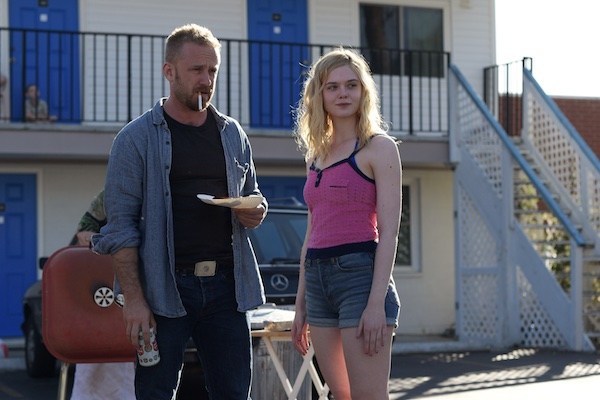
  • That Elle Fanning has few peers when it comes to generating empathy in a role, and if she sees something in tarting down to play a 19 year-old Louisiana (by way of Orange, Texas) hooker, she gets the benefit of the doubt.
  • And that no on-the-lam road picture can be all bad.

So the bleak, violent and somewhat downbeat “Galveston” has that going for it, out of the gate. Directed by French actress-director Mélanie Laurent (“Inglourious Basterds,” “Beginners,” “Night Train to Lisbon”), it’s an aimless road thriller/crime melodrama that delivers a few body blows, but pulls more punches than it lands.

Foster plays Roy, a collector/enforcer for a local “importer” (Beau Bridges) in 1988 New Orleans. Roy keeps the job even though his woman (María Valverde) ditched him for the boss. He keeps secret what the doctor told him about his lungs as he stomped out of having his X-rays explained to him.

And he keeps his doubts to himself when he’s sent on a job by that boss, with the proviso “Nobody should get hurt bad…No guns.”

Before you can say “Set up,” Roy and his sidekick, –the muscle — are jumped. Blood is spilled, a lot of it.

And there was this woman — teenage girl dressed as a woman, anyway. Rocky (Fanning) is tied up in a chair in the house Roy’s broken into. Freeing her complicates his getaway. But Roy, a stone-cold-killer, has a soft spot. How’d she GET here?

“I knew this girl in Orange, Texas,” Rocky begins, dissolving into tears. “Perfect Choice Escorts — I didn’t know.”

He won’t leave her. She won’t give him any peace.

“You’re the one that kidnapped me.”

“I saved you. Be clear on that.”

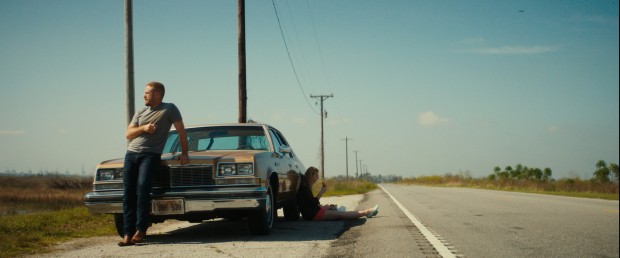
As they motor West, she’s a little too friendly with the barflies at the honky tonks they hit along the way. She comes on to him, maybe as a way of getting back to “normal” after the shock of witnessing the New Orleans bloodbath, maybe because screenwriters are lazy, hasty and lascivious about such matters.

galve4

“You’re 40. I’m 19. Man, that’s nothing, right?”

He turns her down with extreme prejudice — “You’re disgusting.”

But a coughing fit keeps him from ditching her, and when she begs him to make a stop in Orange, Texas, he does. That’s where he hears a shot in a house she’s dashed into, a shot followed by Rocky dragging a three year-old girl out with her.

“She’s never been to the ocean,” Rocky says of Tiffany. And that’s how they wind up in “Galveston.”

Laurent serves up a heaping helping of “local color,” from the dumpy motel run by the no-nonsense Nance (CK McFarland), to the dives around it and the down-and-outs who stay there. Rocky’s sordid trade fits right in there. Violence, despair and poverty hang over this crowd.

That includes the obligatory nosy young guy (Robert Armayo), a kid who with “a job” and a sense of himself as “a professional,” and a proposition for Roy.

“Where’d you do your time, bra?”

Foster, vivid in a role where he barely said a word (“Leave No Trace”) is at his best in the (brief, rare) fight scenes, and in biting off tough guy dialogue and drawling it at the camera.

“Reckon you’re gonna have to hope my words’ a lil’better’n yours.”

But Laurent loses track of her villain (Bridges) and robs the film of its urgency as she does. The story’s turn toward the grim, the fatalistic and the noble is undercut by an epilogue that serves no dramatic function.

The actors are game, the action beats are handled with skill. But the story lacked shape. Laurent had the cachet to land a great cast, but not the skill to bend a tired, unsurprising journey and the script that relates it into something more interesting.

2stars1

MPAA Rating: unrated

Cast: Elle Fanning, Ben Foster, Beau Bridges

Credits: Directed by Melanie Laurent, script by Nic Pizzolatto, based on his novel.  An RLJE release.

Running time:  1:31

Posted in Reviews, previews, profiles and movie news | Comments Off on Movie Review: Elle goes trashy and on the road to “Galveston”

Preview, Toronto sleeper “The Standoff at Sparrow Creek” comes our way Jan 19

A militia nut movie with an edge.

James Badge Dale, Brian Geraghty, Patrick Fischler, Chris Mulkey, Happy Anderson and Robert Aramayo star in “The Standoff at Sparrow Creek,” which is getting VOD release Jan. 19.

Posted in Reviews, previews, profiles and movie news | Comments Off on Preview, Toronto sleeper “The Standoff at Sparrow Creek” comes our way Jan 19

Next screening? “Once Upon a Deadpool” — UNLESS there’s Nickelback involved.

Posted in Reviews, previews, profiles and movie news | Comments Off on Next screening? “Once Upon a Deadpool” — UNLESS there’s Nickelback involved.

Preview, Netflix spends heist picture bucks on Affleck, Isaac, Pascal, Hunnam and Hedlund — “Triple Frontier”

Pretty promising genre picture,  from J.C. Chandor and screenwriter (“Zero Dark Thirty”) Mark Boal.

They filmed “Triple Frontier” in Colombia, and spared no expense in who they hired for the job. This is a fictional variation on that long-planned Mark Boal/Kathryn Bigelow project about the no man’s land corner of South America where several borders meet, I dare say.

“Triple Frontier” arrives on your TV in March.

Posted in Reviews, previews, profiles and movie news | Comments Off on Preview, Netflix spends heist picture bucks on Affleck, Isaac, Pascal, Hunnam and Hedlund — “Triple Frontier”

Preview, Elizabeth Banks raises a monster in “Brightburn”

“He’s not like us.”

You don’t say.

The frights from the scary kid this rural couple “found” come our way Memorial Day, when “Brightburn” reaches theaters. 


Posted in Reviews, previews, profiles and movie news | Comments Off on Preview, Elizabeth Banks raises a monster in “Brightburn”

Movie Review: Dafoe’s Van Gogh suffers, exults “At Eternity’s Gate”

gate1

Rarely has an actor’s “baggage” served him better in a role than Willem Dafoe’s has in bringing Vincent Van Gogh to the screen in “At Eternity’s Gate.”

Soulful and wounded, testy and potentially dangerous — those are the hallmarks of Dafoe’s lustrous and gritty character actor’s career. And those fit neatly into our picture of Van Gogh, a sensitive, mercurial and impulsive character whose painting and actions have invited over a century of second-guessing and post-mortem psychoanalysis.

Dafoe even looks like Van Gogh, the Van Gogh of his self-portraits — worn, lined, fretful. We forget, in an instant, the the Great Dafoe has already lived decades longer than Vincent, who died at 37.

Julian Schnabel’s intimate, psychological look at his fellow artist’s life is valuable not so much for its conjecture on how Van Gogh died or even on his mental struggles, perhaps exacerbated — as the film suggests — by persecution by the rural locals he spent his last years living with and painting. “At Eternity’s Gate” glories in Dafoe’s fragile, manic take on the painter’s mad rush with the brush, his way of seeing the world, which was only truly validated after his death.

Schnabel’s rushed, jerking hand-held camera and judicious use of extreme closeups may underline and mimic Van Gogh’s frantic-to-see, frantic-to-paint, frantic-to-live state. But it is Dafoe who makes us see Vincent’s exultant moments and his despairing ones, makes him sympathetic — flesh and blood and pain and genius all there in his eyes.

“The essence of nature is beauty,” Vincent declares. Though to be fair — Schnabel also shows us many of Van Gogh’s uglier works. He saw beauty in the tangled, brown roots of an uprooted tree, in stark seasons where his beloved sunflowers had withered and rotted, in the despair of an old man in the painting the film takes its title from.

This validates what the world has long thought of Van Gogh, what his friend and compatriot Paul Gauguin (Oscar Isaac, devil-may-care brilliant in the part) sees in Van Gogh, that “no one sees the world the same way” and nobody but nobody saw it like Van Gogh.

“People will be known because you painted them!”

Schnabel, who co-wrote the script, leans on what we already know about Van Gogh, the familiar parameters and geography of his circumscribed final years. “I hate the grey light” of Paris, he says. “Go South, Vincent,” Gauguin counsels. The more-successful Gauguin, meanwhile, keeps threatening to go “to Madagascar!” And not just for the light, but to get away from the competition, the struggle for acceptance, the money pressures. He never made it to Madagascar. And Martinique wasn’t enough of an escape for Gauguin, as he eventually found his way to Tahiti.

Van Gogh’s move to Arles and environs were well-covered by the glorious animated mystery, “Loving Vincent.” But Schnabel — like every other Van Gogh film biographer (Robert Altman’s “Vincent & Theo,” Vincente Minelli’s “Lust for Life”) — cannot resist showing us the real people Vincent knew and the human subjects for many of his paintings.

Children storm his easel and pelt him with stones when he shoos them away. A farm maid flips out when he impulsively asks her to pose, and then manhandles her into position for the most flattering light and animated posture.

“Paintings have to be done in full one gesture,” he exclaims. “The faster I paint, the better I feel!”

“Loving Vincent,” animated as if Van Gogh has done it with his own brush, is still the best appreciation of the artist and recounting of his troubled life. But Dafoe and Schnabel brilliantly give us the man — troubled but focused, misunderstood and scary, impulsive enough to remove the ear that let him hear distressing news, someone who saw the infinite in the muddy boots he took off and preserved on canvas in the yellow light of Arles.

Schnabel’s always been most at home making movies about fellow artists, and he is on his game with the the film’s hand-held style, Van Gogh color palette and appreciation, at every turn, of the artist’s plight. He also rounds up a wondrous supporting cast — Mads Mikkelsen as a sympathetic priest with no eye for art, Emmanuelle Seigner as Madame Ginoux, the cafe-owner/”friend” Van Gogh painted, with Mathieu Amalric (of Schnabel’s “The Diving Bell and the Butterfly”), the great French character actor Niels Arestrup as a fellow inmate in the asylum Van Gogh stayed in, Rupert Friend as the supportive brother/art dealer Theo Van Gogh and Vladmir Consigny as Dr. Felix, seen in a more sympathetic light here than in “Loving Vincent.

But it is Dafoe’s compact, internalized turn as the artist, letting us feel his pain rather than bellowing about it (see “Lust for Life” for that) that pulls us in and gets us as close to the artist as any film ever has. It’s glorious work, and a grand capstone to a fabulous career, with or without Oscar recognition.

3half-star

MPAA Rating: PG-13 for some thematic content

Cast: Willem Dafoe, Rupert Friend, Emmanuelle Seigner, Oscar Isaac, Mads Mikkelsen, Niels Arestrup, Vladimir Consigny, Mathieu Amalric, Stella Schnabel

Credits: Directed by Julian Schnabel, screenplay by Louise Kugelberg, Louise Kugelberg and Julian Schnabel. A CBS Films release.

Running time: 1:50

Posted in Reviews, previews, profiles and movie news | Comments Off on Movie Review: Dafoe’s Van Gogh suffers, exults “At Eternity’s Gate”

Movie Review — Into the blurred murk of “Spider-Man: Into the Spider-Verse”


spider1.jpeg

Yes, that’s how it’s supposed to look. And no, Sony Animation should not have let “Spider-Man: Into the Spider-Verse” out its doors and onto big screens in this blurred, jerky, pixelated condition.

No kidding, six minutes into it, I go track down the studio’s representative at the screening, who had overseen other showings of the film in our market. No, that’s just how it looks, he assures me.

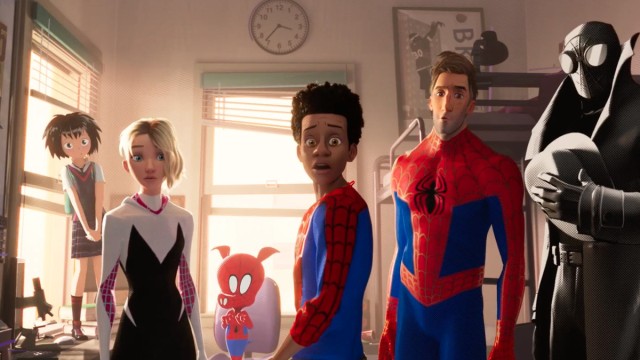
So did all those folks raving this up on Rottentomatoes watch it off screeners on their home systems? Because this plainly cut-rate or at least ill-advised enterprise, in which the dot matrix of characters’ CGI is plainly visible on an IMAX screen near you, the action as jerky as 1960s TV anime and action beats devolve into a “Transformers” blur, is ugly enough on the big screen to spoil a pretty good effort at redefining the comic book movie. They wanted to make it look like a comic book? They went too far.

As in, animate it. Make it look and feel like a comic, with thought balloons for narration, an embracing and a mocking of the entire on-page and onscreen history of the character. Throw in a cuter than usual Stan Lee cameo and the tone, at least, is spot on.

But choosing this “style” without realizing how problematic it would be? How’d that happen?

It is not, as one of the alternate universe Spider-Men (or woman or pig or teen girl), this one a black and white (“noir”) “Shadow” knockoff from the 1930s voiced by Nicolas Cage (perfect) growls, “pretty hard core for an origin story!”

A charter school kid of African American-Latino heritage (Shameik Moore) is bitten by a radioactive spider this time. But there’s already a Spider-Man who has the market cornered on all this crime-fighting and web slinging. It’s only on meeting Peter Parker (wiseacre Jake Johnson) that young Miles is pulled into the fight, against Kingpin (Liev Schreiber), who has a collider/particle accelerator that his minions (Kathryn Hahn is Doc Ock) will use to tear a hole in space-time and tap into alternate universes.

Kingpin? He has his reasons. But that means other Spider-Men break into Miles’ universe, and there are Spider-Man casualties.

Luckily for Miles, he’s got all these comic books to study on how the webslinger is supposed to behave, teach him Spidey’s ethos, all that. “Our family doesn’t run,” and “No matter how many times you get knocked down, it’s getting back up again that matters.”

Good stuff. If only the young teen was confident enough to live up to it. If only he was brave enough to take that first plunge off a big city high rise. That’s a clever touch, too.  Bit of a fraidy-cat, this Spider-Man-Miles.

The main story is just recycled variations on generic comic book themes, and nothing special. It’s the flippant tone, the awkward adjustment of the kid to “changes” in his body (sticky hands and feet, etc.), changes he attributes to “puberty,” that give “Spiderverse” a lift.

“I don’t think you know what puberty is,” a sassy new student who calls herself “Wanda” (Hailee Steinfeld) suggests.

spider2

With each new alternate Spider-Man, the kid hears “You’re like ME,” which Miles is slow accepting.

“I don’t WANT to be.”

The long LONG animated film (which seems longer thanks to the poor aesthetic choice that gives it a direct-to-DVD animation feel) is front-loaded with a lot of laughs, which thin out just as the second hour is getting started. The visuals are even harder on the eyes than the junky looking (somewhat intentionally so) “Teen Titans Go!” movie of earlier this year.

These films were plainly put into production with “devices” other than movie theater projection in mind, as there is no Sony Animation, Pixar, Dreamworks or Blue Sky production that looks as unfinished as “Spider-verse.” I’ll bet it’s perfectly acceptable streaming or on home video where every flaw in motion, design and finish isn’t as obvious. As an aesthetic choice, it just doesn’t work. Was it MEANT to hurt the eyes and induce headaches? 

Fans of the current TV series and “Spider-Man” completists may find more to chew on here. I was amused that Miles is using his mom’s last name (Morales) because his dad’s last name is Davis. Who wants to go by Miles Davis? His Dad (voiced by Brian Tyree Henry) is named Jefferson Davis, so clearly he knew the joke he was ruining on his kid’s birth certificate.

But a lot of recognizable (Lily Tomlin is Aunt May) voices, and unrecognizable ones (Chris Pine and Oscar Isaac are also in the cast), a lot of comic book touches (interior monologues in thought-boxes and the like) and the general jokiness don’t justify this “Spider-verse” making the trek to the big screen.

Direct. To. Video.

And if I’m the only one to say that, so be it. I can’t review anything but the headache-inducing blown-up TV (under) animated miasma I see before me. This is sloppy.

2stars1

MPAA Rating: PG for frenetic sequences of animated action violence, thematic elements, and mild language

Cast: The voices of  Shameik Moore, Jake Johnson, Hailee Steinfeld, Lily Tomlin, Nicolas Cage, Zoe Kravitz, Kimiko Glenn, Kathryn Hahn

Credits: Directed by Bob Persicheti, Peter Ramsey, Rodney Rothman, script by Phil Lord and Rodney Rothman. A Marvel/Sony Animation release.

Running time: 1:57

Posted in Reviews, previews, profiles and movie news | 8 Comments

Next Screening? Let’s swing into “The Spiderverse,” shall we?

“Spider-Man” is, like all comic book characters, a natural for animation.

Here’s Sony spending some real big screen money on a “Spider-Man” cartoon that does what Sony NON-animation hasn’t done, as yet — cast an African-American actor as the web slinger, alternate storyline-hero-the works.

The maitre’d’s and beer wine distributors who call themselves The Hollywood Foreign Press Association picked it as one of the best animated films of 2019. Yay for them. WE will see.


Posted in Reviews, previews, profiles and movie news | Comments Off on Next Screening? Let’s swing into “The Spiderverse,” shall we?