
Filmgoers of a certain age are honor bound to tear-up more than once watching “Jimmy,” the earnest, sentimental and nostalgic new movie about Jimmy Stewart. The film almost earns those tears, but to be honest, what we’re responding to is the man the movie is about, not this malnourished biopic.
Stewart was one of the most beloved figures of Golden Age Hollywood, revered by audiences who aged with him during his four and a half decades of stardom, respected for the man he was off camera as well as on screen.
The movie, flatly directed by Aaron Burns and somewhat colorlessly scripted by Justin Strawhand, whose other significant credit was their poorly-received feature debut, “Birthright Outlaw,” benefits from a fine turn by long and cadaverously lean KJ Apa. A relative unknown, he becomes a decent facsimile of the “Indiana farmboy” turned movie star, someone whose values wouldn’t let him Ronald Reagan/John Wayne his way out of military service during World War II.
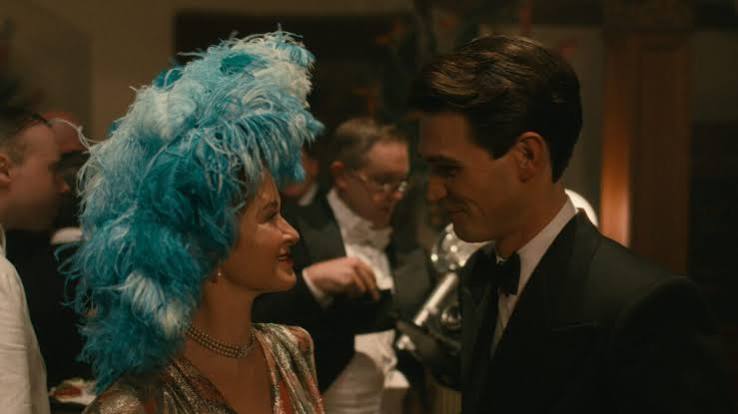
“Jimmy” captures the star at his Oscar-winning peak, an American Everyman at home in romances, satires (“Mr. Smith Goes to Washington”) and especially comedies like “Destry Rides Again” and “The Philadelphia Story,” which earned him that Oscar in Feb. of 1941. We see him pursued by gossip columnist Hedda Hopper (Sara Drew) and proposing to his “Vivacious Lady” co-star Ginger Rogers (Gemma Donovan) when he gets his draft notice.
She giggles at the thought, and at the idea of Stewart serving in uniform.
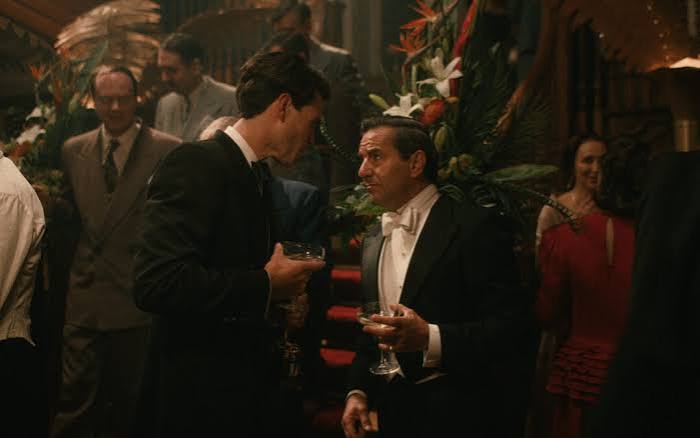
Unlike many stars, Stewart was determined to “do his bit,” in the parlance of the day. The film shows us the machinations of MGM’s Louis B. Mayer, played as a wheeler-dealer and not the sentimental weeper of legend (especially in contract negotiations) by Jason Alexander, to get Stewart a deferment so that he could contribute to the war effort at home, and to MGM’s bottom line.
“You are a god, and gods don’t fly airplanes.”
Rob Riggle plays an Army Air Force officer who also tries to talk Stewart into doing his bit at home, because losing him in combat would gut American morale.
And veteran screen heavy Neal McDonough, experiencing a career renaissance in faith-based or faith-prominent films like this one, plays Stewart’s Spanish-American War and WWI veteran father, who seems to reverse psychology his skinny, sensitive son into going with “You’re just not cut out for it.”
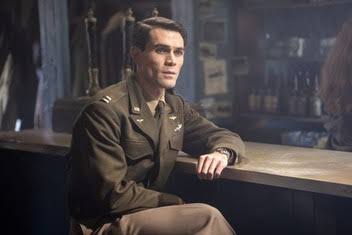
But avid aviator Stewart will not be denied, and soon he’s trained and piloting his B24 Liberator bomber to an airfield in England as the Allied bombing offensive against Nazi Germany’s “Fortress Europe” gears up.
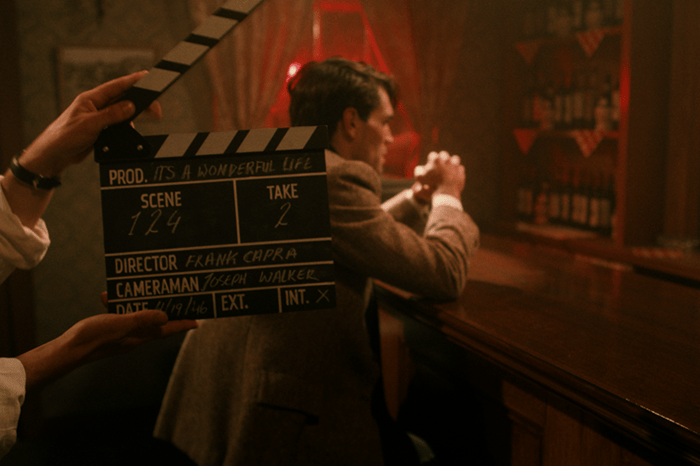
The pre-war fame and combat service are framed within the efforts of the populist immigrant filmmaker Frank Capra (Max Casella, giving Capra a pugnacious edge) to talk post-war Stewart into re-starting his career with a “movie that will be timeless,” one that audiences will watch “100 years from now, after we’re dead and gone.”
That movie was the 1946 box office flop “It’s a Wonderful Life,” a picture that aged into quintessential Americana, a holiday favorite to this very day.
So the thesis here is that the trauma of war scarred and ennobled Stewart, gave him gravitas that his “happy go lucky” earlier years lacked.
That’s a solid formula to hang your picture on — with a fictionalized overseas romance (Kara Killmer), the terror of (CGI assisted) bombing missions over Germany, and the shock of loss when friends and comrades are shot out of the sky. Stewart’s so emotional on the “Wonderful Life” set that veteran character actor Lionel Barrymore (Christopher McDonald, outstanding) is moved to give the broken veteran a pep tal.
But it’s too bad that there’s precious little that’s “happy go lucky” in those early Hollywood scenes. Alexander’s dry-not-droll take on Mayer sets the disappointing tone. While the film isn’t utterly humorless, it comes close. And that doesn’t jibe with our memories of Stewart at all.
I had the pleasure of interviewing Mr. Stewart near the beginning of my career and after the end of his. Apa gets the timbre of the voice close to perfect, and gets a good handle on the exquisite timing that never left Stewart to the end of his days. For decades, no self-respecting comic or mimic could make a living without having a killer Jimmy Stewart in his repertoire. Dana Carvey was probably the last and certainly one of the best.
But the twinkle that Stewart wore in Hollywood, on “The Tonight Show,” in person in interviews and even on occasion overseas, is missing.
Stewart’s ethos in the film, that “I just wanna be able to look at myself in the mirror and see a ‘good man’ looking back at me” is so old fashioned it may have died with him and the rest of The Greatest Generation.
Stewart’s of a bygone era, and judging by the audience I saw “Jimmy” with, the generations that connected with his blend of talent, wit and righteousness by example are all but gone. What he has to say to Gen’s X through Z and Alpha, even in “It’s a Wonderful Life,” is anybody’s guess.
And that’s what we weep for in those moments “Jimmy” reaches for and grabs tears, the loss of innocence, the dangers and grim responsibilities of combat, the nobility of such figures in our culture.
Malnourished polish aside, “Jimmy” underwhelms, more often than not. But James Stewart never did.

Rating: PG-13, combat violence
Cast: KJ Apa, Kara Killmer, Max Casella, Rob Riggle, Christopher McDonald, Sara Drew, Neal McDonough and Jason Alexander
Credits: Directed by Aaron Burns, scripted by Justin Strawhand. A Fathom Entertainment release.
Running time: 2:00