Classic Film Review: Shaw’s “Pygmalion” with Wendy and Leslie

pyg2

Here’s the way the brain wanders.

You’ve just finished reading “The Story of Spanish,” are just now starting on the equally breezy, informal and informative “The Story of French,” books that combine travel with history, geography, etymology and phonetics.

You review two Midlands moviesfrom the UK, whose characters have accents you couldn’t cut through with a chainsaw. You reference the “My Fair Lady” song “Why Can’t the English?” (speak bloody comprehensible English) in one of the reviews.

And then “Pygmalion” pops up, George Bernard Shaw’s delightfully dated and sexist play about “Posh Accents Make the Lady…or Gentlemen” which he helped adapt for the screen in 1938. And as I hadn’t seen it in this millennium, well why not? Aside from loathing most of “My Fair Lady” (which adapted “Pygmalion” into a musical) and having had to review it on the stage maybe half a dozen times over the years, I mean.

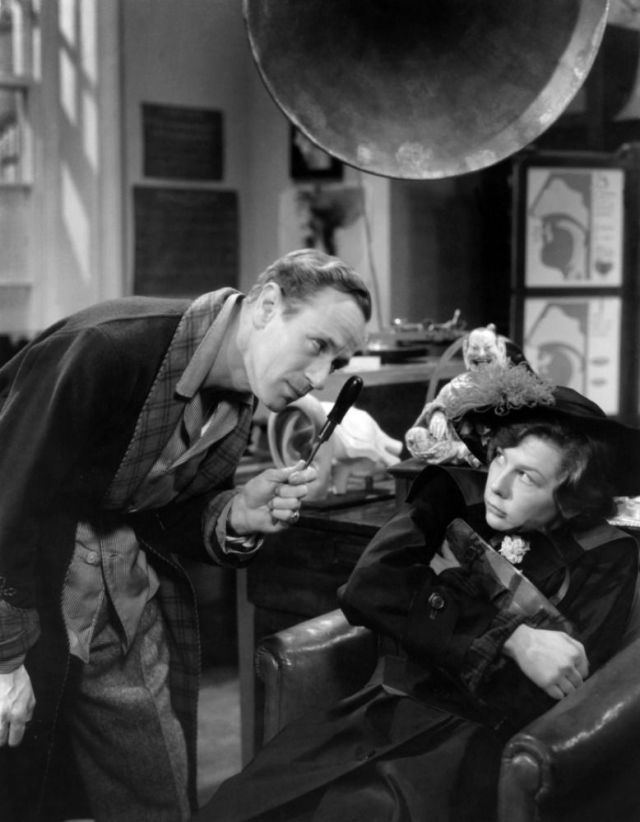
Leslie Howard, most famous for “Gone With the Wind,” was at the top of his profession and the top of his game for this classic-to-be, even taking a co-directing credit to make sure his close-ups were all they could be.

He’s Professor Henry Higgins, phonetics, speech and accent expert, “confirmed bachelor” and misogynist.

Wendy Hiller is a perfectly believable braying Cockney flower seller Eliza Doolittle.

And Scott Sunderland is the phonetics academic Col. Pickering, freshly back from The Raj (India) who returned to London just to meet “My dear Higgins.”

They meet at Piccadilly, as Higgins puts on a show of guessing every street urchin (Liza), pickpocket and society swell’s home and birthplace simply by their accent.

He teaches, too, and that’s how the callous bet is made — that the braggart can turn the grubby flower seller, whom he labels “you squashed cabbage leaf, you disgrace to the noble architecture of these columns, you incarnate insult to the English language,” into a young lady who could pass for a member of polite society — nobility, even.

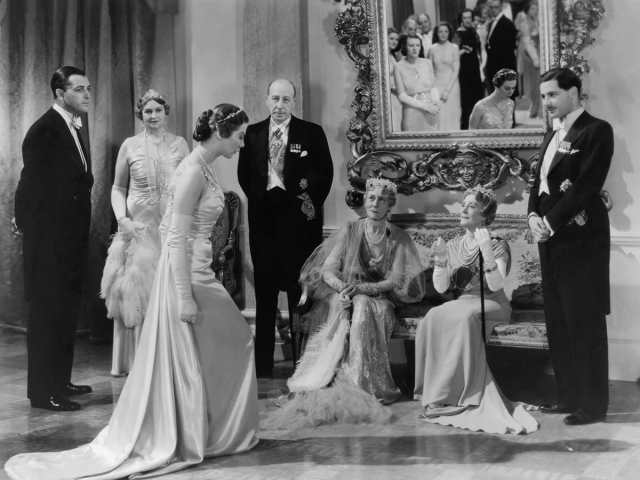
“My Fair Lady,” remember, was an Edwardian pre-WWI period piece. Howard and Shaw’s “Pygmalian” was contemporaneous, a pre-WWII comedy with state-of-the-art speech therapy technology (a phonograph recorder, etc.). That makes for cute (not that funny) teaching montages.

The class consciousness of the piece is much sharper when all those songs and regal non-singer Audrey Hepburn aren’t around.

The banter crackles, the insults fly and this Higgins is close enough to Eliza’s age to not be a creeper, even if Eliza’s extortion-minded pop (Wilfrid Lawson) suggests as much.
pyg4

Musicals work their magic by folding in songs when the emotion of the moment is too great for mere words or longing, lusty looks to do. And knowing both plays and films, you can’t help but miss a couple of the emotional/musical highs.

The finale drags in “Pygmalion” in a way “My Fair Lady” — a front-loaded musical (most of the best songs are before intermission) — rarely has.

But everything before that finale just sings, without music. It’s a deliciously smart and wordy comedy from the age when Hollywood — on this side of the pond — was thinking “screwball” in its approach to the great class divide.

Howard was a fey leading man, something underscored by “Gone with the Wind” and carried to the level of joke in “49th Parallel.” But he’s perfect here, prissy and able to treat females and everybody else with a dismissive harrumph that plays as asexual.

And Hiller, personally chosen by Shaw for the film, was just coarse and common enough to take to the makeover like a butterfly.

“I washed me face and hands before I come, I did!”

Whatever the virtues of “My Fair Lady,” it is “Pygmalion” that’s aging well, a black and white jewel properly enshrined as a classic.

3stars2

MPAA Rating: Unrated, dated allusions

Cast: Leslie Howard, Wendy Hiller, Wilfrid Lawson, Scott Sunderland, David Tree and Marie Lohr.

Credits : Directed by Anthony Asquith and Leslie Howard, script by George Bernard Shaw, based on his play.  A Criterion release, also on Tubi, Amazon, Youtube, etc.

Running time: 1:29
Posted in Reviews, previews, profiles and movie news | Comments Off on Classic Film Review: Shaw’s “Pygmalion” with Wendy and Leslie

Movie Review: Anarchy…and neglect and dysfunction in the UK — “Ray & Liz”

ray5

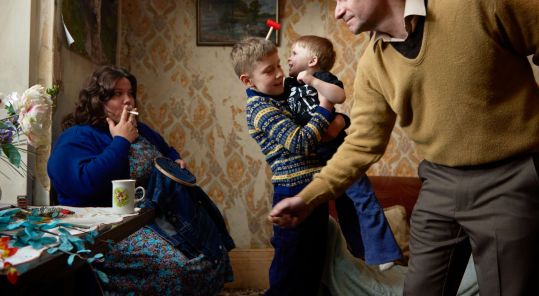
The older boy has a cassette record to play with, like many children of the late ’70s. His toddler brother has no shortage of plastic tools and toys, Legos and the like.

There’s a dog and a parakeet, too. Rich, the oldest, needs a pair of shoes. Let’s go off the shops.

But neglect has many faces, and two parents who seem disinterested at best, wrapped up in their smokes, their drinks and a kitchen sink melodrama they’re too dim to see themselves starring in it have those faces. “Ray & Liz,” their son Richard, “Rich” back then remembers them.

Birmingham “Black Country” photographer Richard Billingham came to fame documenting his parents and their tiny, dysfunctional and circumscribed lives. “Ray & Liz,” his feature film directing debut, shows him still mining their myopia, an adult now with a score to settle.

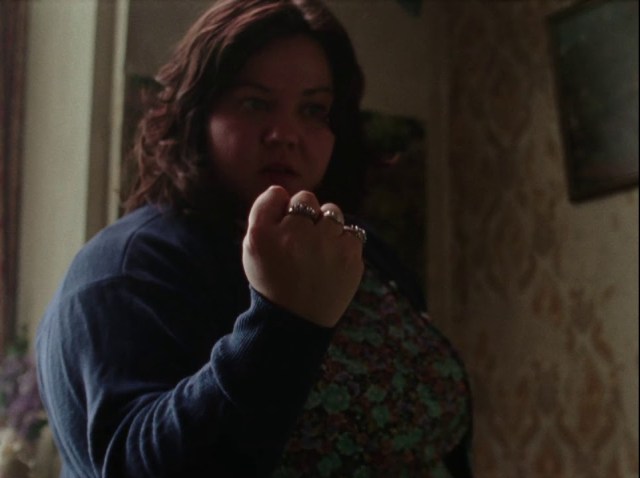
In 108 spare, harrowing minutes, we see the walls closing in on a family that’s given up, never equipped to deal with the despair of Margaret Thatcher’s Britain. Ray (Justin Salinger) and Liz (a fierce Ella Smith) are self-absorbed and self-medicating. And their kids, tracked over the course of half a dozen years, are “free range,” raising themselves, trapped in lives with a very low ceiling and inclined to mimic the callous cruelty their parents teach them with every puff of a cigarette.

There’s no back-story here, and no subtitles for these porridge-thick accents. It’s cheating to tell you that Ray lost his last good job, as a machinist, before events in the movie play out. They weren’t always “Council Flats” (subsidized housing) poor, on the dole, living from handout check to handout. But we can tell something took this couple out of the work force and made them all but check out of life as well.

Billingham doesn’t tell us who this “Lol” (Tony Way) is, an oaf of an uncle (perhaps) who does his best Charles Laughton as the Hunchback impression for little Rich’s cassette recorder. As she and Ray and Rich prep to go shoe shopping, Liz makes a naked threat to Lol that suggests a lifetime of conflict. He’d better keep an eye on little Jason. He’d BETTER not get into their liquor.

That’s not remotely as cruel as what Will (Sam Gittins) pulls when he gets home. He’s their lodger, has a touch of just-out-of-jail about him.

And what’s he do when Lol asks about the liquor? He produces a crate of it, gets Lol passed-out drunk and empties his wallet. And oh yeah, Will paints baby Jason’s face with boot polish and puts a carving knife in the child’s hand. Will then beats a retreat, only returning to see Liz’s beat-the-stupefied-Lol to a pulp meltdown over the scene she finds when the family gets home.

ray6

A few years later, the family’s fortunes have moved them from a modest duplex to those Council Flats. Rich is a self-sufficient teen, but younger Jason (Joshua Millard-Lloyd) is taking the brunt of this “raise yourself” ethos.

One thing they’ve both absorbed is the cruelty. Joking around, Jason sticks things in passed-out-dad’s mouth, the last of which is powdered punch. Ray almost chokes.

When the power’s cut off, Jason goes on a wander into the cold, dark night. And that gets “the authorities” involved.

Billingham’s film is built on the “kitchen sink” realism born in British cinema in the early ’60s, perfected by the likes of Mike Leigh and Ken Loach. It is grim, grey and overcast world and a hard watch, and not just because of those “cold-blooded murder of the English tongue” accents.

Framing the story within the 1990s final years of Ray (Patrick Romer) and Liz (Deirdre Kelly) doesn’t ease that burden. They’re apart, but connected — still drinking (he is, anyway), still selfishly self-absorbed, still badgering cash off each other to purchase some fresh impulse.

The movie memoir “Ray & Liz” most reminds me of is “Running With Scissors,” with “Ray” being a more bleak and humorless look back at a less-than-rosy childhood, less obviously a story told by a son with scores to settle.

But whatever Billingham took from this struggle to make his art, make no mistake –he’s settling a score, here.

The cinematography darkens the tone, the performances — especially Smith, Way and young Millard-Lloyd, revel in reality. And if at the end we feel no more for “Ray & Liz” than they apparently did for their own kids, that’s a final, cruel endorsement of the truth acted-out by all involved.

3stars2

MPAA Rating: unrated, violence, alcoholism, profanity

Cast: Ella Smith, Justin Salinger, Deirdre Kelly, Patrick Romer, Joshua Millard-Lloyd, Tony Way and Sam Gittins

Credits: Written and directed by Richard Billingham. A 1091 release.

Running time: 1:48

Posted in Reviews, previews, profiles and movie news | Comments Off on Movie Review: Anarchy…and neglect and dysfunction in the UK — “Ray & Liz”

Movie Review: “Northern Soul” is tone deaf

soul3

“Northern Soul”was a fad, a movement, that came just after the Mods and Psychedelia, concurrent with Glam Rock and just before Disco and Punk conquered those music-mad Brits.

It got people in the north and Midlands of England back on the dance floor, listening to obscure African American soul music in the ugly fashions of the early ’70s. And as they did, many of them got deeper into the pills that replaced most of the popular drugs of the ’60s.

Photographer turned writer-director Elaine Constantine tries to give this milieu a sort of “Commitments” meets “24 Hour Party People” treatment in her film of the same title, a movie that vividly recaptures a time and place — with the odd stand-out anachronism.

But in trying to get the music to “sound” the way it did then, pre-hi fi 45rpm records heard through Stone Age speakers and gear, she wastes every single pence the picture spent on music rights. No, we weren’t listening to amplified mud, dear.

And robbing the story of the hook, the actual sounds that young fans grabbed and turned into a lifestyle and movement, gives us a movie that’s basically without music or the romance of it, and without a whiff of the last gasp of pre-punk/pre-Thatcher joy.

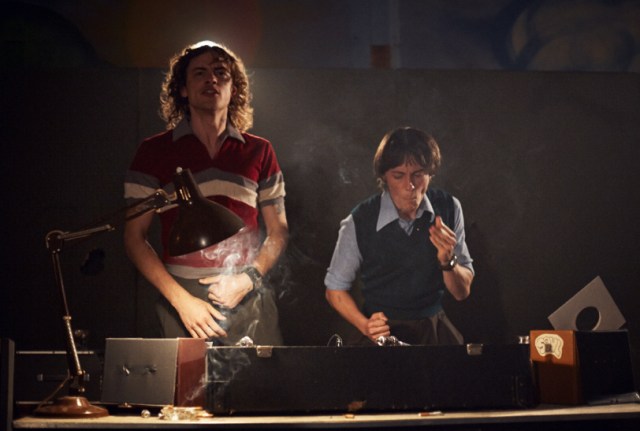
Elliot James Langridge plays an anti-social schoolboy whose parents (Lisa Stansfield and Christian McKay) nag him into attending an after school youth club. He doesn’t necessarily fit in there, either. But the music by local DJ Ray (James Lance) puts him in a trance. He dances by himself.

And when he later meets fellow enthusiast Matt (Josh Whitehouse), John finds his entre to “cool” (Matt gives him a fashion makeover) and deep fandom. It’s all about haunting record stores and street bazaars, hunting for soul that nobody else has heard.

That’s their ticket for doing their own DJing. The goal? To fly to America together to REALLY dig into obscure soul music at its source.

John fancies the cute slightly older nurse (Antonia Thomas) he sees on the bus each day. What he doesn’t fancy is the oppressive school and his tuned-out teacher (Steve Coogan, of “24 Hour Party People”).

And what Matt fancies are the drugs that he listens to the music to.

soul2

The rest of the movie is about their unequal partnership and its shifting dynamics, their rise to DJing paid dances, their growing circle of drug-abusing pals, and their fall.

The performances are energetic but downcast. The dialect is as unfathomable as the music, although I did catch Frankie Valli’s name in the introduction of a song. Edwin Starr to Leo Sayer, Shirley Ellis to The Velvets, the soundtrack (what you can make out of it) ties the film to this generation’s obsession, not unlike the earlier Beatles/Stones generation Brits brought to its deep dive into The Blues.

Whatever its virtues (Tattoos were NOT on every torso back then, especially in the Midlands), one can’t take much more from “Northern Soul” than a moving snapshot, a color scheme. Because “Soul” is the big thing lacking in Elaine Constantine’s one and only shot at making a feature film.

1half-star

MPAA Rating: R for drug use, language throughout and brief sexuality

Cast:Elliot James Langridge, Josh Whitehouse, Antonia Thomas, James Lance, Christian McKay and Steve Coogan.

Credits Written and directed by Elaine Constantine: A Freestyle release.

Running time: 1:42

Posted in Reviews, previews, profiles and movie news | Comments Off on Movie Review: “Northern Soul” is tone deaf

Bingeworthy? Blanchett leads us to the “conservative revolution” as Phyllis Schlafly, “Mrs. America”

You look at the episode list and you think to yourself, “Do I really want to spend nine hours digging into ten years of the political life of anti-Equal Rights Amendment crusader Phyllis Schlafly?”

It’s a valid question. In this, the golden age of bingeable short-term series TV, every narrative idea is stretched to the point of breaking to lure the viewer in, hook you and drag the damned thing out into eternity as it slowly ambles from point A to point B.

But “Mrs. America” (April 15, on Hulu) is, for the most part, worth the short-made-long journey of Schlafly’s life and her key role in the rise of Reagan and the end of the FDR/Kennedy age of progressivism, social progress and long march toward gender, race and income equality.

The first episode, introducing us to “Phyllis,” her allies and foes, sets the series up beautifully. And the finale, “Reagan,” is strong enough to be a stand-alone film all its own.

Credit the casting, sharp dialogue and an insightful script that picks up on both Schlafly’s methods and the fundamental hypocrisy (and blunt dishonesty) of her stance, as well as the back-biting bitchiness that doomed “libber” enemies.

Cate Blanchett gives us the shrewd, smiling, June Cleaver-with-a-switchblade persona that made Schlafly famous — “talking points” (often exaggerations, sometimes flat-out lies) hammered home on every “Phil Donahue Show” appearance. And we see her struggle to hide the disappointment or bitter fury whenever powerful men (Barry Goldwater among them) she is lobbying take her self-owning use of “we homemakers” literally, and ask her to take notes for their meeting.

Just like the second-class citizen status that she made her cause.

We see the idea of fighting the ERA handed to her by a friend (Sarah Paulson), watch her run with this into the spotlight, writing a newsletter and holding her coveted “mailing list” of committed conservatives close to her as everybody from womanizing Congressman Phil Crane (James Marsden) to Ronald Reagan himself leans on her to share it.

In a pre-Fox News/Rush Limbaugh era, TV news was expected to be impartial, but conservatives used the “Fairness Doctrine” to demand equal time to contest the facts of any debate via opinion. Of course, when they took control of Washington, they killed the Fairness Doctrine so that Limbaugh and Hannity et al and the stations that carried their programming wouldn’t face the same “give the other side equal time” requirements that they’d gamed.

Then there’s the infighting between the various factions of “feminism” as it was known in the 1970s — with pioneer Betty Friedan (Tracy Ullman) bitterly sniping at Ms. Magazine “cover-girl” Gloria Steinem (Rose Byrne), and Congresswomen Bella Abzug (Margot Martindale, dialing down the drawl to play New York Jewish) and Shirley Chisholm (Uzo Abuba, who has no trace of Chisholm’s distinctive lisp) unable to keep the peace.

Schlafly mobilized after the ERA passed in Congress with the idea that “It’s not too late to stop it.” She and her team fought the battle, one state legislature ratification vote at a time.

The feminists are slow to pick up on how “the men finally found the perfect smokescreen for their chauvinism — women.” Declining to debate Schlafly, they let her spread her fear — often via deliberate misreadings of the amendment — and hers became the only version widely disseminated.

It’s a fascinating political history that creator Davhi Waller and her team take us into, built on the idea that just enough women could be radicalized and mobilized to fight against women’s rights to amplify the voices of extremism. And once in power, the Reagan/Jesse Helms/Jerry Falwell and Co. (a very young Paul Manafort is glimpsed, at one point) carve the “culture wars” lines out in stone, leading to smearing of liberal ideals, destruction of unions, rapid income inequality and the manufactured “fears” of a vast, unrestrained and over-financed right wing hype machine.

And Blanchett makes the heroic villainness of the piece something you least expect her to be — a self-martyred victim, an ambitious and cunning Lady Macbeth without the self-reflection to see her advocacy as hypocrisy at its most naked, but smart enough to see how small she really is after a decade of gnawing her own and her gender’s legs off.

3stars2

MPAA Rating: TV-MA, profanity

Cast: Cate Blanchett, Rose Byrne, Margot Martindale, John Slattery, James Marsden, Tracy Ullman

Credits: Created by Davhi Waller. An FX/Hulu series

Running time: 9 episodes @ 1 hour each.

Posted in Reviews, previews, profiles and movie news | Comments Off on Bingeworthy? Blanchett leads us to the “conservative revolution” as Phyllis Schlafly, “Mrs. America”

Netflixable? “Coffee & Kareem” is an alltime “Netflix Original” low

coff1

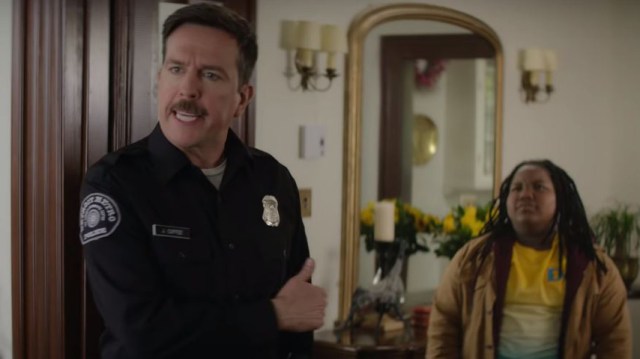
Even Ed Helms might cringe if the coarse, predictably dumb and absurdly violent Netflix action comedy “Coffee & Kareem” gives him some sort of comeback.

Then again, forcing him, Taraji P. Henson and the rest of the cast to repeat themselves, making fresh versions of this repellent farce, might be the perfect punishment that fits the crime.

Because that’s what this ugly, irritating, blood-spattered wallow is. It’s not supposed to be for kids, but pairing up Ed with an over-the-top foul-mouthed tween (Terrence Little Gardenhigh) suggests it is.

Backhanded slaps at Detroit, dirty cops, idiotically-indulgent single-mom parenting, a statement on “the death of childhood, as we know it?” That’s all pretty much out in the open.

There are a couple of laughs, generally not from the leads. And the gory mayhem, from “accidental” executions at the end of a torture session to what a grenade does to a human body, is played for giggles, too.

I had to double-check the credits. Screenwriting newcomer Shane Mack did it, not ultra-violent action comedy specialist Shane Black (“Kiss Kiss, Bang Bang”). The guy who directed “Stuber” was behind the camera. Yeah, that’s obvious.

But Problem One is young Mr. Gardenhigh (of TV’s “Henry Danger” and “Danger Force”), more specifically his character. If there has ever been a more charmless, grating, obnoxious “hero” at the center of an action comedy, I can’t think of him.

I can’t quote Kareem, because every word out of his mouth is raw-dog ugly, every thought is fifth grade sexual (he raps an R-rated come-on to his teacher for his class poetry assignment). He blackmails hall monitors and throws threats around like a streetwise gang banger, when in truth he’s just a spoiled mama’s boy.

His mom (Henson) shows no sign of ever so much as trying to curb his behavior. She’s a nurse, dating a cop named Coffee (Helms), and tries to throw the two of them together to bond.

The plump, dreadlocked punk uses that as an excuse to hire a murderous drug dealer (RonReaco Lee) who just escaped from the cops to kill his mom’s cop boyfriend.

He’ll pay for the his eith his pocket change.

I guess it’s funny that, you know, the cop who let Orlando (Lee) escape was Officer Coffee, who has been demoted and bullied by the TV-friendly detective (Betty Gilpin) who caught the guy. Of at least it’s SUPPOSED to be funny.

That near-hiring of a hitman goes wrong, a dirty cop is murdered and Coffee & Kareem are on the run, trying to prevent the bad guys from silencing them or getting to Kareem’s mom, trying to dodge the law (David Alan Grier has the thankless/laughless job of playing Coffee’s boss) which assumes Coffee is the cop killer, and a child kidnapper.

Yes, pedophilia accusations from the kid are a running gag here.

Helms plays another variation on his grinning nebbish, here, a loser who describes himself to Kareem as “like a bruised fruit — a little blemished, but still delicious.”

If Krass Kareem could stop screaming profanities to hear that, he’d have certainly made much of the word “fruit.”

Because it’s that kind of comedy, “Bad Lieutenant” jokes, killers-in-training cracking up about “practicing my lines for when I’m fixin’ to kill somebody,” “child soldier– brainwashing” gags.

Political correctness is gone before the opening credits are over. And it’s not as though some of this might have worked, but everybody in it is just maddening to spend time with.

Henson can blow a fuse with the best of them, and having her kid call her “six Halle Berry movies mad” at them is kind of amusing. Her telling the trying-to-be-hip-to-the-Black-experience Coffee to “Stop watching BET” is almost funny. But there’s no getting around that she’s playing a shrill, parenthood-challenged stereotype.

Helms is mostly a walking sight gag, a punching bag here. And as for the kid, I’m in agreement with the cop who, on meeting Kareem, suggests a “six hundred week abortion” is in order.

But Gilpin, star of “The Hunt,” playing a short-tempered tyrant, gets every truly funny line and makes every line-reading sing. She’s not just fighting the cocaine trade, she tells a TV reporter, she’s “protecting the tiny nostrils of Detroit.”

Her instructions to her cops before a raid are “Let’s keep this quiet. Don’t SHOOT anybody. We don’t want this s— on Youtube!”

She empties out a strip club (where Coffee has taken Kareem) with a shout, “Go HOME. WORK on your MARRIAGES!”

I could see a “funny mean cop” series built out of her and this character.

She’s the redeeming quality of “Coffee & Kareem,” the sugar that masks (a teensy bit) how distasteful the whole affair is.

But an old rule of movie reviewing holds truer than ever with this one. Never expect anything out of a film with an awful pun as its title.

1star6

MPAA Rating: TV-MA, bloody violence, sex, profanity and drugs

Cast: Ed Helms, Terrence Little Gardenhigh, Taraji P. Henson, Betty Gilpin, RonReaco Lee and David Alan Grier.

Credits: Directed by Michael Douse, script by Shane Mack. A Netflix Original.

Running time: 1:28

Posted in Reviews, previews, profiles and movie news | Comments Off on Netflixable? “Coffee & Kareem” is an alltime “Netflix Original” low

Documentary Review: Veterans are each other’s therapy running “Comfort Farms”

Just outside of Milledgeville, Georgia there’s an organic produce and livestock “eat local” farm run by a collective of combat veterans as a form of self-help therapy, a way of easing them back into civilian life by re-purposing their war zone mind-set.

The product of their labor is farm-to-table “good food,” and the byproduct is healing trauma through a community of people just like them.

“Comfort Farms” is the name of the non-profit, taking its name from a fallen comrade. It’s also the title of a documentary about its work. Filmmaker Carlisle Kellam talks to founder Jon Jackson and other veterans there about their work, their former lives in combat zones and their efforts to “give something” to their community, while taking charge of their own drug-free, therapy-free (or post-therapy) mental health treatment.

Kellam uses interviews, archival combat footage, TV news features and segments from a talk Jackson gives to veterans’ groups, community organizations and schools, papering the film with quotations from veterans, writers like G.K. Chesterton and others about war, the nature of being a survivor of such trauma and the like.

But the big juxtaposition of the film is pairing up all this material about the soldiers with livestock slaughter, which they go to great pains to describe in ritualistic terms.

They butcher the pigs, chickens, cattle, ducks and bunnies “in a spiritual, respectful manner.” They speak about what that process — grim, even to somebody who’s had to pull the trigger for a living — and what it costs them. But there’s little evidence of that, or none shown on camera.

To a one, they’re very in-your-face about this to the film’s viewers, and to the patrons of the farm, who gather for parties, cook-outs and butchering rituals — laying hands on the animals, “make them trust you,” trying to ease the end of their lives, their “sacrifice” for our “good eating.”

You don’t like to see this? That’s “cowardly.” So “eat more vegetables.”

There’s more going on here, with men who have lived through bloody injuries and watching friends die, coping via what they acknowledge is “never an easy thing,” taking an animal’s life with a gun, knife or hatchet.

Kellam, by limiting his film to “in their own words,” reinforces the self-help ethos that Jackson and his fellow vets preach. Having veterans talk about “misconceptions about veterans,” about the flawed tendency of the public and the media to lump them all into a group, lauded and fund-raised for as “an object of pity” or “an object of worship” (Hellooooo Toby Keith.) is unusual and enlightening.

But its narrow “in veterans’ own words” focus allows the film to avoid the big psychological questions about the personailty types that join the “all volunteer military” and what people who have been in combat really get out of spilling all this blood once they come home.

They’re not wrong in that “locally grown” and “if you can’t kill it, maybe you shouldn’t eat it” thinking. But “Comfort Farms” leaves a lot skirted, unspoken and seriously-under-analyzed.

Not everybody in this post-VFW era club served in combat. And while every person and situation is unique, there are psychological profiles that would be helpful to consider, explanations that those too close to the situation have a hard time articulating.

They’re doing good, both for themselves and for their community. And anything that breaks the patterns of “troubled” combat survivors — suicides, domestic violence, joining motorcycle gangs and the like — is to be celebrated.

But personally, I could use a little of that analysis and a lot fewer too-quick-to-register quotations, and maybe fewer of the somewhat random insertions of graphic animal slaughter in all this talk of healing.

Thank you for your service. Now let’s hear what it “typically” does to someone who makes that sacrifice, or who “enjoys” the “good action” and adrenaline rush of combat (several say so) and signs up for repeated tours.

And what’s really going on that makes them want to come home to kill cows, bleed-out pigs and chop the heads off ducks?

2half-star6

MPAA Rating: Unrated, combat violence, graphic scenes of livestock slaughter and butchery

Credits: Written and directed by Carlisle Kellam.

Running time: 1:16

Posted in Reviews, previews, profiles and movie news | Comments Off on Documentary Review: Veterans are each other’s therapy running “Comfort Farms”

Netflixable? Holly Hunter shows a little rust in “Strange Weather”

You could never blame Holly Hunter for not working as much as we’d like.

She could pick a series, here and there, voice Elastigirl in two “Incredibles” movies, show up in tiny but sparkling supporting turns in “The Big Sick” and take a swing at the odd indie drama with promise (“Manglehorn”).

But the glory of her Oscar-winning years, when she was the dazzling muse of James Brooks (“Broadcast News”), the Coens (“Raising Arizona,””O Brother Where Art Thou”), Jane Campion (“The Piano”) and playwright Beth Henley (“Miss Firecracker”) was always going to prove impossible to cling to.

The writing set a high standard, the parts were meatier and the novelty of her rarely-hidden drawl made her work stand out, aside from the fact she was doing the most translucent, beatific acting of the ’80s and 90s. Aging is always tougher on an actress’s career, but in her case working less pointed to a Hollywood and indie cinema that just wasn’t getting the job done in terms of screenwriting.

Like late-career Bette Davis, her career tells us she’s a woman out of her time.

“Strange Weather” has the feel of a vintage Hunter vehicle — a quirky Southern story, a hint of Southern Gothic in the tragedy hanging over it, an intelligent, desirable character pushing 60, a woman still impulsive, temperamental and testy.

But writer-director Katherine Dieckmann lets her down. And every so often, Hunter lets Dieckmann down — showing little of the flash of her best work, out-acted in a couple of scenes, unable to animate recycled cliches, nothing special in an utterly generic, obvious and blase road trip dramedy.

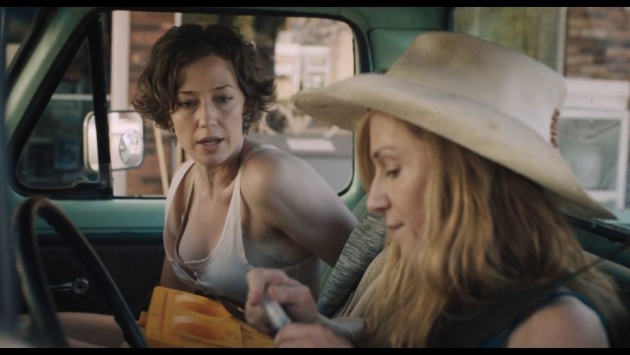
She plays Darcy Walker, an admissions clerk at a tiny Georgia college in her hometown, no college degree but smarter than that, rail thin and overly fond of her duct-taped-together Ford pickup and cowgirl hat, cigarettes and drinking alone.

Carrie Coon positively glows as her best friend and cross-the-street neighbor, a co-conspirator in their late-night gardening binges, probably “an actual lesbian (living with a colleague), but maybe just dabbling.”

Kim Coates of TV’s “Sons of Anarchy” and “Bad Blood” is the bar owner with whom Darcy has had an on-again, off-again fling that’s lasted for years. But she keeps him at arm’s length.

Darcy’s not overly-concerned that layoffs are coming at GPU, sort of adrift and without purpose. Then a chance encounter with a guy (Turner Crumbley) she knew as a kid rattles her. We learn Darcy had a son. He’s dead. And a college classmate has gotten rich down in New Orleans running a make-your-own-hot-dog franchise that sounds like her late son’s college business class pitch.

There’s nothing for it but to start digging around in the past she has avoided grappling with, asking questions about son Walker’s last days of those who knew him — stoners, roomies, pals.

There’s nothing for it but taking a little road trip down to the Big Easy to confront the scoundrel.

strange1

Darcy meets up with young men from her son’s past, and an old man from her own. Glenne Headly, whose career was hemmed in much the way Hunter’s has been, plays an old drinking buddy.

It took Dieckmann five years to pull together the financing for this indie, filmed mostly in small town Mississippi. Imitation Faulkner and Beth Henley is a harder sell than telling a story about women of a certain age.

Her film is a predictable rehash of road picture cliches — any excuse to take “backroads” — and imitation Faulkner Southernisms, with lines about having to “yield to your indomitable will” and “You do know it’s my job to protect you from you?” and that trite Southern literary trope about how a chance encounter or coincidence means the dead are “calling to me” give away the writer-director’s game.

Her son’s “issues” with his mama similarly feel small when freighted with so much import.

“He wanted things to be normal!”

“NORMAL is over-RATED!”

Hunter does what she can with these lines, and the character. Coon gets the picture’s big speeches and best moments. And none of it, including the “dramatic” climax, amounts to a hill of beans, as we say down here. Beans we’ve seen and cooked too many times to count, beans we’ve been served too often to find anything novel or tasty in them.

1half-star

MPAA Rating: R for a scene of sexuality

Cast: Holly Hunter, Carrie Coon, Kim Coates, Glenne Headly and Turner Crumbley

Credits: Written and directed by Katherine Dieckmann. A Netflix release.

Running time: 1:32

Posted in Reviews, previews, profiles and movie news | Comments Off on Netflixable? Holly Hunter shows a little rust in “Strange Weather”

Netflixable: A combat thriller in drag, “Rogue Warfare”

Rare is the combat film that’s as awful, and instantly-so, as “Rogue Warfare,” a thriller as inept as its clunky title.

It begins with a poorly-accented diatribe by the Supreme Leader (Essam Ferris) of a new terror cell called “The Black Mask.”

But Supreme Leader’s mask looks like last season’s sale at Victoria’s Secret. It’s a damned veil, and his whole getup is borderline hijab — feminine. When you’ve wrapped your villain in ninja black with a veil, it’s all downhill from there. And having him go on and on and on about “Your world despises us” to a video camera, asking rhetorical questions (again, in English) about “What pushes my meter?”

Give the guy a lisp and this could be a pre-“woke” comedy.

His followers raid a village, take prisoner the one villager who shoots several of their number, and pointlessly gives him the “You’re either with me or against me” speech, when he knows and we know and the victim knows he’s just going to shoot him and his entire family.

Veteran heavy Stephen Lang makes a car payment for showing up to pen a letter and narrate it in interior monologue (Didn’t even have to memorize lines!) as the president launching Project Rogue.

The script has Trumpian alliance-with-our-enemies overtones, as it includes China and Russia in this international commando team sent to hunt Black Mask and Diana Ross and the Supremes Leader.

The firefights feature digital blood bursts, the dialogue is leftover from 432 previous combat pictures — EVERY guy ever shot in action is told “Look at me! STAY with ME!” — and there’s Chris Mulkey, another veteran heavy, wearing three stars and sending this crack corps into combat.

Some of these dudes don’t appear to have ever held a firearm, and can’t fake it convincingly even when they know the camera is on them.

It’s rubbish, start to finish. And bless their hearts, I see they’ve got a sequel in the works.

star

MPAA Rating: R for strong violence and language throughout

Cast: Will Yun Lee, Jermaine Love, Katie Keene, Essam Ferris, Rory Markham, Fernando Chien, Stephen Lang and Chris Mulkey

Credits: Written and directed by Mike Gunther.  A Saban Films/Netflix release.

Running time: 1:43

Posted in Reviews, previews, profiles and movie news | Comments Off on Netflixable: A combat thriller in drag, “Rogue Warfare”

Bingeworthy? Amazon’s serene, slow “Tales From the Loop”

How far will you go into a series, limited or otherwise, before committing to it, heart, soul and investment in time?

Because pandemic or not, storytelling in the “Binge TV” era has a couple of common traits that a savvy viewer makes before punching in Hulu, Amazon, Netflix, Topic, etc.

The pace of storytelling is geologically slow. Series creators have become quite profligate with the viewers’ time. And hand-in-glove with that glacial pacing is a “less is more” sort of storytelling that resists the urge to put a lot of action or incidents into each episode, or to get to the point with any sense of urgency.

“Tales from the Loop,” a new series from the fellow behind “Legion,” was  inspired by paintings by Swedish artist Simon Stålenhag, dated looking slice-of-life images that showed kids playing in the ruins of an alt-history ’80s sci-fi dystopia — derelict robots, abandoned spacecraft or hi-tech labs.

It plays like a TV series inspired by paintings. Striking to look at — pretty. Static. Austere. Slow.

Creator Nathaniel Halpern (“Outcast” and “Resurrection” are his other pertinent credits) is reaching for that mystery that the audience will latch onto more than characters we connect with and who bring us back.

“Loop,” basically eight stand-alone sci-fi “tales” set in an Ohio town, circa 1979, is about a place where life is impacted by an underground “loop” — think CERN, particle colliders or some such.

The director of MOEP — the Mercer Ohio Experimental Physics lab — is Russ (Jonathan Pryce), who pitches their work and its impact on this place as creating things we know to be impossible, “and yet, there they are.” He repeats that claim to his grandson (Duncan Joiner). We don’t have to hear discussions of time travel, multiverses and the like to feel or speculate that this is what he’s talking about. Science fiction?

“I prove its possible.”

Thus, episodes tamper with mortality, revisiting your younger self via some magical fluke of “The Eclipse,” a huge ball-gadget buried within the confines of the vast underground complex.

We sense little urgency in any of these stories, nothing particularly sinister either. Only the atl-tech ’80s weirdness of “The Loop” connects it to “Stranger Things,” “Black Mirror” or the granddaddy of weird-for-weird’s-sake TV, “Twin Peaks.”

Yes, there might be a mystery to be solved, and it’s to do with this place and the work that that makes a little girl’s mother (and her house) disappear. Or was it ever there at all?

What’s with that mechanical hand Cole’s father (Paul Schneider) sports?

What does Russ’s daughter (Rebecca Hall) know about what’s going on, what’s to come and how is she able to figure out what’s up with the girl and the missing mom in a flash?

And did they really cast the great Jane Alexander, fly her to Winnipeg and give her nothing more than breakfast, babysitting and gardening scenes (with almost no dialogue)?

All of which circles me back around to that fundamental question, is it worth the eight hours it’ll take to binge this beast into submission?

Taking into account different strokes for different folks, I know that SOME people got more out of “Little Fires,” SOME are still chewing on “Ozark” (1.5 seasons for me, enough), and some head-cases are still investing in “Walking Dead,” etc.

I love the genre, and if I was looking for a theatrical film analog to “Tales from the Loop,” it would be “Another Earth,” a chill, austere and faintly creepy feature starring indie darling Brit Marling.

Did you see it? Think that would be worth eight hours of your viewing life? There you go.

2stars1

Cast: Rebecca Hall, Jonathan Pryce. Jane Alexander, Paul Schneider

Credits: Created by Nathaniel Halpern, episodes directed by Jodie Foster, Andrew Stanton, So Yong Kim, Ti West, Mark Romanek, with Matt Reeves (“Cloverfield”) amoong the producers. etc.

Running time: 8 episodes @50 minutes each.

Posted in Reviews, previews, profiles and movie news | 1 Comment

Movie Preview: Yet another horror tale titled “The Haunted”

A winsome young caregiver, a spooky old house.

What might be afoot in this May 22 release?

Posted in Reviews, previews, profiles and movie news | Comments Off on Movie Preview: Yet another horror tale titled “The Haunted”