Movie Review: “22 Bullets,” and why I just love that Jean Reno

bullets2

For a fan, there’s nothing more delightful than stumbling across an action title — or a comedy, a romance, whatever — that you’ve missed starring the French monument to modern cinema, Jean Reno.

Because how many times can I re-watch “Ronin,” “The Professional,” “Cold Blood” or that serene, obscure jewel, “The Big Blue?”

He’s the French Chow Yun Fat, Denzel or Costner — laconic, steely, vulpine. And the fact that he can play comedy with skill, too, makes him a very rare bird indeed.

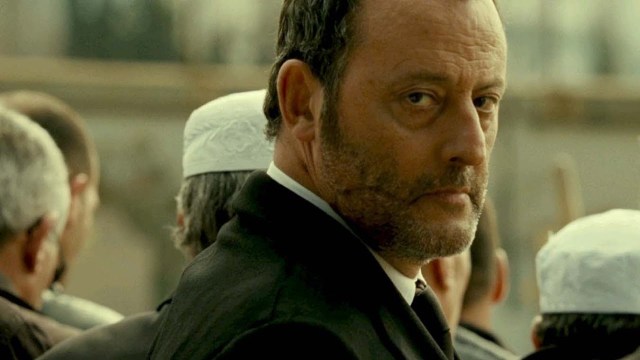
A vulture, judging from those eyes, that profile.

“22 Bullets” came out in France and Europe in 2010, made it to video in North America in 2013, and is a sturdy enough vengeance thriller — a straight-up genre piece with a lot of blood, a few passable shootouts, a half-decent chase, a few whiz-bang editing exercises jazzing up simple dialogue scenes, and one great speech.

Reading the credits, it’s no surprise that “dialogue” required extra hands. This bad guy making his mortal promise to the gang that tried to kill him (22 bullets worth) is a doozie, and I’m just going to quote it and let you imagine Reno biting off every word (in French, with English subtitles). He’s gotten the drop on the would-be assassins, whom he rightly accuses of breaking the rules, attempting “murder,” not “assassination.”

“Charly Mattei, and I’m here to kill you. Out in the open. It’s a matter of respect. I want you to know who kills you. Why you die.

“You don’t kill in a hood. That’s murder. You…you don’t sign the message!”

“I’m going to kill all of you, one after the other. But not right now. I want you to think about what you did, think about it day and night. Beg your wife and children for forgiveness, tell them why you’re gonna die.”

“And when you least expect it — tomorrow, in six months or a year, I’ll be there.”

“You’ll never be safe as long as I’m alive.”

Now that there is a threat, a blood oath to chill the marrow of the most hardened villain.

2half-star6

MPAA Rating: unrated, absurdly violent, drugs, sexual situation, smoking and profanity

Cast: Jean Reno, Marina Fois, Kad Merad and Richard Berry.

Credits: Directed by Richard Berry, based on the novel by Franz-OlivierGiesbert, script by Richard Berry, Matthieu Delaporte, Alexandre de La Patellière and Eric Assous.  A Cinedigm/Roku release.

Running time: 1:57

Posted in Reviews, previews, profiles and movie news | Comments Off on Movie Review: “22 Bullets,” and why I just love that Jean Reno

Movie Review: Oh my (same-sex) darling “Clementine”

clem2

All right, settle down, settle down.

Don’t get your Tommy Johns (women’s, or men’s edition) in a titillated twist.

The come-on for “Clementine,” which could be “licentious young lesbians libidinously lead us on,” is just that, the old bait-and-switch. It’s a little more high-minded than softcore, even if it has the plot and payoff of nothing more than a turgid tease.

We meet Karen (Otmara Marrero) as she awakens to sweet nothings being whispered in her ear.

“You’re so young,” off-camera lover purrs. “You’re gonna break my heart!”

What do we call that, kids? PROJECTION. The unseen artist “D” summarily dumps poor, pretty young Karen, changes the locks and keeps their shared Lab beyond her reach.

Damn her, anyway. That’s what Karen figures. But she takes a lying “I’m at the lake house” voice mail seriously. Showing up with no one there, Karen breaks in and proceeds to do a little revenge house-sitting.

Nothing that destructive. But she’s going to use this place, kick back, snoop around (plenty of evidence of Ms. D’s prior and probably current conquests). Maybe have a row in the boat, sunbathe on the dock.

But there’s this damned teenager already parked there. “Lana” (Sydney Sweeney of TV’s “Sharp Objects” and “The Handmaid’s Tale”) says she’s 19 and doesn’t look it.

She says she has a dog, but Karen doesn’t believe it. And yet she drives Lana around, in the dark, while they look for “Bingo.”

BTW, “no one actually names their dog ‘Bingo,'” she grumps.

But there is a dog, and there’s something about this pushy teen, something in her “Why would I lie about that?” comebacks, her “I’m gonna be an ACTRESS” aspirations, piques Karen’s interest.

The much younger woman is seeing how it feels to be the “older” woman. We don’t see it, but we can guess that maybe she’s wincing in recognition of her own MO thrown back in her gorgeous face — young, beautiful and I know it, using my powers of attraction over an older woman.

Besides, Karen — who can’t be over 24 or so — likes being the sage. Who doesn’t?

“It’s funny how things matter so much when you’re young…You’re only old when you know what you want. And then you can’t get it.”

She even explains D’s paintings, which hang all over the house, in a dismissive way D herself must have used on her once.

“It’s more about the process than the result.”

How many quasi-talented hustlers with a brush used that one?

There’s sharing and flirtation, and then a handyman (Will Brittain of “Kong: Skull Island”) shows up, test the older woman’s patience and the younger one’s commitment to possibly experimenting with same sex sex.

clem1

Writer-director Lara Gallagher can be praised for avoiding the “gay porn cliches” this story could have devolved into. But she shoots for a thriller tone with this, and beat that notion into Katy Jarzebowsk, who did the “tenterhooks” thriller score.

Right.

The players are more poker-faced than alluring and mysterious. Backing away from the titillation at that late stage seems a cheat. Maybe Karen’s older and wiser, but brazen Lana seems a bit of a bust as a vamp.

There are mysteries, dramatic confrontations, and there’s even that old cliche, Chekhov’s “pistol” present in the first act which the rules say, must play a role in the third act.

If you read enough into “Clementine,” you can almost talk yourself into thinking there’s more to it than there is. But if Oscilloscope Labs has it, they must have seen the same undercurrents I did.

And they knew there are tougher things in movie distribution than talking people into seeing a “thriller” with two lithe young lesbians at its heart.

2half-star6

MPAA Rating: unrated, sexual subject matter, alcohol and marijuana use.

Cast: Otmara Marrero, Sydney Sweeney, Will Brittain, Sonya Walger

Credits: Written and directed by Lara Gallagher. An Oscilloscope Labs release.

Running time: 1:30


Posted in Reviews, previews, profiles and movie news | Comments Off on Movie Review: Oh my (same-sex) darling “Clementine”

Netflixable? “The Legacy of the Bones” (“Legado en los huesos”), more witchy goings-on in Spain

bones5

Watching the Spanish thriller “The Legacy of the Bones” is a bit like having a conversation with an elderly relative.

Endless exhausting digressions, a phone book full of characters with speaking parts, scenes that merely underline what’s already been established all of which end with a shout of “Stay FOCUSED. Get back to the POINT.”

And of course that “point” is obvious as the opening scenes can make it.

A prologue establishes a persecuted minority in the North of Spain — the Cagot. If the Basque have a discriminated-against beef with Castilian domination, the Cagot have a legitimate grievance with blood all over it.

And to the historical record of discrimination (think “Gypsies,” outcasts, denied the right to live in town, etc.), this film — based on a Dolores Redondo novel — adds “persecuted for witchcraft.”

We see witch accusations and witch burnings in the early 17th century.

Cut to the present day, when churches are being desecrated wit human arm bones, murderers are dismembering (always an arm) their victims, and then killing themselves before they can be prosecuted.

“Tartalo,” they scribble on notes intended for the detective, Amaia Salazar (Marta Etura of “The Impossible” and “The Man with a Thousand Faces”).

“Tartalo.”

Someone, some group of some thing is hellbent on settling old scores with the Holy Church, the government and this detective, who grew up in this Pamplona-to-San Sebastian region, and is invoking the name of a cyclops of Basque mythology.

Metaphor much?

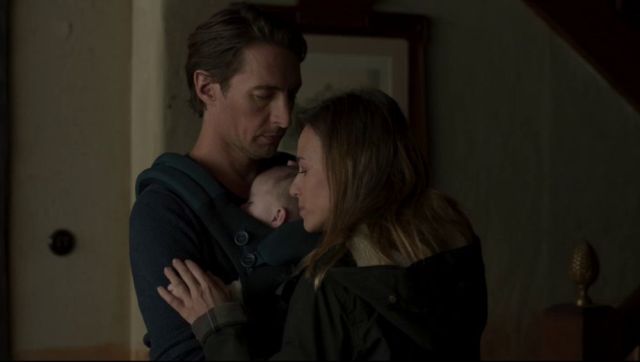
Det. Salazar is A) pregnant and B) has an old family name which ties her to the place and to the distant past. She has a mother in the hospital and a no-visible-means-of-support husband (Benn Northover) who becomes the primary caregiver after she has her baby.

Then there’s the aged Auntie (Itziar Aizpuru) who reads Tarot cards and has a bad feeling about this.

Yes, those are tidbits of FOREshadowing. You don’t introduce a baby and a possible madwoman into the mix if you’re not baking a Hansel & Gretel cake.

Salazar is lectured by her superiors to not “make too much fuss (in Spanish, with English subtitles — or dubbed into English) about this” because they “don’t want” these church desecrations, buried bodies, missing bones and references to an ugly past to “make the papers.”

Meanwhile, people keep getting cut up, or cut themselves up, leaving notes or messages to Salazar as they do.

“Tell her I’m glad she’s back! TARTALO!”

“Legacy,” titled “Legado en los huesos” in Spanish, is a frenetically languid movie. All these locations — murder scenes, churches, offices, prisons, hospitals, morgues, relatives’ homes, a near-Biblical flood — to dash to, lots and lots and LOTS of supporting characters who hissing “Tranquilo” (calm down, take it easy,,BE QUIET) to Salazar.

But she’s getting progressively and UNDERSTANDABLY more freaked out. Nightmares, allusions to her family’s history, DNA wrinkles, a hint of the supernatural and/or a death/dismembering cult, a newborn baby that her nagging do-nothing husband insists she stop, come home and nurse.

You know somebody or something’s gonna want that baby. You don’t have to read a single subtitle to “get” that.

Whatever he felt he owes the novel, director Fernando González Molina owed the viewers a heartless trimming of the script and thinning of the cast.

Movies like this invite me, and you, to do a rough cut re-edit in our heads. We know where it’s going, if not every single digression it’s going to take. Padding the picture with traveling scenes, conversations that don’t advance the plot, all this DOMESTIC stuff (sex scene included) — just means they’ve got around 75 minutes of a chasing witchcraft movie trapped in 121 minutes of Netflix streaming time.

1half-star

MPAA Rating: TV-MA, bloody violence, sex

Cast: Marta Etura, Leonardo Sbaraglia, Carlos Librado, Imanol Arias, Francesc Orella, Itziar Aizpuru and Benn Northover

Credits: Directed by Fernando González Molina, script by  Luiso Berdejo, based on the Dolores Redondo novel.  A Netflix Original.

Running time: 2:01

Posted in Reviews, previews, profiles and movie news | Comments Off on Netflixable? “The Legacy of the Bones” (“Legado en los huesos”), more witchy goings-on in Spain

Preview: Netflix’s “HOLLYWOOD” flips the script on “Scotty and the Secret History of Hollywood”

There’s little doubt who and what inspired Ryan Murphy’s new series “Hollywood” on Netflix. It was the scandalous book and doc and claims of “Scotty and the Secret History of Hollywood.”

The series is about what Murphy, of “Glee” and “Feud” and “American Horror Story” did with that. He looks for an alternate “Hollywood ending” to all the slow-to-change gender and racial discrimination that might have been different had Scotty and other closeted, “use the back entrance” and the like acceptance of the status quo people in and around show business had been upended by what was REALLY going on in Tinseltown during its Golden Age.

Interesting premise. Solid cast.

Looks promising. May 1 on Netflix.

Posted in Reviews, previews, profiles and movie news | Comments Off on Preview: Netflix’s “HOLLYWOOD” flips the script on “Scotty and the Secret History of Hollywood”

Movie Review: Chinese and in Japan? He’ll never fit in without “Complicity”

comp2

The human migrant experience has a universality that spans continents and cultures, that connects the poor Guatemalan fleeing violence and the Indian hoping to escape to opportunity.

Desperation, exploitation, the pull of assimilation battling the comfort and “safety” of hanging with your “own kind,” speaking your native language — you can find this is Little Haiti or Chinatown, barrios, meat processing plants or any restaurant you could name.

Even in Japan.

“Complicity,” the subtle, tense, touching and somewhat slow debut feature of writer-director Kei Chikaura looks at this story through the eyes of a young Chinese immigrant as imagined by a Japanese filmmaker.

It’s about cultures clashing, the desire for assimilation and “succeeding” in a new country that is straining against the pull of the past, the legal and moral barriers, stresses and pitfalls faced when someone this young and poor uproots his life to try and make it somewhere new.

Parking a Chinese illegal immigrant in one of the most infamously insular and racist cultures on Earth is a situation rife with strife, at least around the story’s edges. But Chikaura makes the main focus the heart-breaking and soul-crushing pressures facing Chen Liang (Yulai Lü), who left his ailing mother in the care of his grandmother and slipped into Japan to learn a new trade, “make a lot of money” and send for them back in Henan province.

The moment we meet him, we know how wrong this dream has gone. He’s caught up in a theft ring, stealing water heaters and the like from homes and businesses.

The cost of smuggling means he’s trapped, exploited by the very community one would expect to give him shelter and help. Watch “The Search for General Tso” or “Ghosts” documentaries to see how this can play out.

Chen Liang sees his trap, and in one last desperate act, he buys fake identification (and a new phone) to escape it. He will strike out on his own, scrape together a new life, escape his recent past and unsavory associations while still lying to his mother in their weekly chats about how well he is doing.

As Liu Pei, with a made-up past (he’s now from Beijing) and resume, he takes a job in a tiny noodle restaurant in suburban Ōishida. The gruff owner, Hiroshi (Tatsuya Fuji, a star since 1976’s “In the Realm of the Senses”) becomes a father figure to him as he introduces Liu to the world of soba noodles. His daughter (Kio Matsumoto) is the very picture of accommodating kindness.

And there’s this cute artist (Sayo Akasaka) his age whom he delivers noodle dishes to. She takes a shine to him — or rather the invented version of Liu.

But every time Liu Pei starts to immerse himself in mastering this corner of Japanese cuisine, every time he figures a “normal” life is within reach, his old life an old gang reach out for him.

Why can’t he join in on this “job?” I lost my flat, why can’t I stay with you? Why can’t we all smoke in this restaurant?

Chikaura has Liu Pei see the boorish and even criminal behavior of his “gang” through Japanese eyes. Every Japanese person he meets — even police– is unfailingly polite.

A key scene — Liu Pei screws up a delivery, having trouble finding his way (by delivery bicycle) in Ōishida. He must apologize to his mentor, the daughter insists. That becomes painful for everyone involved.

Liu Pei’s back-story, delivered in flashbacks, shows us just what he was fleeing in China — unpleasant life responsibilities, a slim chance of success and “freedom” to live his own life. Not exactly slave labor or civil war.

Chikaura passes along little judgments of Liu Pei and Chinese immigrants in general like this.

The director passes up the chance to take a more conventional route, immersing us in the painstaking and oh-so-Japanese way of making buckwheat noodles and the dishes they’re used with, to focus on all the strings tugging poor Chen Liang/Liu Pei in different directions, ensnared in this new name, new lie and illegal life he’s living.

Yulai Lü gives the character a poker-faced stoicism that fits his unwillingness to show weakness and emotion to his Japanese hosts.

Surprising turns here and there don’t wholly lift “Complicity” out of the realm of melodrama. But this intimate, personal and otherwise fresh take on the immigrant experience in a place that resists immigration like an island stuffed with Arizona sheriffs has rewards enough to keep us engaged in this kid’s story, start to finish.

2half-star6

MPAA Rating: unrated, smoking, profanity

Cast: Yulai Lü, Tatsuya Fuji, Sayo Akasaka, Kio Matsumoto

Credits: Written and directed by Kei Chikaura. A Film Movement Plus release.

Running time: 1:56

Posted in Reviews, previews, profiles and movie news | Comments Off on Movie Review: Chinese and in Japan? He’ll never fit in without “Complicity”

Netflixable? Can this sexist, bullying “Jefe” be saved?

jefe1

On this side of the Atlantic, we expect our comedies to at least pay some lip service to “woke.” Even the cringe-worthy ones.

So an “Office” comedy like “Jefe,” from Spain, should best be compared to say the BRITISH version of “The Office,” with Ricky Gervais, and not the more squishy, pathetic “Office” run by Michael Scott (Steve Carell). We feel sorry for that clueless jerk Michael Scott. We never, ever feel sorry for the loathsome David Brent.

Well, I didn’t, anyway.

Imagine that guy taken to tyrannical, drug-abusing, homophobic, sexist and physically-abusive extremes, name him César and make him Spanish, and that’s the boss in “Jefe,” a Spanish comedy that tests our tolerance in who we’re supposed to root for.

Because this puerco isn’t likeable, not for a second. Even showing the hell César (Luis Callejo of “The Fury of a Patient Man”) goes through just to make to the office on Monday doesn’t make him sympathetic.

He berates staff in the morning meeting. That balance sheet problem, the taxes suddenly due, the inspectors who will see the game is up just by glancing at their books? That’s worth an impulse firing, some homophobic put-downs as her literally “kicknny” (on the bottom) one guy out.

Because nothing is ever César’s fault. Snorting coke and knocking back Red Bulls, he figures he can browbeat/bully/tough his way through this debacle.

“I will not LEAVE THE OFFICE until this company’s safe!” he declares (in Spanish with English subtitles, or dubbed if you prefer).

He’s so unpleasant that it’s no wonder that his wife hires somebody to tell him she’s kicking him out of the house. Not a lawyer, either. It’s a somewhat effeminate “Bad News Messenger” (Adam Jezierski, funny) who shows up with that bad news, and with talking points for César’s inevitable push-back.

She’s demanding alimony, the house and custody of their son, and that’s that.

Conversely, when he gets César’s fiery reply, Charly the Messanger has to deliver HIS bad news to her. And César is very particular about how his counter-offer comes off.

“Say it like a man! Make her CRY!”

That’s the first funny scene in the movie. There aren’t many that follow.

He ran his business into the ground by firing anybody who told him “the truth,” keeping only yes-women and “ass-kissers.”

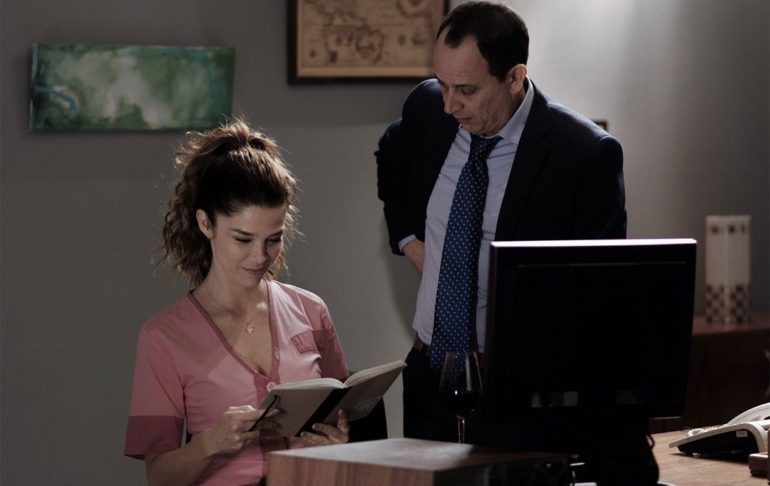
But spending all night, every night in the office for this torturous week, he finds consolation. He hides from Ariana (Juana Acosta) when he first sees her (he’s not dressed). And she puts on a show — calling home to Colombia on the company phone, rummaging through everyone’s desk drawers, vacuuming in the buff.

And using his shower.

jefe2

Callejo, Acosta, director Sergio Barrejón and screenwriter Natxo López wring a few laughs out of this dated male wish-fulfillment fantasy portion of the picture.

But office intrigues eat up most of the third act, and as there’s no way a Western audience (except for a terribly sexist one) is rooting for this pene, that’s kind of a shame.

A story arc suggested by Ariana’s line, “Imagine your problems if you were a woman,” isn’t developed. There’s no “growth” here. Summoning César to a secret meeting in the third act shows him just as awful as he’s been since the first act.

“You’ll need a roofie if you intend to rape me…Hey, I respect WOMEN. Pretty, fat, ugly, old, lesbians…”

It’ll take funnier lines, funnier scenes and a funnier lead performance to make this guy amusingly loathsome, or even amusing.

2stars1

MPAA Rating: TV-MA, nudity, sex, slurs, profanity

Cast: Luis Callejo, Juana Acosta, Carlo D’Ursi, Josean Bengoetxea, Maika Barroso, Bárbara Santa-Cruz

Credits: Directed by Sergio Barrejón, script by Natxo López. A Neflix Original.

Running time: 1:29

Posted in Reviews, previews, profiles and movie news | Comments Off on Netflixable? Can this sexist, bullying “Jefe” be saved?

Classic Film Review: Caron and kids treat Cary Grant as “Father Goose”

goose7

Cary Grant was 60 years old, grey and most comfortably cast in grumpy curmudgeon roles by the time the 1964 comedy “Father Goose” was tailor-made for him.

But watch him nimbly scamper down beaches, over branches and around coconuts, through whatever set this undemanding but adorable kid-friendly comedy parks him on. The dude was still fit, still leading man material.

Focus on his every facial expression — not just in close-ups, reacting to whatever outrage spoiled schoolgirls and their “teacher” (Leslie Caron) — perpetrate upon this dipsomaniacal loner, marooned with them on a deserted isle in 1942.

Check out amped-up outrage acting opposite a radio-contact-only, deliciously droll Trevor Howard as the Royal Navy officer who drafted/hoodwinked Grant’s cruising vagabond Walter into becoming a coast watcher for the Allies.

Grant shared scenes with children, and by God he didn’t let them steal’em, the little imps. Every line-reading — and we’re not talking Shakespeare here — is Cary Grant perfect.

“Let me tell you…I am not a father figure. I am not a brother figure or an uncle figure or a cousin figure. In fact, the only figure I intend being is a total stranger figure.”

I hadn’t seen this thing since childhood, catching it on “NBC’s Saturday Night at the Movies,” probably, with my parents.

Clocking in at two hours, it asks a lot of indulgence from the viewer — even taking into account the WWII “action comedy” genre this sits within. Still, the laughs are here — sight gags, Grant double-takes, kiddie hijinks.

It’s nobody’s idea of a masterpiece, but it’s Classic Cary. And if I want to add a piece of the puzzle to my lifelong love of boats — living on them, sailing them, stocking them with gin and rum and tonic and books — this movie was part of the sales pitch.

I dare say Walter Eckland’s previous boat had sails.

2half-star6

MPAA Rating: “Approved,” the G-rating of its day

Cast: Cary Grant, Leslie Caron, Trevor Howard

Credits: Directed by Ralph Nelson, script by Peter Stone and Frank Tarloff A Universal release.

Running time: 1:58

Posted in Reviews, previews, profiles and movie news | Comments Off on Classic Film Review: Caron and kids treat Cary Grant as “Father Goose”

Movie Preview: ’80s Nostalgia, served up squishy and Disney-friendly in a “Valley Girl” remake

Just listen to this one without watching it. The insipid remakes of ’80s pop classics tells you all you need to know.

Orion Pictures made this May 8 remake.

Alicia Silverstone is the nostalgic mom of a teen. Jessica Rothe, who turns 33 at the end of May, plays Alicia’s character’s Valley Girl younger self.

Oy.

Posted in Reviews, previews, profiles and movie news | Comments Off on Movie Preview: ’80s Nostalgia, served up squishy and Disney-friendly in a “Valley Girl” remake

Netflixable? Brit Gangsters miss Guy Ritchie in “Once Upon a Time in London”

london1

Oozing with atmosphere and dripping with violence, “Once Upon a Time in London” aims to deliver a 30 year history of the London Mob. Or Mobs.

Starting in the Great Depression, with Jewish mobsters brawling in the streets with British fascists, and running to the moment where London’s most famous gangsters — the much-documented monsters The Krays — took over, it’s basically the true story of all the thugs who inspired every Guy Ritchie gangster movie, and every other British gangster movie.

Mugs with colorful names like “Jack Spot,” Odd Legs, Bears Breath and Moishe Blueball, Electric Alfie, Elephant Dave and Billy the Yank ran rackets, bookmaking and robberies, scamming rationing during the war, and did shakedowns and extortion.

And you’d think a more colorful film could have been wrung out of this lot, and not the dry — save for the savagery and staggering amount of bloodshed — jerky drift through the decades that director Simon Rumley and British acting’s C-list deliver.

Jack “Spot” Comer (Terry Stone, who also had a hand in the script) was the Jewish head of a mob that took on Britain’s fascists, led by Sir Oswald Mosley, in the streets, which the film is more interested in talking about than showing.

Because unlike Hollywood’s treatments of gangsters in the World War II era, there’s no romanticizing this lot. WWII was just a smorgasbord of fresh opportunities.

“‘Ooo knew wartime would be so good f’business?” one crows, at one point.

Jack Spot is depicted as a raving egomaniac with a short temper and zero violent impulse control. He sets the tone for the picture and the milieu — gang wars largely settled with fists, bats, knives  and razors.

Because “only a mug would shoot someone. Because that’s the death penalty!”

They’re psychotics, but they’re not stupid. And they’re tough enough to deliver and suffer the blows, do time in hospitals and prisons, and wear the lifetime of scars such dirty work brought them.

Jack doesn’t mellow with age. As the years pass and the scars add up, he’s even more prone to delivers a beating, stabbing and slashing.

“I’M king o’the London UNDERWORLD!”

He says this a lot. Perhaps Mr. Stone added that to his portion of the script. But his performance is the heart of the picture and it is riveting in the most appalling ways.

Jack’s onetime underling and growing rival is Billy Hill, played by Leo Gregory of the lesser of the two movies about sailor Donald Crowhurst (also directed by Simon Rumley). Billy’s a smart aleck, more a lover than a brawler. He’s all over his Aggie (Hollie Earl) in the film’s early scenes.

Billy knows his place, pays whatever boss runs things in his territory his share. Until the days, several prison sentences later, when he doesn’t put up with that.

The script is more interested in chronology than cohesion. And with the thick, street accents, picking up on the story via dialogue is trickier (maybe watch it with closed captioning on) than simply following it from brutal fight and torture to “battles” and beatings that follow.

Rumley & Co. seem most intent on upping the violence ante from the various films about The Krays (Tom Hardy was in the most recent one, the Spandau Ballet Kemp brothers in another). They succeed in this.

But the movie’s very much a witless slog through dimly lit warehouses and pubs, the odd jazz guitar trio never lightening the mood, no gangster standing out for anything other than cruelty, bravado and toughness.

Netflix gave Martin Scorsese a blank check to make “The Irishman.” They couldn’t avail themselves of the exchange rate, pitch in with Signature (the producing studio) and get Ritchie, Matthew Vaughn or Paul McGuigan to do this justice?

2stars1

MPAA Rating: TV-MA, graphic violence, sex, more violence and profanity

Cast:Terry Stone, Leo Gregory, Hollie Earl, Josh Myers, Christopher Dunne and Shereen Guerlin Ball.

Credits: Directed by  Simon Rumley, script by Will Gilbey, Simon Rumley and Terry Stone.  A Signature release on Netflix.

Running time: 1:51

Posted in Reviews, previews, profiles and movie news | 1 Comment

Classic Film Review: Rosalind Chao, Chris Cooper, an East-meets-West Western, “Thousand Pieces of Gold”

gold3

Not many people saw “Thousand Pieces of Gold” when it hit theaters in 1991, although more saw it when it aired on the PBS indie cinema series “American Playhouse.”

It’s worth remembering and revisiting as an example of the ambition indie cinema once had. You couldn’t make a movie on your cell phone, with just actors and a sound mixer and a script. But you could make a Western on a shoestring, an original melodrama of scope and relevance — good enough to attract some of the best character actors working.

The regal Rosalind Chao took on a rare leading role for this period piece. TV’s “After M*A*S*H” was her biggest credit to date, “The Joy Luck Club” came a couple of years later.

She plays Lalu, a young shepherd in a nomadic family in the 1880s Mongolian steppes, “the North,” as people in China put it.  After three years with no rain, with their sheep dying off, her father abruptly sells her to a marriage broker.

Lalu is shipped off to America, where Chinese immigrants will pay a premium for a wife who isn’t one of the “white demons” who make up the majority of the U.S. dating pool.

Jimmy (Dennis Dun) is the sympathetic soul who buys Lalu, “who can’t even understand Cantonese,” at auction in San Francisco. “I am not your husband,” he tells a confused Lalu. Merely her escort to Oregon.

Leading his pack-train north, he starts teaching her the lingo and the wonders and ways of this new land.

“Learn English,” he lectures. “Start your own business. Carry a gun. Don’t let anyone push you around.”

But the man on the receiving end of this journey isn’t what she might have hoped. Hell, he isn’t even in “Oregon.” Hong King is “too OLD,” she whines, upon meeting him in Idaho. He (veteran character actor Michael Paul Chan) is a callous brute with certain expectations of her. And he is partners on a drinking establishment with hard-drinking Charlie (a very young future Oscar winner, Chris Cooper).

Hong King renames her  — “‘Polly’ is all the demons understand” for names, he grouses. “Forget about your family. You father SOLD you!”

But she cannot forget about them, or about Jimmy — who was kind and sweet. And she has a hard time ignoring/fending off the attentions of Charlie, who figures he’s just being sweet and all. He helps her with her English.

“Aye LEEV at de sah-LOON,” she learns. “No whore” is how she rejects the advances of the miners and other ruffians among the “white demons, ghosts” or “black demons” who give her the eye.

What follows is a romantic melodrama, a test of wills and a fish-out-of-water tale about adapting to a new world — one that has a long and difficult history of accepting “others,” especially Chinese.

Lalu’s odyssey has an easy familiarity about it, with just enough surprising twists included to keep it interesting.

Chao and Chan, Dun and Cooper make their characters compelling and complicated. The only caricatures are the bit parts surrounding them.

Director Nancy Kelly has yet to direct another feature, although she’s gotten a couple of documentaries made. She’s not quite early enough in the “Women Step Behind the Camera” story to be called a pioneer, not enough of a stylist to make us wince at a career smothered at birth.

Her great achievement here is in simulating 19th century Mongolia and the American West (basically the same location), putting flesh and blood people in those locales and telling a grounded story on a shoestring, making it look like an A-picture.

This newly restored IndieCollect is earning a virtual cinema re-release through BAM and The Gene Autry Museum and in select cities, a way to watch a good movie you almost certainly missed and support non-profit screening rooms.

It’s worth tracking down, especially if you’re a filmmaker just starting out with a cell-phone camera and a dream. You don’t HAVE to tell a story from the here and now, shot just down the street. If the script’s good, good actors will crawl over each other to help you tell an original, resonant story torn from history.

2half-star6

MPAA Rating: PG-13

Cast: Rosalind Chao, Chris Cooper, Dennis Dun, Michael Paul Chann

Credits: Directed by Nancy Kelly, script by Anne Makepeace, based on the novel by Ruthanne Lum McCunn. A Kino Lorber Virtual Cinema streaming release.

Running time: 1:45

Posted in Reviews, previews, profiles and movie news | Comments Off on Classic Film Review: Rosalind Chao, Chris Cooper, an East-meets-West Western, “Thousand Pieces of Gold”