Movie Review: Plague and witches meet in “The Reckoning”

The interminable horror period piece “The Reckoning” is a picture out of its time. It’s a Restoration plague, swirling amidst witch hunters, witch trials and positively Medieval punishments.

Let’s give Neil Marshall (“The Descent”) and his team the benefit of the doubt and call that “the point” of it all. A great infectious calamity like a contagion brings out the primitive in us all, or at least the most deplorable among us.

Abandon humanity and human progress — science, however primitive — for “witch finders” and superstition, mob rule and conspiracies.

Sound familiar, anti-vaxxers, “COVID is a hoax” folks? History is but a distant mirror.

But this movie, a gruesome, grim, grinding, and bumping and-grinding (got to have sex scenes) affair with period detail and anachronistic dialogue, is never less than a chore to get through.

In 1665, the time of “The Great Plague,” and English town is ravaged, but a farm family (Charlotte Kirk, Joe Anderson) is socially distancing and weathering it well enough. Still, there’s a baby on the way and crops to sell, so Joseph goes to town to sell it.

That’s where he runs afoul of a harlot (Emma Holzer) and his nefarious landlord, the Squire (Steven Waddington). One poisoned drink later and he’s showing symptoms.

And when he fears for his family back home, there’s nothing for it but the noose, leaving poor Grace to dig his grave in the rain and cut his body down and bury it.

The Squire’s master plan seems murky to us, but Grace can only imagine what it is he’s truly after, and what he’s willing to do — attempted seduction, accusations of witchcraft, the works — to achieve it.

“You’ll pay for this, harlot!”

That brings in Moorcroft (Sean Pertwee), the greatest “witch finder” of them all. England’s no longer Catholic, but here’s a British version of The Inquisition in one man, a veteran of trumped-up charges and burnings at the stake, someone Grace and everybody else is familiar with.

An interesting touch. Moorcraft keeps a burn victim who survived the stake (Margit Bárdos) in his employ, as a murderous bodyguard.

“Never doubt the virtue of our task!”

With such forces arrayed against her, what chance does Grace have? Might these visions of her dead husband and mother in her prison cell hold the key?

Is Satan available?

Everything director Marshall and his team do here seems designed to drag this out, from the ridiculous afterthought of numbering the days Grace is imprisoned with intertitles — Day 1, she’s locked up, Day 2, she’s whipped, Day 3, the Rack! — to the ruminations of the witch finder.

A habit of bad horror — if you’ve got a fetching leading lady, give her a few sexual moments. Consorting with the Devil, anyone?

The tale’s turn towards revenge is too tepid and comes entirely too late. The most creative killing involves minor supporting characters.

And the whole tedious affair makes one wish they’d gone to less trouble making a bad movie with tame villains, an uninteresting lead and confused (Was this recut to play up “the plague?”), scattered story.

All that lovely period detail gone to waste.

MPAA Rating: unrated, graphic violence, sex

Cast: Charlotte Kirk, Steven Waddington, Joe Anderson, Sean Pertwee, Emma Holzer, with Ian Whyte as The Devil.

Credits: Directed by Neil Marshall, script by Edward Evers-Sweindell, Charlotte Kirk and Neil Marshall. An RLJE/Shudder release.

Running time: 1:50

Posted in Reviews, previews, profiles and movie news | Comments Off on Movie Review: Plague and witches meet in “The Reckoning”

Movie Review: Did the Proud Boys/Boogaloo Boys ruin “Fight Club?”

The answer to that rhetorical question headline is “Yeah, pretty much.”

David Fincher’s brutal, sprawling fever-dream of Incel America can seem prescient, 22 years after its release.

It crossed over into cult status sometime before the lunatic right embraced its anarchy, toxic masculinity and division of huMANity between those who submit to the pain of life and embrace violence as a means of changing it, and “snowflakes.”

“You are not special. You are not a beautiful or unique snowflake.”

“Fight Club” embedded itself in the culture with its swagger, bravado and catch phrases.

 “The first rule of Fight Club is: you do not talk about Fight Club. The second rule of Fight Club is: you DO NOT talk about Fight Club!” 

Watching the film now, post Jan. 6 2021, it’s hard to see in the same visceral if seriously troubling way it washed over us all on first viewing. The satiric, stumbling narrative still stings, but the sting is no longer particularly funny.

It felt 30 minutes too long in 1999. It plays closer to “interminable” now.

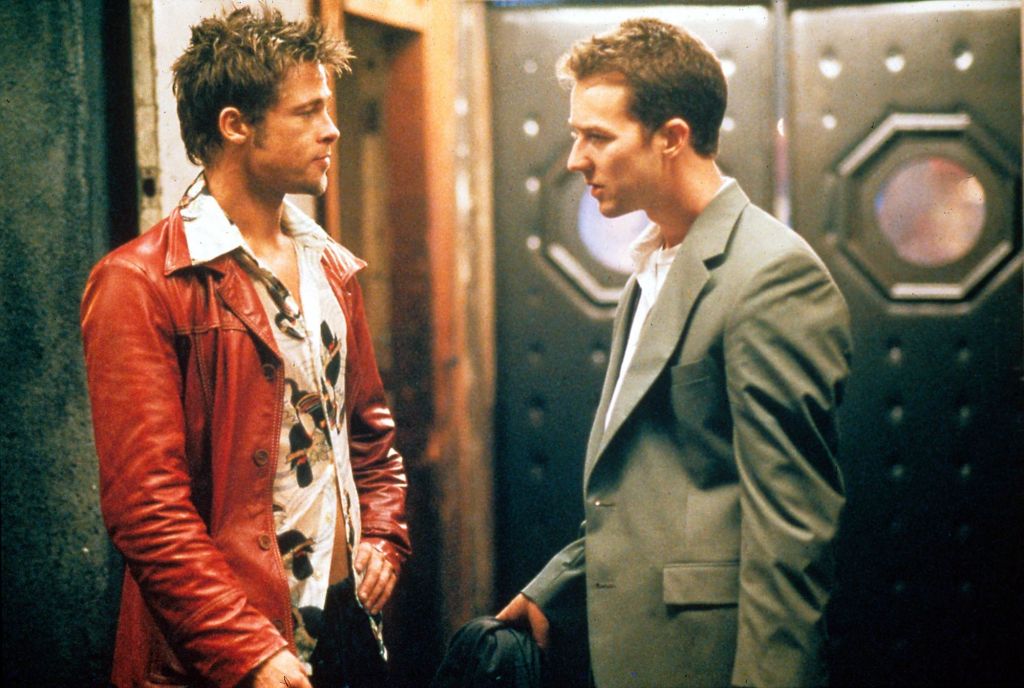
Edward Norton’s insurance recall assessment agent, drowning in a pitilessly amoral job that reduces his life to frustrating air travel, soul-crushing car accident analysis and an IKEA-furnished “nest” at home, is by most measures Incel Patient Zero. No, he’s not unattractive, morbidly obese and living in the cliched “Mom’s basement.” But Incel he is, so numbed that he starts crashing support groups — testicular cancer to TB — just to “feel” something, to unload his suppressed Life of Tears.

Meeting a fellow support group crasher (Helena Bonham Carter at her Goth-punk sexpot best) doesn’t help. But this swaggering hunk Tyler Durden does. He’s “don’t give a f—” America incarnate — all bravado and attitude, willing to take a punch and more than willing to deliver one.

Whatever else once-and-always pretty boy Brad Pitt has done on the screen, this is the role that defines him. And who is he defining? Tyler’s a craft soap maker (Holocaust allusion) and banquet waiter who pees in the soup he serves the well-heeled.

Tyler Durden is still walking among us, refusing to “socially distance,” that “ass without a mask.” He is quick to trigger, quicker to feel dismissed, quick to turn violent. He is an icon to just the sort of people who ruined this movie, the ones who filled (more than one seat each) a commuter train I took in Orlando a year or so ago — uniformed and uniformly obese pasty-faced Proud Boys on their way to a Trump rally. I was taking the same train to see the Baby Trump balloon. Go figure.

When The Narrator of Many Fake Names (Norton, often speaking to the camera) and Tyler Durden invent Fight Club as a release for the similarly-disaffected, Tyler is the one who gets the girl. The Narrator finds himself surrounded by Incels, the emasculated looking for masculine meaning — pain, honor, glory, belonging to something larger than themselves.

Last summer’s riots, with much of the rioting organized by masked and tac-geared-up Boogaloo Boys, was “Fight Club’s” coda, an epilogue to the organized mass destruction that the Project Mayhem offshoot of Fight Club delivers in its finale.

I think David Fincher and novelist Chuck Palahniuk were prophetically reading the tea leaves rather than “inspiring” the cretins who adopted this movie as their ideal. Scorsese didn’t invent the mob, but his mob pictures provably influenced mob behavior, mores and social acceptance. That’s where “Fight Club” sits — a socially prescient social hot button film that was a magnet for disaffected, struggling white guys who wanted to see an idealized, buff and quotably flippant version of how they imagined themselves.

“We are all part of the same compost heap,” Durden aphorizes. “I see all this potential, and I see squandering. God damn it, an entire generation pumping gas, waiting tables; slaves with white collars. Advertising has us chasing cars and clothes, working jobs we hate so we can buy shit we don’t need. We’re the middle children of history, man. No purpose or place. We have no Great War. No Great Depression. Our Great War’s a spiritual war… our Great Depression is our lives. “

The film tapped into what was, 17 years later, to make Trump president and 20 years later would lead to the sacking of the capital.

Aside from prophecy, how’s the film hold up? The grimy design, runway ready gaucherie of Durden’s look, attire and that Camaro convertible he peels off in for his airport exit is all of a piece. It’s ugly-beautiful.

The performances are spot-on, a hallmark of Fincher’s pictures. Norton’s reputation for immersion in a part predates this film, but it was chiseled in stone after it.

The narrative? It’s a tad sloppy and ambling. The picture unravels in pretty much the way the narrator does, with a third act that feels inevitable and unearned, “just right” and ridiculously “on the nose.”

And while there are jaw-dropping surprises along the way, the picture’s look and tone give away the biggest “twist,” then and now.

I remember wincing at what I thought were its flaws, way back when. Seeing “Fight Club” again, post-Jan. 6, they stick out more.

Cult films are seldom great films, they just connect with a corner of the audience more intensely than was intended, elevating their status.

That’s “Fight Club.” And appealing to the wrong sort of cult just makes that clearer.

MPAA Rating: R for disturbing and graphic depiction of violent anti-social behavior, sexuality and language

Cast: Edward Norton, Brad Pitt, Helena Bonham Carter and Meat Loaf.

Credits: Directed by David Fincher, script by Jim Uhls, based on the Chuck Palahniuk.  A 20th Century Fox release.

Running time: 2:19

Posted in Reviews, previews, profiles and movie news | Comments Off on Movie Review: Did the Proud Boys/Boogaloo Boys ruin “Fight Club?”

First look — Edgar Wright’s “The Sparks Brothers” doc looks at “the best British (band) ever to come out of America”

First time I ever saw “Saturday Night Live” this band with Hitler on keyboards appeared. I thought it was another comedy element of the show. This film just premiered at Sundance.

Posted in Reviews, previews, profiles and movie news | Comments Off on First look — Edgar Wright’s “The Sparks Brothers” doc looks at “the best British (band) ever to come out of America”

Not saying I’ve been doing this a long time, but…

I see this stacked in my “warm clothes” collection at my mother’s place in frigid N.C., a studio-provided turtleneck from the days when critics were critical, films were shot on celluloid and Michael Palin might be just the priest to comfort fallen women.

The message on back…

Posted in Reviews, previews, profiles and movie news | Comments Off on Not saying I’ve been doing this a long time, but…

Movie Preview: A Shelley dreams up her “Frankenstein” — “A Nightmare Wakes”

Shudder has this one, which starts streaming Feb. 4. Creepy?

Posted in Reviews, previews, profiles and movie news | Comments Off on Movie Preview: A Shelley dreams up her “Frankenstein” — “A Nightmare Wakes”

Movie Review: “Happy Cleaners” and the burden of Korean-American expectations

Good storytelling skates by on the tension between what we see, read or hear unfold, and what we hope or fear might happen as the tale unfolds. Dickens or “Dumb & Dumber,” it’s all about meeting or willfully defying our expectations, great or otherwise.

“Happy Cleaners” is a Korean-American immigrants and their children drama, a story of the Korean dream transported to America and burdens passed from generation to generation. It’s a movie built on expectations that it lets us cling to, even if we fear the filmmakers have no intention of giving we the viewers our wish or their characters an easy way out.

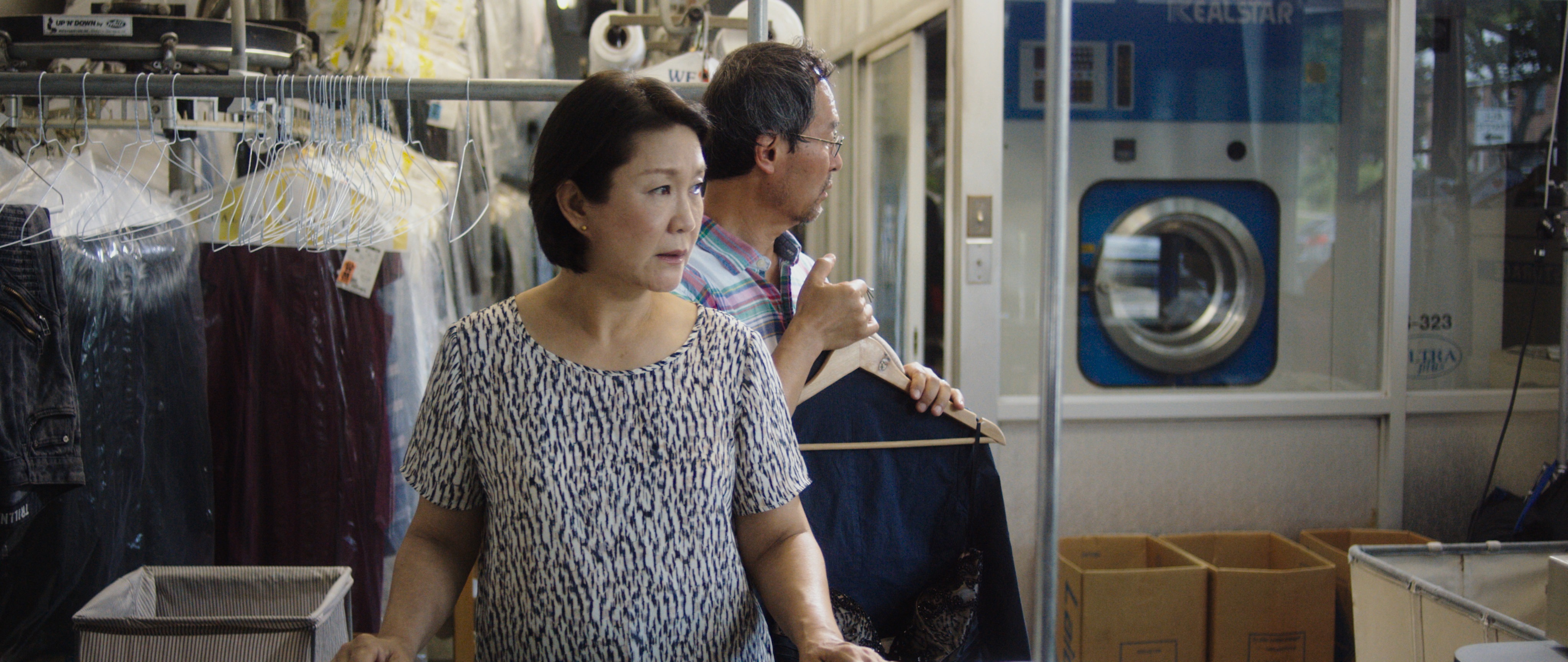
It’s about a Flushing, N.Y. dry cleaning business run by first-generation immigrants. Mom (Hyang-hwa Lim) is the driven one, Dad (Charles Ryu) is somewhat hapless, clinging to his pride and his masculinity in the face of a lifetime of hard, low-margins labor.

Their daughter Hyunny (Yeena Sung) is a nurse, resigned to how they are, propping up their struggle as best she can. Son Kevin (Yun Jeong) is in open rebellion. He’s dropped out of college, abandoning Mom’s dream of “a medical degree.” He’s into food, works in a food truck and longs to try his hand in Los Angeles.

“It’s not my fault you work this this,” is how a lot of their arguments end, followed by Kevin storming out.

The sexism here is masked in “traditional gender roles,” with the petulant, indulged son refusing to carry the weight of what his family wants and the daughter left to pick up the slack.

Hyunny is in love, but she’s furious that beau Danny (Donald Chang) is letting his own family’s struggle — they have a liquor store — put his education, and any future he might have with Hyunny, on hold.

“Are you gonna work like this forEVER?”

It may be pragmatic, but it’s certainly not helpful of Mom to weigh in on that, in Korean (with English subitles).

“Break up with him immediately.”

The dry cleaning business is a struggle, with equipment failures, a new landlord and the debts of a previous business gamble — a restaurant venture years before — still hanging over them.


Danny may seem buried under responsibilities and Kevin all-too-eager to shed his, but Hyunny, the “success” in this story, hears herself parroting her parents’ work-ethic mantra, one that you can also hear in the Korean American drama “Minari.”

“Anything is possible if you work your ass off.”

It was always thus. It takes a generation or two for newcomers to America to realize that while much is indeed possible here through hard work, “anything” is an overreach. Some never stop struggling and never get their heads above water. Some drown.

First-time feature co-writer/directors Julian Kim and Peter S. Lee create character “types” and then set out, with the aid of a pretty good cast, to upend our expectations of these people and what would appear to be their fate — good or bad.

Lim’s Mom is brittle, judgmental but no harridan. She’s never so outspoken that Kevin won’t come back after storming out, and Kevin is never so angry that he can’t see himself back under their roof, learning cooking tips from Mom and when she visits, Grandma (Jaehee Wilder).

Dad is close to pitiable, cowed by a jerk landlord or irate customer, deferring to his wife but stoically staying on task and maintaining their current course, even if the ship is taking on water.

Sung’s Hyunny is the character many of us will identify with, straddling the middle ground between her parents’ “work hard and it’ll work out” notions and Kevin’s realizations that this life isn’t worth repeating. She’s just as trapped and smart enough to realize that, even if her lashing out is only at her overwhelmed boyfriend.

The arrival of “Happy Cleaners” at almost the same time as the Oscar-buzzed “Minari” (Feb. 12) reinforces “Tiger Mom” and “work hard” cultural stereotypes, and the stories sync up on with a “gamble everything for a chance to get ahead, even if you fail” theme as well.

The honesty of these stories, and 2017’s “Gook,” is filmmakers’ staring without blinking at the generational schisms, the ongoing sting of “YOU people” racism and the inevitable realization that whatever parents went through to get them here, the expectations they saddle their kids with don’t always pay off with achievement. Sometimes, their only benefit is giving you the courage to defy them.

MPAA Rating: unrated, profanity, smoking

Cast: Hyang-hwa Lim, Yun Jeong, Yeena Sung, Charles Ryu, Donald Chang and Jaehee Wilder.

Credits: Directed by Julian Kim and Peter S. Lee, script by Julian Kim, pat Kim and Peter S. Lee. A Passion River release.

Running time: 1:38

Posted in Reviews, previews, profiles and movie news | Comments Off on Movie Review: “Happy Cleaners” and the burden of Korean-American expectations

Movie Preview: Danielle McDonald, Hugh Skinner and Joanna Lumley ask “What’s Opera, Doc?” in “Falling for Figaro”

A little song, a little prance, a little Patsy from “AbFab” in her cups and in your hands.

Posted in Reviews, previews, profiles and movie news | Comments Off on Movie Preview: Danielle McDonald, Hugh Skinner and Joanna Lumley ask “What’s Opera, Doc?” in “Falling for Figaro”

Movie Preview: An agent’s assistant remembers “My Salinger Year”

Joanna Smith Rakoff’s memoir about working in a New York literary agency that represented J.D. Salinger becomes a break-out vehicle for Margaret Qualley and a reminder that nobody knows that New York/Old Money world better than Sigourney Weaver, who rarely goes back to it on screen.

A March 5 release.

Posted in Reviews, previews, profiles and movie news | Comments Off on Movie Preview: An agent’s assistant remembers “My Salinger Year”

Movie Review: Couple tries to have it all, a threesome that begins at “First Blush”

“First Blush” is a Millennial Dance with the Tiger romance, another generation’s flirtation with the “Threesome that Works.” Victor Neumark’s film posits that maybe this time, with this generation, we can stop the dance without the tiger eating us.

Hey, it could happen!

It’s obvious the first time we see them together that Nena (Rachel Alig) is a little controlling, maybe a tad highly strung. And Drew (Ryan Caraway) both defers to her and dotes on her.

Her little rant about keeping her 30th birthday quiet, about “hating” surprise parties earns a gentle, non-confrontational “How do you know?” Because she’s never had one, until now.

Their chatterbox pal Carrie (Jordee Korpanski) has invited a lot of people Nena doesn’t even know to this surprise. And the biggest surprise of all is how quickly she clicks with the young, slightly glamorous (she used to model) Oliva, played by Kate Beecroft.

Alig, who has an Aubrey Plaza look and vibe, nicely captures how rattled Nena is at what she tells this stranger on first meeting, how her marriage’s bottom line is that she knows she won’t “die poor and lonely.”

But no worries. Moving on. Her goal is that she hopes to “say yes” a lot more in her 30th year. Carrie and her fiance (Christopher Moaney-Lawson, funny and droll) convince Nena and Drew to come camping with them. So. “Yes.”

And when they get there, who should be the fifth wheel but Olivia, who doesn’t have her own tent?

Writer-director Neumark doesn’t fall into the titillation trap that most “threesome” movies do, making it all about the sex. He’s more interested in how the addition of Olivia to this marriage opens people up and opens cans of worms, some of which can never be closed.

The warnings are there, echoed by people privy to this little “arrangement” (they try to keep it secret). This “always” ends in “drama.” But sure, you kids go ahead and find out for yourselves.

No, “We can’t go back to the way things were.” Or can we?

The willowy Beecroft nicely embodies the laid-back-about-life confidence of “beautiful and I know it.”

Alig brings an antsy, analytical and confused energy to Nena.

Caraway’s character makes the longest journey, the guy whose too-honest wife talks about her first encounter’s sparks with Olivia and responds, hopefully, “We’re together forever, right? We’re solid? Right?” His undemanding “I live for your happiness” motto might not be all Nena wants out of life, but it plays well to them both. At some point, what’ll he expect in return?

The not-quite-comical squirming discomfort of some of scenes remind the viewer that Neumark cut his producing teeth on TV’s “Portlandia.” It’d be easy to see these characters, in more cartoonish form, on that show. But whatever tone he was going for, the thin sprinkling of laughs makes “First Blush” drag on more than it should.

He hits his serious points with just the right touch, here. Even if every generation has to figure out relationships on its own, and every generation looks for ways to, as the writer Tom Robbins pondered, “make love stay,” there’s enough evidence that maybe these three are foot soldiers in a post-binary world of sexuality, commitment and happiness.

Or maybe they’re like everyone who came up with this “solution” before them — kidding themselves.

MPAA Rating: unrated, sexual situations

Cast: Rachel Alig, Ryan Caraway, Kate Beecroft, Jordee Kopanski and Christopher Moaney-Lawson

Credits: Scripted and directed by Victor Neumark. A Gravitas Ventures release.

Running time: 1:47

Posted in Reviews, previews, profiles and movie news | Comments Off on Movie Review: Couple tries to have it all, a threesome that begins at “First Blush”

Classic Film Review: Is Montgomery Clift’s “The Big Lift” the first Cold War Comedy?

The Cold War comedy had become its own genre by the time Mel Brooks and Buck Henry put in on TV with “Get Smart.”

The idea that Russian spies, Russian authoritarianism and “The American Way” could collide for laughs should have been a stretch for a generation that survived the biggest Hot War, WWII. But by the time films like Billy Wilder’s “One, Two, Three” and Norman Jewison’s “The Russians are Coming, The Russians Are Coming” came out, American audiences had bought in.

But when did we first start to laugh at the whole idea of a war of ideas, of a clash that was deadly earnest and deadly serious but without (much) shooting, was hard to take seriously?

I’ll bet it was “The Big Lift,” a just-after-it-happened, docudrama-real and often laugh-out-loud funny account of the Berlin Airlift, the first major confrontation of The Cold War.

I’d never seen this pre-Korea 1950 dramedy, with Montgomery Clift and Paul Douglas as Hawaii-based Air Force crew suddenly shipped to Germany to keep Berlin from being starved to death by the Soviets. George Seaton, who went on to write and direct “Airport,” and “The Country Girl,” wrote and directed “Miracle on 34th Street” and scripted a couple of Marx Brothers romps, wrote and directed “Lift.” And if he’s not parked in what Andrew Sarris loftily called “The Pantheon” of cinema stylists of that era, the record reflects the writer-director knew where to find laughs in even the grimmest of settings.

It’s dark — set mostly in a ruined, rubble-filled Berlin, with war criminals wandering the streets and even the local “schatzis” (friendly frauleins) a dubious proposition. The work was dangerous, flying food and coal in via C-57 transports through a narrow air corridor, harassed by Russian fighter planes, into an airport surrounded by apartment blocks (“Like landing in the Rose Bowl” one pilot cracks.).

But as serious as it all was, this mad scramble (20 minutes between landing and the next takeoff) to save survivors of a genocidal regime from another genocidal regime, had to seem a tad ridiculous.

The bluff Sgt. Kowalski (Douglas, of “The Maggie” and many a comedy or drama of the era) has a “This is where we SHOULDA used the A-bomb,” a sentiment that can’t have been unique at that time.

Sgt. Danny McCullough (Clift) isn’t quite that cynical. But he probably didn’t serve in the European theater. And when he’s singled out for a hometown profile by an Associated Press reporter, and honored, strictly by chance, at a “thank you” ceremony for the work they’re all doing, he warms to the first woman (Lithuanian-German actress Cornell Borchers) he’s seen during this service.

As McCullough and Kowalksi explain their jobs and the milieu to the AP reporter, McCullough steals away to spend time with the widowed Frederica. That’s how he sees the city, up close, with its ruined buildings, civilians pressed into labor gangs to remove rubble to rebuild it and the patently-absurd four-power arrangement that divided Berlin into “zones” occupied by the victorious Allies and the liberated French.

Seaton, mixing his cast with real-life fliers and GIs, creates a swaggering, bantering world of inter-service rivalry, with the Air Force guys razzing Navy crews who come to pitch in, with MPs (working in teams, with one soldier from each of the four occupiers) struggling to keep the peace and the “fraternizing” to a minimum.

Newsreel coverage opens the film, and is cleverly folded into the proceedings as Seaton has it interrupted by the Hickam Field (Hawaii) airmen watching it as they’re given their orders to report for “45 days” of “training.” In Berlin.

The script is patriotic without being heavy-handed, with the brutish Kowalski explaining to his bullied fraulein (Bruni Löbel) the virtues of democracy with a cute “Dewey Defeats Truman” anecdote and a defense of a society with its own anti-Semitism (and race) problems.

The Germans our heroes meet include Strieber (O.E. Hasse), a survivor and hustler and freely-admitted “Russian spy” who documents the comings and goings of Berlin Airlift flights. He’s a comical cynic who jokes of the 15,000 Germans the Russians have spying for them in Berlin, and the 10,000 the Allies have on their payroll.

Travel between “sectors” has a certain peril that Seaton finds comical. Russians hassle tram riders for food and coffee, and we see an older German man counsel a weeping woman to hide her little bag of coffee under her hat.

When he rats her out, it’s a jaw-droppingly funny shock and the entire tram turns on him. When he laughs and opens his coat to reveal a year’s supply of coffee, and gives her a couple for her service (she took suspicion away from him), the joke has the perfect punchline.

Both leads have arcs, with Clift’s Danny turning a bit more jaded about the Old World and Old Enemies that can’t be trusted, and Douglas’s Germa-phobic Kowalski warming up from the guy who doesn’t hesitate to glower the “Krauts” off their own sidewalks as he stomps down the street he was when he arrives.

“They belong in the gutter. If they don’t get outta my way, I’m gonna push’em there.“

“The Big Lift” is a film that takes us back to a simpler time, America at its most confident, not yet wholly wrestling with the Civil Rights Movement and thus self-righteous in ways that made us overdue to be knocked down a peg or two.

And it’s a stand-out film in the career of a filmmaker whose deft hand with comedy and drama “(The Country Girl” was an Oscar winner) made him a go-to choice of the studios, even if he was no Hitchcock, Huston, Wilder or Wyler.

Wilder may have made the funniest Cold War comedy of them all. But Seaton got there ten years ahead of him in a classic film well worth tracking down on Tubi, Roku or your favorite classic film channel of choice.

MPAA Rating: Approved

Cast: Montgomery Clift, Paul Douglas, Cornell Borchers, Bruni Löbel and O.E. Hasse

Credits: Scripted and directed by George Seaton. A 20th Century Fox release on Tubi, Amazon, etc.

Running time: 2:00

Posted in Reviews, previews, profiles and movie news | Comments Off on Classic Film Review: Is Montgomery Clift’s “The Big Lift” the first Cold War Comedy?