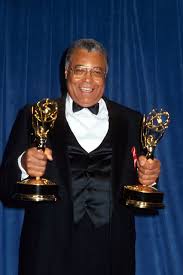
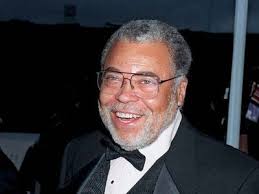
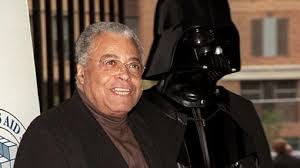
The Man, the Voice, the Laugh, the Legend — James Earl Jones, 1931-2024

It’s got to be the most unusual of dilemmas, facing your twilight years as one of the most beloved figures in American pop culture.

James Earl Jones, a giant of the American theatre, Black theatre and screens big and small, carried that mantle with grace and pride for decades. The Grand Old Man of every medium he dabbled in died today at his home in Dutchess County, New York. Jones was 93.

“Star Wars” made him an icon, and even led to a hilarious turn or two sending up his “Darth Vader” voice and image on “The Simpsons” and “The Big Bang Theory” and the like.

But in a long career that collected nearly 200 screen credits — he made his film debut in Kubrick’s “Dr. Strangelove, or How I learned to Stop Worrying and Love the Bomb (1964)” — Jones made it a point never to to act above the material, unless the material demanded it.

He played the first Black president (“The Man,” 1972) and embodied the bitter, racially discriminated-against boxing champion Jack Johnson in an Oscar-nominated turn in “The Great White Hope.”(1970)

His autobiography, “Voices and Silences,” is a read of rare frankness and vulnerability for a celebrity autobiography, something he generously attributed to his co-writer, Peggy Niven, when I interviewed him about the book some years back.

Jones was the first person I ever heard use the word “racialist” for someone a little too quick to play “the race card.” He used it about the great poet Maya Angelou when they worked on a play together — Jean Genet’s “The Blacks” — in about 1960 in his autobiography. And he tossed it out there again the first time I interviewed him, about “Field of Dreams” but talking up a particularly memorable role in a couple of episodes of “L.A Law.”

Jones was the son of African American theatre royalty, Robert Earl Jones. Dad leaving him with relatives may have contributed to his son’s lifelong stutter, something James Earl rarely let out on stage or the screen. But one reason James Earl had no patience for “racialists” was his awareness of his own struggle to conquer that stutter and father’s shadow to become one of the great performers and voices of his age — narrating everything under the sun, making Darth Vader his own even though he never came closer to the masked and caped villain than a recording booth.

I had the pleasure of interviewing several times over the years, with the first being memorable for how prickly he was. We were talking up his avuncular turn in “Field of Dreams,” but he was on set for “L.A. Law,” and staying in “racialist” character, he explained, laughing, years later. “The guy was a prick,” and that probably spilled over to that phone chat. It was rough going, in a “I don’t suffer fool journalists gladly” sense.

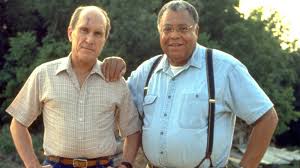
He was warmth-personified talking about “Sounds and Silences,” and the marvelous pairing with Robert Duvall titled “A Family Thing,” a simple dramedy that laid bare the absurdity of racism even in a pre Ancestry.com America. “We’re all EVERY different race,” he laughed in that sonorous roar of his.

Who wouldn’t want to be related to James Earl Jones?

His modesty, in spite of all he’d accomplished and experienced, was overwhelming. “Star Wars” or not, he was still “a thousand-aire” not a “millionaire,” he joked. He took on comedies (“Three Fugitives”) and authority figures (“The Hunt for Red October”) and classics of the American theater (including plays by August Wilson), a working actor first and last.

And as I noted, in recalling his glorious turn in 1987’s “Matewan,” he wasn’t above putting himself and his name on an indie film about the Mingo County War and early 1920s coal mining and getting that masterpiece made.

Race was a subtext of many of his most iconic performances, from “The Bingo Long Traveling All-Stars and Motor Kings” to “The Great White Hope.”

But he was a grand villain (“Conan the Barbarian”) and a fitting choice for a king (“Coming to America,” “The Lion King”). And he took every unexpected hit (“Sandlot,” “Star Wars”) with the same equanimity that he regarded his many prestige projects.

He was an Emmy, ACE and other award winner and collector of lifetime achievement awards.

He will be missed, and I dare say it won’t just be fans like me who mourn his passing. You got a taste of how beloved a presence he’s been back in 2011 when he deservedly collected an honorary Oscar, live from the London theater where he was co-starring with Vanessa Redgrave in “Driving Miss Daisy.”

Rest in peace, Mister Jones. Well done.
Posted in Reviews, previews, profiles and movie news | Comments Off on The Man, the Voice, the Laugh, the Legend — James Earl Jones, 1931-2024

Netflixable? Southern cops seize the wrong out-of-towner’s cash in “Rebel Ridge”

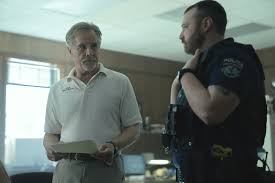
The dialogue has a metallic tang and the smell of a just-fired revolver about it in “Rebel Ridge,” an “In the Heat of the Night” style tale of Southern justice in the golden age of “cash forfeiture.”

Lines like “Just because you was right that don’t make us wrong” leave a nasty aftertaste when delivered with a “Bama-ass” drawl.

The latest thriller fom writer-director Jeremy Saulnier is sharp, deliberate and lean, more “Blue Ruin” and “Green Room” than “Hold the Dark.” It takes its sweet, suspenseful time to get hold of us and give us a good shake.

“I wasn’t aware it was a pissin’ contest.” “It always is.”

By genre, this is another “You picked the wrong guy to mess around with” action pic, one smart enough to never have to use that cliched line. It’s “First Blood” and “Taken,” about a man with “particular skills” crossed by the wrong people — this time, small-town Southern law enforcement enjoying its decades of immunity from scrutiny, investigation and oversight.

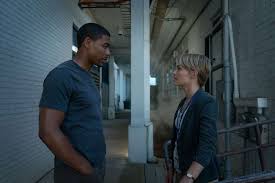
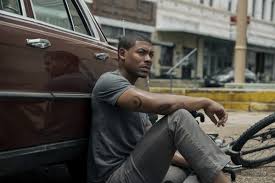
Aaron Pierre (“Brother,” Malcolm X in TV’s “Genius”) plays Terry, a guy minding his own business, pedaling a bike through the Deep South (Louisiana, based on the use of the word “parish”) when he’s rammed by a small town cop who fails to take into account the cyclist is listening to music through his earbuds and can’t “stop” when ordered to, for no good reason.

Terry is harassed, threatened and cuffed. He is questioned and searched. “May I have your permission to look through your backpack?” “No, you may not.” He is misused and manhandled, but respectful and always in control of his emotions.

That cash? It’s to bail his cousin out of a “possession” arrest in Shelby Springs. He’s got to post it before that cousin is shipped off to the state pen for holding until trial. This is a matter of life and death.

Not that the cop (David Denham) and his backup (Emory Cohen) give two damns about that. This money is impounded, subject to forfeiture, all based on their “suspicion” and prejudice.

Terry may find a sympathetic ear in the courthouse, an assistant clerk and law student played by AnnaSophia Robb, in her best role since “Charlie and the Chocolate Factory.” “This can’t be legal” turns out to be legal. And in this corner of the BFE South, “this” is a whole system of arrests, charges and seizures that the police chief (Don Johnson) banks on and the judge (James Cromwell) signs off on.

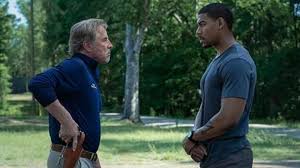
Pushing back, trying to file a “robbery” report, only pisses off that chief, the one to whom everything is a “pissin’ contest.” Chasing down the bus prematurely transporting that cousin to prison doesn’t reassure the cousin, Terry or us that this is going to end well.

Because the cops may have all the cash and all the cards. But they’re going to find out they picked the wrong Black man to railroad and rob. All we have to do is wait for the shoe and the hammer to drop.

The genius of Saulnier and Pierre’s approach here it to keep that shoe from dropping, to play all this on simmer, to emphasize “less lethal” “special skills,” “de-escalation” and patience. Sooner or later, lines will be crossed and the ante will be upped in that “pissin’ contest.” Sooner or later, those small town police will figure out what all those Marine Corps acronyms attached to Terry Richmond’s name mean.

Pierre is stoic and stonefaced as Richmond, a man who may not remember “which amendment (to the Constitution)” guarantees “due process.” He is still someone of inner resources and inner reserve, willing to comply, to go along to get along, to make “a deal” because “a deal is a deal.” But corruption this ingrained, this officially sanctioned, makes “a deal” as worthless as the promise of a police chief.

Johnson never lets this “Chief Burnne” become a caricature. He is electric in the part, not inclined to lose his cool, willing to “mislead” rather than overplay or give away his hand, hellbent on having his way in all this. Because the police chief wants to be county sheriff,.

Saulnier’s film is at its best on familiar, factual ground. “Last Week Tonight with John Oliver” was all over this “civil foreiture” sketchiness ten years ago. Some of the side issues — small town paranoia, job insecurity, all the people who have to look the other way for this corrupt cop hustle to operate — take on melodramatic touches.

But for all its flinty dialogue, there is no catch phrase, no glib “You picked the wrong” this, that or the other person “to mess around with.” Pierre makes us buy into the calculus Terry is working with, the training he’s absorbed. This is a potentially violent chess game, and Terry has to size-up his opponents, the cost-benefit and potential hazard of this move or that one. Pierre makes us reason this out with him.

I found the ending of “Rebel Ridge” a bit of a reach.

But Saulnier’s made a slow-burn thriller that surprises and keeps us guessing and waiting, mostly for that moment when somebody draws “First Blood,” and even then he trips up expectations, and deliciously so.

Rating: TV-MA, violence, profanity

Cast: Aaron Pierre, AnnaSophia Robb, David Denman, Zsane Jhe, Steve Zissss and Don Johnson

Credits: Scripted and directed by Jeremy Saulnier. A Netflix release.

Running time: 2:11

Posted in Reviews, previews, profiles and movie news | Comments Off on Netflixable? Southern cops seize the wrong out-of-towner’s cash in “Rebel Ridge”

Movie Preview: A Deeper peek into “Saturday Night” and its live debut

J.K. Simmons as Milton Berle, Willem Dafoe as the voice of Network doom, and Jason Reitman’s survey of how the hot mess that was and is “SNL” first made it on the air serves up players — Gilda and Jane and Chevy and Dan and Andy K. and musician Paul, folks who are literally “not ready for prime time.”

Oct. 11.

Posted in Reviews, previews, profiles and movie news | Comments Off on Movie Preview: A Deeper peek into “Saturday Night” and its live debut

Movie Preview: The horrors of the Dust Bowl aren’t all that’s scary in “Hold Your Breath”

So there’s a “Green Man” killer stalking the Plains in one of the great disasters in American history. “Slender Man” meets Ken Burns’ worst documentary nightmare.

A mother tries to protect her children from the fatal choice to move to the prairie as it’s blowing away, and a monster is now on the loose.

Odd time for Searchlight to to get into the horror game, I must say. The horror audience has drifted off, for reasons not wholly understood. Which is why “Hold Your Breath” comes to Hulu Oct. 3.

Posted in Reviews, previews, profiles and movie news | Comments Off on Movie Preview: The horrors of the Dust Bowl aren’t all that’s scary in “Hold Your Breath”

Movie Review: Lads from Oz face WWI and what happens “Before Dawn”

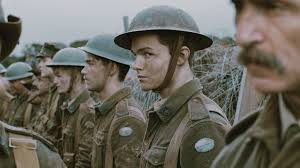
“Before Dawn” is a World War I saga as uninventive as its title, a flat recreation of the trenches of France and the young men who fought there that adds nothing to the extensive canon of films documenting “The Great War.”

Aussie filmmaker Jordon Prince-Wright’s bitten off a lot for his debut feature, which he’s dedicated to his grandfather in the closing credits. But ambition aside, “Dawn” can’t hold a candle to the best Australian film about World War I (“Gallipoli”), much less the classics “Paths of Glory,” any version of “All Quiet on the Western Front” and “1917,” even if his film stands far above most indie efforts to recreate The Somme, etc., on a tiny budget.

It’s the story of a young sheep rancher from the Outback, joining his mates on the great adventure enlisting promises because “You wouldn’t miss it, wouldya Jim?”

Jim Collins (Levi Miller) leaves behind the rancher/parents who depend on him for a 900 day “adventure” in the mud and blood stalemate of the Western Front.

Prince-Wright’s film, scripted by Jarrad Russell, skips back and forth in time as it tells the story of Jim’s long deployment, the “mates” and what happens on “Day 28,” “Day 753” etc., must of it underscored by Jim’s wartime diary or letters home, recited in voice-over.

We viewers instinctively know better than to get to attached to Jim’s mates, and even Jim’s blunders, tests of courage and morality in trenches that are often too shallow to keep the young men defending them from being picked off come off as “nothing new.”

Good combat sequences, reasonable recreations of No Man’s Land, a few salty “types” — Myles Pollard stands out as the fearless jaded, slouch-hatted sergeant trying to keep this lot alive — lots of “win this” “big push” and “we go home” promises — “Before Dawn” serves up the tropes of the genre and well-worn situations of the war, with the odd Aussie touch.

The lads and their Sgt. set off on a late night “revenge” raid to take out a machine gun crew that killed some of their mates.

The story arc can’t help but be over-familiar. Jim, labeled a “crack shot” by those who know him, is reluctant to take that first life and even more reticent about showcasing his marksmanship.

One thing nobody on the corner of the Western Front misses is a shave or a bath. Muddy moments aside, these are the best-turned-out, made-up trench soldiers of any WWI film of recent vintage.

The odd shot can be striking — very young men piled into a horse-drawn wagon lit by a kerosene lantern, riding out to their destiny in a pitch-dark Outback night. The battlefields and trenches pass muster, but offer little that we haven’t seen before.

One can appreciate the effort and the sentiment driving it. But the conventionality of the story, the long, dull stretches between the passable combat scenes and lack of emotion in the departure from the sheep station and the deaths of friends and comrades hobble “Before Dawn,” a World War I overreach, pretty much start to finish.

Rating: R, violence, profanity, smoking

Cast: Levi Miller, Travis Jeffery, Myles Pollard, Stephen Peacocke and Kelly Belinda Hammond

Credits: Directed by Jordan Prince-Wright, scripted by Jarrad Russell. A Well Go USA release.

Running time 1:40

Posted in Reviews, previews, profiles and movie news | Comments Off on Movie Review: Lads from Oz face WWI and what happens “Before Dawn”

Classic Film Review: Segal’s not waiting for Ruth Gordon to die — Carl Reiner’s “Where’s Poppa?” (1970)

Over fifty years after its release, Carl Reiner’s cult comedy “Where’s Poppa?” has lost some of its transgressive edge, but not a bit of its ability to make you cringe.

A dark 1970 comedy about Jewish sons and Jewish mommas, dementia and the terrors of the phrase “put me ‘in a home,” this satire is perhaps most famous for a downbeat and twisted ending that isn’t seen on most versions of it circulating — a senile mother (Ruth Gordon) asking her son (George Segal) for the hundredth time, “Where’s Poppa?” He at last answers that “Here’s Poppa,” as they’re in bed. Together.

And the film is most infamous for being the first time American moviegoers heard the familiar New York phrase “c–ksucker” on a film soundtrack.

The down-market nursing home, a rambling, rundown private residence run by a cynical Paul Sorvino in his first screen appearance, still stings.


“It’s tough getting help,” he grouses. “Nobody wants to take care of old people!”

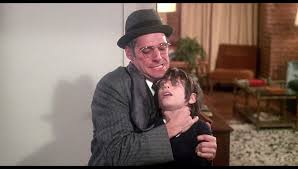
An unhappy wife (Rae Allen) berates her husband (Ron Liebman) for dashing out at night to help his brother care for their delusional, impossible-to-manage mother for the umpteenth time and then blocks the door.

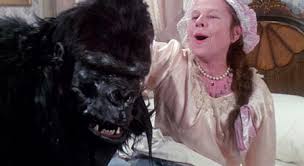
“Get away from that door or I’m gonna CHOKE your child.” Oh yeah. He means it. See the still shot above.

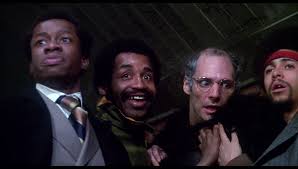
But the most shockingly funny bit would probably never pass muster today, a late night mugging that turns to comical sexual assault, with the repeat mugging Central Park victim (Liebman, always searingly funny) baited into taking on the rape by the amused and amusing Black gang (pre-“SNL” Garrett Morris is the most famous face in the lot) who regard their “regular” victim as “a friend.”

“This your first rape?”

Segal stars as Gordon Hocheiser, the son who lives in their roomy but dated and cluttered Central Park West apartment with his dotty mom (Gordon, immortalized in “Harold & Maude”). Her clingy madness is battering his once-promising legal career, as he keeps showing up to defend people he’s barely met or researched.

We see an assault case against a not-so-peaceful peace protester (Carl’s son Rob Reiner) who whacked off the toe of an aged Army officer (Barnard Hughes), a brawl that began with the younger man raging about “How many ‘g–ks and ‘krauts’ we killed?” Col. Hendricks takes the stand to ghoulishly brag about how many “g–ks and krauts” he killed.

Gordon’s mom chases off every caregiver, has pinched or punched many a hairdresser. And Gordon is desperate for help. Then, an angel dressed like Florence Nightengale (Trish Van DeVere, making her screen debut) applies. Gordon swoons. They click and spoon over her frank discussion of her abortive “32 hours” long marriage.

But Mom is still around, on a demented tear, to muck it all up.

The brothers bicker in that distinctly New York version of brinkmanship — see “choke your child” above.

As things go quickly if not demonstrably from bad to worse — Nurse Louise owns up to how she’s not a “very good” nurse, etc. — brother Sidney’s late night park muggings turn cinematic.

“Remember Cornel Wilde?” Yeah, he was just in “The Naked Prey.” “You better start praying ’cause you’re gonna be naked” and chased through the park, as Wilde was in Africa in that film.

Gordon’s efforts to shock his mother into a stroke include waking her, bellowing and growling, in a gorilla suit. That suit is all he offers naked Sidney after that naked Central Park chase. And a New York cabbie would still rather pick up a guy in a gorilla suit than a Black domestic servant when it comes to late night cab rides.

Reiner, already a comedy legend thanks to “The Dick Van Dyke Show” and his long “2000 Year Old Man” party record partnership with Mel Brooks, did an efficient job of adapting Robert Klane’s novel (screenwriter Klane wrote the script), staying out of the way of some laughs, amping up the energy of the arguments and courtroom scenes (Vincent Gardenia plays another hapless Hocheiser client).

The “plot” is a tad slapdash and the finale — no matter which version you see (Tubi has the “happier” ending) — is abrupt and less than satisfying.

Segal vamps the hell out of his fear and loathing of his mother and instant lust for her prospective new nurse. Gordon is more passive here than in her iconic turn in “Harold & Maude.”

But Liebman, Hughes, Reiner and the hilarious Comic Park Five (Morris, Joe Keyes Jr., Arnold Williams, Israel Lang and Buddy Butler), gang go hilariously over the top and ensure that this comedy’s biggest laughs endure through the ages.

You’d have to tweak that “Your first rape?” scene if you remade the film today. Well, maybe you would. Maybe lean harder on the Manhattan “Jewish momma/Jewish son” dynamic post Eptstein/Weinstein and Woody, or abandon it as the still-amusing stereotype it and so much else in “Where’s Poppa?” is.

But if easy to see the path that Reiner’s comedy was headed on, dark and kind of Mel Brooks Lite in terms of intentional satiric offense, destined to turn dizzy (“The Jerk”) and gloriously sentimental (“Oh God!” and “All of Me”) before he retired and rested on laurels that 98% of Hollywood would envy.

Rating: R, nudity, profanity, adult subject matter

Cast: Ruth Gordon, George Segal, Trish Van Devere, Ron Liebman, Barnard Hughes, Vincent Gardenia, Joe Keyes Jr., Rob Reiner, Garrett Morris and Paul Sorvino

Credits: Directed by Carl Reiner, scripted by Robert Klane, based on his novel. A United Artists/MGM release.

Running time: 1:24

Posted in Reviews, previews, profiles and movie news | Comments Off on Classic Film Review: Segal’s not waiting for Ruth Gordon to die — Carl Reiner’s “Where’s Poppa?” (1970)

Movie Preview: Is Dad J.K. Simmons the real problem with “Little Brother”

This road trip drama stars Philip Ettinger as the troubled sibling brother Jake (Daniel Diemer) must “evaluate” on the drive back to their demanding or perhaps understanding and wise father (J.K. Simmons).

Might Mom (Polly Draper) have a say in writer-director Sheridan O’Donnell’s debut feature?

“Little Brother” comes out Sept. 24.

Posted in Reviews, previews, profiles and movie news | Comments Off on Movie Preview: Is Dad J.K. Simmons the real problem with “Little Brother”

Movie Preview: Festival fave Reality “Winner” bio-pic has a distributor

That’s the good news. “Winner,” starring Emilia Jones as , Zach Galifianakis and Connie Britton, played at Sundance and other festivals this year.

Winner, you should recall, was an NSA translator thrown into prison for leaking information about how much the government knew about Russian efforts to put Donald Trump in the White House.

Vertical, a poverty row distributor, picked “Winner” and is set to release it. Will anybody outside of film festival goers see it? Soon?

Let’s hope.

Posted in Reviews, previews, profiles and movie news | Comments Off on Movie Preview: Festival fave Reality “Winner” bio-pic has a distributor

Movie Review: Cost-cutting Kiwis make that the virtue of “The Paragon”

“The Paragon” is one of those indie film festival darlings that seems to come out of nowhere, with its budget a big part of its legend.

Movies from “El Mariachi” and “Clerks” to “Slackers” “The Blair Witch Project” and “Tangerine” have found glory and distribution based on film fest buzz of the “Look at what they got out of $9, $22 or $25 thousand dollars!”

“Paragon” is sci-fi on the cheap, and being from New Zealand, leans more towards the twee charms of “Safety Not Guaranteed” than the doom and dread of the even cheaper “Primer.”

It’s a parable of the true cost of revenge and the great value of enlightenment. Managing that in a movie with no famous faces and no “names” in its cast is no mean feat, even if this comedy never quite comes off.

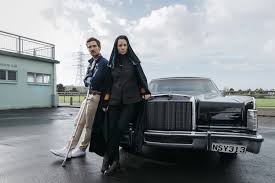
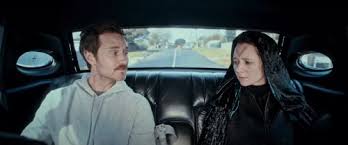
“Paragon’s” laughs are mainly light chuckles, its action another variation on “good” supernaturalists fending off “evil” ones. And its best special effect may be a 1970 Lincoln Continental which our anti-hero’s psychic “coach” can drive from the back seat when everyone knows the steering wheel’s in the front.

Dutch, played by Benedict Wall (New Zealand’s Will Forte?), is a once 347th ranked tennis pro who loses his “Knife Fight Tennis” coaching business, his bored wife Emily (Jessica Grace Smith) and his house when he becomes the victim of a hit and-run.

“The end of me and tennis” has him morose, on crutches, living in his half-brother’s (Shadon Meredith) travel trailer and lusting for “revenge.”

The cops aren’t interested in looking for that one particular silver Toyota Corolla in Auckland. He’s fuming and lost until he sees the flier with phone-numbers dangling below, one of which he tears off.

“Do you want to see the Unseen?” it asks. Dutch does. He wants to find that Corolla and its driver and punish both for what they’ve done to him.

Calling the number from a pay phone, he’s not nearly impressed enough by the fact that the woman answering it knows his name and sends him to an empty gym on the other side of town “for answers.”

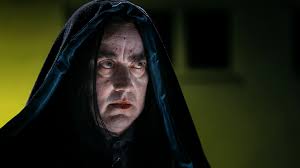
His cynical goof of a brother insists its a scam, because “people are running scams all the time. That’s basically how the economy works these days.” But Dutch goes, meets the cowled and mysterious Lyra (Florence Noble, the deadest deadpan since Buster Keaton) and submits to her extensive list of questions.

“How often do you masturbate?”

The woman with the giant “V” tattooed on her forehead is ready to turn the raging smart-aleck down when he pleads with her and they touch and she gets her clue that he might be ready to receive “psionic powers.”

“Have you ever been dead, Mr. Lawson?” Why, yes he has — after the accident — for six minutes.

The bulk of writer-director Michael Duignan’s film is one long lecture, training and psychic testing montage.

“Please take off your watch.” “Please stop smoking, drinking coffee and masturbating so much.” There’s a even “color diet” (“blue food, yellow food, red food” etc) to heighten Dutch’s reception of “The Protocol.”

Duignan, a veteran TV director (Down Under?) has our hero learn “telelocating,” which will help him find that illusive Corolla. Dutch must learn about the “ten dimensions,” what to do if he gets “lost in a parallel universe,” and to be wary of Lyra’s evil brother Haxan (A “Blair Witch” joke?), given a sinister edge by Jonny Brugh.

Naturally, there’s a magic crystal that must be telelocated.

The structure of “The Paragon” is a tad cumbersome — with events visually forshadowed and Dutch occasionally breaking into third person voice-over narration. The joke of Dutch looking for and being given “shortcuts” to enlightenment amuses. A bit.

And as with much Kiwi comedy, slightness of it all won’t tickle everybody. But after feeling offhand, glib and flaky for much of its length, it shows a little heart as we circle around the “revenge” that is a long time coming.

The performances are daft enough to land, and the audacity of it all counts for something.

If “The Paragon” isn’t the paragon of indie cinema frugality (“Tangerine,” shot on a cell phone, owns that title), it is a great example of how the conceit and the script will always be more important than the “stars” you attract to your debut feature.

Rating: unrated, profanity

Cast: Benedict Wall, Florence Noble, Jessica Grace Smith, Shadon Meredith and Jonny Brugh

Credits: Scripted and directed by Michael Duignan. A Music Box release.

Running time: 1:25

Posted in Reviews, previews, profiles and movie news | Comments Off on Movie Review: Cost-cutting Kiwis make that the virtue of “The Paragon”

Movie Preview: Eighty-four years and counting, Universal still claps for the “Wolf Man”

This major studio reboot — part of Universal’s horror brand and legacy — has attracted a lot of horror genre talent.

The cast (Christopher Abbott has the title role) is lesser known. But Leigh Whannel (“The Invisible Man”) directs, so this has “Saw” and “Insidious” and Blumhoue bonafides.

Jan. 17, a slow season for cinema, is when it opens.

Posted in Reviews, previews, profiles and movie news | Comments Off on Movie Preview: Eighty-four years and counting, Universal still claps for the “Wolf Man”