
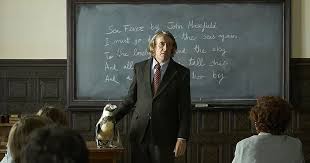
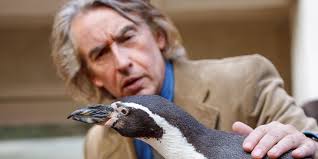
No English speaking actor in film is better at making caddish and insufferably self-absorbed charming than Steve Coogan. That proves to be a saving grace of “The Penguin Lessons,” a sweet saunter through a true story of a rescued bird and a “lost” foreigner trying to drift through another country’s fascism as if it doesn’t affect him.
Director Peter Cattaneo, best-known for “The Full Monty,” turns out to have just the right touch in this winning, featherweight memoir that barely hides the jagged edge underneath the feathers. His movie is sad and warm, with a glimmer of hope peeking through the resignation that ordinary people must wear when intolerant, armed thugs govern their daily lives through terror.
Because whatever’s cuddly about rescuing a penguin from an oil slick, this is a story set in Argentina’s junta years, when the world learned the word “desaparecidos,” the name for people The Government made disappear — many of them permanently.
Tom Michell is a British born English teacher who has been “working my way down” the Americas, drifting from private school job to private school job. His newest, Saint Georges, is in Buenos Aires, an elite boarding school where the children of the rich and powerful study in prep for university and taking their place in the elite their parents represent.
It’s 1976, and martial music — including, ironically, Sousa’s “Liberty Bell March,” the theme from “Monty Python’s Flying Circus” — on the radio means the fascist military has taken over, hellbent on ridding the country of “communists” and other dissenters — anyone who might dare criticize their murderous ways or an unjust status quo.
Most all of the locals are resigned to this reality, but not everyone. Tom’s officious new headmaster (Jonathan Pryce) stresses that “politics” are to be avoided, in and out of the classroom. Tom barely notes the armed soldiers everywhere. He barely engages with anything, including his class of spoiled, uniformed boys, many of them bullies, most of them quick to pick on the one seemingly sensitive lad (David Herrero) in their ranks.
Tom’s Swedish colleague (Björn Gustafsson) has taken drinking and prattling on about his divorce as coping mechanisms. Tom just drifts through his days, seeking solace in a long weekend off (after the coup happens) just across the Rio de la Plata, in Uruguay.
But the solace of a night club pick-up (Micaela Breque) is interrupted when they come across an oil slick on the beach, which is covered in dead birds. Tom gallantly is goaded into “rescuing” one survivor. His new female friend then leaves him in the lurch, with one appreciative Magellenic penguin following him everywhere.
“He’s not my penguiin,” he tells all who ask. “I don’t like penguins.”
And yet he takes on the responsibility, the testy questioning from border control agents, who refuse to take the bird off his hands, the threats he ends up making to the zoo, which doesn’t fall all over itself to assume custody.
Tom keeps his penguin in a rucksack when he takes it out, and leaves it to itself in his school flat with balcony during the day. Eventually, his efforts to feed and care for it put him in touch with “the other” Argentina — kind and sympathetic people trapped in an impossible situation.
The man who goes through the motions in class and naps through rugby practice — he’s the coach even though “I actively dislike rugby” — sees his new responsibility, his moral calling to break rules and unjust laws, and to give object lessons in fascism to his fascist offspring students.
The penguin is just a prop to get their attention.
And when one of the school’s custodians (Alfonsina Carrocio) is grabbed off the street for her “leftist” sympathies, his shame and the despair of the maid who raised her (Vivian El Jaber) pushes him even further.
Tom’s first hint of spine? Facing down a red-faced spitting fury of a soldier by showing him that all he has in his shoulder bag is a bird.
“El pingüino no es comunista,” he says. “The penguin is not a communist.”
The film’s topicality is inescapable for anyone living in the U.S., Britain, Germany, Israel or Hungary at this moment. “Pacifism” may apply, but passivity won’t cut it. “We are many and they are few” isn’t just a Percy Bysshe Shelley lesson for school boys, to be taught after they’ve mastered the metaphor of Masefield’s “Sea Fever.”
Coogan’s aloof approach to the role won’t be to every taste. Naturally, there’s an “explanation” for Tom’s state (fictional, and not in the real Tom Michell’s memoir). But the pair-bonded penguin metaphor hits home and the call to resolution in the face of despair and hopelessness is unmissable.
Well, plenty of critics missed it, or just discounted it, to be honest.
Coogan, Cattaneo and screenwriter Jeff Pope have adapted a touching tale that is the Argentine penguin embodiment of “Keep Calm and Carry On,” for those who’re willing to see it.

Magellenic penguin who comes to be named Juan Salvador
Rating: PG-13, violence, profanity, “suggestive material”
Cast: Steve Coogan, Vivian El Jaber, Alfonsina Carrocio and David Herrero and Jonathan Pryce.
Credits: Directed by Peter Cattaneo, scripted by Jeff Pope, based on the memoir by Tom Michell. A Sony Picture Classics release on Netflix.
Running time: 1:50



