Hard lives the way they used to be lived are the subject of documentarian Robert Flaherty’s classic “Man of Aran,” a fictional film capturing the traditions of the past on Ireland’s Aran Islands in the 1930s.
A black and white film of poetic power, few movies have since captured the primitive past and the primal nature of subsisting on what the torn, unforgiving sea gave these hardy islanders. The director of “Nanook of the North” felt it was almost enough to just show the crashing seas and three fishermen battling it in their tiny curragh rowboat as they hunt for “monsters” who congregate near the shore in certain times of the year.
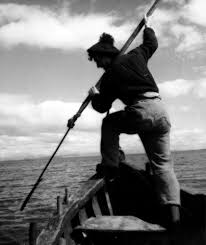
As the “monsters” described here are giant, plankton-eating basking sharks, modern viewers may see the hunt for them in a different light. They’re more like whales, with the fishermen enduring days-long harpoon hunting them for “oil for their lamps,” placid creatures hunted for the film. But this practice had died out decades before the movie was filmed.
That’s one of several liberties the pioneering Flaherty took with documentary realism to create this film. The “rules” were different, and as he was the filmmaker who helped make those rules you take the unrelated Araners “cast” as a family (Colman “Tiger” King, Maggie Dirrane and Michael Dillane) and other documentary deviations with a grain or two of sea salt.
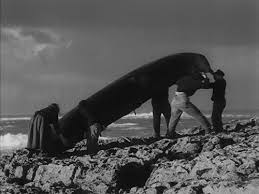
The island that the pounding, relentless waves that “Tiger” and his mates beach their fragile, traditional boat on has no trees and almost no soil. Flaherty’s film treats us to how the islanders fished, made lamp oil and created soil for gardens and pastures for sheep to graze on outside of their ancient, thatched and turf-heated cottages.
Maggie rocks her toddler, and puts her down for a nap in rocks among the shallows as she and “son” Michael fish kelp out of the sea to lay on plant beds that Tiger — when he’s not fishing — pounds out of the rocky clifftops with a sledge hammer. It’s a laborious process practiced on greenery-starved islands the world over, and a vivid reminder of how clever and enterprising our ancestors were.
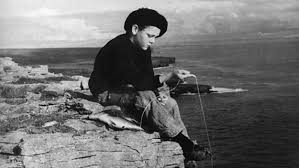
Michael fishes for dinner from the cliff tops, catching and keeping a crab in his Aran Islander’s cap until he’s got a line — with a rock as “sinker” — which he artfully winds up and hurls into the shallows to hook a fish.
Tiger and his crew battle the waves rolling into a lee shore, timing out their arrival to spare the boat a beating, patching it with cloth and pitch in The Olde Ways when it gets stove in.
Much of the film is taken up with shark hunting, an “Old Man and the Sea” ordeal of harpooning, tying off and riding out the fish’s efforts to escape until it gives up. As few seaquarium visitors today would be fooled into thinking of these huge, toothless sharks are “monsters,” this dated practice weighs on a film that is otherwise most illuminating in its quaint folkways.
The looped sound — with dialogue scripted and “performed” — gives away the “not a documentary” game early on.
But the portrait of these thin-margin lives lived on a stark rock in the Atlantic remains eye-opening, even if we suspect a movie about the making of it (there’s already been a documentary about the documentary) would be more revealing nowadays.

Rating: shark hunting violence
Cast: Colman “Tiger” King, Maggie Dirrane and Michael Dillane.
Credits: Directed by Robert Flaherty, scripted by Robert Flaherty and John Monck. A Gaumont British release on Tubi, TCM, other streamers.
Running time: 1:16