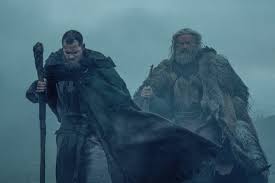
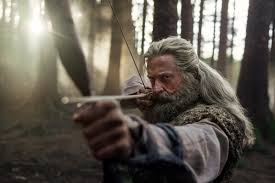
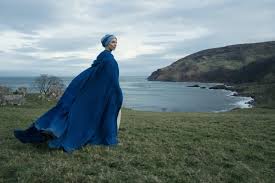
Here it is, the latest “Robin Hood” that nobody asked for and perhaps nobody wanted, something that’s been the case ever since Russell Crowe dragged some merry men into Sherwood sixteen years back.
Michael Sarnoski’s “The Death of Robin Hood” demythologizes the egalitarian hero of English folklore and gives us a cynical “brigand” in his last days, accepting who he “really” was, or at least casting off some of the lore about his exploits as, –full of remorse — he sets the record straight at the end of his days.
It’s a glum and downbeat tale of the mid-Middle Ages, capturing a world where life was “nasty, brutish and short,” as the old expression goes. Fighting was grim, intimate, bloody and to-the-death, even if the stakes were as low as a loaf of bread to sustain the winner through another day.
But what makes it interesting, what pulls you in, is a compelling turn by Hugh Jackman in the title role.
This is “Logan” with “King Lear” pretensions, a cynical “hero” who recognizes that the myth is more important than the truth, but sees the limitations of that in a public that worships one false god/icon after another.
“Lies upon lies,” our wizened, white-haired murderer and armed robber describes events that “never happened,” “characters that never lived like “Little John” and “Guy of Gisbourne. “It’s just a story.“
In the treeless north (Northern Ireland locations), Robin Hood keeps to himself, feeds starving strangers who come to his fire and recognizes the clans he’s crossed in blood feuds that bring even young women seeking revenge on the man who has filled an impromptu graveyard on the snowy, windswept mountains and moors.
He reunites with a grieving Little John (Bill Skarsgård), who goes by “Edward,” having taken a victim’s name and wife and started a family with her, only to have his past bloodily catch up with him.
So many clans have been slaughtered, creating scores of enemies, that nowhere is safe. And the onetime Robin of Loxley hasn’t the stomach to “start over” somewhere new. He’s facing his fate one ambush or botched attempted rescue of Edward’s wife and child at a time.
There’s nothing dashing about being able to shoot an arrow through a tween-age boy’s eye, no time for sword fighting derring do, nothing romantic in writhing knife-fights in the mud and muck, no “Maid Marian” to save from evil Prince John/King John.
This is just a thieving/killing “villain,” denying his identity to one and all, playing out his hand, waiting for the end.
Convalescing in an island priory where Sister Brigid (Jodie Comer) practices state-of-the-art 13th century healing (bleeding) just delays the inevitable, as Edward/Little John’s daughter (Katie Breen) is taken in, and the last fighting-age male (Noah Jupe) in a clan Robin killed off is sure to show up.
A leper (Murray Bartlett “Tales of the City” and “The White Lotus”) can urge the “crippled” stranger to learn which trees to care for and which traps to set, to keep the priory going. But we know our Robin is not long for St. Clement and its elderberries, pears and apples.
Sarnoski, who did the most recent “Quiet Place” and the Nic Cage culinary classic “Pig,” works in close-ups, with limited, spare to the point of barren locations and a color palette in shades of grey, brown and red — stone, mud, fur, leather and bleeding injuries of the terminal and healing variety.
He keeps the story fatalistic and the mood glum, and the dialogue spare.
“Would you like me to pray for him?”
“If you wish.”
“The world cares only about blood.”
If there’s an allegory applying to the present day, it’s the stripping of heroes and mythos from the culture, with every figure reduced to his or her human failings and the repercussions of that through cults and culture.
But truth be told, this is hard-going as a movie-watching experience, a “Quest for Fire” without humor or sex, a “Robin and Marian” without romance, a “Robin Hood” without dash, derring do, “merry” men, just accomplices.
This is a fanboy’s idea of Robin Hood — a Dark Knight/Wolverine anti-hero bloodying his hands in a world without pity, justice or empathy and only remorse about eveyrthing that’s missing. And it’s worth asking “Who the hell wants that?”

Rating: R, gruesome, graphic violence, nudity
Cast: Hugh Jackman, Jodie Comer,
Bill Skarsgård, Katie Breen and Noah Jupe.
Credits: Scripted and directed by Michael Sarnoski. An A24 release.
Running time: 2:03