
Wes Bentley stars in this crime drama, about “a suburban dad who turns to a life of crime to support his family.” Seems a little dated, with unemployment back below 6%. But we’ll see. Jason Isaacs is in it. Dec. 12 release.
Wes Bentley stars in this crime drama, about “a suburban dad who turns to a life of crime to support his family.” Seems a little dated, with unemployment back below 6%. But we’ll see. Jason Isaacs is in it. Dec. 12 release.
 “Dumb and Dumber To” felt like a blockbuster, earning laughs from the audience I saw it with even as I wearied of it at about the 30 minute mark.
It had a big Friday — not epic, but big for a comedy — and appears headed for a weekend win at the box office, besting “Big Hero 6” $36-33 million, according to Deadline.com’s estimates.
Saturday’s the bigger day for an animated film, so “Hero” could pull out the upset. “Interstellar” doesn’t figure, as it is in line for a still-very-healthy $28 million or so.
Apparently, women aren’t making the big movie going decisions this weekend. The very fine genre picture “Beyond the Lights,” perhaps suffering from the low profiles of the stars and the clunky title, is only opening in the $6-8 million range. A love story set against the coarse backdrop of modern hip hop, maybe the music genre is scaring people off. Maybe they’ll show up Saturday. Gugu Mbatha-Raw is the bomb, and she’s bound for stardom.
“Birdman” added hundreds of theaters and cracked the top ten, “Gone Girl” has cleared $150 million, and “St. Vincent” is over $30. I think that last figure means that Bill Murray will collect an Oscar nomination, an indie smash (it’s earned three times what “Birdman” has). So all three of those figure in the Academy Awards.
 Reviews won’t hurt “Dumb and Dumber To.” The college crowd I caught it with ate it up. Granted, they weren’t Ivy Leaguers, but I dare say a generation that grew up with the original semi-raunchy Two Stooges Throwback are going to be all over the AARP qualified Jim Carrey and Jeff Daniels.
But the reviews have been pretty brutal. A few fell for its sentimental streak, and underwear stains. But not many. Watching “Horrible Bosses 2” last night I was struck again by how dated the Farrelly Brothers’ PG-13 grossout slapstick seems now. Their style may come back, but the Carrey and Mike Myers style of character farce — broad, cartoonish, unreal — has given way to believable dopes played by Will Ferrell, Ed Helms, Charlie Day and Jason Sudeikis.
The good reviews this weekend go to Jon Stewart’s directing debut, “Rosewater.” A good film telling the story of a journalist not exactly beaten to the edge of death in an Iranian prison. He was famous enough to have Stewart and Hilary Clinton, among others, rattling Iranian mullahs for his release. So his suffering seems pale by what the movies normally show us. But it’s realistic and commonplace, Stewart and the film’s subject prisoner told me.
The better reviews roll in for Tommy Lee Jones’ “The Homesman.” Hilary Swank leans into another Oscar worthy turn as a spinster who, with an old rascal (Jones) escorts three crazy women from the desolate prairie to Back East. Very good, I thought.
“Beyond the Lights” is a simple “Bodyguard” style take on music, the music biz, stardom’s cost today — but it stars Gugu Mbatha-Raw and critics such as myself are totally smitten. Very good reviews for a genre piece.
Then there’s “Foxcatcher,” the best reviewed release opening this weekend. OK, limited release.VERY limited release. Wider soon. Steve Carell, Chaning Tatum and Mark Ruffalo also transform themselves for this (somewhat) true story about the rich DuPont heir who murdered a wrestler.

For a few moments, it feels like a mistake, a director’s miscalculation.
Documentary filmmaker Gabe Polsky lets us hear his awkward, groping questions to an imperious, dismissive 50something Russian hockey legend.
Like many of the ex-Soviet interview subjects of Polsky’s Soviet national hockey team film, “Red Army,” Slava Fetisov doesn’t bother to turn off his phone. He keeps it in his hand, and dismisses the silly filmmaker’s clumsy efforts to draw him out — holding up his hand, smiling rudely as he takes a text and a call.
But Polsky is clumsy like a fox. With that simple introduction, he shows us what tough cookies these guys were to interview — “To be continued,” one tells him. “Next question,” in Russian.
And that takes us right back there, to the arrogant glory days of Red Army hockey, when this unemotional “Big Red Machine” destroyed the world’s best with their finesse, teamwork and nerves of ice.
“Red Army” is a delightful eye-opener, an entertaining history lesson that allows Cold Warriors, given the gift of time, to appreciate just how magical those dominant Red Army Club teams were in the ’70s and ’80s. They skated over, first to Canada and then the U.S., and utterly dismantled the best the Free World had to offer, weaving and passing and slapping the puck home in a series of humiliating defeats in exhibition matches, World Championships and Olympic games that played out like skirmishes in the Cold War.
Polsky tracked down “The Soviet Five,” the legendary line of that team through much of the ’80s, and tells us the inside story — the Politburo intrigues, the patriotic pride, the hateful coach who took credit for their glory and later, the lure of the N.H.L. and its big contracts as the Soviet Empire finally collapsed.
Polsky shows us old footage of the father of Soviet hockey, Anatoli Tarasov, a cliched portrait of a big, bearish, huggable Russian — teaching kids, encouraging them, building the team that became the world’s best by having them learn chess and ballet, only to run afoul of Brezhnev regime and be shunted aside.
Polsky wisely builds the film around Fetisov interviews, and the gifted defenseman’s biography mirrors the rise and fall of Red Army hockey and the country and system that produced it. If you don’t know his story, you will be drawn in to his battles with authorities, his betrayal by teammates, his pride and his difficult adjustment to the North American version of the game he has loved since birth.
We see America’s “Miracle on Ice” from a Russian point of view, watch as Fetisov tears up and cannot bring himself to watch that infamous 1980 Olympics defeat on videotape. “Red Army” recaptures the context — a fresh Soviet invasion of Afghanistan, worldwide rebukes, America celebrating the victory of “our system” over theirs. Since, as Soviet-era spokesman/journalist Vladimir Posner reminds us, “sport was a form of warfare,” that blow kicked the Bear where it hurt.
Polsky interviews a bemused ex-KGB agent (Felix Nechepore) in a park in front of a statue of Lenin. In between interruptions by his irrepressible granddaughter, Nechepore details the level of state control, the ways the KGB watched and “guarded” the star athletes, whom the state feared would defect decades before the defections began.
“Red Army” has chilling moments in common with “Blood in the Water,” the Cold War water polo grudge match documentary, and the lighter and more triumphant chess match film “Bobby Fischer Goes to War.” But here the triumph is more personal, an essay on Russia’s idea of patriotism that goes a long way to explaining the success of Vladimir Putin’s rule in spite of everything he does that threatens to throw the country and the world into reverse, into another dictatorship firing up another Cold War.
“Red Army” reminds us that the system that produced once invincible hockey could not survive exposure to the consumer economy and the lure of capitalist athletics then. And it probably won’t again, no matter how much they, as Detroit Red Wings coach Scotty Bowman enthuses, elevate “hockey to an art form.”

MPAA Rating: PG for thematic material and language
Cast: Vyacheslav “Slava” Fetisov, Scott Bowman, Alexei Kasatonov, Vladisllav Tretiak, Vladimir Posner,Lada Fetisov
Credits: Written and directed by Gabe Polsky. A Sony Pictures Classics release.
Running time: 1:16
 “The Mule” is a bloody, violent and yet grimly comic tale of an unlikely drug smuggler and the ugly war of wills that began the moment he got caught.
Because from the moment we see Raymond, played by Angus Sampson, who co-directed and co-wrote this “based on true events” story, we know he’ll be caught. Ray is undergoing a full cavity search in customs. Top to bottom, he looks guilty.
“Mule” then takes us back two weeks so we can see how Ray reached that point. A hulking fellow, Ray earns a big honor from his Australian football club. He is bullied by his TV repair shop boss, doted on by his hovering mum (Noni Hazlehurst), tapped for cash by his boozing stepdad and cajoled by his “brother,” his best mate and teammate, Gavin.
Leigh Whannell, co-creator and co-star of “Saw,” makes Gavin the sort of best friend Ray doesn’t need. Gavin likes his drugs, is slippery and manipulative. And he’s in cahoots with the team owner (veteran Aussie character actor John Noble) in a drug smuggling scheme. They want Ray to come along on a season-ending team trip to Bangkok and bring a load of heroin back. And they’ve got leverage — deadly leverage.
Early scenes establish Ray’s doltish spinelessness. He waffles, he hems and haws, even after Gavin’s made the purchase.
But Gavin trots out that word “brothers” often enough that Ray relents. As in such films as “Maria, Full of Grace,” we’re treated to a “How To” manual on drug smuggling — condoms full of powder that Ray must swallow, “Cotton shirt — breathes, hides your sweat.” No eating before the flight, but don’t refuse the meal on plane.
“Stewardesses’ll flag you as suspicious.”
Despite all those preps, Ray is caught. The cops are sure he’s holding. But they need his digestive tract’s cooperation to prove it.
It’s 1983, and Australia is eaten up with America’s Cup fever. Even the cops who hold Ray in a hotel room, waiting for nature to call, are swept up in it. Ray, though, is made of stern stuff. We see why he’s valuable to his football team. He won’t break. Or take a potty break.
Hugo “Matrix” Weaving delightfully chews up[ his scenes as a cop not above roughing Ray up, with Ewen Leslie as the “good cop” who tries to cajole our lad into taking a laxative.
The third act violence comes from the club owner, who has foreign-born henchmen he uses to try and get his cargo. But the humor, sprinkled throughout, comes from Ray’s bowel predicament and the clumsy ways he tries to survive it.
The story turns desperate here and there, but there’s often a defusing moment of humor. One henchman is Thai with the unhappy name of Phuk, and every time he’s summoned, there’s a laugh.
The script has just enough twists to keep us guessing, even though those twists have an air of predictability about them. But first scene to last, Sampson’s Ray is sympathetic to the point of pathetic, a hapless pawn intellectually over-matched by all the hustlers, relatives and cops he’s trying to outwit. Does he have the stomach for it?

MPAA Rating: unrated, with graphic violence, drugs and drug use, nudity and profanity
Cast: Hugo Weaving, Angus Sampson, Leigh Whannell, Georgina Haig, John Noble
Credits: Directed by Tony Mahony, Angus Sampson, written by Jaime Brown, Angus Sampson, Leigh Whannell. An XLRator Media release.
Running time: 1:43
Twenty years after they permanently lowered the bar on big, broad and dumb character comedies, Lloyd and Harry are back, “Dumb and Dumber” than ever in “Dumb and Dumber To.”
And within moments of the opening credits, you may find yourself overcome with sentimental warmth at seeing two 50something actors as characters that the years have not made smarter. Jim Carrey and Jeff Daniels energetically reprise their popular roles, and the warmth follows.
Sure, it’s only trickling down your leg and never comes close to reaching your heart, but warmth is warmth, right?
Those fart-joke farceurs, the Farrellys, re-team with their stars and an equally aged supporting cast for a film of occasional funny lines, random uproarious sight gags and bodily function jokes, all scented with a whiff of desperation.
Harry visits a catatonic, bearded Lloyd in a rest home, only to learn he’s been the butt of Lloyd’s twenty-year-long practical joke. The come-uppance? Harry enlists two groundskeepers to help him yank out Lloyd’s catheter (after changing his colostomy bag, with his teeth, of course).
And they’re off, doubling up on a Schwinn to visit Harry’s aged, estranged Asian parents and then the aged, bloated floozy (Kathleen Turner, enduring jokes about her current appearance) who supposedly had Harry’s baby and gave her up for adoption, decades ago.
Harry needs a kidney. So the 50something “ten-year-olds” motor to Maryland and then El Paso in search of the dopey bombshell (Rachel Melvin, game but out of her depth) who might be his donor-daughter, a “genital donor match.”
The Farrellys, who peaked “artistically” with the raunchy, rude and yet romantic “There’s Something About Mary” in 1998, hurl miss-or-hit sight gags and throw-away lines at us. Harry looks over 20 years of mail his parents saved for him.
“Oh. I got into Arizona State!”
Six credited writers, with onetime funniest man alive Jim Carrey on the set, and you get malapropisms such as “It’s all water under the fridge,” and “”That’s just a suburban legend!”
The fetching Miss Melvin tries her hand at a couple, as her character wonders if she should “go to India and volunteer at one of those Leprechaun colonies!”
The road trips here, with Rob Riggle playing a malevolent schemer trying to keep them from reaching Harry’s daughter, have an epic fart joke, but too many lame zingers and gags to sustain them.
Carrey’s recent appearance on “Saturday Night Live” reminded us of his gift for mimicry, and his post-Farrelly films have shown ambition and flashes of brilliance. And Daniels has been reliably funny in a wide range of comedies over the decades. They can still bring it. Watching Carrey eat a mustard-drenched hot dog is positively Keatonesque — Buster, not Michael.
Truth be told, I was never a fan of the first “Dumber,” but the stars made it endurable and convincingly stupid. Here, they’re sometimes funny, and sometimes just sad. They’re better than this, no matter how good they are at hiding the fact that they know it.
A whole generation has grown up on the antics of these two Rhode Island rubes, so a little nostalgia isn’t unwarranted. Box office hopes for this pre-packaged but very late sequel should be high. But the strain shows, even in the wizened-but-not-wiser stars, who are 52 and 59, respectively.
It’s just that comedy left the Farrellys behind over ten years ago, and their best efforts at reviving their PG-13 Three Stooges style feel cllumsy, old-fashioned and tired.
And that warmth we feel in those promising early scenes? With luck, it’ll come out in the wash.
 MPAA Rating: PG-13 for crude and sexual humor, partial nudity, language and some drug references
Cast: Jim Carrey, Jeff Daniels, Kathleen Turner, Rachel Melvin, Rob Riggle, Laurie Holden
Credits: Directed by Bobby Farrelly, Peter Farrelly, written by Sean Anders, Mike Cerrone, John Morris, Bennett Yellin and Peter and Bobby Farrelly. A Universal release.
Running time: 1:50

Gloom gathers over the movie “Foxcatcher.” The skies are perpetually grey and the only time we see don’t see red leaves tumbling to the ground is when they’re covered with snow.
We know something fatal is coming, even if our memories of the news story that broke there over 20 years ago are faint.
“Foxcatcher” is a story of obscene wealth and the careless arrogance that comes with it, of the in-bred lack of impulse control for those raised in a world that has never told them “No” or failed to indulge their every whim.
Some of the super rich get their jollies yacht racing, breeding horses for fox hunting or wielding behind-the-scenes political power. John E. DuPont found that limiting. A dilettante’s dilettante, he acquired degrees and published books as an ornithologist, donated buildings to colleges, spent the money to become a famous stamp collector and then, in his 50s, decided athletics was the next field he’d dabble in.
He collected Olympic wrestlers and swimmers at his family’s Pennsylvania estate. He liked to change his sissy French middle name “Eleuthère” to “Eagle,” and some of his lackeys bought into it.
Steve Carell transforms himself into a flesh-and-blood version of his “Despicable Me” super villain “Gru” as DuPont, a beady-eyed, eagle-beaked, barrel-chested man-child who lured Olympic wrestler-brothers Mark (Channing Tatum) and Dave Schultz (Mark Ruffalo) to his state-of-the-art facilities, where he could mine about, wear tracksuits and kneepads and pretend to coach them (older brother Dave was a college coach and Olympic champion) and then bask in the glory of “his” achievement.
Carell’s thick-featured, 50ish DuPont doesn’t look like the bearded madman we saw on the evening news. But with every breath, every brown-toothed grimace of a smile, he lets us know this guy is “off.”
And so is his “protege,” Mark Schultz. As Mark, Tatum juts his jaw and keeps his head down, covering ground in a muscle-bound simian stride. Always focused, Mark has an Olympic gold medal and a college degree, but he relies on his brother for training and access to the facilities where Dave is coach. Mark needs the tiny per diem schools pay him to speak to students and show his medal just to eat and gas up his cheap hatchback. When DuPont calls, offers to put him up, feed and pay him, it’s the answer to a prayer.
It’s just that DuPont, assembling a crack Team Foxcatcher, wants Dave, too. And the wily older brother is slow to warm to the weirdo.
“What’s he GET out of all this?”
A tug-of-war over the fragile Mark ensues between the brother-coach and the fellow whose family has been rich for so many decades that he figures anything can be bought — including Olympic glory.
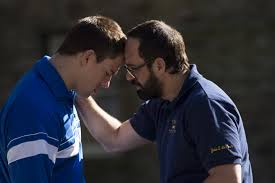
Actor’s director Bennett Miller (“Capote”) introduces Ruffalo and Tatum in an almost dialogue-free opening — training, wrestling, getting under each other’s skin and drawing blood. Their sibling connection can be read in Rufflalo’s eyes, in the way Tatum leans in to him, forehead on forehead, a wrestling posture that symbolizes their communication and closeness. It’s no stretch to see the beefy Tatum as an athlete, but he brings a sullen resentment to the role, an accomplished Olympian stuck in his brother’s shadow.
Ruffalo bulked-up and mastered the physical shorthand of the sport for his part, and brings a regarding soulfulness to Dave. He watches this odd duck his brother has hooked up with, and worries.
Carell, though, is the real shock to the system here. He is quirky, queer in the old fashioned sense, and pathetically funny. His DuPont is a wannabe surrounding himself with real athletes. Carell makes you feel sorry for the lonely rich man, failing to impress his dowager mother (Vanessa Redgrave), collecting tanks, enjoying target practice with the local police on a range he has built on his family’s estate. It’s a life of impunity, isolation, drugs and a craving for accomplishment to match his legendary ancestors.
Miller and his screenwriters toy with the timeline of events — most of what is here happens around the Seoul Olympics of 1988, DuPont didn’t set up his training until the 1990s.
But that doesn’t diminish or dilute the point of “Foxcatcher,” that to the monied classes which no “death tax” can touch, the rest of us are eternally “ungrateful.” And their contempt can have deadly consequences for people with so little regard for those they dare not call “the little people” except behind closed doors.

MPAA Rating: R for some drug use and a scene of violence
Cast: Channing Tatum, Steve Carell, Mark Ruffalo, Vanessa Redgrave, Anthony Michael Hall
Credits: Directed by Bennett Miller, written by E. Max Frye, Dan Futterman. A release.
Running time: 2:14
No, we’re not talking Bruins or Gophers or Badgers here. “Red Army” is a documentary about Soviet Era hockey — how it was built, what the one party dictatorship used it for and how it was perceived INSIDE the USSR, not outside, where the rest of the world hoped and prayed for its defeat. It’s supposed to be great. “Do you believe in Miracles? YES!”
“Red Army” opens in NYC Friday, and around the rest of the country as the winter rolls on.

“Beyond the Lights” is another pain-behind-the-music romance.
But it’s so well written, cast and played that we lose ourselves in the
comfort food familiarity of it all. This hip hop era “Bodyguard” has heart and
soul, thanks to stars Gugu Mbatha-Raw, Minnie Driver and Nate Parker. Simple as
it is, it simply works.
Mbatha-Raw shows a totally different set of skills from those on display in
her breakout period piece hit “Belle.” As rising hip hop phenom Noni, she sings
about her frankest desires and provocatively dances in outfits that leave little
to the imagination.
She’s dating the star rapper Kid Culprit (Machine Gun Kelly) who
guest-starred on her debut record. She doesn’t drink and never loses track of
the album that’s about to drop. Her driven stage mother/manager (Minnie Driver)
sees to it that Noni’s eyes are on the prize.
But Noni is in misery. On impulse, on what should be her moment of glory, she
gets drunk and staggers out onto a balcony to jump. Only the cop assigned to
guard her door can save her.
That’s the question that hangs over the rest of the movie. Can Officer Kaz
Nicol (Nate Parker) save Noni? From herself, her mother, a career path that is
as phony as her streaked weave, the falsies her handlers stuff into her bra
before each photo shoot, the sexpot persona that’s been built for her?
The twists to writer-director Gina Prince-Bythewood’s (“Love &
Basketball”, “The Secret Life of Bees”) film come from the competing agendas set
up here. Officer Nicol is the son of an L.A.P.D. captain (Danny Glover), a kid
being groomed for politics.
 Whatever the tabloids and gossip websites think did or didn’t happen on that
balcony could be damaging for Noni. But Kaz’s interest in helping her, his
supposedly reluctant “reward” for becoming her “hero” and thus a part of her
celebrity world, could be fatal to his ambitions. The exhibitionist singer can
succeed with notoriety. But “Hero Cop” could write off his political
future.Parker (“The Great Debaters,” “Red Tails”) has made “earnest” and
shirt-shedding roles a specialty, and he benefits here by us seeing his
conflicted character through Noni’s eyes.
Flashbacks show us the painful past that put Noni where she is, and show the
authentic voice the young working-class Brit seemingly borrowed from the late
jazz and soul chanteuse Nina Simone. Driver’s stage mom isn’t painted in broad,
monstrous colors. She’s just another damaged, needy woman living vicariously
through a child who has chances she never had.
The unutterably gorgeous Mbatha-Raw has the best “You had me at hello” eyes
in the business and the charisma that has us rooting for her, for love, no
matter the role. The real shock here is her musical presence, a voice that could
take her into intimate clubs for the rest of her life, or with the right skimpy
costumes and sexual choreography, into Nicki Minaj World.
Like Noni.
She gives life to this old-fashioned/sexually frank romance, totally
believable as a woman who might be impressed by the strong man comes to her
rescue, totally acceptable as a flashy-trashy candidate for Super Bowl halftime
show. If this sometimes corny romance works “Beyond the Lights,” it’s because
the lights are so perfectly pointed at her.

MPAA Rating: PG-13 for sexual content including suggestive gestures, partial
nudity, language and thematic elements
Cast: Gugu Mbatha-Raw, Nate Parker, Minnie Driver,
Credits: Written and directed by Gina Prince-Bythewood. A Relativity release.
Running time: 1:56
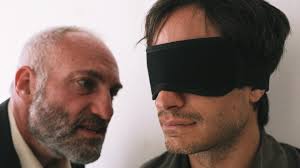
Maziar Bahari was a reporter in the right place at the right time. An Iranian ex-pat turned Western journalist, he toted a video camera and moved with smiling, cautious ease through his native land — catching up with his mom, careful not to expose himself or his sources as Iran’s 2009 elections turned into the abortive “Green Revolution.”
But he wasn’t careful enough. Within days of his return home, he was arrested, despite being an accredited Newsweek reporter. What happened to him in a prison cell of the Islamic Republic of Iran, endlessly questioned by an aging, violent and increasingly agitated ex-revolutionary turned interrogator, is the riveting focus of “Rosewater,” the film directing debut of pundit-comic Jon Stewart of “The Daily Show.”
“Rosewater” shows Bahari (Gael Garcia Bernal) arriving, always grinning as he befriends a young taxi driver (Dimitri Leonidas) who then guides into him into the youth culture that has been educated in a repressive, censorious Islamic state, by “Dish University.”
That’s what they call their fields of hidden satellite dishes, their connection to news that’s not propoganda, to web servers where the Twitterverse was still free. Bahari feeds his video and bends over backword not to endanger his sources or offend his hosts.
Then the election happens, President Mahmoud Ahmadinejad’s wins in a dubious landslide that made no sense to his foes, who knew the demographics. Like much of the Middle East, Iran is overwhelmingly young, and the young want “Mad Men” and Katy Perry CDs, not old guard Anti-American revolutionary rhetoric. As the protests start and the government-backed enforcers start shooting, Bahari is among those to get footage — uncredited — to the outside world. And that’s when the plainclothes cops arrive.
“He who knocks on the door at midnight has come to kill the light,” his mother (the soulful Iranian ex-pat Shohreh Aghdashloo) says, quoting the poet Ahmad Shamloo. And so he has.
“Rosewater” was the name Bahari gave his persecutor (Kim Bodnia), a cunning, perfumed older man charged with getting a confession from this Westernized Iranian, a confession that discredits his reporting and the bad light Iran is in since the election, with its ensuing violent government crackdown on protesters.
As Rosewater, Bodnia builds on the menace of potential. He is much bigger and tougher than Bahari. The prisoner is kept blindfolded, helplessly seated. Daily beatings are not necessary. It’s the psychological threat that eats at the reporter. He hallucinates debates with his dead father (Haluk Bilginer) frets over the mother he doesn’t hear from and the pregnant wife (Claire Foy) he cannot contact. His solitary confinement isn’t the ugliest we’ve ever seen. But the silence, the lack of books, human contact (other than increasingly intense questioning) wears on his psyche.
Stewart, whose “Daily Show” interviewed Bahrani in Iran, a fact used against him in the interrogations, plays the suspense card well. In adapting “Then They Came for Me: A Family’s Story of Love, Captivity, and Survival” he makes the abrupt turn-abouts alternately inspiring and alarming.
And Bernal shuts down any complaints about a Mexican playing an Iranian with his performance — by turns cheerful, fearful, broken and disappointed.
Bahari’s story might not be representative of every prisoner of conscience trapped in an Iranian jail. But Stewart and Bernal have made a smart, moving and media-savvy memoir that might not make the world’s totalitarians quake in their boots. But from North Korea to China, Iran to Syria, it will have them looking over their shoulders and on rooftops, in search of satellite dishes.

MPAA Rating: R for language including some crude references, and violent content.
Cast: Gael Garcia Bernal, Shohreh Aghdashloo, Dimitri Leonidas, Kim Bodnia
Credits: Written and director by Jon Stewart, based on the memoir by Maziar Bahari. An Open Road release.
Running time: 1:43