Movie Review: “The Homesman”

home

There’s a hint of the Dust Bowl in Oscar-winner Hilary Swank’s face — a worn, rawboned quality straight out of a Walker Evans photograph.
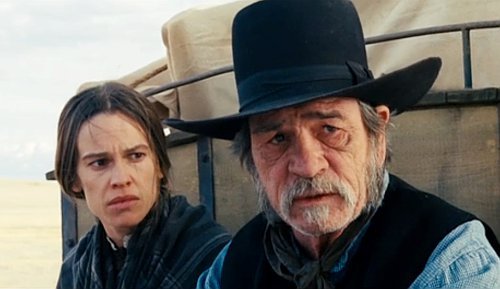
That makes her the perfect Mary Bee Cuddy, the sturdy not-quite-old-maid of Tommy Lee Jones’ film, “The Homesman,” based on the Glendon Swarthout novel. Mary is genteel but practical, tough, and wholly aware she is no great beauty. “Plum damn plain,” one potential suitor calls her. “Plain as an old tin pail, and bossy,” is how George Briggs describes her.
Considering that Mary just rescued this rascal (Jones) who made up his name on the spot, cutting him down from a vigilante’s noose, that’s not at all generous.
And Swank lets us see the vulnerability and hurt underneath this flinty woman who has taken on the task of escorting three farm wives who have lost their minds in their corner of treeless, remote 1850s Nebraska. She practices songs she remembers on a cloth mock-keyboard, grimaces every time she considers her loveless life, and then puts away that hurt to get back to the matter at hand.
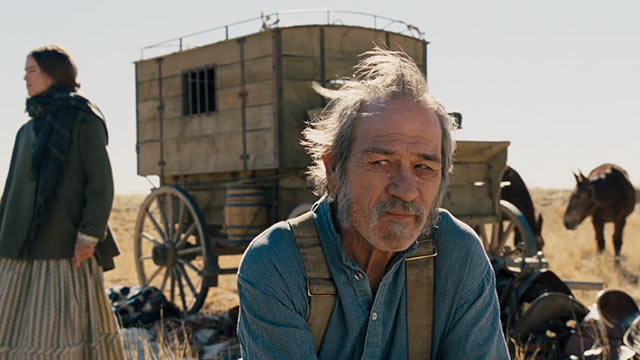
With claim-jumper Briggs coerced into helping, they will drive a jail wagon through five weeks of snowy early spring, all the way to the Missouri River where the women will be handed off to someone who can get them to relatives Back East.
We’re shown how the women (Miranda Otto, Grace Gummer and Sonja Richter,all terrific) descended into madness. One buried three babies, killed by diphtheria. Another snapped and killed her own child, and the third, a Norwegian (Richter), gave up her sanity when her mother died, leaving her raving at her cruel brute of a husband.
And then they’re off, passing through a wild land where armed teamsters are as dangerous as armed natives, where Indians and settlers alike desecrate each other’s graves, in search of clothes or blankets to aid their own winter survival.
“Homesman” is a quest parable set in a flat world of browns and greys, where spying that first cottonwood is enough to make Mary pause and marvel at just seeing a tree. Jones takes exceptional care documenting this world — the sod houses with their dirt floors, livestock prone to death by starvation, freezing or diseases the poor homesteaders had no clue how to cure.
Briggs and Cuddy are as hard as the land they travel through, though he’s pretty far gone. She is still compelled to acts of kindness, but in this environment, a pause to display a little decency can get you killed.
John Lithgow is the splendidly upright, if a tad hypocritical as the preacher who charges Mary with this quest, William Fichtner is hard-hearted husband to one of the women, Tim Blake Nelson makes a vivid impression as a teamster with thoughts of taking one of the crazy women for himself, James Spader is perfectly oily as an Irish-accented town developer and Meryl Streep transforms into a Martha Washington look-alike as a kindly preacher’s wife.
Jones tells this story with care and a lack of hurry, a pace to fit an age when people traveled no faster than two mules pulling a wagon could carry them. It’s “True Grit” and “The African Queen” with a moment of “Lawrence of Arabia,” period-perfect and a total immersion in this world.
He gives himself a juicy entrance, as we meet Briggs as he’s smoked out of a cabin he’s moved into without permission, an ornery cuss who likes his drink and loves his freedom. But Jones struggles a bit to make Briggs as light a character as he seems, and the little jigs he dances and songs he sings while drunk let you feel a serious actor straining to be whimsical.
But Swank’s Mary we meet behind the plow, “hardy pioneer stock” incarnate, a woman as dry and hard as the land she’s moved to. And the triumph of this performance is letting us see that the strength Mary projects may be the only thing keeping her on top of that wagon, and not locked inside it.

3half-star
MPAA Rating: R for violence, sexual content, some disturbing behavior and nudity
Cast: Hilary Swank, Tommy Lee Jones, Miranda Otto, John Lithgow, Meryl Streep
Credits: Directed by Tommy Lee Jones, written by Tommy Lee Jones, Kieran Fitzgerald and
Wesley A. Oliver . A Roadside Attactions release.
Running time: 2:02

Posted in previews, profiles and movie news, Reviews | Comments Off on Movie Review: “The Homesman”

Movie Review: “Always Woodstock”

1half-starwood1Only the faintest echo of hippy magic clings to “Always Woodstock,” a romantic-comedy-with-music set in the storied village where all that musical and cultural history was made on Yasgur’s Farm over half a century ago.
“Always” is about Catherine, a perky record company publicist (Allison Miller of TV’s “Selfie”), fired from “wrangling” a difficult Brit DJ-starlet (Brittany Snow). As she stumbles in on her self-absorbed actor-fiance (Jason Ritter) having sex with his dialect coach, this might be a good time for Catherine to return to her original life plan.
She wanted to be a singer-songwriter. The best place to do that? The old family homestead, which is not nearly as grand as it sounds. It’s a rundown, character-free ranch-style tucked away in Woodstock, New York, where musicians and artists linger, decades after Dylan, The Band and the crowds that came to that famous music festival left.
“In Woodstock,” Catherine narrates, “you can plant a daisy, and out pops a rose.”
There’s a sassy bartender (Rumer Willis) and a local barn converted into a music hall. If only Catherine can avoid getting drunk, singing karaoke and falling for a local doctor (James Wolk) long enough to write the songs that will get her signed to a record deal.
Fat chance. Their “attraction” is solely based on the requirements of the script, as is the record deal.
A little icing on this Rice Krispie Treat of a comedy — Katey Sagal, sitcom actress and singer, plays Lee Ann, once a famous singer-songwriter, now a cafe owner who doesn’t perform any more. She gets all the sage lines of advice that Lee Ann gives to Catherine.
The kid is thinking of selling out, but honey, “You are so much better than what just came out of your mouth.”
The kid has a past, maybe she should use it in song.
“Wherever you go, you take yourself with you.”
Ritter makes an amusing impression in his scenes — vain, dopey, weeping hysterically after sex. Miller isn’t without her charms, working a line like “I’m on a little thing called ‘The Rebound'” nicely.
Mostly, though, “Always Woodstock” is as instantly forgettable as the pleasant but unremarkable tunes Miller, Sagal and assorted soundtrack artists sing during the film.

wood2

MPAA Rating: unrated, with profanity, sex, a little violence
Cast: Allison Miller, Katey Sagal, Jason Ritter, Rumer Willis, James Wolk
Credits: Written and directed by Rita Merson. A Gravitas release.
Running time: 1:32

Posted in Reviews, previews, profiles and movie news | Comments Off on Movie Review: “Always Woodstock”

Movie Review: Jason Momoa chews it up in “Wolves”

momoa

Blame the jaw-dropping, laugh-out-loud but still hot werewolf sex scene. Who knew she-werewolves got their underwear ideas (boy cut) from “Sex and the City”?
Embrace the high-end transformation effects, the inspired casting of Jason “Conan” Momoa as a were-villain. Cackle over the jokey-ironic tunes selected for the soundtrack — “Bad Dog” (Gravelroad), “Big Bad Wolf” (The Heavy).
Dumb as it is, darned if “Wolves” isn’t the most entertaining hairy-human with fangs picture in ages, a short, brisk Canadian-made thriller with more wit in its 86 minutes than “Twilight” managed in a whole series of vampires and werewolves tales.
It’s a teen coming-of-age picture, which Cayden Richards (Lucas Till) narrates, start to finish.
He’s a high school jock, a quarterback dating a potential prom queen. But he has these nightmares. And one night on the gridiron they start to come true. Supernatural strength overwhelms him and he bludgeons an unsportsmanlike opponent.
Then there’s his freak-out/make-out session with Lisa (Kaitlyn Leeb). When he comes to, there’s blood all over his house, his parents are mostly-eaten and Cayden goes on the run.
His first tip that he’s something special comes from the one-eyed biker, Wild Joe (John Pyper-Ferguson). Wild Joe knows. Check out the dude’s teeth.
“You’re a predator,” he growls. “That’s what you are.”
He sends Cayden off to find his kind, and that naturally takes him to Lupine Ridge. There’s a bar, run by the fetching Angelina (Merritt Patterson), she of the boy-cut undies, and her comically drunken sister (Melanie Scrofano). There’s work, with farmer John Tollerman (veteran character actor Stephen McHattie).
And there are a lot of people with luminous blue eyes, elaborate beards, men who smoke antique pipes with a Black Forest/Brother’s Grimm look, women who have a hint of the dog-in-heat about them.
Yeah, this is their town, “the most vicious, secretive pack on God’s green Earth.” Cayden’s going to have to fit in, or be eaten.
Till, who was Havok in “X-Men: Days of Future Past,” has an agreeable screen presence and a voice deep enough to overcome his blond pretty-boy looks. Patterson, from TV’s “Ravenswood,” is beguiling and competent and hurls herself into the love scenes and fight scenes.
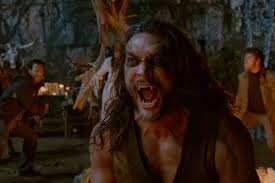
But Momoa, as Connor Slaughter, leader of the woodland wolves (as opposed to the domesticated “town” werewolves), dominates the picture and drives the action. He is menacing in every moment, utterly believable as an alpha dog who kills and eats other wolves as punishment. In a film with some pretty cool effects, he’s the coolest.
Writer-director David Hayter has fun with Momoa’s presence, with the music, with the effects and with throw away moments — a TV newscast labels the on-the-lam Cayden “The Cannibal Kid” for his crimes.
As zombies reach the limits of overexposure and vampires slide into semi-retirement for the same reasons, studios are sniffing around for werewolf scripts, reviving another staple of horror cinema as they do. But Hollywood will be hard pressed to top this lean Canadian indie picture that knows it’s just another dumb werewolf movie, but has fun with that knowledge.

2stars1
MPAA Rating: R for bloody violence throughout, and some sexuality
Cast: Lucas Till, Merritt Patterson, Jason Momoa, Stephen McHattie,
Credits: Written and directed by David Hayter. A Ketchup Entertainment release.
Running time: 1:26

Posted in Reviews, previews, profiles and movie news | Comments Off on Movie Review: Jason Momoa chews it up in “Wolves”

Movie Review: Katie Holmes is packing heat and a smile in “Miss Meadows”

Miss-Meadows

“Miss Meadows” never just walks anywhere. When you’re always in tap shoes, you never know when the urge to do a heel tap or paradiddle will strike you.
Unfailingly polite and genteel, she wears white gloves. Always. She never says good-bye, when “Toodle-oo” will do.
She keeps her home, in a rundown corner of suburban Cleveland, spotless — her yard a sea of flowers. And she wears the cutest floral, summery dresses, which she has the hardest time removing the blood stains from.
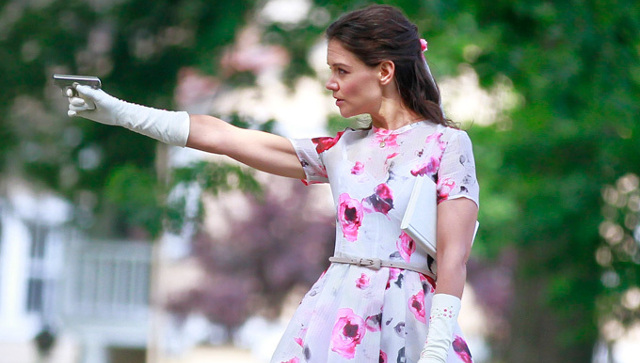
Because should a would-be rapist try to badger her into her pickup, should a sex offender (Callan Mulvey, the new “Joker”) move into the wrong house, should a priest be caught sexually assaulting a child, Miss Meadows isn’t shy about taking care of this social ill herself. In that tiny purse she carries is a tiny .25 caliber pistol.
Miss Meadows, given a dainty sparkle by Katie Holmes, could be “a ‘Pulp Fiction’ Mary Poppins,” as one sheriff’s deputy describes this vigilante law enforcement is looking for. The film about her isn’t quite that, a dark comedy that takes a darker turn into reality for its third act. But Holmes never breaks character in it, and what a character this Miss Meadows is.
An itenerant substitute teacher, she is direct and as honest as she can be, considering.
“I remind (children) of their goodness,” she says of her first grade teaching qualifications. Her motto, passed on through reminder phone-calls with her mother (Jean Smart), is “make a difference in this world.”
So if the teacher she’s replacing is dying of cancer, she gives the kids optimistic hope in the face of the harsh reality administrators would prefer she share. They write get-well cards, and when Miss Meadows learns the teacher has died, she brings the cards back to attach to balloons that will make their way heavenward.
There is no lesson that can be taught with a smile and a poem.
“Our time we must not idly waste,” mother always taught her, “since all our hours fly off in haste.”
The sheriff (James Badge Dale) is instantly smitten by this woman given to stopping on busy streets to make sure a toad makes it to safety. She isn’t unapproachable. But she only calls him “Sheriff,” even after it’s obvious he’s pulling that law-enforcement style of stalking, even as she’s giggling through sexual intercourse with him.
Writer-director Karen Leigh Hopkins has lots of fun with this surreal set up, and only really loses the thread when reality intrudes. There’s a reason Miss Meadows is how she is. The police are on her trail, her ability to get the drop on a bad guy is impeded when she starts making threats and everybody older than a first grader knows what can happen when you have unsafe sex.
But “Miss Meadows” makes a dandy showcase for an actress who a few years on the shelf, when plainly she still has a lot to offer. Just tell her to bring her tap shoes.

2half-star6
MPAA Rating: unrated with violence, sex, children in peril
Cast: Katie Holmes, James Badge Dale, Callan Mulvey, Jean Smart, Mary Kay Place.
Credits: Written and directed by Karen Leigh Hopkins. A Phase4 Films release.
Running time: 1:30

Posted in Reviews, previews, profiles and movie news | Comments Off on Movie Review: Katie Holmes is packing heat and a smile in “Miss Meadows”

Movie Review: “The Theory of Everything”

theory2

A great performance makes us forget the actor and see only their creation. That’s what happens in “The Theory of Everything.” We forget Eddie Redmayne’s meticulous efforts to recreate the brilliant physicist Stephen Hawking, a great thinker trapped in a contorted, crumbling, body.
His turn is so uncanny that we lose track of how beautifully conventional this story would be, were it not for its unconventional focus. This isn’t “My Left Foot” with a computer-voice interface. This is a biography of the author of “A Brief History of Time” tucked into an appreciation for the extraordinary woman who married him, nursed him and propped up his increasingly disabled body so that his brilliant mind could do its work.
“Theory of Everything” takes us from 1963 Cambridge, when young Hawking was hiding his potential behind laziness and procrastination. His esteemed professor (David Thewlis, always spot-on) may want to separate “the quarks from the quacks” in his class, but he sees Hawking’s potential and indulges his genius.
Then Hawking meets another distraction, to go along with chess and Wagner. Jane (Felicity Jones) is pert and pretty and proper, and not afraid of the shy atheist who flirts with her at a campus mixer. How smart can he be? He doesn’t know what she means when she says “C. of E.” (Church of England).
Young Hawking just grins and shrugs off “the whole celestial dictator premise” of Christianity, and she’s charmed. Meeting his family of wits — Simon McBurney is disarmingly warm, dismissive and sarcastic as Hawking’s dad — doesn’t scare the Medieval Spanish poetry major Jane off, either.
“I like to time travel,” she flirts to the cosmologist Hawking, “like you!
But there’s a hitch in his gait and a growing gnarl to his fingers. And when, 45 minutes into his search for “The Theory of Everything,” student-Stephen crashes to the ground on a Cambridge quad, the tragedy of his life begins. His diagnosed motor neuron disorder, “Lou Gehrig’s Disease,” gives him a two year life expectancy. He may smile when he says it, but he chases away friends and Jane.
This is where Jane shows her resolve and the movie averts a turn to tragedy. Remember, these were the children of Britain’s World War II generation, born during or just after the conflict. Hawking’s dad counsels her “This will not be a fight, Jane. This will be a very heavy defeat.” But she’s absorbed her parents’ spine of steel and won’t be chased off. They will marry and “fight this disease together.”
“Theory” isn’t about treatment or therapy, but it is, in a way, about what has kept Hawking alive half a century beyond his “two years” life expectancy. There’s the work, his ever-evolving epiphanies about time and black holes. And there’s Jane, who has his children and takes care of him and them without complaint.

thrr
Director James Marsh, working from an Anthony McCarten script, emphasizes the lightness, the comic sparkle that makes Hawking, robbed of so many of his body’s functions, a natural comic, even today. The real Hawking pops up on sitcoms (“The Simpsons,””The Big Bang Theory”). Redmayne lets us see the twinkle in his eyes as others notice the computer voice synthesizer given him has “an American accent.”
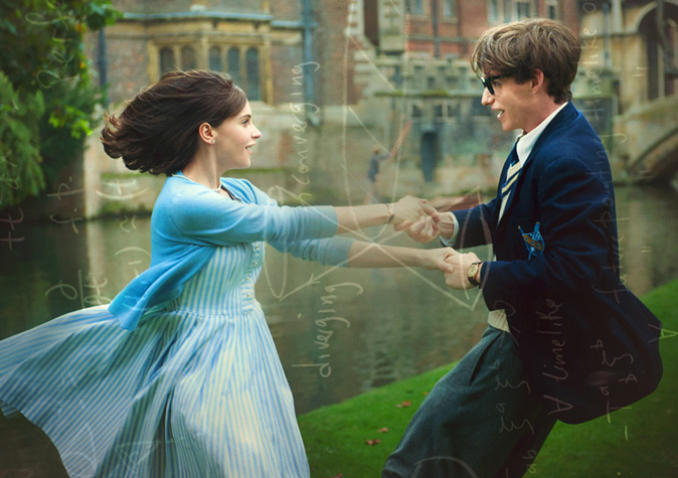
A favorite scene — a spring dance in college, where the non-dancing Hawking woos the poetry major by explaining why the white ties and vests of the formally attired men shine brighter in the low light.
“Tide,” he says. The laundry detergent had phosphorus in it.
Marsh keeps the camera in close — extreme close-ups for a doctor’s diagnosis, a hint of Jane’s attraction or Hawking’s crooked grin well after the disease has started its awful work. Somebody has been looking for him.
“You just missed him,” he stammers and slurs. “He was here, earlier!”
Jones has a beguiling screen presence that allows us to see what Jane misses as her husband becomes less of a companion and lover and more of a burden. We never quite see why she chose this life, willingly and with open eyes from the start, which is a shortcoming of the film.
As this is based on Jane’s book, and both she and the now-divorced Hawking are still living, we’ll have to take their word for it that this was most amicable divorce in history, or we’ll have to wait until those involved die to get at some messier truth.
But no matter how short “The Theory of Everything” falls in those regards, this delightful and inspiring drama succeeds the way Hawking has, even as he fails to deliver that “one theory” that explains “everything.” It’s reaching beyond your grasp, in life, in science and in film biographies, that achieves greatness.

3half-starMPAA Rating: PG-13 for some thematic elements and suggestive material
Cast: Eddie Redmayne, Felicity Jones, David Thewlis, Emily Watson, Simon McBurney, Christian Mackay.
Credits: Directed by James Marsh, screenplay by Anthony McCarten, based on the Jane Hawking autobiography. A Focus Features release.
Running time: 2:13

Posted in Reviews, previews, profiles and movie news | Comments Off on Movie Review: “The Theory of Everything”

Next Interviews: Questions for “Homesman” stars Tommy Lee Jones and Hilary Swank?

homsss

Tommy Lee Jones has turned into a pretty fair filmmaker in his later career. And Hilary Swank has emerged as a probable heir to Meryl Streep and Hepburn — so committed, so immersive, that it’s rare that she turns up in a film in which you aren’t thinking, “Could this be another Oscar for her?” She aims high, commits and often, the result is dazzling.

“Homesman” is Jones’ adaptation of a story about a stoic, “plain” single woman running a farm on the desolate, treeless prairie of pre-Civil War Nebraska charged with getting three farmwives who have gone mad out there where the winters are murderous, the baking summers unrelenting, the hardships many and the loneliness a trial. When I was in grad school in North Dakota, I read quite a few accounts of exactly this sort of thing happening — people going crazy under these conditions, and “Homesman” feels just so right in its depiction of that phenomenon.

Jones plays the itinerant rascal she blackmails into helping her. It’s as iconic a Western as any cattle drive tale or outlaws on the run epic. Five people, a wagon, winter lingering in May and many tests to endure before their journey is done.

Questions for Jones and Swank? I’m talking with them about “Homesman” and the world their characters today and would love some suggestions. Comment below.

Posted in Reviews, previews, profiles and movie news | Comments Off on Next Interviews: Questions for “Homesman” stars Tommy Lee Jones and Hilary Swank?

Today’s first screening, “Foxcather,” has Oscars written all over it

The story of the demented Olympic wrestling fan/coach from the chemical cash DuPont clan and his protege, “Foxcatcher” is built on performances by Steve Carell as DuPont, Channing Tatum as his star athlete and Mark Ruffalo as a fellow coach who sees the destructive spiral this relationship is turning into. Director Bennett “Capote” Miller lured Vanessa Redgrave into this prestige picture, going into limited release Friday. A can’t miss film.

Posted in Reviews, previews, profiles and movie news | Comments Off on Today’s first screening, “Foxcather,” has Oscars written all over it

Jon Stewart reveals why he made “Rosewater,” and how

daily

Discussions of “Rosewater,” the film directing debut of “Daily Show” host Jon Stewart, bring to mind Dustin Hoffman’s famous line about “Ishtar.”
“A baby isn’t born knowing how rich his parents are.”
Not that “Rosewater,” earning respectful and generous reviews from critics at home and abroad, is anything like “Ishtar,” a famous big budget flop stuffed with Oscar winners. But the sometimes controversial comic and political scold Stewart threatens to overshadow his film about an Iranian Newsweek journalist imprisoned for his coverage of Iran’s abortive “Green Revolution.”
If “Rosewater” ‘had been made by an unknown director, it would pass in the night with only scant notice,” Todd McCarthy sniped in The Hollywood Reporter.
Perhaps, but it stars Gael Garcia Bernal and Oscar nominee Shohreh Aghdashloo. And as Stewart admits, of all the parts of the movie business he knew little about, “marketing” a film tops out as that which he knows the least.
“I’m not even sure how you come to find out how you will get people to come see the movie,” he says. “The hope is that it connects with people and the word spreads.”
More than a few reviewers have suggested, as Entertainment Weekly’s Joe McGovern did, that the reason Stewart made the film is that Maziar Bahari, the reporter, was arrested after doing a seemingly harmless comic-interview about the Iranian election, from Iran, on “The Daily Show.”
“Stewart felt pangs of guilt over Bahari’s Kafkaesque plight” and made the film, McGovern opined.
“Unfortunately, our colleagues in the press take the poetic license that Jon is doing this out of a sense of guilt,” Bahari says. “‘The Daily Show’ and Jon Stewart did not play any part in my arrest and imprisonment…We press people simplify a story to make it more compelling.”
Stewart, 51, befriended Bahari, 47, after the Iranian was released from prison, and says the film “came organically from my friendship with Maziar. After he got out of prison, we used to have breakfast in New York and talk about life, family and politics. He was writing this memoir and he asked if I could help turn it into a movie.”
Stewart — lest we forget — has 25 acting credits in films (“The Faculty,””Death to Smoochy,” “Big Daddy”) and TV. That’s enough experience to justify stepping behind the camera to make a prison torture drama, set in Iran and filmed in Jordan.
“I leaned, most heavily, on my experiences making ‘Half Baked,”‘ Stewart cracks. “I paid a great deal of attention to the mechanics of filmmaking during that time. And applied that. Yes.”
Since taking over “The Daily Show” anchor duties in 1999, he’s interviewed the powerful, the famous, the funny and a lot of people from film. Stewart had access to a lot of advice.
‘”Always LOOK the DP (director of photography) in the EYE when you ask to change the set-up,'” he says. “But no, I didn’t get any helpful fortune cookie one-liners like that from anybody.”
But he did ask for phone numbers from Oscar-winner Kathryn Bigelow, who made “The Hurt Locker” and “Zero Dark Thirty” in Jordan, “people who could make a movie happen, there.” And he hired experienced Hollywood production people.
“I went into it knowing that I didn’t know what I didn’t know, not to sound too like Rumsfeld there. It really was a situation where I just made sure that I hired a team that knew their stuff…I just had to surround myself with people experienced enough to be able to raise flags when I was going off the rails.”
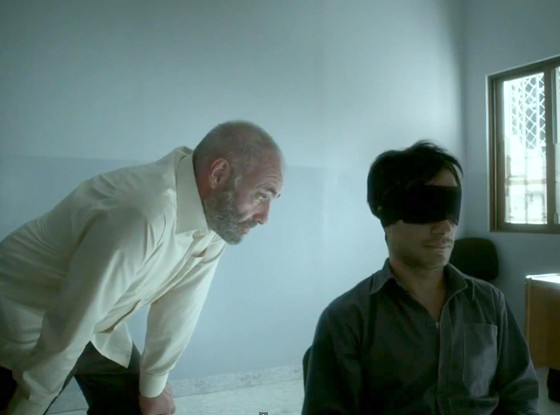
The film he and Bahari came up with focuses not on the sort of torture depicted in films such as “Syriana” or TV shows like “24.” It’s psychological, sensory deprivation-based and unhurried. And it’s much more common in the world than we like to think, Bahari says.
“What I went through and what Jon portrays in the film is what happens to the majority of people in prison in Iran, in China, North Korea,” says Bahari, now an activist and facilitator for journalists wanting stories out of Iran. “Of course, some people are more brutalized physically than I was. When you see ISIS beheading prisoners, those are anomalies. Those are not things that governments do on a daily basis. What Jon showed in the film is a systematic, institutionalized form of interrogation and torture. These governments — Iran, Russia, China — they have created a regime based on this sort of system of imprisonment and interrogation.”

daily2
Stewart says that aside from wanting to help his friend, to tell a story of a war of wills between an interrogator nicknamed for his cologne, and a prisoner (Bahari, played by Bernal) willing to sign anything just to escape his isolation, a big reason for filming “Rosewater” was to show Americans that our idea of torture is out of date.
“Our narrative vision of torture from the movies and TV create an expectation about it that may not match the reality,” Stewart says. The cattle prods, electric shocks, water boarding and physical abuse (a little of that is depicted in “Rosewater”) may go on. “It’s more cinematic to show beatings, and ‘Tell me VAT you KNOW, American dummkopf!’ That kind of thing. But it’s unsustainable and doesn’t get the results. It’s not really the way it is in most countries which torture today.
“There is a bureaucratic institutionalized form of torture in the countries where this goes on where prisoners are removed from society, removed from stimulation by seeing or hearing things, people, which truly drives them crazy,” he says. “I just hope the film makes us evaluate what it means to keep someone in solitary confinement.”

Posted in Reviews, previews, profiles and movie news | Comments Off on Jon Stewart reveals why he made “Rosewater,” and how

Box Office: “Interstellar” wins Friday, “Big Hero” should win weekend.

It may be that Deadline.com, after years of underestimating the Saturday impact of kids’ movies on weekend box office, is guessing right this time out.

“Interstellar,” almost 3 hours long and in limited IMAX release since Wed., won Friday with a healthy though not Marvel-sized $16.5 million take at the box office, on its way to a $50-52 million weekend. Very good.

“Big Hero 6,” opening Friday, with kids in school and late shows after kids’ bedtimes (well, good parents set earlier bedtimes) still did $16 million itself. It’s fanboy friendly and will pull the anime lovers out of the “Interstellar” set (they will see both, apparently).

So a big Saturday will give “Big Hero 6” and $55-60 million weekend, FTW.

Considering how weakly the box office has been performing this fall, that’s a welcome break.

Further down the charts, we see “St. Vincent” closing in on $30 million. Prediction, if it lingers into Dec. and closes in on $50, Bill Murray will get an Oscar nomination. A hit, even if it isn’t his greatest work, ups his chances. “Gone Girl” made lots of money, but has faded out of the top ten. Not sure if its Oscar chances fade with it, but that would be my guess.

“Fury” will finish in the $80 million range, “Nightcrawler” is still not pulling them in -a 44% drop, second week. Pity.

Posted in Reviews, previews, profiles and movie news | Comments Off on Box Office: “Interstellar” wins Friday, “Big Hero” should win weekend.

Movie Review: “Bhopal: A Prayer for Rain”

bhopal759

There is no zombie film, no torture porn picture that can match the horrors or pathos of “Bhopal” A Prayer for Rain.” The worst industrial accident in history makes a harrowing backdrop for a disaster film, and gripping melodrama.
This semi-fictionalized account of events that led up to a release of over 30 tons of poisonous methyl isocyanate (MIC) into the air by a factory surrounded by an Indian slum is all about the foreshadowing.
There’s the Union Carbide chief (Martin Sheen) who visits the pesticide plant, with its aged out-of-date technology, gets his hands dirty, yells at the lax safety regulations and “Indianization” of the factory he championed to “build better farmers” for India. But India is in a drought, so the company is losing money.
The plant safety inspector (Joy Sengupta) sputters in fear at the impoverished workforce’s lack of training, at the insistence of the local bosses that “we cannot stop production” for maintenance, that every near-disaster can be shrugged off “as long as we’re learning from our mistakes.”
Then there’s the haphazard local journalist (Kal Penn) whose UFO headlines and frequent print retractions undercut his constant efforts to expose that what Union Carbide is doing is dangerous.
The warnings were there, in hindsight. But as the film opens, Sheen’s company chairman Warren Anderson is sputtering at the first reports out of “that godforsaken slum,” that “I never should have trusted ‘those stupid people,'” and already thinking “damage control.”
In flashback, we see the world that grew up around this plant, which in ten short years had attracted a populous slum surrounding it. A mishap kills a worker, but that’s an opportunity for Dilip (Rajpal Yadav), a floor sweeper who finds himself promoted to maintenance gauge-watcher. He doesn’t know why he does what he does, or what the gauges mean. He only knows that he’ll be able to feed his family and provide a dowry for his younger sister.
The company line, that MIC is “harmless” and akin to the effects of tear gas, is swallowed by all — company men, loyal employees, even a local doctor.
But Motwani (Penn) smells the foul air, sees people getting sick and hunts for answers about this dead worker, a man “murdered by Union Carbide.” In what comes closest to the film’s big false step, he coerces a foreign features photographer (Mischa Barton) into confronting the visiting Anderson about the plant’s safety.
“We’re not making perfume here, miss.”
The 30 years that have passed, with a payout from the company that devalues Indian deaths and an India that is dashing from Third World to First World, contributes to a surprising even-handedness in the story. Locals bragging about “Indianization” — cheap, ill-conceived shortcuts for “efficiency” — callous supervisors and government officials who only voice concern that the plant might close, costing jobs , get equal villainous billing to the multi-national corporation which opened a factory that would never have passed muster in modern America.
Penn stands out among the performers, summoning up a thick Indian accent that his American roles rarely require. He gives this reporter a sort of righteous amorality, ends-justify-the-means ethos. It’s no wonder that his warnings fell on mostly deaf ears. He was “crying wolf” too often.
Co-writer/director Ravi Kumar does a wonderful job of building suspense as this long flashback brings people and events together for that one tragic night in December of 1984, when as few as 4,000 or as many as 16,000 people died — choking, vomiting, bleeding from their mouths, hurling themselves into waste water ponds to escape the deadly gas.
It’s a violent, shocking and moving sequence and a painful reminder that whatever the U.S. Supreme Court says about corporations enjoying the same rights as people, we have yet to see a company get the death penalty for mass murder — here or abroad.

3stars2
MPAA Rating: unrated, with scenes of graphic, bloody suffering and death
Cast: Kal Penn, Martin Sheen,Rajpal Yadav, Misha Barton, Tannishtha Chatterjee
Credits: Directed by Ravi Kumar, written by Ravi Kumar and David Brooks. A Revolver/Sahara release.
Running time: 1:36

Posted in Reviews, previews, profiles and movie news | Comments Off on Movie Review: “Bhopal: A Prayer for Rain”