
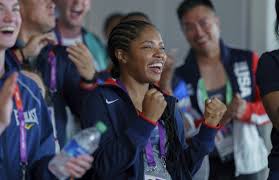
Movie Review: Woman Boxer shows us “The Fire Inside”

A couple of great performances lift “The Fire Inside,” a generally conventional “fight picture” about a boxer long odds in pursuit of Olympic glory.

The novelty to this compact genre drama from cinematographer turned director Rachel Morrison and Oscar winning screenwriter Barry Jenkins, of “Moonlight” and “If Beale Street Could Talk,” is that the fighter’s a woman, and in the film’s depiction of the fleeing glory of Olympic fame, which doesn’t necessarily translate into dollars for our real life heroine.

The fact that our real life boxer, Claressa Shields, is Black, poor and from Flint, Michigan makes her inability to cash in on her fame something of a metaphor for Flint itself, a city where poverty and race contribute to official neglect and disregard that led to an international scandal. That’s left unspoken and underdeveloped in a movie far too content to stop at each way station on the generic heroine’s journey in a movie that lacks suspense and a proper third act payoff.

“Girlfight,” which launched Michelle Rodriguez, was a lot grittier. “Million Dollar Baby” was more moving.

The little girl who shows up at Flint’s Berston Field House, a makeshift gym with a hand-lettered sign identifying it as such, is treated as peculiar and already unpopular. But she must be tough, as much taunting as she’s willing to silently endure from the boys already being tutored by part-time coach-and-manager Jason Crutchfield. But Crutchfield, given his trademark immersvive three-dimenionality by Brian Tyree Henry, indulges the eleven year-old (Jazmin Headley).

The boy boxer doing the most razzing is put in the ring with her, and it’s an insant mismatch. But the trainer gives Claressa tips between punches.

“Keep your front foot planted. This ain’t no ballet.”

Unlike the boys at that age, Claressa listens and follows instruction. She’s got grit. Her arms are short, and when she gets worked-up, they deliver a pummeling in short, swift strokes. “T-Rex” they nickname her.

Five years later she’s a contender. Claressa (now played by Ryan Destiny) is only 16 turning 17, battling much older boxers for a spot in the 2012 Olympics. But there are all these obstacles in her way. Her dad’s (Adam Clark) in prison, and isn’t exactly a help when he gets out. Her mom (Olunike Adeliyi) is just broke, self-absorbed and careless enough about “boyfriends” to make Claressa and her two siblings’ home life hell.

And that lifelong sparring partner (Idrissa Sanogo)? He’s grown up with Claressa, and their sparring can turn into wrestling and love taps these days. Uh oh.

Oscar-nominee Henry (“Causeway”) makes Jason instantly credible as a guy who knows a bit about boxing and a lot about kids. We can believe this cable TV repairman and married father of two is someone who’d welcome his prize prospect into his paycheck-to paycheck family, if that’s what it takes to give her a shot. We don’t worry about ulterior motives because there aren’t any.

But as Claressa punches her way towards an Olympic podium moment, we start to wonder what form her success will take, and how it will impact all their lives. Not in ways we’d expect.

TV star (“Grown-ish,” “Star”) transformed herself physically for the role. Her technique in the ring mimics the real Claressa, and her bravado — sulking, trash talking — is treated as attributed to her youth, and something that gets the fighter lectured by the Olympic powers that be about how to behave if she wants to make it onto that Wheaties box.

The struggle between her rough-hewn “true self” and the sort of young woman who attracts an agent and big endorsements isn’t particularly novel, or suspenseful. But it’s interesting to ponder this in the cold hearted calculus of “popularity,” female athletes’ “sex appeal,” race and the underclass.

“The Fire Inside” is a feel-good picture that feeds off our disappointment that not everybody who succeeds against the odds wholly “succeeds” against those odds, and makes us wonder if this will ever change.

Because “The Fire Inside” and pursuit of excellence for the sake of excelling isn’t enough, and for any athlete not born rich but dedicated to be the very best, it shouldn’t be.

Rating: PG-13, boxing violence, profanity, sexual situation

Cast: Ryan Destiny and Brian Tyree Henry

Credits: Directed by Rachel Morrison, scripted by Barry Jenkins. An MGM/Amazon Studios release.

Running time: 1:49
Posted in Reviews, previews, profiles and movie news | Tagged , , , , , | Comments Off on Movie Review: Woman Boxer shows us “The Fire Inside”

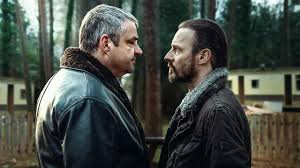
Netflixable? Dutch underworld’s less of a treat in “Ferry 2”

The Dutch underworld saga of “Ferry” Bouman finishes with something like a flourish in “Ferry 2,” the sequel to a gritty rise-of-a-“Pill King” in the Amsterdam underworld tale.

But a lot of what precedes that flash finale is pretty frustrating, a movie that’s slow to get going, with less interesting characters and stakes that feel lower because not enough attention is paid to “character arc” this time around.

Frank Lammers made a cunning hulk in the original “Ferry,” an underworld enforcer who got a dirty job done — any job. Here he’s a retired hulk, a man of violence living under an assumed name in a caravan (RV) in the South of Spain, where much of Europe — not just mobsters — moves when their working days are done.

Ferry is 50something, grey haired and the first guy the trailer park activities folk think of when they’re looking for somebody to play Santa for the local kids. As “Andre” he speaks Spanish and seems to get by.

Then his punk grand niece Jezebel (Aiko Beemsterboer) shows up uttering the “You OWE me” (in Dutch with subtitles, or dubbed) cliche at the old man who “wasn’t there for” her after her grandmom and then her mom died. She’s shown up with a lapdog beau, Jeremy (Tobias Kersloot) who happens to know how to “cook” ecstacy.

They’re in the hole with a ruthless mini-kingpin named Lex (Jonas Smulders), and no amount of protesting “I want no part of any of this” from the guy in the Santa suit will do.

Ferry drives them north in that caravan, abruptly ups the ante with the venomous Lex and before he knows it, these “f–king kindergarteners” have him tied up in a scheme to steal the raw materials, find a disused cargo boat to “cook” in and keep this new villain and one old one, the turncoat Dennis (Huub Smit) at bay.

Jez is a flatly-drawn character who grows from impulsive and angry to impulsive and enraged. Ferry’s obligation to her, as “family,” seems dubious. The first time she “changes the plan,” he should have the sense to bail.

But the story decrees that he’s got to stick around and warn the kid that “The longer you wait” to get out, “the harder it gets.” He’s got to be reminded “You got old.” And he has to handle stand-offs with an aged gambler’s unjustified, past-its-expiration-date confidence.

An early heist is handled with a minimum of fuss, and the big final shoot out is in exactly the sort of place you’d expect with exactly the outcome you’ve seen coming.

For such a short thriller, “Ferry” never manages to feel brisk or breathless or even satisfying. Lammers should be irked that they wasted such an interesting character on a movie full of “kindergarten s–t.”

Rating: TV-MA, violence, drug abuse

Cast: Frank Lammers, Aiko Beemsterboer, Tobias Kersloot, Huub Smit, Hamza Othman, Charlie Chan Dagelet and Jonas Smulders.

Credits: Directed by Wannes Destoop, scripted by Geerard Van de Walle and Tibbe van Hoof. A Netflix release.

Running time: 1:35

Posted in Reviews, previews, profiles and movie news | Tagged , , , , , , | Comments Off on Netflixable? Dutch underworld’s less of a treat in “Ferry 2”

Series Preview: Former President DeNiro tries to save us from another “Zero Day”

Netflix is in the Bobby DeNiro business. This thriller series about the aftermath of a cyber attack on America, and the threat of another, premieres Feb. 20.

Posted in Reviews, previews, profiles and movie news | Comments Off on Series Preview: Former President DeNiro tries to save us from another “Zero Day”

Movie Review: French couple constrained by the limits of “Just the Two of Us”

“Just the Two of Us” is a textbook domestic abuse melodrama, a French film with just enough mystery about it to make us wonder if it will transform into a thriller.

Based on a novel by Éric Reinhardt, Valérie Donzelli’s movie tells the story of a love affair, marriage and its breakdown from the woman’s point of view.

Virginie Efira from “Madeleine Collins” and “Benedetta” is Blanche, who meets the handsome and rakishly-named Grégoire Lamoureux (Melvin Poupaud of “Jeanne du Barry”) at a party her twin sister (Efira again) is throwing.

Actually, they “meet again.” They went to school together. He used to be “fat,” he says, as if such creatures ever turn up in French films. He’s tall, dark and handsome, a smoker with a name so poetic sounding she keeps repeating it.

He cultivates an air of mystery, but insists “Lamoureux” the banker “doesn’t want to keep secrets from” Blanche the high school French teacher. He quotes from “Brittanicus” (in French, with English subtitles), charms and seduces. A tumble into bed becomes a romance, a pregnancy and a marriage.

But the concern she expresses to her OB-GYN — “I haven’t known my partner very long.” — is our first tip that this isn’t what it seems.

He is charming, but controlling. The first lie she catches him in is a doozy. That “transfer” to a bank branch “in the boonies” far away from the coast and her family and friends wasn’t ordered. He asked for it. He wanted to get her away from her twin, her widowed mother and her school.

He doesn’t like the degree that she shares their lives with her sister.

“She’s my twin!”

“She’s not part of our relationship!”

Another baby comes, and the “control” ramps up. Her taking a job at a distant school, showing independence, isn’t his idea of a marriage.

The fact that we reconstruct much of what happens by virtue what Blance says to an interviewer (Dominique Reymond) tells us something went wrong. But is she talking to a lawyer? A counselor? A police interrogator?

The simple plot is decorated with tense moments, brittle arguments and textbook examples of manipulation and “abuse” that begin long before violence is threatened.

Efira makes Blanche understandable and sympathetic in classic “women’s melodrama” fashion. She cheats and she lies, but whatever reason she’s being “interviewed,” we trust it’s her side of the story that we will identify with.

Poupaud gives the game away by putting us on guard, right from that first seduction.

This French film never quite lapses into “Lifetime Original Movie” victimhood, but with every hint of stalking, badgering phone calls at work and every berating she endures, we know that whatever Blanche does to escape this is justified.

Still, it’d be nice if there was more to guess about, more suspense and more subtlety to the conflict. “Just the Two of Us” seems pre-ordained and predigested, with every emotion tugged at and every “trigger” and behavioral “tell” underlined so as to remove any doubt about what’s going on, who is the victim and who is to blame.

Rating: 18+, violence, sex, nudity

Cast: Virginie Efira, Melvil Poupaud, Bertrand Belin and Dominique Reymond

Credits: Directed by Valérie Donzelli, scripted by Audrey Diwan and Valérie Donzelli, based on a novel by Éric Reinhardt. A Music Box release on Amazon Prime.

Running time: 1:45

Posted in Reviews, previews, profiles and movie news | Tagged , , , , | Comments Off on Movie Review: French couple constrained by the limits of “Just the Two of Us”

Documentary Preview: A longer (full trailer) look at “Becoming Led Zeppelin”

It’s been a long lonely lonely lonely time. But that ends this Feb. “Authorized” and sanitized? Sure. Still looks fun.

Posted in Reviews, previews, profiles and movie news | Comments Off on Documentary Preview: A longer (full trailer) look at “Becoming Led Zeppelin”

Movie Review: Jackie Chan, in the silly present, in the fantastical past “A Legend”

Let the record reflect that Jackie Chan is more limber, nimble and in better faux fighting trim at 70 than you are at 60, 35 or 20, “Boomer,” “Xer,” Millennial or what have you.

Hong Kong’s king of martial arts clowns is still working, still slinging punches and taking falls, albeit with a little more help from stunt doubles, digital effects and wirework these days.

The fact that he’s making “Karate Kid” sequels in Hollywood and action fantasy foolishness like “A Legend” in China takes nothing away from his legacy. And while many of us would rather watch a clip-filled documentary of Jackie’s Greatest Hits, stunts and accidents titled “A Legend,” this Stanley Tong reincarnation spectacle is what we have on offer instead.

Chan plays two roles in this big budget boondoggle. There’s the fictive present, in which an archeologist (Chan) leads a team of young researchers in pursuit of a Hun Hoard, a hidden treasure trove of ancient Han China/Hun Invaders history. And there’s the Han Dynasty past, where a de-aged Jackie is a general, one of the leaders trying to turn the tide against the Huns via Chinese patriotism, Chinese ingenuity and Chinese might.

“The peace of our country and home is forged by heroes!” the cavalry shout, the sort of messaging we see in more than one Chinese film of the current era. It’s agitprop masquerading as entertainment, and one can only hope it isn’t any more meant to ready “the people” for World War III than a Hollywood “Top Gun” sequel, or a Chinese flag-waver in the “Top Gun” style.

In the present, our professor tries to give a clueless assistant (Zhang Yixing) hints that cute, always-mini-skirted-assistant (Peng Xiaoran) has a crush on him. That’s while they are researching this jade and gold amulet they found on a buried warhorse.

In the past, a dynasty hangs in the balance as the Han prepare to face down a ruthless new leader of the Huns (Max Huang).

Shamanism plays a role in events of the past and the present as the scientist and his aide start having dreams that insert them into this past of derring do and self-sacrifice.

The battles are vast in scale, on a par with “Spartacus,” Jet Li’s “Hero” and other overpopulated historical spectacles where waves of extras gallop across the screen.

But any hope that the ancient story will becoming gripping and immersive is frittered away every time writer-director and longtime Chan fight choreographer Stanley Tong (Chan’s “First Strike” and “Vanguard” are among his directing credits) takes us back to the designer-clothed silliness of “research” and clumsy flirting in the present.

You just know this thing will climax in an underground ice palace of Hun construction filled with stolen Han gold.

The rom-com stuff elements are piffle, as is the plot. The younger version of Chan is a lot more lean, leading man-looking than the Prince Valiant-coifed Jackie we remember from 40 years ago. The acting is adequate, nothing more.

But the fights still measure up. Kind of.

Rating: unrated, violence

Cast: Jackie Chan, Gülnezer Bextiyar, Yixing Zhang, Chen Li and Max Huang

Credits: Scripted and directed by Stanley Tong. A Well Go USA release.

Running time: 2:09

Posted in Reviews, previews, profiles and movie news | Tagged , , , , | Comments Off on Movie Review: Jackie Chan, in the silly present, in the fantastical past “A Legend”

Movie Preview: Donnie Yen’s a two-fisted cop who kicks more ass as “The Prosecutor”

Love that Donnie Yen.

Jan. 10.

Posted in Reviews, previews, profiles and movie news | Comments Off on Movie Preview: Donnie Yen’s a two-fisted cop who kicks more ass as “The Prosecutor”

Classic Film Review: Cleese shows us Classic Comedy can be “Clockwise” (1986)

A person hellbent on maintaining his dignity in the face of everything thrown at him to deny it, and failing, is the essence of comedy. So it was with Keaton, and so it is with Cleese.

Somebody said that once. Maybe it was John Cleese himself, that paragon of British reserve, keeping up appearances, keeping calm and carrying on, and convulsing in barely-controlled fury when the world conspires to be uncooperative.

A tall, lean, business-suited sight-gag, Our Lord J.C. was long the tentpole who held up the canvas over “Monty Python’s Flying Circus” and the very picture of British reserve-upended as Basil Fawlty, hotelier from hell. And Torquay.

His greatest film outing, “A Fish Called Wanda,” illustrated this, with Cleese writing himself a posh upper-class barrister, stuffily-married, but outed as a man willing to throw character, ethics, morality and British reserve out the window the moment vamp outlaw Jamie Lee Curtis shows him a little leg.

But 1986’s “Clockwise” shows Cleese as his peers saw him. The English playwright Michael Frayn, hot off the success of the grand farce “Noises Off,” tried his hand at screenwriting a role tailor-made for Britain’s premier funnyman, still basking in the glow of “Fawlty Towers” himself.

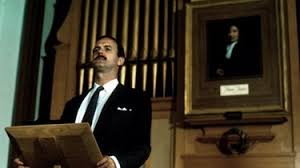
Brian Stimpson would be the quintessence of Cleese, an officious, class-conscious over-achiever who runs Thomas Tompion Comprehensive School with a Big Brotherly iron fist. His eyes peering through all-seeing binoculars, his every bark betraying that he knows each and every student by name, his every utterance announcing their shortcomings.

“Right,” he snaps at each and every miscreant who isn’t toeing his narrow line. “9:20!”

That’s their appointment for a visit to his office for a very firm chewing out — “EXECUTION!” Because Stimpson’s every move is a “correction” aimed at turning out successful students destined to show-up the posh “elites” sent to the far pricier Eton, Harrow and Westminster.

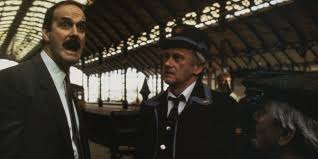
On the day we meet him, Stimpson will lead the school through another singing of “He Who Would Valiant Be,” and then hop a train to Norwich for a meeting of the elite Headmaster’s Association. Brian Stimpson of downmarket Thomas Tompion is the newly-elected chairman of that group of his betters.

He’s a clock-watcher, scheduled down to the minute. His wife (Alison Steadman, who’d go on to glory in Mike Leigh’s “Life is Sweet” and “Topsy-Turvy” and TV’s definitive “Pride and Prejudice”) shows up early, and that’ll never do.

His tendency to snap “RIGHT” at the beginning of every sentence is about to be his undoing. A clock-conscious martinet is about to experience an existential crisis, a trip to Norwich that becomes a long, sunny stumble into tortured, tested tardiness.

He goes “RIGHT” when the rail ticket collector keeps trying to tell him “left.” A train is missed, his wife is off to give little old ladies (including Ann Way and future Miss Marple Joan Hickson) from the nursing home a drive in the country.

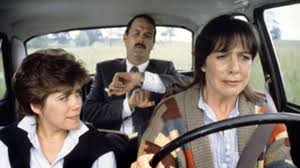
It’s 1986, when the film scores were synthesized and there was no cell service or cell-enabled ride-shares. Brian Stimpson, who left the “this is a historic day” speech he’d been rehearsing to give to the headmasters on the wrong train, sprints and scrambles and eventually arm-twists a star pupil (Sharon Maiden) into driving him 163 miles to Norwich.

“Call your parents,” before they set off in her family car, he orders. She doesn’t. She calls her beau to break up with him, leaving one and all in the dark.

Her parents panic at the stolen car, then at the missing daughter. Her “beau” turns out to be the creeper school music teacher (Stephen Moore of the BBC’s “Hitchhiker’s Guide to the Galaxy”). Stimpson’s neglected wife spies him chatting up student Laura as he fills up her parents’ Morris 1100.

All sorts of scandalous misunderstandings, threats of real justice and rough justice and reprisal pile up as our “couple” make their heedless, hapless way to scenic Norwich.

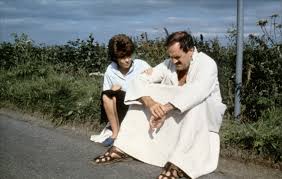
Parents, his wife, cops and that groomer-teacher are all in hot pursuit. But none of them, and no fender-bender, stuck car, smart aleck farmer, monastery full of not-utterly-silent monks, no Porsche-driving posh who resents being carjacked, British busybodies or a college girlfriend (Penelope Wilton, later a star of “Downton Abbey”) can keep Brian Stimpson from his date with destiny.

Cleese is marvelously self-absorbed as Stimpson, taking care to never show us the raging Basil Fawlty of his most recent series as Stimpson faces every fresh challenge with a panicked “adapt to our circumstances” logic. Brian is simply dismayed at each new obstacle to achieving his simple goal — that meeting, his speech and the glory and meaning it will give to his hyper-focused life.

“It’s not the despair, Laura. I can stand the despair. It’s the hope” that breaks him.

What Frayn, Cleese and director Christopher Moraham conspire to give us is the promise of a Cleese spitting, bug-eyed rage, looking for laughs in denying us what we crave — a meltdown for the ages.

This 90 minute picture is never rushed, ticking over clockwork fashion, logically and amusingly leading us from one barrier to the next, paying off with that big “meeting” with his more privileged (all white “old boys” of the original “Old Boys’ Network) where everything and everyone will come to a very English (reserved) boil.

The finale doesn’t wholly come off. But this picture plays, and Cleese sparkles in one of the only genuine big screen showcases he ever starred in, a slow-boil farce from a master at writing them paying tribute to an actor tailor-made to star in them.

Rating: PG, innuendo

Cast: John Cleese, Alison Steadman, Penelope Wilton, Sharon Maiden, Stephen Moore, Joan Hickson, Peter Cellier, Ann Way and Geoffrey Palmer

Credits: Directed by Christopher Morahan scripted by Michael Frayn. A Thorn EMI/Universal release on Freevee, Vizio, Mubi, Youtube, Amazon etc.

Running time: 1:36

Posted in Reviews, previews, profiles and movie news | Tagged , , , , , , , | Comments Off on Classic Film Review: Cleese shows us Classic Comedy can be “Clockwise” (1986)

BOX OFFICE: “Sonic the Hedgehog 3” goes “BOOM,” “Mufasa” is NO “Lion King”

Adding Keanu Reeves to the (voice) cast of the “Sonic the Hedgehog” franchise pays off with a franchise-best opening weekend for “Sonic the Hedgehog 3.” The franchise-best was the first film, which opened at over $72 million. The third fiilm in this video game adapation series looked to be a world beater, but fell off dramatically Sat (Word of Mouth?) and will clear $62 million the weekend before Christmas, per Variety.

With Reeves playing “Shadow” in the Sonicverse, the sequel did $26 million in business Thursday and Friday, not shabby at all.

Reviews are as indifferent as you might expect, perhaps less negative than earlier outings. But then, most critics haven’t bothered to review it. It’s a hit, almost a blockbuster, but not a franchise best, a world beater or anything else. Look for “Sonic 3” to fall off a cliff next weekend.

“Mufasa,” the “Lion King” prequel that Disney CGI’d to life, is giving the House of Mouse a wakeup call. Wearing out intellectual property with CGI remakes of animated classics, repeating yourself to try and repeat the business of earlier smashes, has its limits.

“Mufasa” did half the box office of “Sonic” on Thursday and Friday, and may clear $35 million. Saturday will be the make or break day for it, even though this film was set up to be holiday-season smash. Ticket buyers may smell the cynicism in this project, or they may just be tired of “The Lion King” story, recycled and prequeled to death.

Holding “Moana 2” until Thanksgiving wasn’t the smartest move, and now Disney finds itself competing with itself — and “Sonic” — for that family audience it let “The Wild Robot” have all fall.

Critics weren’t any more thrilled to see it than audiences seem to be.

“Wicked” leapfrogged “Moana 2,” as Disney split the audience for animated family fare. “Wicked” nudged in at $13.5 million, with “Moana 2” slowing its roll to $13.1,

“Gladiator II” is running out of gas with a $4.6 million weekend, its last in the top five.

A lot of Oscar contenders are opening Christmas, although none of them are expected to suck the life out of “Sonic” and “Mufasa” — “A Complete Unknown” should crack the top five, and there’s that Nicole Kidman cougar sex games thriller “Babygirl” and “The Brutalist” going wide as well.

Posted in Reviews, previews, profiles and movie news | Tagged , | Comments Off on BOX OFFICE: “Sonic the Hedgehog 3” goes “BOOM,” “Mufasa” is NO “Lion King”

Netflixable? Black Women serve in WWII — “The Six Triple Eight”

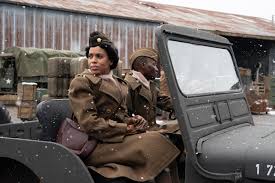
The only all-Black Women’s Army Corps united to serve in World War II n Europe is fondly remembered in Tyler Perry’s “The Six Triple Eight,” a polished, sentimental and old fashioned picture that points out to the culture at large an important piece of African American history.

World War II was a turning point in American civil rights, as Black troops and Black pilots were reluctantly celebrated in a country slowly coming to grips with the idea of “equal rights.”

Black women making the mail run to and from the combat zones played their part. And if that seems lower stakes than the myriad other Black contributions to the war effort, Perry’s film tries to remedy that. It’s not wholly successful.

Ebony Obsidian (“If Beale Street Could Talk”) stars as Lena, a Philadelphia high school teen courted by a Jewish boy (Gregg Sulkin) as he’s about to enter the Army Air Corps. When he’s killed in 1943, she resolves to finish high school and sign up for the WACs.

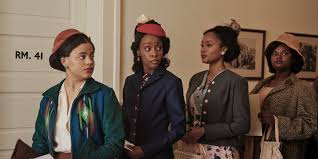
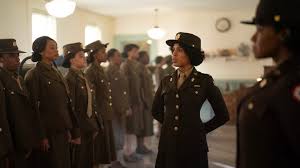
That’s where she meets Black women from all over America anxious to serve. Shanine Shantay, Pepi Sonuga, Sarah Jeffery, Jeanté Godlock and Moriah Brown play Lena’s comrades in arms, put through their basic training paces by Lt. Campbell (Milauna Jackson) and the 3888 Batallion’s commanding officer, the accomplished and driven Captain Charity Adams.

She’s the one determined to prove her more cynical volunteers’ fears wrong, that “They ain’t gonna let no Negro women NEAR Europe, much less Hitler.”

Captain Adams (Kerry Washington) clasps her hands behind her back and reminds them “We have the most to prove” as she warns the recruits about all the racists, in and out of the Army, who “do not want us to succeed.”

They can’t even get themselves assigned anywhere after completing basic training in Georgia.

But the movie’s opening scene has hinted at a logistics problem the war effort has failed to master. A pilot is killed, strafing a battlefield. A GI who finds him takes a bloodstained letter out of his jacket. All sorts of mail, to and from the front, is not making it to the troops fighting or the folks back home anxious to hear from them.

That’s a crippling “morale” problem that comes to the attention of first lady Eleanor Roosevelt (Susan Sarandon), and to Mary McLeod Bethune (Oprah Winfrey) a member of President Roosevelt’s “Black Cabinet,” the civil rights advisors who bargained for racial equality through participation in the conflict.

That’s where the Six Triple Eight will make its mark, straightening out the mess with the mail under the thumb of racist white officers bent on ensuring their fail and a white general (Dean Norris) determined to let the world know when they do.

The script strains to make this part of the war effort’s importance known and felt. The film’s resemblance to “Hidden Figures” is most obvious in the ingenious ways the WACs reason out where assorted units are on the fluid front lines.

But “The Six Triple Eight” stumbles as the characters are often stock “types” — the sassy one, the preacher’s daughter, etc. Liberties are taken with the timeline of events and Perry’s inattention to the militaria of it all bites him in the bum time and again.

The opening combat scene is clumsily conceived and staged, and the narrative bungles events in the action, which is mainly confined to the last months or even days of the war. Lena’s Jewish pilot is shown shot down in a P-51 Mustang many months before they were in service. The cockpit instrument panel shown is plainly for a more more modern (swept wing jet) aircraft. A V-1 “buzz” bomb air raid is inaccurately timed, and myriad other events are packed into the mere days between President Roosevelt’s death and the war’s end in Europe.

Washington is good in a role that asks for little more than stern stand-offs and speechifying, Obsidian has a moment or two and Shantay (of TV’s “Perfect Harmony”) stands-out as the mouthiest, most short-tempered member of the battalion, whose commanding general refers to as a “company,” at one point. A war zone love story is treated as an afterthought.

“The Six Triple Eight” illuminates the barriers these women faced, confronted by outright racism on occasion and reduced expectations at every turn. Perry’s sympathetic treatment of this history — stay through the credits — is laudable, and no one can ever say he can’t turn out slick to the point of immaculate melodramas. These ladies are so smartly made-up and prepped for their closeups that it calls to attention how tidy and sterile this cinematic war is. It barely looks lived-in, much less fought.

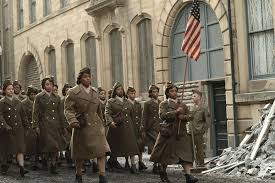
The best scenes are a parade march through bombed Glasgow, and an elaborately staged USO dance, a blast of jitterbugging that would best anything filmed in the musicals of the World War II era.

But Perry’s growth as a filmmaker peaked with his adaptation of the celebrated play “For Color Girls” back in 2010. Here, he’s blessed with material just as dramatic and important, and you’d swear from the evidence that he’s never seen a WWII movie, much less gotten his co-writer to cross his T’s and dot his I’s researching it to get the details right.

Rating: PG-13, violence, profanity

Cast: Kerry Washington, Ebony Obsidian, Shanice Shantay, Milauna Jackson, Kylie Jefferson, Susan Sarandon, Sam Waterston, Dean Norris and Oprah Winfrey

Credits: Directed by Tyler Perry, scripted by Kevin Hymel and Tyler Perry. A Netflix release.

Running time: 2″07

Posted in Reviews, previews, profiles and movie news | Tagged , , , , | Comments Off on Netflixable? Black Women serve in WWII — “The Six Triple Eight”