
“Once Upon a Time in the Middle East” is a Chinese blockbuster with an Iraqi War setting and spaghetti Western title.
As epic sagas go, Muye Wen’s film lurches along a tightrope, teetering between intimately sprawling and ambitiously overreaching, between an Eastern perspective on conflict children and straight up People’s Republican agitprop.
Wen, who directed “Dying to Survive” about “foreign” control of life-saving medicine, and who contributed a segment to the “My People, My Country” anthology film celebrating the founding of the People’s Republic, waits until the later acts of the film to bend it towards “child victims/child soldiers” of international conflicts. So the messaging feels like an afterthought in a tale of one righteous Chinese chef’s struggle against Western Imperialists, Islamic terrorists and “Americanized crap” Chinese dishes like General Tso’s Chicken and Chop Suey.
The perspective can be fascinating to Western eyes. The filmmaking is immersive enough to take us into the beginnings of the American invasion of Iraq in 2003 — vivid grounds-eye-view scenes of the first air attacks on Baghdad — on into the horrors of terrorism that spread throughout the Middle East when Saddam Hussein’s regime was brought down.
The storytelling? It’s kind of a mess — meandering and occasionally damning until it zeroes in on our hero’s efforts to “save those kids” — war orphans — and goes all sentimental on us.
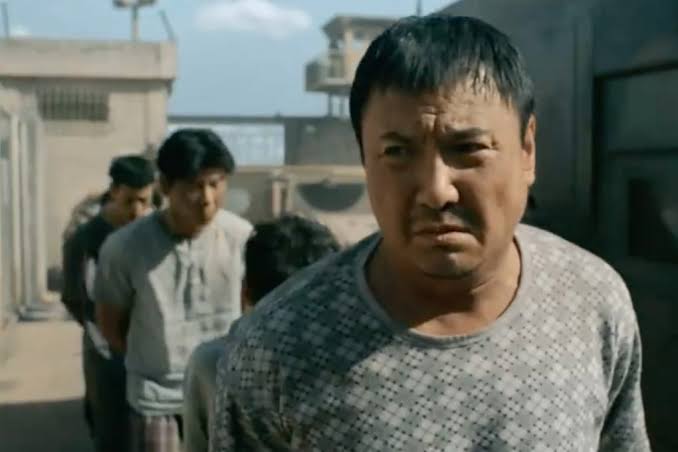
It’s framed within a flashback that begins as an aged and scarred Chinese chef, Xu Fu (Teng Shen) faces hard present-day questions from the customs officers of an unnamed state (Iraq). He was labeled a “terrorist” years ago. Why should we let you back in?
“It’s more complicated than that,” he says.
In the days after 9-11, Xu was a widowed cook deep in debt who took a job in Loong Restaurant in far-off Baghdad. He left his young teen daughter with his mother and traveled far for big bucks which will allow him to pay his bills.
Desperate as he is, he takes umbrage at any how-Chinese-food-should-be-cooked questions from Zaid (Sharif Subhi), a Ba’athist and former government minister who owns Loong Restaurant and appears to be on the outs with Saddam’s regime.
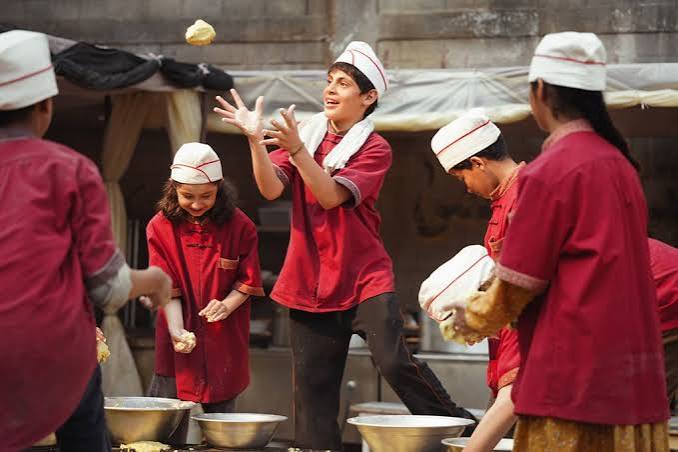
But with manager Ma Jungsheng (Qiming Jiang) acting as peacekeeper/intermediary, Xu takes the job and proceeds to dazzle the locals and keep the place packed.
All those TV press conferences with their American and Iraqi posturing and saber rattling? “Just noise,” Xu is reassured.
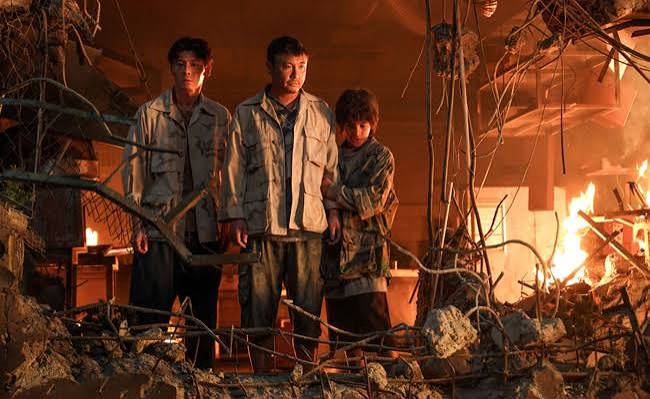
Then the bombs start and the city and country shut down in war mode. The neighboring orphanage, which still has children from earlier conflicts, still needs to be fed, as do the occupiers. Zaid, back in power thanks to the American alliance, arranges for this lone restaurant to feed the Green Zone thanks to U.S. food supplies and other black market arrangements.
Xu takes on the orphan boy Saif (Omar Sherif) as an apprentice. And Zaid takes and pays bribes, trying to save his sickly daughter via black market U.S. Army medicine.
And then things break down, the Iraqi uprising begins and all that food prep and pep talks to orphans is set aside as Xu runs afoul of first one side and then another. The restaurant becomes an illegal after-hours bar. One “ABC” (“American Born Chinese”) GI (Aarif Lee) is either the best intermediary they could wish for if they want to get rich off this war, or the guy who could be their downfall.
And that one English phrase Xu’s quick to master doesn’t do him nearly as much good as he’d like when the door is kicked.
“Cook. NOT terrorist!”
The narrative is over-reliant on voice-over (Mandarin with English subtitles) narration as the script has Xu try to keep a story that’s all over the place on the screen somewhat more coherent just with words. The pace suffers as the plot proper takes forever to get to the starting line before ambling along to the finish.
Teng Shen of China’s rally racing “Pegasus” film franchise creates a stoic and enterprising hero to build the story around. But every new character — our “ABC” GI, the Iraqi restaurant owner who changes priorities, a jihadist “head master” teaching kids in prison — adds a plotline that has only cliches and archetypes to recommend it.
The pictures comes to a halt any time the picture pauses to underscore some point about those nefarious Yankee Imperialists, or the Muslims China fears and stereotypes just as much. Yeah, we get it.
The production values are great, and the food prep montages sparkle and tempt. But I found the whole unwieldy as “Once Upon a Time in the Middle East” staggers into this cliche, that predictable turn of events and one villain after another.
It’s perfectly fair to paint American interventionists and future members of ISIS in a damning light. But surviving and escaping them should require more than just plucky plot tropes slathered in sentimentality.

Rating: unrated, graphic violence, profanity
Cast: Teng Shen, Qiming Jiang, Aarif Lee, Sharif Subhi and Omar Sherif.
Credits: Directed by Muye Wen, scripted by Qunli Lang, Muye Wen and Wei Zhong. A Well Go USA release.
Running time: 2:20