Movie Preview: A romance directed by Julia Stiles — “Wish You Were Here”

Hollywood has had its share of troubles making touching romances in recent years. But if you want somebody who knows the genre and has been in memorable movie romances, you could do a lot worse than giving Julia Stiles (“Ten Things I Hate About You,” “O,” “Hamlet,” “Save the Last Dance”) a shot at directing one.

Her feature debut is a bittersweet city romance involving graffiti and a love-testing illness.

Jan. 17, we see if she and her stars Isabelle Fuhrman (“The Novice,” “Orphan”), Mena Massoud (“Aladdin,” “Hotel for the Holidays”), Jennifer Grey and Kelsey Grammer deliver.

Having interviewed her a couple of times, I’d betting she pulls it off. The really smart ones pay attention to what works in a script, and what comes off on a set.

Posted in Reviews, previews, profiles and movie news | Comments Off on Movie Preview: A romance directed by Julia Stiles — “Wish You Were Here”

Movie Preview: James Gunn pulls out all the sentimental stops for his “Superman” teaser

Lex and Lois and Clark and a caped critter who barks.

Echoes of John Williams, a few names in the cast Brosnahan, Hoult, Gunn’s brother, a mwmber of the Reeve family and Wendell Pierce is “newspaper” editor Perry White.

Pushes the right buttons, right?  

July 11.

Posted in Reviews, previews, profiles and movie news | Comments Off on Movie Preview: James Gunn pulls out all the sentimental stops for his “Superman” teaser

Netflixable? Investigator meets a Murder Suspect and imagines herself “In Her Place (El lugar de la otra)”

The lone woman on a team investigating an instantly-notorious and very public murder finds herself understanding and even envying the murderess in “In Her Place,” a thriller with a message about the lot of women in 1950s South America, and the world.

Chile’s submission for the Best International Feature Oscar is based on a true story about a shooting in a swank hotel where Chile’s aristocracy gathered, a case that made headlines as a novelist faced prison for killing her lover, seemingly mimicking a more famous crime years before.

Elisa Zulueta plays Mercedes, a secretary to the judge (Marcial Tagle) charged with investigating this case and passing judgement. Mercedes is a wife and mother and the engine that makes that judge’s office run, a smart cookie in a patriarchal time in a very sexist culture.

Every man who calls her “Mechita” and “Mecha,” from her piggishly traditional husband (Pablo Macaya) to Judge Veloso is diminishing her and her status with a mere nickname. She must wait for the judge to leave his “club” before giving him his messages. “No women or salemen allowed.”

She keeps their cluttered, down-market apartment together and finishes each day by doing all the cooking while her failing portrait photographer spouse can’t be bothered to lift a finger, and her older teenage sons couldn’t imagine themselves pitching in.

The son who refers to her as “judge,” as if recognizing her career talents and importance, aspires to go to law school, become a lawyer and then a judge. But even he laughs when his sibling cackles “Mom could be your secretary (in Spanish, or dubbed into English).”

Something about this “crime of passion” that the judge seems inclined to minimize gets under Mercedes’ skin. She knows her boss has a “type,” rich, pretty women who do little time for their crimes. But she sees this case resembling one from years before.

She’s seen the suspect, Maria Carolina Geel (Francisca Lewin), her face covered in blood, led out of Santiago’s Hotel Crillón. She’s taken notes on every interrogation the judge conducts about the case, learning why that face was so bloody that the press has taken to nicknaming her “The Vampire.”

And whatever the judge and his aide Domingo (Gabriel Urzúa) think, whatever counter-arguments the persistent defense attorney (Pablo Schwarz) makes, in or out of the judge’s chambers, Mercedes sees clues that point to the “art” of it all.

Geel insists on going by her pen name and not her legal one, which might point to a dissassociative personality disorder that the male doctors who conduct her psychological evaluation could flag in her defense. The various witnesses, relatives and friends of the deceased paint a dark portrait.

The suspect treats the one other woman in all this, Mercedes, as a natural ally, but not one of the same class with the same privileges. Mercedes is the one sent to fetch Geel clothes and toiletries, to be delivered to her cushy incarceration in a convent. And in the suspect’s posh apartment, Mercedes tries on her lipstick, dabs on her perfume, and allows herself to sample this life of wealth, quiet contemplation and art.

Two-time Oscar-nominee (for best documentary) director Maite Alberdi immerses us in this world and underscores the sexism of that era, and even the patronizing benefits of it. No mere woman accused of such a “crime of passion” could possibly face the severest penalties. Especially a member of the elite.

Zulueta’s performance is a subtle transformation, from a functionary taken for granted by literally every man in her life to someone more made-up, better-dressed and more confident in the world thanks to her access to all the trappings in Geel’s apartment and the comfort of her life.

We feel little pity for the husband who apparerntly isn’t even as good a photographer as Mercedes. He’s using her inherited cameras to take these bridal photos, and can’t get the exposure time or the lighting right without her gentle manipulations.

Her “manipulations” of the judge are just as overt.

But much in this drama is left unsaid, so it’s up to Zulueta (“El fantasma”) to let us see what she’s feeling and thinking with just her eyes. She does.

It’s a terrific piece of work, and she and Alberdi and fellow screenwriters Inés Bortagaray and Paloma Salas have created in Mercedes a grand fictional conceit. This is a woman in man’s world who “gets it” and through her, we see this case as the prism it was, breaking down Chilean and Latin American society and sexism and illuminating a whole gender being ignored, past the moment a heinous crime was committed and into the “justice” that might be delivered by the men who ran that world, or thought they did.

Rating: PG-13, violence

Cast: Elisa Zulueta, Francisca Lewin, Marcial Tagle and Pablo Macaya

Credits:Directed by Maite Alberdi, scripted by Inés Bortagaray, Paloma Salas and Maite Alberdi, based on a book by Alia Trabucco Zerán. A Netflix Release.

Running time: 1:30

Posted in Reviews, previews, profiles and movie news | Tagged , , , , , , | Comments Off on Netflixable? Investigator meets a Murder Suspect and imagines herself “In Her Place (El lugar de la otra)”

Classic Film Review: Cary Grant Saunters into the Sunset, in his boxers — “Walk Don’t Run” (1966)

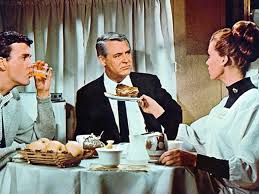
There’s an inspired silliness to the Technicolor bon bon “Walk Don’t Run,” the final film in Cary Grant’s legendary Hollywood career.

Surely a mere screenwriter — TV veteran (“Bewitched”) Sol Saks in this case — can’t have been the one to dream up tis all by his lonesome. The mere logistics of the picture hint that somebody or somebodies a lot higher up at Columbia Pictures had to be involved even before the pitch. There’s a bit of a “brain trust” feel to it.

Studios were remaking intellectual properties that they own the rights long before the phrase “intellectual property” was born. Columbia Pictures filmed and released the 1943 classic “The More the Merrier,” a rom-com where two-guys-and-a-woman are thrown together in a WWII housing shortage, with the older man matchmaking for the younger two. IThat story was always ripe for remaking.

But doing it in the more overtly sexy 1960s, setting it during the housing crunch at the 1964 Tokyo Olympics? Shooting sequences during those Olympics? Folding in the silliest track and field event of the games, the butt-twitching 50 km Race Walk?

Mocking British prudery, American provincialism, Soviet paranoia, apologetic Japanese manners and the cute culture shock of modern Westerners exposed to modern Japan, and ancient Japanese customs, mores and cuisine was merely a collection of clever finishing touches.

And trotting out Grant one last time, not destined to “get the girl,” but fit and over 60 and showing off comic timing polished during the Golden Age of Screwball Comedies is the cherry on top of it all. That was just the right level of “cute” and “quaint” this featherweight comedy needed. A very funny man lifts an amusing conceit into something that actually plays.

Grant is Sir William Rutland, an impatient industrialist who shows up at his regular Tokyo hotel, but not at the reserved time.

“Two days early” one clerk, then another and then a manager apologize, each bowing as they do. “OLYMPIC, you know,” they repeat, one after the other after the other. “Very sorry!”

Pinched for a place to stay, Rutland hits up the British embassy, gets the brush-off from a functionary with the too-too-British name Julius D. Haversack (John Standing), but then he finds an offer the share an apartment on the embassy’s bulletin board.

Next thing we know, he’s chauffered to this tiny upstairs flat with several tiny rooms and opaque paper walls. Next thing she knows, our young room-renter (Samantha Eggar, fun) is utterly buffaloed into letting him rent and stay there. With her.

One running gag begins. She simply can’t have this. Well, she needs the cash. So long as they leave “seperately.” So long as they have an understanding.

“You’re married?” she’s shocked/relieved to learn.

“Why not? I’m old enough!”

A second running gag, he drops this detail on his wife, by long-distance, and repeats it to business folk that he meets about this arrangement with “a young lady…a very attractive young lady.”

Everybody asks, “Relative?” As if Cary Grant didn’t have a shot.

Jim Hutton plays a long, lanky architect who has qualified for the Olympics in a sport he dares not mention by name. He, too, showed up early. He, too, has no place to stay.

Rutland makes the mistake of taking an interest in him — “You remind me of myself a few years ago. Well, quite a few years ago.”

We’re treated to the spectacle of the younger man buffaloing the older one into letting him share his “half” of the already crowded flat.

Christine may be engaged, to a stuffy fellow Brit — guess who? But all the brusque Yank and too-proper Brit need to make their love connection is Cary Cupid.

Grant is a delight all the way through this — scrambling up a (soundstage) gutter to get back into the apartment after he’s locked out, turning up unshaven, befuddled and annoyed, even stripping to his boxers and T-shirt to join in the Olympic 50 km Race-Walk to try and finish the (matchmaking) job in the film’s most famous scene.

One-liners are repeated as characters switch places, Hutton’s Steve Davis cracking “You remind me of myself a few years from now,” Grant’s Rutland turning Christine’s “I don’t think I LIKE tricky people” on Steve when the roles are reversed.

The picture’s a bit slow by modern standards. All this stuff about “bathroom scheduling” bogs down the opening act, and there’s a little too much of Rutland’s ongoing effort to distract Christine’s fiance so that Steve can make time with her.

But cute scene follows cute scene, many of them throwing “foreigners” into what had to seem exotic to audiences not that far removed from World War II — a bustling, modern Japan, a taste of Japanese dining out here, a visit to a public bathhouse there.

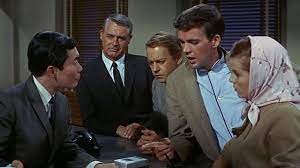
A WWII joke lands, the Russian Olympic Team’s easily fooled KGB man (Ben Astar) doesn’t. George Takei plays a Tokyo policeman trying to get to the bottom of Russian suspicions.

By this stage of his career, Grant had legions of comic impressionists joking about his suave accent, exaggerated phrasing and always-worth-a-laugh TIME-ing. He doesn’t make every line funny, but he gives it the Old Hollywood try. And that’s enough, in this case.

Director Charles Walters also helmed “The Unsinkable Molly Brown.” He didn’t take the right lessons from his best comedy, “Lili” (1953). It’s a half hour shorter than these later efforts, and pace is paramount in comedy, even when the comedy’s Columbia’s intellectual property.

Rating: TV-PG, innuendo

Cast: Cary Grant, Samantha Eggar, Jim Hutton, and George Takei.

Credits: Directed by Charles Walters, scripted by Sol Saks, loosely based on the script to “The More the Merrier,” by Frank Ross and Robert Russell. A Columbia Pictures release on Tubi.

Running time: 1:53

Posted in Reviews, previews, profiles and movie news | Tagged , , , , , | Comments Off on Classic Film Review: Cary Grant Saunters into the Sunset, in his boxers — “Walk Don’t Run” (1966)

Movie Preview: Jenna Ortega, Tea Leoni, Richard E. Grant and Paul Rudd face the consequences of the “Death of a Unicorn”

Will Poulter also stars in this March release, the debut feature of a writer-director who…was on the set (“additional crew”) of Eggers’ “The Witch” and got a producer credit on “Blow the Man Down.”

It looks dark and funny and Alex Scharfman got A24 to release “Death of a Unicorn,” so…

Posted in Reviews, previews, profiles and movie news | Comments Off on Movie Preview: Jenna Ortega, Tea Leoni, Richard E. Grant and Paul Rudd face the consequences of the “Death of a Unicorn”

Netflixable? Life’s Losers hit the Big-time at “Hotel Bitcoin” — they think

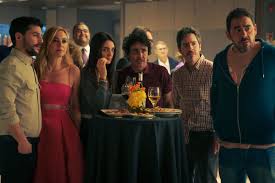
“Hotel Bitcoin” is a screwy Spanish variation on the well-worn “We’ve got the winning lottery ticket” formula. Broke people — the more careless and impulsive the better — find themselves theoretically flush, for once. The “fun” is in seeing how wrong they are and how badly they handle this.

The laughs here come from the usual places — clumsy, chatterbox dummies who can’t hide “We’re RICH!” as they evade family, mobsters and opportunists. But this time the payoff is in crypto currency.

We laugh at the many “How could they BE that stupid?” indiscretions and stumbles, or rather we’re meant to. We ignore the patchwork plotting and cardboard character “types” and giggle away at the reckoning we figure is coming for our four heroes, lifelong pals who have passed themselves off as “The Fantastic Four” since long before Marvel’s many attempts to turn that comic book into a movie.

It doesn’t work, but yes, those involved in comedy have hit on a great hook.

Alejo (Alejo Sauras) narrates this saga about the lifelong friends who have followed him off other financial cliffs before. Burly Tano (Pablo Chiapella) is “the tough one,” Pascual (Mauricio Ochmann) is the guy born in Mexico, still trying to just “fit in” all these years later. They’re all single.

Lucas (Canco Rodríguez)? He’s got a wife (Leonor Lavada) and two kids, so naturally he’s the “henpecked” one in their foursome.

Alejo is in deep with a rich mobster/loan shark, so deep he’s got to flee the country. But when Pascual pops open an old laptop left over from a previous failed business venture, he finds a stranger loaded all this Bitcoin on it years ago. And now it’s worth over 100 million Euros.

OK. Sure.

Alejo, “thinking” fast, insists they grab the laptop and dash off to the nearest high-end hotel, a five-star place in Mirasierra, one of Madrid’s toniest districts. They’ll get by for the weekend on the few Euros they have in their pockets, and on the biggest limit credit card among them until Monday, when they’ll track down a broker who can turn their Bitcoin into real cash and make them all rich.

What could go wrong? Who will screw up first? Whose unwanted attention will these loud louts grab?

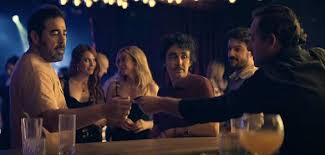
The problems pile up like bodies in the bathtub, or out-of-their-league babes who get their attention in the nightclub. Could they be sex workers? Even Mar (Marta Hazas), the one who says she “knows” Alejo?

Is that cocaine? What’s the dumbest way a screenwriter ever introduced a pistol into a narrative? A nosy bellhop (Antonio Gómez), a wedding they might crash, a poetry convention as cover and a too-curious, permanently-depressed former classmate (Sergio Bezos) figure in all this.

They’re mostly blown opportunities in a comedy that never gets up a head of steam.

There’s almost a laugh in how the script, by co-directors Manuel Sanabria and Carlos Villaverde, with screenwriter Ángela Obón, evades “explaining” crypto to the four dopes who stumble into it and, by extension, to the audience. There’s a good documentary about it, and of course the steady stream of scandals, schemes, fortunes lost, etc. in the news is out there for anybody who wonders where the next Great Depression will begin.

Yeah, crypto bros bet BIG on the con artist in chief.

The “Oh no they DIDN’Ts” are in so many scenes that it’s a pity they’re rarely worth a giggle. The dimwittedness undercuts any credibility in the “cunning” the quartet is meant to suddenly acquire later on.

The few possibly-funny characters don’t have enough to work with, the violence is treated like a glib (and blood and brains-spilling) afterthought.

All of which underscores the sad truth about “Hotel Bitcoin.” The comic possibilities are here. They’re almost never allowed to pay off.

Rating: TV-MA, violence, drug abuse, sexual situations.

Cast: Alejo Sauras, Pablo Chiapella, Marta Hazas, Canco Rodríguez, Leonor Lavado,
Mauricio Ochmann, Sergio Bezos and Antonio Gómez

Credits: Directed by Manuel Sanabria and Carlos Villaverde, scripted by Manuel Sanabria, Carlos Villaverde and Ángela Obón. A Netflix release.

Running time: 1:40

Posted in Reviews, previews, profiles and movie news | Tagged , , , , , , , | Comments Off on Netflixable? Life’s Losers hit the Big-time at “Hotel Bitcoin” — they think

Movie Preview: Jackie Chan, Ralph Macchio, “Karate Kid: Legends”

This has “made for streaming” all over it. Sorry, did I sound too enthusiastic, there?

But Jackie’s still (somewhat) Jackie, and maybe Ben Wang is a better draw than Will Smith’s kid. Ralph Macchio? “Great to be here!”

May 30.

Posted in Reviews, previews, profiles and movie news | Comments Off on Movie Preview: Jackie Chan, Ralph Macchio, “Karate Kid: Legends”

Movie Review: A French prison break that involves “Hunting with Tigers (Tigres et Hyenes)”

“Hunting with Tigers” is a heist picture with two heists — one involving cars and motorcycles, the other a boat. The second heist is a prison break from a heavily-guarded courthouse.

The script checks-off the requisite boxes of the genre — “assembling the team,” “casing the joint,” procuring the vehicles and puzzling over possible double-crosses as “the kid” trains with firearms.

“If you keep up the Dalai Lama act, we’ll never get anywhere!”

Our anti-hero is troubled by flashbacks to the afternoon his life was saved as the man he owes a debt to mowed down mobsters to do that saving.

And “Tigers” is French, so we expect the action beats to pop, the editing and the acting to pull us into the plot and the sizzling chases and whatnot.

But it’s a bust. The build-up is desultory, the payoff laughably French. There’s nothing funnier than a shoot-out involving hundreds of rounds punctuated by a screenwritten cop shouting “Don’t shoot, they’re unarmed!” (in French, or dubbed) when the murderous villains run out of bullets and options.

The occasional flashy shot or trunk-lid cam race through Paris doesn’t make this thriller make more sense or even engage the viewer.

The handsome Waël Sersoub (“MILF”) stars as Malik, who dashes home from Spain in his BMW convertible to be by his mother’s side for his stepfather’s trial. Serge (Vincent Perez) was in a gang that attempted a heist that went wrong and turned deadly. Malik, we learn, is also working the illegal side of the tracks.

A more famous armed robber, Chérif (Omar Salim) is implicated in Serge’s plot. But his lawyer insists he’s being railroaded. That lawyer (Géraldine Nakache) summons Malik to her office witn an offer and a taunt.

He can “help” his stepdad by delivering a message, in Spain, to another gangster. That made man might be able to bust Serge and Chérif out. If Malik had his dad’s bravery and genes, she implies, he’d do it.

Besides, she knows what’s in those flashbacks Malik is having. He was a kid, got into a deadly jam and Serge got him out of it.

Malik meets Avi (Sofiane Zermani), who owes Chérif, and Avi adds older hardcase Ange (Olivier Martinez, whose credits go back to “The Horseman on the Roof” and “Unfaithful”) and reformed-crook turned sofa-salesman Azzedine (Samir Guesmi) to their gang.

Because Malik is now a lot more than an errand boy.

Their “payment” and financing for this will come after they pull off the robbery of an armed convoy delivering a mountain of kickback-cash to a soccer star’s agent. Once they do that, it’s on to court, where the trial of the several suspects is underway.

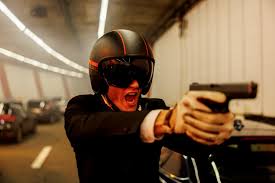
The first gambit makes (a little) more sense and has more action to it — hiding within an upscale Arab wedding party car convoy, then shutting down a busy tunnel. The second seems somewhat suicidal, only because it is. We can tell that even the screenwriters throw up their hands and shout “WhatEVER, they GET AWAY!” at several points.

There’s nobody to truly empathize with and fear for, as Malik is too passive to care about and other characters are even more thinly drawn. Still, he’s pretty enough to have a gorgeous girlfriend (Cassandra Cano) willing to stick with him through thick and thin. And maybe a cut of the cash.

French thrillers are generally closer to the cutting edge than whatever comes out of Hollywood. The coolest stuff we see in heist pictures from major American studios is often cadged from a recent French film, or directed by a Hollywood-hired French director.

Director and co-writer Jérémie Guez shows more flashes of competence than inspiration here. His film is slow and clunky, beginning with promise, ending with the last of a string of third act let-downs. Hollywood may wait a bit before luring him West, because he’s got to show us more than this.

Rating: TV-16, violence

Cast: Waël Sersoub, Géraldine Nakache, Sofiane Zermani, Samir Guesmi,Vincent Perez, Omar Salim, Cassandra Cano and Olivier Martinez

Credits: Directed by Jérémie Guez, scripted by
Jérémie Guez and Louis Lagayette. An MGM release on Amazon Prime.

Running time: 1:49

Posted in Reviews, previews, profiles and movie news | Tagged , , , , | Comments Off on Movie Review: A French prison break that involves “Hunting with Tigers (Tigres et Hyenes)”

Movie Preview: Blanchett and Fassbender, agents in action for Soderbergh’s “Black Bag”

This March 14 spy thriller was written by David Koepp, which might matter more than having an ex-James Bond (Pierce Brosnan) and former Miss Moneypenny (Naomie Harris) in the supporting cast.

Koepp scripted the first Tom Cruise “Mission: Impossible,” the Tobey Maguire “Spider-Man,” “Jurassic Park,” a couple of “Indiana Jones” movies, a “Mummy” and a “Jack Ryan.”

This Brit-pic, a serious-minded “Mr. and Mrs. Smith,” pops like a Bond thriller without the weight of a “franchise” on it.

Posted in Reviews, previews, profiles and movie news | Comments Off on Movie Preview: Blanchett and Fassbender, agents in action for Soderbergh’s “Black Bag”

Classic Film Review: Chaplin’s ode to a Dying Corner of Comedy — “Limelight”

Memory is a merciful thing when it comes movies. We remember the grand moments in films, the signature bits, and much of what’s less moving, entertaining or important just drifts away.

Charlie Chaplin had become Charles Chaplin long before “Limelight,” a grand old man (he was over 60) of silent and sound comedy, of vaudeville before that and of the English music halls which gave him his start and first taste of fame that was to grow until his was the most recognizable face and mustache in the world.

But he’d followed his father, a somewhat famous British singer and mimic, into those music halls. And he’d seen what changing tastes, declining status and obscurity did to show people. Crushed pride was the least of it, and alchoholism was often a consequence.

“Limelight” is a somber, sentimental and seriously old-fashioned melodrama, a lumbering, under-edited meander through the English music hall life of the early 20th century, when cinema first showed up to announce its eventual death.

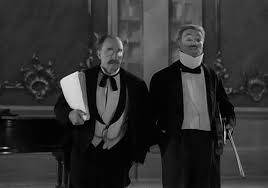
But what we remember about it is the magic of the two greatest silent film comedians, Chaplin and Buster Keaton, sharing a few scenes late in the film, recreating a little of the earlier slapstick and mimed magic from their days treading the boards, living out of a trunk before the movies and Hollywood lured them West.

Chaplin’s movie is a literal relic, a far less edgy, dynamic and cinematic experience than “The Entertainer,” a blast of the new “kitchen sink realism” that scorched some of the same ground less than a decade later, and more sentimental and far less amusing than “Stan & Ollie,” the most recent film to reach back into that world.

The camera is anchored and static, with pristine, lifeless Hollywood backlots doubling for London streets, and mostly spare sets (and painted backdrops) for scenes often allowed to play out in a single long take.

That was a remarkable trait of Chaplin’s silent classics, as we see the clockwork comedy of a genius of the pratfall and near-pratfall dodge blows, gigantic machinery and automobiles and show off just how completely he’d mastered roller skates. But editing is what animates cinema, and “Limelight” only allows it when the star needed another take on that last bit, or decided a close-up is necessary.

He’d mercifully turn away from the hokey suicidal-dancer-who-won’t-dance plot to deliver entire music hall routines, corny songs, understated dances and dated monologues that preserve the institution he was celebrating — in amber.

But as the melodrama progresses and ballet-with-slapstick moves center stage, as the faded “star” Calvero’s “comeback” begins, “Limelight” livens up. By the time Keaton shows up we get why this picture, which earned plenty of indifferent reviews upon release, has come to be celebrated as Chaplin’s last “great” (almost) movie.

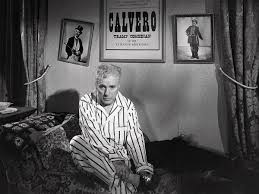
Calvero used to be a top-of-the-marquee “tramp act” in the music halls. We meet him drunk, having whiled away a night in his cups with his fellow unemployed old timers in 1914 London.

He smells gas upon finally making his way past the lock on his apartment house’s front door. And after elaborately checking his shoes to ensure he hasn’t stepped in something, spies a downstairs flat with towels stuffed under the door.

The gamine (Claire Bloom) has tried to kill herself — drinking poison, turning on the gas. Calvero rescues her, fetches a doctor and even talks the unsympathetic landlady (Marjorie Bennett) into letting her stay with him to recuperate, something the doctor ordered.

Thereza or “Terry” is broke, a dancer who can’t dance thanks to a bout of rheumatic fever. The doctor sets Calvero straight. She probably didn’t have rheumatic fever. This “can’t use my legs” thing is all in her head.

“Are you in pain?” Calvero asks. If not, “the rest is fantasy.”

It’s hopeless, she insists.

“Then live without hope. Live for the moment. There are still…wonderful moments!

He dreams of a stage collaboration between them, but once awake he has accept the honesty in her “No one would ever think you’re a comedian.” He’s not funny, not while sober, anyway.

His agent (Barry Bernard) insists his name is “poison” to theater bookers. But as Calvero reaches his low ebb, at least he’s encouraged Terry to begin anew. She joins a dance company, and her director (Hitchcock favorite Norman Lloyd) and the producer (Nigel Bruce, Watson to Basil Rathbone’s Sherlock Holmes) have a ballet in mind, a “harlequinade,” that requires clowns.

Maybe Terry knows someone? And if she freezes up before dancing onto the stage, he’ll be right there to slap her back into reality. (Ouch)

Chaplin’s direction seemed more and more old-fashioned and lackluster the longer he directed and the more the cinema “grew up” and grew more visually sophisticated around him. The best images are in his real-time treatment of the ballet, as he uses crane shots to show the silent, efficient bustle of scene-changes in a theater.

Chaplin won his only competitive Oscar as a very old man, as “Limelight” wasn’t properly released in the U.S. under Academy rules, and the Best Original Score Academy Award (1973) came to the film after its “official” L.A. release in 1972. “Terry’s Theme,” also known as “Eternally,” is one of the most recognizable melodies in screen score history.

His acting was always presentational, closer to mime than “Method.” But the performances surrounding him here are pretty good, with Bruce, Lloyd and other veterans in top form and relative-newcomer Bloom holding her own and Chaplin’s son Sydney Chaplin not bad as the composer/love-interest who might turn Terry’s head away from the elderly savior she’s “fallen in love” with (Um, ok).

The real magic here is where it always was, putting two legendary troupers together in a dressing room, on a music hall stage, performing shtick (not exactly hilarious). They remind us of the nerve and craft that it takes to do it and that while tastes in comedy change, old tramp comics never die. Not while there’s a film camera around to catch them at their peak.

Rating: “approved” (G)

Cast: Charles Chaplin, Claire Bloom, Nigel Bruce, Sydney Chaplin, Norman Lloyd and Buster Keaton

Credits: Scripted and directed by Charles Chaplin. A United Artists release on Tubi and other streamers.

Running time: 2:17

Posted in Reviews, previews, profiles and movie news | Tagged , , , , | Comments Off on Classic Film Review: Chaplin’s ode to a Dying Corner of Comedy — “Limelight”