Documentary Review: Families cope with “different” children of every type in”Far from the Tree”

tree1

Andrew Solomon grew up a child with “weird hangups,” dressing in costumes, “obsessed” with the more morbid poems of Emily Dickinson, and with tragic opera.

His affluent parents indulged all of his idiosyncrasies, right up to the day he came out to them as gay. Years of brooding over this estrangement made him curious about how other families “managed” dealing with children very different from them — the degrees of support they gave to a child who might be “every parent’s nightmare” — autistic, born with Down Syndrome, dwarfism, even parents of kids who commit inhumanly cruel crimes.

Like the rest of us, Solomon has been stunned by the pace of societal changes in the attitudes toward homosexuality, a “disease” that was regarded as “treatable” in his youth, now commonly accepted and to varying degrees tolerated, even in the most intolerant corners of America.

Solomon’s book “Far From the Tree” becomes Rachel Dretzin’s upbeat documentary of the same name, a film that celebrates “difference” even as it accepts the heartbreak and agonizing effort it takes for people and society to change attitudes towards those we have historically treated as “abnormal…diseased…retarded” and “broken.”

Dretzin profiles Solomon, and takes her camera into the lives of both the children born “different,” and the parents who found the focus, the energy and patience to make give their child the “freedom to be” at home in their family and in their world.

There’s Jason Kingsley, now 42, born with Down Syndrome in the ’70s, but fortunate enough to be born to New Yorkers who made educating him and proving the doctors who suggested warehousing him, “discarding him,” wrong. Jason lives in a group home now, has worked in a mailroom for decades. He quotes a little Shakespeare, revels in the ethos of the heroine of “Frozen” (“Let it Go”) and carries on frank discussions about his limitations and his future with his mother.

Back in the ’70s, no one would have thought any of that possible of someone “Mongoloid,” and medicine wasn’t operating along those lines. Emily, his mother, was a writer for “Sesame Street,” and father Charles was a painting contractor who made his son and his son’s misunderstood condition his cause.

Jason became a “Sesame Street” star, showing just how smart and adaptable someone with Down Syndrome could be. Jason and his parents almost single-handedly changed America’s attitudes about it.

Jack’s parents gave Dretzin access to home movies of his infancy, the bubbly child who soon made them realize he couldn’t communicate with them. “Autism” was the diagnosis, and like most every parent interviewed here, his mother, in particular, grappled with guilt over what she might have done during pregnancy to cause it.

“It was overwhelming,” his mother admits. “I didn’t want it.”

Then we see the therapy sessions that got through to the boy who cannot speak, the tearful reactions of Jack’s parents as they drift from opining that this time-consuming, tedious training was just a “parlor trick” to realizing they were watching a miracle of medical science at work.

Jack, using a computer/voice synthesizer keyboard not unlike Stephen Hawking’s, talks about his ultra-sensitivity to noise, about a life that is “like being a tiger in a cage” — at 13. We come to the same conclusion his parents did. Here’s a smart kid trapped in a body that won’t let him show it.

There’s a touch of affluence or at least comfort to almost all of the families presented here, because when you have money you can cast about for answers and devote the time and resources to finding help.

The more working class family of Loini, a lonely 23 year-old with dwarfism, are at a loss how to help her. She is isolated by her condition and life situation, until that magic day when she makes it to a Little People of America Convention. Her mother and sisters see the change that comes in finding one’s “tribe.”

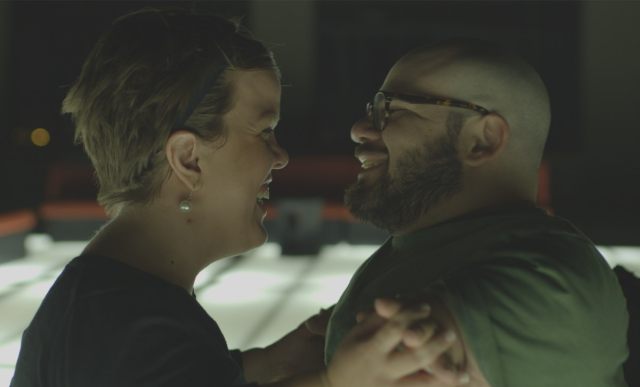
The film then follows the happy, well-adjusted dwarf couple, Leah and Joe, who found each other in just that way. The outgoing activist Joe may be tied to a wheelchair, much of the time. But thinking “I must be miserable” is a mistake. He’s positively giddy around Leah.
tree2

Solomon’s thesis isn’t one that lends itself to being neatly adhered to in a documentary, as we see Dretzin break format, first with the dwarfs — we only meet Leah and Joe’s parents briefly, in the film’s upbeat coda — then when she tests that thesis on the Louisiana (now Texas) family of a teen murderer, Trevor Reese.

The murderer’s parents are focused on to the almost total exclusion of their son, and the film doesn’t dwell on this part of Solomon’s wide net of “acceptance” and opinion that “defectiveness is a matter of perspective.” Families find ways to carry on, to get over the misplaced guilt they feel, and will love their children and try to help them. But for society to make that leap seems naive and indeed destructive.

“Far from the Tree” reminds us of the rapid pace of change, driven by medical and social sciences. And it shows us parents who, rather than throwing up their hands and accepting the medical/societal status quo, make the effort to first accept their child as “different,” and then make the rest of us aware that “different” is, in most cases, nothing at all to be ashamed or afraid of.

3stars2

MPAA Rating: unrated

Cast: Andrew Solomon, Jason, Jack, Loini, Leah and Joe, the Reese family.

Credits:Directed by Rachel Dretzin. An IFC/Sundance Selects release.

Running time: 1:33

Posted in Reviews, previews, profiles and movie news | Comments Off on Documentary Review: Families cope with “different” children of every type in”Far from the Tree”

Preview, “Bohemian Rhapsody” delivers a second trailer almost as joyous as the first

Oh Freddie, you had me at “Roger, there’s only room in this band for one hysterical queen.”

Uncanny impersonation/performance by Rami Malek and the ensemble (Ben Hardy is drummer Roger Taylor, Gwilym Lee is guitar virtuoso Brian May, Joseph Mazzello is bassist John Deacon). delightful recreations of how they cooked up the musical effects in their masterpiece, climaxing with Live Aid, the greatest live show any rock band ever put on.

The trailers to “Bohemian Rhapsody” are raising expectations. They simply cannot release a movie that is anything less than joyous, a celebration.

November 2, we’ll know if we have something to celebrate.


Posted in Reviews, previews, profiles and movie news | Comments Off on Preview, “Bohemian Rhapsody” delivers a second trailer almost as joyous as the first

Netflixable? Fonda and Redford, together one last time for “Our Souls at Night”

souls3

Netflix’s ongoing outreach movie audiences the theatrical release studios have abandoned includes making movies for filmgoers who by and large just don’t go to the movies any more.

Thus, “Our Souls at Night,” a reunion of 80something former “Barefoot in the Park” and “Electric Horsemen” co-stars Jane Fonda and Robert Redford.

A tale of two long-widowed neighbors in sleepy tiny Holt, Colorado, it is stately, quiet and elegiac, all respect-your-elders politesse for “Pleasantly dull.”

It begins with a drop-in, and “a proposal…not marriage,” from Addie, who lives down the street but doesn’t really know Louis all that well.

“Would you be interested in coming to my house sometime and sleeping with me?”

She adds a sentence that each of them will repeat, ad nauseam, over the next 100 minutes.

“It’s not what you think.”

One of the hellish adjustments of old age is loneliness. Your kids move away, your spouse dies, along with almost all of your friends. The elderly face a shrinking world of limited mobility, shrunken horizons and little human contact.

“Nights are the worst, don’t you think?”

Louis, a man of few words, has to “think about it.” But when he consents with the hope of lying awake and just having somebody to talk to, he is disappointed. At first. Addie literally cannot get enough sleep alone. So having company lets her catch up.

But as these sleepovers go on, they unburden themselves the way people do in fiction and the movies (it’s based on a Kent Haruf novel). She always thought he was “a good man,” he saw her as “a person of substance and character.”

Of course there’s a lot more to each of them than that — past flaws that these nightly confessions reveal. Present flaws include a reluctance to take this arrangement public. She wouldn’t mind, he prefers being her “back door man.”

“You know how people talk.”

Chief among those talkers is Dorlan, head gabber at the coffee-klatsch Louis drops in on at the cafe. Bruce Dern plays Dorlan, and he makes you think of “Nebraska” and much more realistic and honest a depiction of old age, family, dignity and indignities that was.

I started thinking of how much more spirited, colorful and interesting Louis would have been had Dern played him.

“Our Souls at Night” may accurately show flawed people still fretting over the past, still worrying about their adult kids (Judy Greer for him, Matthias Schoenaerts for her). A grandson is taken in and charmed into a more engaged and interesting kid by the close attention of his elders. He’s played by Iain Armitage of TV’s “Young Sheldon.”

The kid hijacks the story and turns the movie into something else, at least for a while. The “confessions” play into that, and a kind of abrupt disapproval leaps forth from one adult child, and perfunctory, ancient-history guilt trips are administered by both.

A more common gripe for me of films like this is their disconnection from the reality of old age in America. I might buy that a retired school teacher and widowed housewife might set a table for one for dinner, listen to jazz and lead their twilight years in quiet contemplation — in a European movie.

In America? The TV would be on, tuned to endless “Blue Bloods” marathons. And that’s where meals are taken, in front of the tube. Things around the house, like the folks who own them, start to go — grooming, housekeeping, attire and weight give this away.

Alexander Payne’s “Nebraska” nailed all that.

Never for one second do we buy into these two good-looking, well-preserved, trim and exercised outliers as anybody we’ve run across in rural America.

There’s nothing inherently wrong in making a romance novel fantasy about two unexceptional people played as ordinarily extraordinary by a couple of the prettiest movie stars ever to come down the pike.

But the stars, decades of warm feelings generated by their respective screen roles, reach for the mundane by underplaying, and that they do gingerly, because even the perfectly-preserved drop down into their lower gears past 75. And what little happens here feels humorless, predigested or at least sterilized for our protection.

2stars1

MPAA Rating: TV-14, adult situations

Cast: Robert Redford, Jane Fonda, Iain ArmitageJudy Greer, Matthias Schoenarts and Bruce Dern

Credits:Directed by Ritesh Batra, script by Scott Neustadter, based on  a Kent Haruf novel. A Netflix release.

Running time: 1:43

Posted in Reviews, previews, profiles and movie news | Comments Off on Netflixable? Fonda and Redford, together one last time for “Our Souls at Night”

Preview, Felicity Jones becomes the Notorious “RBG” in “On the Basis of Sex”

A Christmas present for fans of Ms. Jones and Ruth Bader Ginsberg, a bio-drama about what made her reputation long before she became the most beloved Supreme Court Justice by the left.

Oscar bait? One can only hope.


Posted in Reviews, previews, profiles and movie news | Comments Off on Preview, Felicity Jones becomes the Notorious “RBG” in “On the Basis of Sex”

Netflixable? “Deidra & Laney Rob a Train”

deirdra1.jpg

Desperation, as a general rule, makes for good comedy.

For a “caper comedy,” it’s an absolute pre-requisite.

“Deidra & Laney Rob a Train” is fraught with desperation, real and comic.

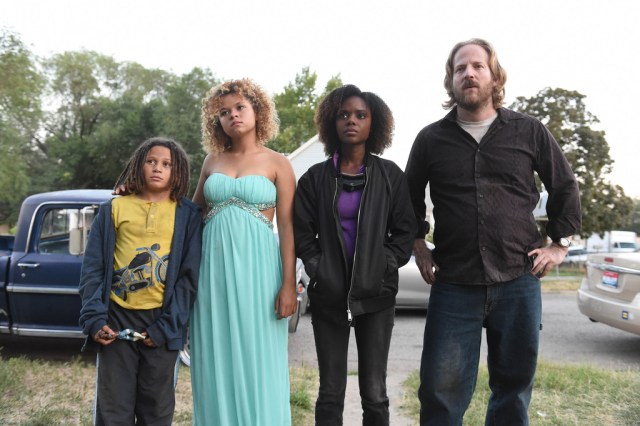
Deidra (Ashleigh Murray of TV’s “Riverdale”) has it. She’s pretty much raising younger sister Laney (Rachel Crow) and brother Jet (Lance Gray) before flaky, self-absorbed mom (Danielle Nicolette) flips out one-time too many in the parking lot of the electronics store where she works.

“This is who I AM!” She smashes an HDTV, that gets classified as “domestic terrorism.” And she’s HAPPY in the joint, happy to ditch the three kids she wasn’t really raising..

“Every meal has a SALAD! ‘Salad law!'”

Super-organized, super-smart valedictorian Deidra sells homework and test prep assistant to classmates and fills her big wall calendar with the deadlines that loom larger with every passing day.

She’s missing school, struggling to get her scholarship applications filled out so that she can get into “any college that’s at least a two day drive from this Goddamned hillbilly town.”

That would be Shelbyville, Idaho. She’s from an interracial family, so her African American guidance counselor (Sasheer Zamata, funny) wants her to succeed, wants “one student I have here get into a college that doesn’t have ‘community’ in front of it.” The African American GC wants to get out of this GD hick town too, “to an inner city school, where things are…nicer,” herself. So, “I need you to get desperate!”

As the deadlines snowball, the responsibilities mount (Child Welfare Services is involved), bills roll in.  “Genetic determinism” (apples not falling far from the tree) is a fresh worry brought up in sociology class.

What if she’s just like her crazy mom and no good dad? No child support dad (David Sullivan) is no help. But…he does work for the railroad.

And there are ways, a century and then some after the deaths of Butch and Sundance, to rob a train. Can a very smart teen and her always-in-her-shadow sister pull off a heist?

The whole voice-over “How to rob a train” montage is the first dull stretch in a comedy built on good casting, sparkling dialogue, brisk editing and yes, desperation. I mean, wouldn’t you feel anxious about your future if you mom was in prison? Especially after she drops one little dollop of “serious” about her past into one prison visit.

“Thought I could reach for something more,” Mom lectures. “‘More’ is not for us.”

The capers are childishly clever and amusingly tense, but it’s the high school and home life stuff that sings here.

Missi Pyle plays the etiquette/home ec teacher running the Miss Idaho Teen Pageant who arm-twists downtrodden Laney into entering.

Tim Blake Nelson is the railroad detective on the case — “Trying to think of a small word that means ‘ignoramus.'”

And Myko Oliver is the ex-boyfriend who works at a burger joint who pooh-poohs Deidra’s other get cash quick schemes.

“Sell weed? You broke up with me because I sell weed.”

deirdra2

A tip of the Pacific Western Railroad hat to the always-funny as a villain Nelson, and to screenwriter Shelby Farrell. Whatever else Netflix is doing to carve a niche in faintly-edgy teen films — crime, illegal substances, sexuality, profanity — starting with witty dialogue and likable characters.

“What do I want to be? You do realize that for thousands of years, that wasn’t a question. No Mesopotamian farmer asked his kid, ‘What do you want to be?'”

“Deidra & Laney” engage in a ferocious sibling catfight (“Bitch” always leads to a throw-down), struggle to cope with bills and school bullying.

The caper and its investigation robs the film of some of its momentum and fun. I’m inclined to say “Rob a Train” (rob “trains,” in point of fact) says what it has to say and does what it sets out to do in the first 45 minutes.

But this generally deft Sydney Freeland film gets more complex, sometimes comically so, for another 45. It also goes all sentimental.

Still, “Deidra & Laney Rob a Train” is that rare made-for-Netflix comedy clever enough, desperate enough, that it could have found an audience on the big screen.

2half-star6

MPAA Rating: TV-14, burglaries, sexual situations, profanity (a single F-bomb included)

Cast: Ashleigh Murray, Rachel Crowe, Missi Pyle,

Credits:Directed by Sydney Freeland , script by Shelby Farrell. A Netflix release.

Running time: 1:32

Posted in Reviews, previews, profiles and movie news | Comments Off on Netflixable? “Deidra & Laney Rob a Train”

Netflixable? Gay bachelorette comedy “The Feels” ought to be funnier

feels1.jpg

It’s the first or second thing they teach you in all the better “How to Script a Romantic Comedy in Nine Lessons” online courses.

Find an excuse to throw a bunch of sexually active folks together, find a cool location, introduce drinks and pot as “truth serum” and bring in a promiscuous wild card/free electron to stir stuff up.

Let hilarity and maybe a few hurt feelings (with tears) ensue. There’ve been so many big screen variations of the “Secaucus Seven/Big Chill” formula that I lost count that I lost count around the time of “Love! Valour! Compassion!” And that was way back in 1997. “About Alex,” “Peter’s Friends,” the list is endless.

“The Feels” is a slapdash lesbian entry in the field, a laugh-free roundup of seven friends for a bachelorette weekend in or around Healdsburg, in California’s Sonoma Valley wine country.

There’s a little (very little) “Bridesmaids,” and “Bachelorette” (a Kirsten Dunst flop) thrown into this “Big Chill” variation.

The novelty here is having a confession cam — or what plays like one. Characters break from the partying to sit and talk about themselves — mainly about orgasms — for some half-hearted attempt at mockumentary reality.

It’ll chiefly be remembered as the movie Constance Wu made before “Crazy Rich Asians” made her famous and possibly a bankable box office star. Wu stars as Andi, the “attractive, powerful and cool” about to marry Lu (Angela Trimbur). Five of their pals join them for this “wild” weekend in the country.

There’s Vivien (co-writer Lauren Parks) and Youtube lesbian-pop- singer Karin (Kárin Tatoyan). “Regular Helen” (Ever Mainard) is the amusingly blunt, stereotypically butch friend who shows up with a VW Microbus. 

And there’s Josh (Josh Fadem of TV’s “Better Call Saul” and “30 Rock”). He’s done much of the organizing, haplessly managed the decorating (AndiLu4EVR poster), and is the one who relishes telling the disappointed Lu that her married-with-two-kids older sister Nikki (director and co-writer Jenée LaMarque) won’t be coming. Or will come. Late. And let down her sis.

Josh is a little on the bitchy side. He’s also the wild card, an Eddie Deezen in the Jeff Goldblum role, heterosexual male in the henhouse. Not quite the right casting, I have to say.

There are awkward toasts, treks to town where they are “Round, brown and ready to party down” (?), according to Helen. Lauren got off early this weekend by lying “to my boss. I told him I was having my eggs harvested this weekend.”

As asides, they have these little confessions — about their first sexual experience, in a two story house with a shiny banister, in a hot tub with frisky waterjets, etc.

Despite those “accidental” Os from puberty, it turns out one of them has never had an orgasm. Ever.

feels2.jpg

Feelings are hurt, and mended. The singer sings an improvised Lordes-ish tune. Love is all around, no need to waste it. Which is to say that the dweeby guy makes his move (moves).

And precious little happens aside from that, mainly the No Big O revelation, and everybody telling everybody else “Not that there’s anything wrong with that.”

Every movie has the potential to speak to “its audience,” and “The Feels” is no different. But basic building blocks like entertainment value, funny lines and funnier situations, played with zest and directed with some sense of pace are dispensed with.

If you’re not inclined to grade on the curve? Slapdash.

1half-star

MPAA Rating: TV-MA, drug abuse, sex, nudity, profanity

Cast: Constance Wu, Angela Trimbur, Jenée LaMarqueJosh Fadem, Ever MainardKárin Tatoyan, Lauren Parks

Credits:Directed by Jenée LaMarqueLauren Parks , script by Jenée LaMarqueLauren Parks . A Gravitas/Netflix release.

Running time: 1:28

Posted in Reviews, previews, profiles and movie news | Comments Off on Netflixable? Gay bachelorette comedy “The Feels” ought to be funnier

Preview, Elle Fanning is menaced by Ben Foster in “Galveston”

Melanie Laurent’s new film opens in France before the U.S (Oct 10), but with this cast, we’ll see “Galveston,” based on a Nic Pizzolatto novel, in limited release shortly.

Brush up on your French with this English language with French subtitles trailer, which puts Elle Fanning in rough company of Ben Foster for 90 minutes.

Posted in Reviews, previews, profiles and movie news | Comments Off on Preview, Elle Fanning is menaced by Ben Foster in “Galveston”

Movie Review: Kelly Macdonald is charmed by Irrfan Khan in “Puzzle”

puz1.jpg

“Puzzle” is a lightly charming New York variation on “The Lunchbox,” another aching tale of romantic longing and disappointment about a lonely married woman who tumbles for the soulful charms of Irrfan Khan.

This time Kelly Macdonald is the housewife trapped in a suffocating, unfulfilling marriage who falls for the sleepy-eyed Indian stranger. “Puzzle” becomes that rare vehicle to make full use of the baggage the sweetly-mousy Macdonald and the droll, sensitive Khan bring to their movies.

Agnes is the child of immigrants, living in the house she grew up in with her high school beau, Louie (David Denman), a mechanic, and their two college age sons.

Her life is built around “taking care of” the other three, a submissive wife who volunteers at church, takes a back seat in every decision being made and when we meet her, is lighting the candles on the cake she had to bake at the party of mostly-his-friends she had to organize — for her own birthday.

She’s not a worldly woman, and that makes her come off as a little dim. The iPhone she got as a present rattles her need for simplicity, quiet and that tiny shred of independence that she enjoys in her Luddite life.

“Would somebody please tell my mom she has to stop living in the 20th century?”

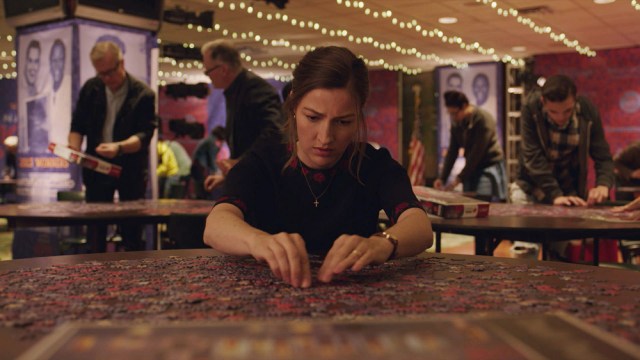
It is another gift that changes Agnes’ life. It’s a jigsaw puzzle. We glimpsed her aptitude for reasoning out shapes and missing pieces when Louis broke one of her dishes. Now, she takes to this thousand-piece challenge with relish.

She tears through it in a flash. She calls the relative who gave it to her, wanting to know where she can get another? She’s that sheltered. That leads to her first trip in ages from Bridgeport to the Big City, tp the puzzle shop where she finds what she’s looking for and the flier that piques her curiosity.

“Champion seeking puzzle partner.”

Robert (Khan) lives in a beautiful old house in New Rochelle, a man of means with a maid and a lot of idle time on his hands. She takes the train to his house and he dumps a puzzle on the table.

“Is this a test?”

“Absolutely.”

Whatever else she doesn’t know, whatever her limited life has kept from her, Agnes is a damned jigsaw savant, a “godsend…It was meant to be,” Robert enthuses.

And thus begins their training in the arcane sport of competitive jigsaw puzzling.

She is shy and just coming out of her shell, he is wounded and a little aimless. She has to lie to her husband about where she’s going and what she’s up, because he thinks, “Children play with puzzles, Agnes.”

But as the Agnes and Robert puzzle away, tinkering with their mismatched techniques, the odd personal question gets answered. He starts calling her by her given first name, Marta. She understands the sort of mind that obsesses over every disaster on cable news, a man who craves the order that comes from disorder in solving a puzzle.

And of course, there’s “The Big Game” cliche that they’re prepping for, the Nationals. With that comes a prize, a trip to the Worlds, in the capital of Belgium. She doesn’t know about that.

“You don’t want a free trip to the ancestral home of the Brussels Sprout?”

That line and Khan’s dry, fatigued and yet effortless reading of it should be a tip. If Hollywood wants him for a movie, this is the sort of part they should be offering and not villains in bombastic “Jurassic World” movies. He has the effortless charm all the great romantic leads possess.

puzzle

Macdonald has a gift for getting across a Gandhi-like passivity built on top of steel. Agnes may put up with a lot. She may not have a clue what her hip, smart younger son’s vegan/Buddhist girlfriend (Liv Hewson) will eat. But the other son, the drowning in garage work older son (Bubba Weiler) catches the wince in her eyes when Buddhist-girl explains her belief system over dinner.

“We have to give up on the idea of ever being happy.”

Every disaffected wife movie has certain touchstones, and how well they work depends on how easy it is to sympathize with the woman’s plight. Louie is appreciative, but insensitive, never thinking she’s smart enough to be in on the Big Decisions he always has made for them.

The husbands always snore in these movies.

The wives, be they “The Prize Winner of Defiance, Ohio,” the bored, repressed English suburbanite who craves “The Escape” or the Indian woman whose care filling “The Lunchbox” is wasted on an insensate lout, have varying degrees of justification for their wandering eye.

Agnes’ tiny world is suffocating her, and Louie’s chief sin is not seeing that. Seems a little weak, but as she fibs and keeps up the charade, Agnes loses all patience with a lifetime of grievances with him and their sons, justifying her actions to herself, at least.

Director Marc Turteltaub is far better known as a producer, with indie classics from “Little Miss Sunshine” and “Sherrybaby” and “Chop Shop” among the projects he helped get before audiences. He has a light touch behind the camera here. His chief contribution was recognizing the perfect people to play these two leads and letting them play to their strengths.

“Puzzle” doesn’t get lost in its jigsawing subtext, thankfully. It lets us get lost in new discovery, finding common ground, the empathy that grows with getting to know someone and finding they appreciate you in ways others don’t.

And thanks to its most engaging, sympathetic stars, even the over-familiar path it takes lets us find the warmth in the predictable first steps its characters take toward a richer life.

3stars2

MPAA Rating:  R for language (sexual situations)

Cast: Kelly Macdonald, Iffan Khan, David Denman, Bubba Weiler

Credits:Directed by Marc Turteltaub, script by Oren Moverman, story by Natalia Smirnoff . A Sony Classics release.

Running time: 1:43


Posted in Reviews, previews, profiles and movie news | Comments Off on Movie Review: Kelly Macdonald is charmed by Irrfan Khan in “Puzzle”

Preview, “Lord, what fools these Hollywood folk be,” a new indie “Midsummer Night’s Dream”

Rachel Leigh Cook, {Paz de la Huerta, Hamish Linklater and Finn Wittrock are the big names  — OK, not quite big — attached to this latest cinema stab at Shakespeare.

“A Midsummer Night’s Dream” isn’t my favorite of the plays, but it lends itself to modernization, sexy spins and the like. This doesn’t look half bad, and it sounds — like all reasonably respectable and respectful Shakespeare, like a long, lyrical song. Lovely.

An outfit called Brainstorm Media is releasing it next Friday, so maybe we’ll get a look at it before it reaches Netflix.

Posted in Reviews, previews, profiles and movie news | Comments Off on Preview, “Lord, what fools these Hollywood folk be,” a new indie “Midsummer Night’s Dream”

Movie Review: Gemma discovers housewife ennui is still a thing in “The Escape”

escape2

Even filmgoers too young to remember the ’70s are likely to find “The Escape” dated — almost quaint.

A well-acted, intimate drama about a housewife’s depression over the limited life she’s leading, it harks back to the Decade When Hollywood Discovered Feminism, aka The Golden Age of Jill Clayburgh.

Films such as “An Unmarried Woman” and “It’s My Turn” covered this ground in American cinema 40 years ago. So now it’s Britain’s turn?

Gemma Arterton is most famous internationally for being a “Bond Girl” in “Quantum of Solace.” But she once starred in a Brit updating of Flaubert’s “Madame Bovary,” the original housewife ennui tale, a film called “Gemma Bovery.” So she’s covering familiar ground as Tara, a suburban housewife whose horizons have shrunk with every year of her marriage to Mark (Dominic Cooper).

You can see it in the thousand yard stare she wears during perfunctory sex, in between the short bursts of enthusiasm she summons up to entertain their two pre-school age kids.

“I make myself care,” she admits, when pressed by her somewhat self-centered husband over “What’s wrong?”

To him, to her mother (Frances Barber), she “has it all.”

But the definition of that has changed over the decades. A two car, house in a London suburb lifestyle is not “having it all” in the “lean in” era, when woman are assured that yes, they can have fulfillment on levels Clayburgh’s characters could never dream of, back in the day.  Tara is dying of boredom, and Arterton, to her credit, makes this seem literal.

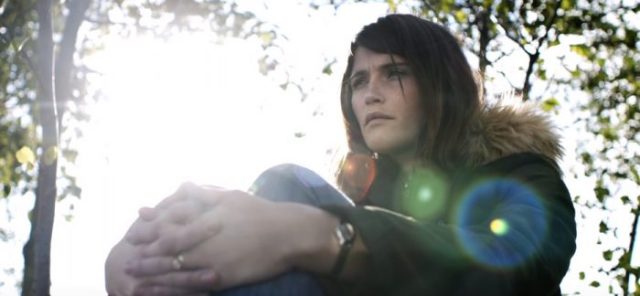
It’s not that she’s suicidal. But she’s checked out. A day trip to London, the chance purchase of a book about famous tapestries (“The Lady and the Unicorn”), that’s what gives her the spark of life, a little hope that there can be more to life than the drudgery of child-rearing and being around other women perfectly content with that.

Writer-director Dominic Savage and his stars go to some pains to not allow either  Tara or Mark to slip into caricature, and all concerned generally succeed at that.

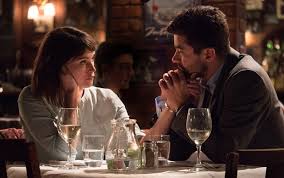
Cooper’s Mark can be selfish, fretting over the ingrate his wife seems to be, doting on his kids when he gets home, not entirely selfish in bed all of the time. But Mark has a temper, and all his concern, “Let’s get this sorted,” and the like, seems coerced. He’s utterly at a loss in terms of suggestion solutions, or even agreeing to Tara’s self-cure idea (art classes).

escape1

Arterton’s Tara comes closer to “A Woman Under the Influence” than “An Unmarried Woman,” if we’re referencing ’70s feminist mainstream cinema. Her mood swings are wide, her boredom with the “security” of this life soul-sapping.

“I never meet anyone. Ever. I’m not happy.”

Nothing’s more depressing than seeing the future and not seeing anything more than humdrum routine on your horizon. This isn’t a new feeling or a new phenomenon. Listen to “Try a Little Tenderness,” or the third act appearance of a sympathetic Older Woman Who Gets It (Marthe Keller) in “The Escape.”

Some cope with that by making vacations more adventurous. But being this close to London, and thus that close to Paris, Tara can almost see her salvation, a place where art and beauty and romance are paramount in life, where sensual and intellectual pleasures abide.

We know what’s coming, but Arterton and her director tease it out, almost endlessly, and find no fresh resolution for all this thought of “Escape.”

That makes this a sturdy melodrama, more enjoyable for its performances than from its aged, time-tested and formulaic plot.

2half-star6
MPAA Rating: unrated, sex

Cast: Gemma Arterton, Dominic Cooper, Marhe Keller

Credits: Written and directed by Dominic Savage. An IFC release.

Running time: 1:41

Posted in Reviews, previews, profiles and movie news | Comments Off on Movie Review: Gemma discovers housewife ennui is still a thing in “The Escape”