
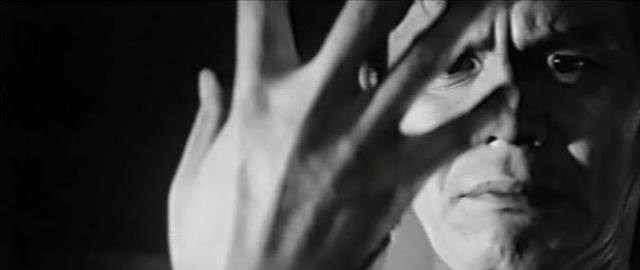
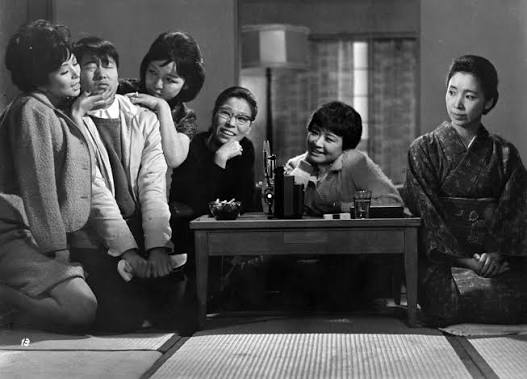
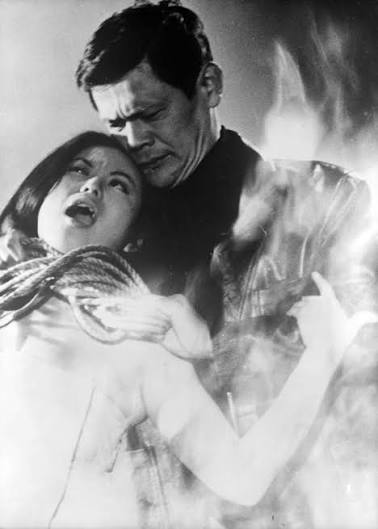
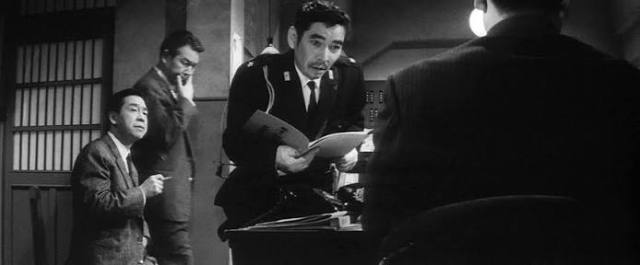
Here’s a lean, mean serial killer thriller from 1960s Japan with sex, grim violence and style to burn.
“I, the Executioner,” more poetically subtitled “Requiem for a Massacre,” has a McQueen/Belmondo cool ladykiller– leather sportscoat, black turtleneck, shades and an omnipresent cigarette on his lips or lightly pinched between the fingers.
“Ladykiller” is literal. He (Makoto Satô) is a torturer and strangler of women, who beds them before unleashing his savage side.
Yakuza film stylist Tai Katō (“Tokijiro: Lone Yakuza,” the “Red Peony Gambler” series and “By a Man’s Face Shall You Know Him”) throws us into this black and white slaughter before daring to suggest that there’s meaning to this madness.
Five women (Kin Sugai, Yuki Kawamura, Junkô Tôda, Sanae Nakahara and Ranfan Ou) had a drunken Mahjong revel. Now, they’re being strangled and worse.
Why?
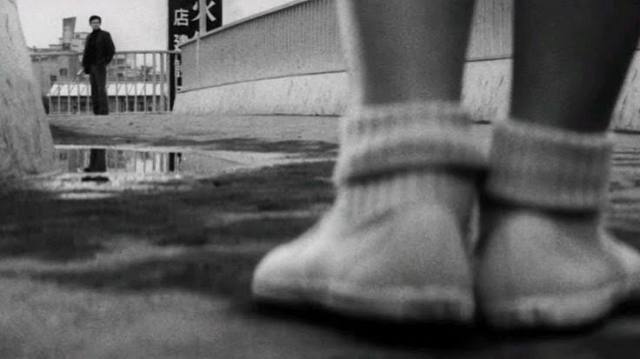
Katō, works from a script by Haruhijo Mimura with DP Keiji Maruyama (“Village of Doom”) framing shot after arresting shot — check out the “Citizen Kane” compositions — and editor Shizu Ôsawa (he cut Katō’s samurai classic “Miyamoto Musashi”) ratcheting up suspense as we follow events from the killer’s, assorted victims’ and the cops’ point of view.
The film leans into the tropes of such tales even as it puts a distinctive Japanese stamp on film noir.
Fujio Suga plays the meaner, younger detective, inclined to dismiss connections and clues if they come from his police force inferiors. The chief (Tatsuo Matsumura)? He’s more sanguine. He’s unsympathetic to suspects — they have a “list” of fourteen — and uncomfortable all the way through this.
Blame his hemorrhoids.
“Once an alibi fails,” he muses (in Japanese with subtitles), “we can issue a warrant and arrest you.”
As they work their way down their list, our killer is striking here and there, picking off that Mahjong gathering, each murder as perverse as the one preceding it.
But wait! There’s a noodle shop waitress Haruko (Chieko Baishō) who is attracted to our kill’er’s brooding and seeming gallantry. Is she in danger, too?
This film comes from an era before much of the world’s urban culture had become homogenized, and the late ’60s the culture clash this picture preserves is a real eye opener.
Geishas join the ’60s J-pop whirl of a discoteques. Street scenes, transit stations and the construction boom that brought Japan back to life after the devastation of World War II feature in the background.
We ponder the absurdly laxity of the prison sentence it is suggested that this “pervert” “thrill killer” faces, something cops and others discuss. We fear for each new victim, lured to her doom by a cool hunk who never breaks a smile.
And we wrestle with the seriously twisted, monstrously sexist “motive” the cops start to wrestle with as they piece the connections together.
Katō saves much of the explanation of this plot for third act flashbacks, as stylishly cut into it as the dramatic framings of victims with their would-be killer in the background.
The violence — nudity, bondage and strangulation included — jolts. But the tone is musing, almost romantic, backed by sentimental Japanese ballads of the day.
Satô and Baishō are the stand-outs in the cast, but each victim is given a surface personality and a hidden agenda and the players play around with that to great effect.
Other supporting players have Kurosawa (“Seven Samurai,” etc.) credits and flesh out the film’s milieu with commitment to the older cop no one listens to, the aged noodle shop owner who rejects the era he finds himself trapped in.
The subject matter and its very Japanese and quite dated attitudes and treatment play as cringey on a different level today. But “I, the Executioner” remains a riveting Japanese entry in a genre where it can invite comparison to works by Huston, Wilder, Lang and Welles and hold its own quite well, thank you very much.

Rating: TV-MA, graphic violence, sex, nudity, smoking
Cast: Makoto Satô, Chieko Baishō, Sanae Nakahara, Ranfan Ou, Kin Sugai, Kin Ishi, Fujio Saga,
Junkô Tôda and Tatsuo Matsumura
Credits: Directed by Tai Katō, scripted by Haruhiko Mimura , Tai Katō and Yōji Yamada. A Shochiku, Film Movement Classics release on Tubi, other streamers.
Running time: 1:33



