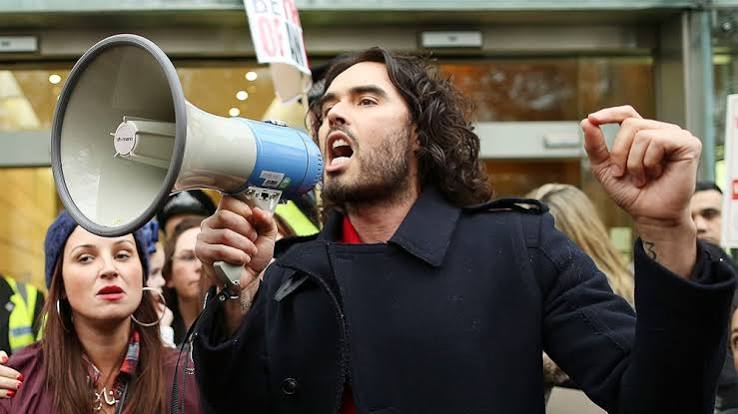
Viewers on this side of “the pond” have their choice in points of connection to the sordid, sorry story of Brit-comic Russell Brand as told in “Russell Brand: Open Secret.”
Brand’s saga of sexual assault, manipulation, celebrity and cruelty has a lot of similarities to the decades-longer raping career of Bill Cosby. Cosby’s “open secret” of drugging and raping women was so well known in comic circles that it took a new generation of comics — led by Hannibal Buress — to call him out and make the “rapist” accusation from the stage.
In Britain, one comic interviewed for Olivia Isaacs’ new Netflix documentary insists, plenty of comics would throw “Russell Brand is a RAPIST” in with their acts, followed by a “mike drop.”
Like Cosby, who had “Spanish fly” and “slip’em something in their drink” bits in his early stand up routines, Brand “openly bragged about what he was doing ” in his act.
“I raped someone once,” the three-time “Shagger of the Year” would blurt. And to every confession of onstage depravity that he’d make to big laughs, there was always the “funnier” punchline.
“I do worse than that EVERY DAY!”
Another angle North American viewers will pick up on is Britain’s insistence on referring to the MTV, radio, “Big Brother” and podcast host and stand-up comic as “a Hollywood star.”
Nah. His Hollywood “career,” such as it was, was over with 2011’s “Arthur.” The documentary hints that word was getting around in the U.S. about Brand’s ticking-time-bomb/non-consensual kink and avoided him as if he was already box-office/ratings poison.
I interviewed Brand once, and all he wanted to talk about was how he’d play “the same role the rest of my life,” that sauced satyr rocker he brough to life in “Forgetting Sarah Marshall” and wrung out with “Get Him to the Greek.” He’d be the new “Peter Sellers,” he enthused. Didn’t happen, although one sees his voice-acting credits in animated films extended as far as 2023.
Now he’s in prison, and Netflix rushed and timed its release of “Open Secret” to put an exclamation point on what British justice decreed.
Isaacs builds her “celebrity scandal” film around the little-known and unknowns of Brand’s life — the women this very-famous-and-powerful figure assaulted, the ex-girlfriends who found themselves questioning “What am I DOING” with this creep and the female reporters in the years-long London Times and Channel 4 investigation into Brand’s tendencies.
A comic here and a former roommate there fill in some of the biographical “rise to stardom” blanks, with plentiful footage of Brand rehearsing his bits as a gonzo, free-form comic to illustrate their points.
But it is reporters Rosamund Irwin and Charlotte Wace who show us that Brand was “always telling us” who he was and what he is from the stage, and from his 2007 autobiography, “My Booky Wook.”
Look at who and what Brand’s dad Ron is and did. He took his lad for a father-son sex trip to Thailand, sharing a room whilst they had their way with prostitutes. Irwin visibly recoils from this, on camera. It’s no wonder Brand-the-younger made a video “bit” out of him challenging his father to a boxing match to work out their “issues.”
Listen to what Brand was saying for years from comedy stages and in interviews, Irwin insists.
“He told us over and over again who he really was.”
Isaacs’ film makes the case that Brand “fell in with the (hedonistic) times,” “the aughts” (early 2000s), when “laddette” culture decreed that young women could and should be as DTF as any randy, self-absorbed shag-and-bag bro.
The documentary struggles, as did the reporters and the very-slow-to-act legal system, with the hazy nature of “consent” in a Grindr-friendly universe. Brand, the dogged reporters insist, talked so openly about his promiscuity and appetites that he “normalized” his own behavior to the public, to women and to the legal system.
As he became famous and women flocked to him, there could be little debate about whether they knew what they were getting into — selfish, rough-and-ready one-offs in hotel rooms, club bathrooms and the like.
But a couple of earlier girlfriends are allowed to express their shock at what he turned into once “you woke up and he was EVERYwhere” in British pop culture.
The cynicism in Brand’s claim that something “bad” was destined “to happen to me,” and his turns towards cultish conspiracy-mongering and feigned religion as the walls closed in would be hilarious if this cliche weren’t being perpetrated by such a creep.
Isaacs’ damning movie’s larger point, the one played up in British press coverage of its release, is of the BBC and British media’s eagerness to ignore the whispers, rumors and open confessions and give Brand platform after platform of legitimizing immunity. The wankers.
As footage of Brand’s earliest TV ventures pick up on his anarchic energy and mania for “shock,” but not talent or wit, one wonders how the powers that be didn’t take a breath and consider just what he and they were “selling.”
And while the view of “Open Secret” may figure “ten years+ in prison” is “just deserts” for Brand, the open question by its end is why legions of enablers, especially Jonathan Ross, are still around instead of having their heads mounted on pikes?

Rating: TV-MA, discussions of rape, sex, profanity
Cast: Russell Brand, Rosamund Irwin, Nish Kumar, Harriet Kemsley, Mark Pinheiro, Jordan Martin, Georgiana Baillie, Amanda Alguero Alejos, with Tucker Carlson, Sean “Diddy” Combs and Jonathan Ross.
Credits: Directed by Olivia Isaacs. A Netflix release.
Running time: 1:23