
You know and I know the title song “9 to 5” was always better than the movie “9 to 5,” right?
Memory can fix a “classic” film’s failings, and this one — a big, touched-a-nerve hit when it premiered in 1980 — lumbers along for a solid 70 minutes (out of a bloated 109 minute running time) before getting around to what it’s really about.
The slapstick and cutting remark comebacks produce highlights that stand out in one’s mind.
“I’ll tell you one thing. If you ever say another word about me or make another indecent proposal, I’m gonna get that gun of mine… And I’m gonna change you from a rooster to a hen with one shot!
The leading lady trio that ran the show sparkled, with Lily Tomlin doing the heavy lifting, Jane Fonda channeling her dizzy, retro “Barefoot in the Park” past as a house wife dumped for a younger woman and Dolly Parton making her screen debut with a heaping helping of country sunshine and sass. Dabney Coleman, at his most sexist and dastardly, was the perfect villain. You could believe this version of The Boss as bully — limited, potentially violent, promoted by a sexist ol’boy’s network culture, willing to steal credit for others’ ideas and looking down on women as inferior.
One remembers every good moment set to its syncopated, perfectly-crafted jewel of a title song, written by Dolly and nominated for an Oscar, even though it’s really only in the opening and closing credits.
“9 to 5” earned over $100 million in an era when movies rarely did that, especially movies without Luke Skywalker or Superman in them, and as I recall, it was a genuine crowd pleaser and really played with live audiences.
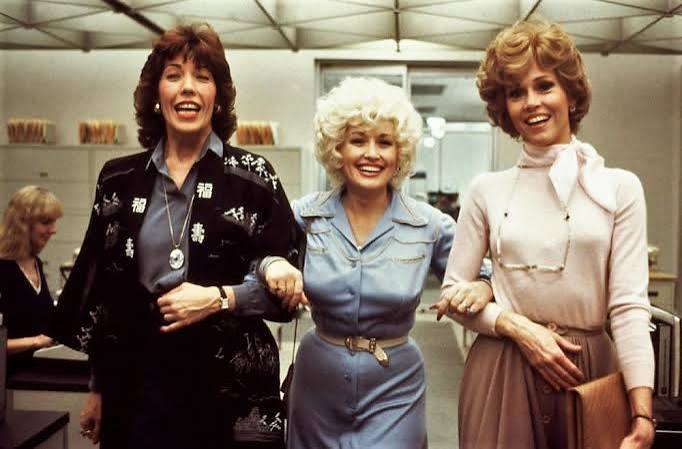
Fonda plays Judy, the newly-dumped new hire at a big corporation housed in a city high rise. Tomlin plays the boss’s “right arm,” Violet, the sharp and hyper-competent fixer who makes the trains run on time, even as mediocre men are promoted above her.
And Parton, who passed away as one of the most beloved figures American pop culture has ever produced last month, plays Doralee, the boss’s lusted-after secretary. She drawls. She drives to work in a Chevy Luv, the tiniest pickup truck of the day. Oh, and she keeps a pistol in her purse.
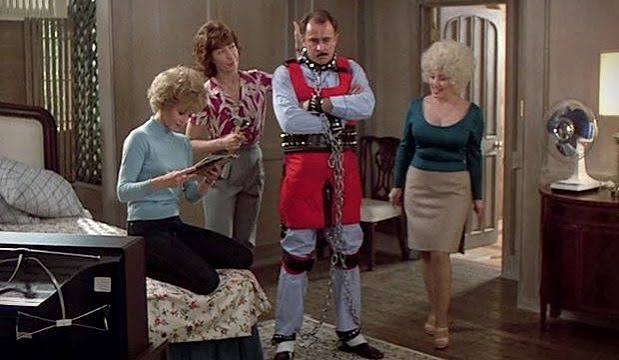
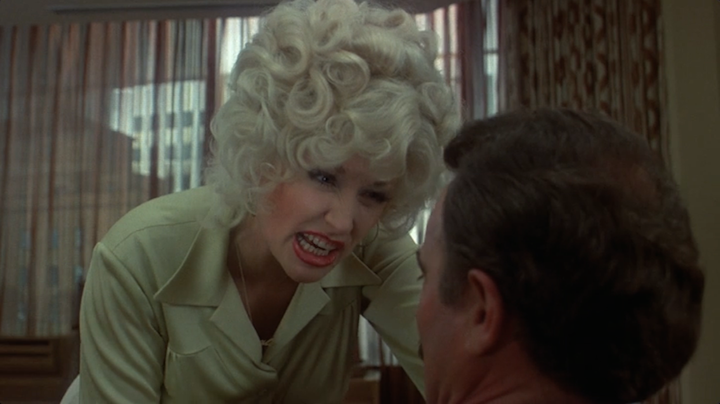
Dolly’s role is meant to be the scene stealer, and the petite Smokey Mountain blonde delivers. When an accident at work forces the three women to team up against hated boss Franklin (Coleman), Doralee’s the one who hog-ties the creep and waves her pistol in his face like she means business.
And when they’re at a loss about what to do to extricate themselves from kidnapping and attempted murder charges, she’s the one who makes the most sense and lands the movie’s biggest laugh.
“Well, I say we hire a couple’a wranglers to go upstairs and beat the s–t outta him!”
The movie’s other comic highlights are provided by Coleman, blustering, cussing and threatening even after he’s amusingly trussed up in a getup designed to keep him from escaping from his house — for a month. Yes, he did his own stunts (hoisted by his own petard, via a garage door opener), and Coleman made damned sure he play that physical shtick land.
God knows how he must have hated re-takes.
I was but a college radio station critic when this picture premiered, and remember feeling it was better at messaging — with the boss in lock-down, the women liberate their workplace — than at delivering laughs.
As a director (“Foul Play,””The Best Little Whorehouse in Texas”), Colin Higgins was always better appreciated as the writer of “Harold and Maude,” “Silver Streak” and “Foul Play.” The originating writer of this workplace comedy was Patricia Resnick, who wrote Robert Altman’s “comeback” classic “The Player.” Higgins rewrote her script, but he didn’t write, shoot or edit it for pace.
He’d only direct four films, and none of them lost money. But his career and life were shortened by AIDS.
What’s a bit jaw-dropping about “9 to 5” now is the hot button issues it brings up in an America in the process of failing to pass the Equal Rights Amendment are still with us. Turning the movie into a TV series didn’t change American politics.
Equal pay for equal work? “Job sharing?” A workplace-provided daycare is still the Holy Grail in a culture that refuses to address that most basic “right” as the people who fight all these changes the hardest try to figure out ways to force women to have more children.
So the film is more of a “feminist classic” than a comedy for the ages. It’s still a classic, even if its greatest pleasure these days is in breaking down that title tune as you hear it on the soundtrack — the workplace timeclock ticking rhythm, the compact storytelling in every phrase and Dolly’s triumphant performance of what still feels, well, revolutionary 46 years after she composed it.
“‘9 to 5,’ yeah, they got you where they want you
There’s a better life and you think about it, don’t you?
It’s a rich man’s game no matter what they call it
And you spend your life puttin’ money in his wallet.”

Rating: PG, a little violence, a smattering of profanity
Cast: Jane Fonda, Lily Tomlin, Dolly Parton, Dabney Coleman and Sterling Hayden.
Credits: Directed by Colin Higgins, scripted by Patricia Resnick and Colin Higgins. A 20th Century Fox film now on Netflix, other streamers
Running time: 1:49



