
Pattinson? Brooding, not particularly
Butch. Hoult, as “Tolkien” demonstrates, is just dull.
https://deadline.com/2019/05/rob-pattinson-nicholas-hoult-batman-short-list-matt-reeves-1202616908/
Pattinson? Brooding, not particularly
Butch. Hoult, as “Tolkien” demonstrates, is just dull.
https://deadline.com/2019/05/rob-pattinson-nicholas-hoult-batman-short-list-matt-reeves-1202616908/
Tough crowd.
For profit Full Sail University’s most famous director alum is a veteran of the “Saw” franchise and Lionsgate has him attached to the comoc’sb”twisted” new pitch.
https://www.theguardian.com/film/2019/may/16/saw-movie-reboot-chris-rock-twisted-promise
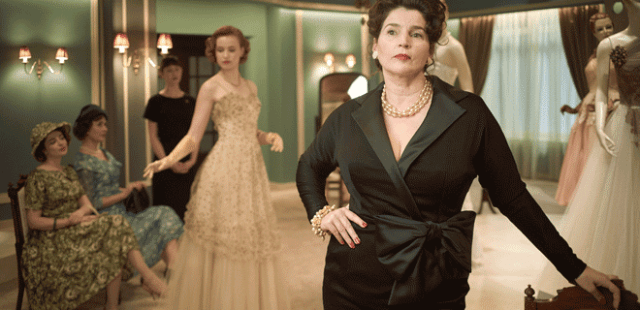
It’s no great surprise that the great Australian director Bruce Beresford wrings every ounce of sweet out of “Ladies in Black,” an upbeat Down Under tale of women who work in a prestigious department store back when there were such things.
He made “Driving Miss Daisy,” “Tender Mercies” and “A Good Man in Africa,” so this slight, sugary confection set in his homeland didn’t present much in the line of difficulties. He makes the characters distinct, their trials easily overcome and keeps the soap opera aspects in check in adapting Madeleine St. John’s novel for the screen.
And if there’s this charming subtext about the world-broadening vitality of immigrants, refugees, derisively labeled “REF-os” back in old Oz, that’s just an Old Master keeping his tale topical.
Goode’s is the posh multi-story Macy’s of 1950s Sydney, a city block of elegance where culture and couture meet in a country just then discovering them as it comes into its own not far removed from World War II.
There’s a uniformed doorman, a dapper greeter and floor manager (Nicholas Hammond) in tails, and a pianist playing Chopin as the customers pour in.
And there’s a locker room out back, where the saleswomen put on their “war paint,” change into their personal black dresses, earrings and heels and become “Ladies in Black” for the day.
Lisa (Angourie Rice, “Spider Man’s” Betty) is the new girl, gawky and 16 and brought in for the Christmas rush, a teen ready for “the leaving.” That’s what they call graduation in Australia.
The staff veterans, Fay and Patty (Rachael Taylor, Alison McGirr) are to show her the ropes, which they do. They’re nice enough, and posh as all get-out in appearance. But they’re working class, through and through, and they’re awfully quick to warn Lisa away from the “REF-o” Magda, a regal foreigner in charge of the “Model Salon,” where one-off designer dresses are sold.
“Soon you veel come to me,” Magda (Julia Ormand) sniffs to Lisa. “Some help I kan use.”
Our girl longs to be a poet. Or an actress. Or perhaps a novelist. The other ladies may raise an eyebrow, her parents (Susie Porter, Shane Jacobson) may range from “Let her dream” to “No daughter’a mine’s goin’ t’university!” But not Magda.
Over the course of that holiday season, Magda will give Lisa a makeover, the polish she’ll carry into adulthood, and expose her to The Big Wide World by way of her life experience and meals with her husband, Stefan (Vincent Perez).
Lisa, who is trying to outgrow her parents’ hand-me-down provincialism as sweetly as she can manage (“Lisa” is the name she’d prefer, not the one Mum gave her), reads “Anna Karenina” over lunch and exposes Fay to Great Books and Big Thoughts. Fay’s xenophobia is about to be overwhelmed, her horizons forever broadened beyond “the cocoon” Australia, at the time, was.
And Patty struggles to make her ranch worker husband (Luke Pegler) more “attentive,” so that they can have a baby.


There’s nothing particularly dramatic in any of this, but some of that is how gently Beresford handles this admittedly old-fashioned story and well-worn characters. All the rough edges, if there ever were any, are rubbed off every situation and every character.
Still, he never leaves his heaping helping of corn stuck in our teeth.
The perfectly-appointed store is home to many a recycled situation; the drudgery of the work, dealing with women who say “This has ALWAYS been my size” in the changing rooms, and cleaning up after vomiting little boys whose mothers dragged them shopping in this oasis of The Good Life in the middle of a city of streetcars and lunchpail jobs.
The players are well-cast, but the screen veteran Ormond (“Sabrina” and “First Knight” were her break-out films in 1995) has the most to play and the most fun, it would seem, playing it.
She purrs in a Croatian accent that “the Amerikins are sooooo modern,” that her fashion line is all gowns “too small for zees beeg Australian girlz,” that dresses made in Britain are ugly because they are cut to fit a nation of women “shaped like pears.” Lisa she takes under her wing, telling the others she wants to “steal your leetle slave girl” — just for a minute.
“Be heppy, ALL-vays! Eese goot choice!”
The European “REF-os” all have the whiff of displaced nobility (men in cravats), the Aussie men are either dandies or “manly” beer-swilling dullards, and Lisa, her mind broadening, has one piece of encouragement to carry with her into the liberating (even in Australia, to some degree) 1960s. Dated, yes, but worth remembering, Beresford suggests.
“A clever girl…That’s the most wonderful thing in all creation.”

MPAA Rating: PG for some suggestive material, mild language, and smoking
Cast: Julia Ormond, Angourie Rice, Rachael Taylor, Susie Porter, Alison McGirr and Celia Massingham
Credits: Directed by Brcue Beresford, script by Sue Milliken and Bruce Beresford, based on the novel by Madeleine St. John. A Sony release.
Running time: 1:48
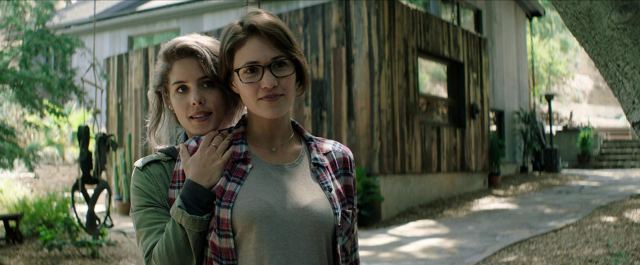
Charm and wit count for a lot in romantic comedies, and they compensate for the many sins of “Funny Story.”
It’s a darkly funny “romance,” but only in the broadest terms.
The film covers familiar ground, and not just in the sense that it’s yet another tale set in scenic, over-filmed California.
And it traffics in cliches and stereotypes, or at least widely accepted tropes common in same-sex romances on the screen.
Walter, given a wry twinkle by Matthew Glave (of TV’s “Angie Tribeca” and “Better Things”), is a semi-retired TV actor with that one, goldmine of a hit under his belt. Decades before, he starred as a sword-and-sorcery “space Viking” in the popular series, “Youngblood.”
Set for life? Ask Shatner, Lynda Carter or Lucy Lawless. “Conventions” and residuals keep him flush.
Which is why he’s all set to dump the too-young/too-ditzy second wife (Daisye Tutor, yes that’s how she spells it.). She puts down her phone and her e-cigarette just long enough to blurt “I’m pregnant,” and put a stop to that.
That’s not news he’s looking forward to telling his adult daughter (Jana Winternitz), who is “always a bit standoffish” when he brings up “the girl that ended my marriage to her mother.” Can’t do it on the phone, and Nic just bailed on a weekend they were to spend together to be with friends up at Big Sur.
No worries, Walter can “drive up.” But Dad, one last thing. Could you pick up a friend, Kim (Emily Bett Rickards) whose car just died? You know, give her a lift up here?
We’ve met Kim as she skulked into her mom’s funeral, trying to shrug off the judgmental “Sorry that I never ran into you at the hospital” relatives.
Kim’s got issues that she might be working out with promiscuity.
Walter? We get a hint that he’s cut a wide swath through highway and byway barmaids and hoteliers.
These two may meet brusque, with brittle conversations about the “boob cancer” that took her mother and the like. We know “OK, do you have a PROBLEM with me?” and Kim’s testy recounting of Walter’s shortcomings as a father aren’t the end of it.
“For someone so small, you wear a huge layer of ‘bitch.'”
Not when he croons a little karaoke. Not when she offers, “Will you do a shot with me?”
Yup. “The best hair in daytime television” has a romp with a woman young enough to be his daughter.
And when they get to Big Sur, Walter figures out how wrong that was. His daughter comes out to him, Kim is her longtime love and oh yeah, this is the weekend they’re getting married.
“This is WONDERFUL. I think.”
I was amused by Walter’s over-the-top efforts to be “cool” with all this, his flippant reaction to his latest “stranger in a strange land” situation, the lone straight male in a fallopian jungle of California lesbians.
Glave gives this guy a light charm, witty and droll about just about everything, including the gulf between himself and the “My cell phone is more interesting than you” generation he’s dealing with.
He’s still popular with the fanboys, and the ladies he weekends with could consider him a sage, if they wanted to.
“Sometimes, regrets are our blessings.”
Rickard’s Kim is clearly a neurotic mess, life not working out on any level, the sort of woman you’d want your child to steer clear of, even if you hadn’t mounted her on a B & B’s armoire. Rickard walks the fine line between villain and basket case with her performance.
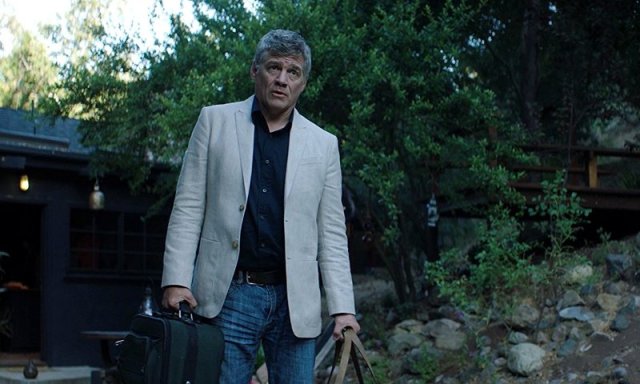
But man, the California cliches threaten to overwhelm this sort of faux Woody Allen (black screen intertitles, ancient jazz in the score) “awkward weekend” sex comedy.
Whatever popular culture says about gay men, in movies and on TV, gay women have long been portrayed with this “fluid” sexuality that is the politically correct norm for our more trans-friendly era.
“There are no doors,” one woman explains, cryptically satisfying Walter’s curiosity.
But in the movies, at least, you can’t be a lesbian without being a foodie/vegan, with all the crystals and teepees and shakra cleans uping cliches and wedding ceremonies that “commune with our friends in nature.”
Yeah, one woman plays the autoharp.
And that’s not even taking into account the whole promiscuous indiscriminate, on-the-spectrum sexual omnivore thing that gay women characters are in too many movies to count. What’s that mean? They’re still “available” to the hetero male hero, right?
That’s another thing this Michael J. Gallagher/Steve Greene script has that feels like an homage to Woody Allen — dated stereotypes.
These knocks don’t ruin “Funny Story,” and Glave sees to that. He makes Walter a soulful heel, so we don’t have to strain to believe he’d be attractive to women in general, bisexuals included.
But the trite tropes do make a pretty “Funny Story” a little less funny, I have to say.
MPAA Rating: unrated, sex, nudity, marijuana use, vaping, profanity
Cast: Matthew Glave, Emily Bett Rickards, Jana Winternitz
Credits: Directed by Michael J. Gallagher, script by Michael J. Gallagher and Steve Greene. A Blue Fox Entertainment release.
Running time: 1:25
Director Olivia Wilde declared war on Georgia’s cranky old men wanting control of women’s bodies bill, so one has to show one’s support. This looks rude and hilarious and is one summer movie I have been dying to see.
UPDATE And here’s my review of “Booksmart.”
“Kursk” was the original title of this submarine disaster thriller.
Thomas Vinterberg (“Far from the Madding Crowd,” “The Hunt”) directed it.
Something went amiss, which is why its release is so limited with this cast. Lea Seydoux is one of the wives on shore.
Americans don’t like movies about Russians? Outside of the White House and South Carolina, I mean?
“The Command” opens in limited release (June 21) and on Direct TV May 23.

The arc of your typical “Band that should’ve made it, but didn’t” documentary leans heavily on some outstanding conflict, some provoking incident, that got in their way.
Think “Anvil!: The Story of Anvil” or “The Best Band You’ve Never Heard” (about The Samples).
Filmmaker Matt Hinton, or maybe it was just the people marketing “Parallel Love: The Story of a Band Called Luxury,” point to that one traumatic incident that kept this indie alt rock “Christian” band from Toccoa College in Georgia from breaking out.
It was a horrific van accident, and knowing what we all know about start-up bands, the hard travel and the road unworthiness of vans, we get it. It’s a wonder any performing ensemble survives the years before it can afford safer wheels.
But the band members healed, continued playing and taking a whack at cutting records. The actual break-up/drift apart was some time later.
The real hook to “Parallel Love” is the odd fact that three members of this quartet headed into the clergy after giving up their hopes that Luxury, their band, would ever break out. Even odder? They’re Eastern Orthodox, men who abandoned a post-Grunge punk rock ethos for the rituals and icons of a very conservative, tiny (85,000 members nationwide) Christian sect.
And I’m not sure the assorted band members adequately put into words why that happened, either.
Still, the film is a fascinating time capsule and account of the evolution of Luxury, which signed with a Christian music label and then set out, almost by design, to make records that Christian bookstores, where such LPs were sold, would ban.
Hinton secures testimonials from promoters, an NPR producer, music contemporaries and writers from Vice and Paste Magazine who marvel at this “explosive, stunning” quartet, with its handsome, gender-bending and soulful lead singer backed by close vocal harmonies, thrashing guitars and drums.
“Why didn’t Luxury make it?”
The bandmates all came off as “sensitive,” a word many use to describe this well-dressed, haircut-ahead-of-its-time mid-90s band from Northeastern Georgia, seemingly built to stand out from the post-Cobain white boy music of the day.
Members of rival bands from their era and their area noted that “pretty girls” showed up for their shows, which set them apart. Lead singer Lee Bozeman was a fan of The Smiths and fancied himself a new Morrissey.
He and his brother, the guitarist Jamey Bozeman, were sons of an evangelical pastor, which is a big reason they ended up at Christian Toccoa College, where they rolled their eyes at the squares they were surrounded by, and where Jamey would play his Fender until his fingers bled — literally.
Drummer Glenn Black fell for KISS, Alice Cooper and Queen, and found an escape from his traumatic childhood by pounding away at his kit.
And college newcomer Chris Foley decided in an instant that he just had to play bass with these guys.
Old footage reveals Lee Bozeman’s “high and tight” haircut, pretty voice and Michael Stipe-ish stage mannerisms that came off as feminine.
Contemporaries speak of his “ambiguous sexuality” as being part of the band’s appeal. And how a group with songs titled “Pink Revenge” and “Flaming Youth” ever agreed to sign with a Christian music label (Tooth & Nail) makes for interesting on-screen speculation.
But they did, and despite rocking local and regional clubs and a big Christian music festival, they pushed back at being categorized. A member of a rival band refers to Lee’s love of “taking the piss out of” the mores of the college and the Christian community they lived and performed in.
A big question around town? “Are they or aren’t they?”
For Lee, it wasn’t about sexuality or anything all that deep. It was just, “If I say that (in a song), that’ll be fun.” “Fun” being code for “provocative.”

Benefiting from the tensions built into that church/band conflict, and their guitar-rock sound fronted by Rick Astley: The Next Generation, Luxury was on the brink of something big. Maybe.
The sound, look, energetic performances and songs suggest that might very well have been the case, although no expert witness here was in a position to know that or help make it happen, for that matter.
The van wreck may have stopped them cold, or their self-imposed/self-regretting “Christian music” labeling might have limited their potential.
In any event, they never did “make it.” But their music’s good and Hinton gives us an interesting, if not particularly deep look at their lives and what led them to where each member is now.
“Why didn’t they make it?” is perhaps more interesting than “Why’d they become priests?” Perhaps not. I’m just not sure “Parallel Love” ever really answers either question.
MPAA Rating: unrated, squeaky clean
Cast: Lee Bozeman, Glenn Black, Chris Foley, Jamey Bozeman
Credits: Directed by Matt Hinton. An Abramorama release.
Running time: 1:39
When I interviewed him, his arm was in a sling. Roger Moore got hurt a lot, too. Tough gig. https://brobible.com/culture/article/daniel-craig-injuries-james-bond/amp/
Documentaries are my form of continuing education.
Never heard of this Georgia band, subject of “Parallel Love: The Story of a Band Called Luxury.” Now I have. A movie’s going to explain why they’re worth a documentary, right?


