
Charlie Hunnam, Aaron Taylor Johnson, Billy Bob, Juliette Lewis, and a lot of fantastic visualizations of an addict’s halucinations drive this drama.
Billy Bob stands out in the trailer, because that’s what he’s good at.
Charlie Hunnam, Aaron Taylor Johnson, Billy Bob, Juliette Lewis, and a lot of fantastic visualizations of an addict’s halucinations drive this drama.
Billy Bob stands out in the trailer, because that’s what he’s good at.
And a touch of “A Walk to Remember.”

As I write this, there are half a dozen reviews of “Overcomer” posted on the review aggregator website Rotten Tomatoes, even fewer on Metacritic.
And I get it. Whatever you say about the films in terms of writing, directing, acting and just “quality,” people take a bad review of a faith-based film as an attack on their faith, an affront. Who needs the “You just don’t get it” or “I’ll pray for you” complaint mail?
I’ve always found the movies by Georgia’s preacher/filmmaker Kendrick brothers harmless tear-jerkers, politically-muted proselytizing which — considering the state of Southern Baptists these days — is in itself a blessing.
And the films have an audience, so I’ve tried to catch every one of their releases after missing their debut feature (“Flywheel”) — the sports drama “Facing the Giants,” “Fireproof,” “Courageous,” and “War Room.”
Approach them as genre features, take notes on the script, the performances, the caliber of actors they’re able to enlist. Listen for more sophisticated dialogue, look for more polished direction, search for signs they’re growing as filmmakers.
It’s the same tack I took, ages ago, with Cheech & Chong movies, with Chuck Norris or Tyler Perry’s careers. Like those other examples, these aren’t film school alumni, they’re two of the pastors at Albany, Georgia’s Sherwood Baptist Church. Are they learning their craft, moving beyond Kendrick Brothers and “Christian conservative” branding and realizing there’s more to a movie than messaging?
The films have never been less than competent. The stories have something of an arc, obstacles for the heroes/heroines to overcome. Scenes are pieced together with coherence and order, and music grows in importance with every release.
But “Overcomer” is, I think, their worst movie. And these guys once hired Kirk Cameron.
It’s about what one must “overcome” in life to achieve your goals, and what you overcome when you find your way to Jesus.
An orphaned 15 year-old Hannah (Aryn Wright-Thompson) who broods, keeps to herself and steals, is new to Brookshire Christian School in Franklin.
It’s a mill town that loses its mill, gutting the school’s enrollment and devastating Coach John Harrison’s (Alex Kendrick) top tier basketball team as parents leave town for jobs elsewhere.
Nowhere is it mentioned that the school’s tuition might be a luxury newly-unemployed folks cannot afford.
Coach Harrison has to double up, take on another sport. Cross country it is. Principal Brooks (Priscilla C. Shirer) must have seen “McFarland, U.S.A.” I dare say the Kendricks did.
Hannah loves to run, much to Coach’s chagrin.
“I had one girl show up,” he tells his wife (Shari Rigby). “And she’s got asthma.”
One more thing for Hannah to overcome.
Oh, and Coach stumbles into her blind, dying dad in the hospital while on a church visit to the sick. Hannah thinks her Dad (Cameron Arnett) is dead. That’s what the grandma who raised her always said. Would she like to see him, see that he’s Saved?
OK, that’s two more things to overcome.
This movie, more than earlier Kendrick pictures, seems to exist in a bubble where kids still say “Yes sir” and “No sir,” where marital conflicts are contrived and never as big a deal as the characters seem to think and are resolved with “We need to pray,” where sibling rivalry doesn’t exist.
“Ethan’s a good big brother.”
Insipid is the word for that, all of it.
The drama has a solid grounding in reality, but the jokes play like watered-down lemonade, from Coach/Dad who’s delusional about his physical condition to the flamboyant drama teacher who uses Coach and the cafeteria lady to judge dramatic presentations.
Showing how tolerant we are? Not a bad idea, just shoehorned in too obviously to work.
“Why would ANYbody do this?” is a running gag about running cross-country, 5K races that test lungs and your ability to hold your lunch, if you’re not in shape.


The acting is stiff and static — player after player standing stock-still, too-often blank-faced, delivering speeches, too many of which go on past their payoff.
The leads are so flat and bland that the odd moment of tears or fire from supporting players is almost rattling. Not powerful, exactly. Just rattling.
Scenes reach whatever climax they have in them, and go on and on.
The direction is pedestrian. The Kendricks’ scripts need brutal, blunt work-shopping and their footage needs heartless cutting.
There’s not a “name” in the cast. Every time I see Alex on screen, I think of the legal joke about a defendant who represents himself. If the parts were any good, wouldn’t somebody else want to play them? Sure, it saves money. But if you’re not exercising vanity, why wouldn’t you let pride take precedence? Wouldn’t you want a better actor saying your lines?
They must like their independence. Like Spike Lee in his years in the wilderness, they don’t want their writing, blocking, acting and directing criticized by people who have been around the movie block a few times.
It’s no more hateful than any other film in their canon. But there’s just nothing here.
Even as comfort food for true believers, “Overcomer” cannot overcome its myriad shortcomings.

MPAA Rating: PG for some thematic elements
Cast: Alex Kendrick, Aryn Wright-Thompson, Shari Rigby, Priscilla C. Shirer
Credits: Directed by Alex Kendrick, script by Alex Kendrick and Stephen Kendrick. An Affirm Films release.
Running time: 1:59

There isn’t much to “Before You Know It,” but where there is I have to say I absolutely adored.
It’s a sisters comedy, one of those “walking and talking New York” tales of mismatched siblings, dysfunctional parents, and the frothy, just a tad bitchy world of “the-A-tuh” actors and the soaps. And there are just enough delights scattered throughout — in the situations, the snappy banter, the performances and the milieu — to put it over.
Co-writers Jen Tullock and Hannah Pearl Utt co-star as Jackie and Rachel, daughters of a mercurial, domineering playwright, Mel Gurner, given a mood-swinging, song-singing twinkle by Mandy Patinkin.
The sisters grew up with the “unconfirmed” rumor that their mother was an actress. She died when they were little. Dad raised them in the Village’s Gurner Family Theatre, where they helped him put on the decades of flops he’s written since his acting peak (the early ’70s) passed.
Jackie (Tullock) has a fizzy, dizzy, impulsive side, just like her dad. An actress, she’s raised a daughter she incongruously named Dodge (Oona Yaffe) in that same, roomy basement flat underneath the theater that she’s shared with Dad and Rachel for 30 years.
Rachel? “Imagination’s not really Rachel’s thing,” her sister cracks. “Rachel’s actually more of a logic guy.”
That’s a little mean. Rachel is the stage manager of the theater, which earns most of its money by hosting support group meetings. She’s producing Dad’s latest play, “The Way I See It,” “which could actually BE something.” She’s editing him.
“It’s my play,” he sniffs. “It’s my play and I should be able to do what I want with it, right? Inserting yourself in the process does not make you a playwright!”
“I just need you to have a life so that I can finally have one,” Rachel confesses. It’s a pity play she’s producing. She’s a thirtysomething New York lesbian who can’t manage a relationship, and the trap of Life with Father…and sister and sister’s kid is what she blames for all that.
Jackie’s never had a role-model mother to help her with Dodge. Mom would have talked her out of the stupid name, for starters. And now she’s taking the kid to her first therapist (Alec Baldwin), one of those “just here to listen” guys she’s met at a wine tasting. If he wasn’t just listening, he’d ask Dodge what’s going on with making herself look like a “Third Rock” era age-12 ringer for young Joseph Gordon Levitt.
And then Dad has his last death scene.
You see as many movies I have, what you find yourself hoping for is the odd “perfect moment,” something with a dash of “Welp, never seen THAT before.” The first one here is when Dad has to give a speech to an off-Broadway theater’s fellowship committee, the people who are offering a “real” theater and cash to get his play produced.
Patinkin’s Max bursts into nonsensical song when asked to make a speech, and ends with a raspberry when that’s not enough — self-destructive to a fault.


The second perfect composed, staged and acted scene comes in the office of the daffy lawyer (Ben Becher, killing it) where the sisters read Dad’s will. Rachel figures out that their mother isn’t dead in a pregnant pause, staring at a computer screen, looking at a Googled photos and bio of the name on the deed of the Gurner Family Theatre and asking, “Why is a soap actress…listed as co-owner…of…our…building?”
Jackie plays catch-up, and eventually gets there, too. And “the impulsive one” immediately sets out to meet the elusive Sherrell Gearhardt, forcing Rachel to chase after her as she dashes for the “Soap City” (Manhattan TV production center) studio where Gearhardt has been on TV for the past 30 years.
“I’d say we could just flirt our way in. But you decided to dress like a Menonite caterer today.”
Judith Light plays Gearhardt, who has some of Jackie’s grasping ditziness and a touch of Rachel’s smarts and kindness. They all “meet cute,” but the daughters withhold big chunks of their story from her out of wariness.
Meanwhile, Jackie and Rachel have lost track of Dodge, who falls into the care of their just-hired accountant (Mike Colter, TV’s “Luke Cage,” always good). And that’s where Dodge, who lacks real-world role models, falls in with the accountant’s slightly-older daughter, Olivia.
Here’s the third perfect moment of “Before You Know It.” The girls, barely getting along, bond over something Olivia (Arica Himmel, bubbling over with personality) has experience with that Dodge doesn’t. A big-screen “How to use a tampon” lesson is the very definition of “Welp, never seen THAT before.”
The play within a play, viewed through a single scene rehearsed, rewritten and cast throughout the film, is “Bad Theatre” without being funny. The “Soap Dish/Tootsie” soap opera recreations are more amateurish than the real thing, and dated-feeling to boot. Have our co-stars/co-writers (Utt also directed) never watched a soap in this millennium?
But the relationships here all impress and defy expectations. The screenplay finds new twists to timeworn actor’s life cliches, and Tullock and Utt discover new wrinkles to the “stunted emotional growth” that dysfunctional families tend to produce in such movies.
There isn’t a bad performance in this, and sweet-talking Tim Daly into a bit part as a soap co-star, Baldwin into a two scene cameo and the famously persnickety Patinkin into taking on their father figure and letting it all hang out, are just bonuses.
Sitcom veteran Light brings a fragile majesty to Sherrell, stuck in the security of a TV show where the writing was never great, but has become more hackneyed with every passing decade.
Yaffe lends real-world drollery to Dodge, who never has a line too clever for a 12 year-old to think up and say. Her arrested development mom is self-involved, forgetful, loves her wine too much and is late for everything.
“I’m pretty sure she can’t tell time.”
And as the sisters, Utt and Tullock are walking, talking, weeping and kvetching endorsements for that age-old actor’s maxim, “If you’re not offered good parts, WRITE one for yourself.”
Which they did, and if there’s any justice, “Before You Know It,” they’ll get to write, produce and star-in another.

MPAA Rating: unrated, adult situations, alcohol consumption
Cast: Judith Light, Jen Tullock, Hannah Pearl Utt, Mandy Patinkin, Alec Baldwin,Peter Jacobson, Tim Daly
Credits: Directed by Hannah Pearl Utt, script by Jen Tullock and Hannah Pearl Utt. A 1091 release.
Running time: 1:39
“Star Wars” finally has the Germanic villain/film icon it has always needed, the great Werner Herzog, a directing icon at the Larry Olivier anything for a buck stage of his near retirement.
Nov. 12 Disney takes on Netflix with stuff just like this. And Jeff Goldum.
The late wit and novelist Gore Vidal once said “Never pass up an opportunity to have sex, or appear on television.”
To that I would add “or spend time, in any way, with Jeff Goldblum.”
I have interviewed him several times, and he has grown more fascinating with every passing year.
He’s evolved from distracted flake who cannot finish a thought to “non linear thinker” whose curiousity and enthusiasm for just about everything is infectious.
A damned fine actor — catch him in “The Mountain” — an accomplished jazzman, and now the Replacement for Anthony Bordain that we have all been waiting for in this travel, conversation, explore and question show, “The World According to Jeff Goldblum.”
Streaming this fall.

My pre-weekend hunch that Gerard Butler’s “Angel” would far exceed the widely quoted $14-15 million projection for its opening take has proven correct.
Box office analysts use tracking data on pre sales of tickets, polling and social media analytics — how often the trailers have been viewed, shared, etc.
They look for how familiar the title is, what the previous films in the series have done, the star’s recent opening weekend takes.
I just consider the last couple of items. In the movies today, “brand” is everything. Ticket buyers flock to the familiar, reliable comfort food movies.
“Angel” is on track to manage $18-20 million. As I said. Reviews weren’t awful, so there was no reason to expect any less. Butler has a little of that Eastwood and Mel Gibson vibe and connection with one specific audience — violence, reactionary messaging.
“Ready of Not” opened Wed. and that deflated its weekend take quite a bit. Under $7 is better than the $5 it was expected to earn. Not awful, in terms of its opening weekend take. Imagine how it might have done if it was as good as some delusional critics were saying
Meh.
The preaching Kendrick Brothers’ “Overcomer” is doing a healthy $7.5 to 8. I will get to it this afternoon.
“Angry Birds” have fallen, “Once Upon a Time” has one more weekend in the top ten, perhaps its last.
https://deadline.com/2019/08/ready-or-not-angel-has-fallen-good-boys-box-office-weekend-1202701545/
Streaming later this year.
So that’s a plus.
It never ends.

The three saddest words we hear off the screen this year just might be, “Jesus, John Paul.”
Sarah Greene speaks them, playing a Dublin mother of four, in “Rosie,” a heartbreaking, underplayed and intensely gripping Roddy Doyle story about modern homelessness.
Greene is the title character. Rosie has spent all day, for days on end, running through her cell-phone minutes, trying to find a place for her, her toddler to tween kids and her kitchen-assistant partner, John Paul (Moe Dunford) to live.
And that line and the way Greene (of “Noble,” and TV’s “Penny Dreadful”) plays it is as wrenching as any anecdote from “Angela’s Ashes.” There is exhaustion, despair and just a touch of panic in her performance.
“Jesus, John Paul.”
She’s getting the kids dressed, every morning, feeding them and taking them to school in the under-sized minivan in which all their worldly belongings are packed. She’s not giving up her hope and determination, not letting the little ones — and her oldest, Kaley — see her desperation. She is not losing her temper.
But just at this moment she sees the juggled balls hitting the ground. In this instance, all her “My faults” and “I’m sorries” that get her through the day — with the kids, who whine, bounce off hotel beds when they have a room, off the walls of the van while they’re looking for a room, with the teachers she apologizes to about “late again” — hit her right in the face.
“Jesus, John Paul.”
In one of the great cities of Europe, with all the social safety nets a citizen of the modern European Union can expect, a lower middle class mother and her mate cannot provide the most basic shelter for themselves and their four children.
Doyle, a chronicler of modern working class Dublin without peer (“The Snapper,” “The Van,” “The Commitments”) taps into the irony of this most domestic of domestic tragedies.
And Greene becomes his muse, his vessel for making a statement about how close to the margins many of us are in a world where housing, in the control of what-the-market-will-bear landlords, is increasingly imperiled.
Dublin, like many cities, is pricing the lower ranks of the social order right out of their ability to survive there.
Greene gulps down the alarm in her voice when Rosie hears, from a hotel clerk, that Lady Gaga is in town for a show. She knows that hundreds of hotel rooms are now out of circulation for days, subsidies from the state be damned.
The calls are all the same — “I’m looking for a room for a few nights. There’s six of us.” One call after another, poker-faced pleas that cannot show the panic, the urgent need.
“That’s right. City Council Credit Card.”
One child is hyperactive, another plainly stressing out at Mom’s “We just moved house” explanations to one and all, hiding their eviction from the place that is now being sold, “too dear” in price to be within their price range.
The youngest is fully potty trained, but frazzled by all the driving, calling, moving in with garbage bags full of clothes.
“I need the toilet. I need the toilet now.”
“Ok. Right,” Mom says. And then a moment where we catch the lost look in her eyes, “Where’ll we go?”
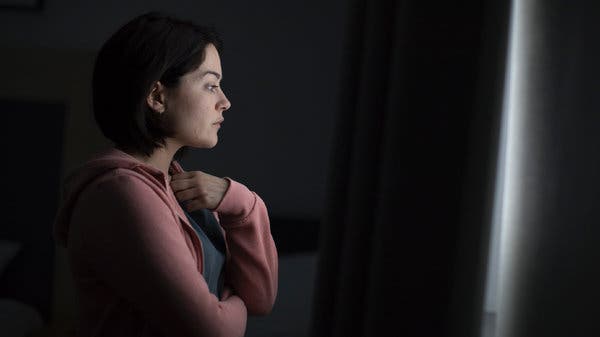
The oldest girl Kayliegh (Ellie O’Halloran) dutifully does her homework, bottles up her gripes, embarrassment and disappointment and tries to not be a burden. That’s a lot to ask of a 13 year-old girl.
Director Paddy Breathnach, who gave us an early Brendan Gleeson triumph, “I Went Down,” doesn’t fussy up this simple tale. The camera is always on Rose, “Rosie,” as her kids turn fractious and another hotel patron in the same situation begs her to quiet her unruly son “or we’ll’ get trone out, like. And I’ve nowhere else, like.”
John Paul is low man on the totem pole at the restaurant, so he’s little help during the day — lunch break apartment and house hunting — getting a call where his family will be on his bus ride “home.”
“Remember when we used to think it’d be great to stay in a hotel?”
Doyle injects a little extra melodrama in the estranged relationship between Rosie and her mother. They’ve already worn out their welcome with every other family member and friend in Greater Dublin, but Grandma’s place could be out of the question.
Any parent will recognize the form childhood rebellion takes in a seven year-old, and a thirteen year-old. Anybody watching will fear for Rosie’s sanity as she has zero time to cope, no energy left for added drama, which children cannot help but provide.
And any film fan will appreciate seeing one of the great, subtle performances of the 2019 cinema, glorious work in the simplest and most dramatic role of them all — motherhood.

MPAA Rating: PG-13 for thematic material.
Cast: Sarah Greene, Moe Dunford, Ellie O’Halloran
Credits: Directed by Paddy Breathnach, script by Roddy Doyle. A Blue Fox Entertainment release.
Running time: 1:26
Born out of a diptheria outbreak, inspiration for the animated “Balto,” and now this one.
Oct. 25 it hits theaters.

 Movie Nation