Movie Review: “Teacher”

teacher1.jpeg

There’s no predicting how “Teacher” will play in the world wide cinescape. But it hit me. I found writer-director Adam Dick’s debut feature relentlessly disturbing on all sorts of levels. And no, that won’t be to every taste.

He and star David Dastmalchian –;of TV’s “MacGuyver,” “Ant Man and The Wasp,” and Denis Villeneuve’s upcoming big screen version of “Dune” — create one of the most serrated cinematic portraits of bullying, the ways it tears through a school and scars for life.

It traffics in tropes and stereotypes, ups the ante on the extremes its bullies go to and yet never seems, at any point and in any way, removed from reality.

This is our world, a daily dose of cruelty doled out by the insensate. Here’s a movie that carves “Hurt people hurt people” into the heart and rarely lets us off the hook as it does.

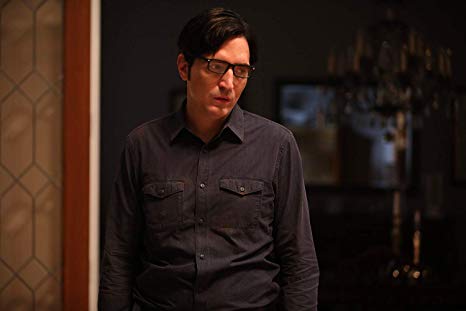
Dastmalchian is Mr. Lewis, teaching Shakespeare’s “The Merchant of Venice” to juniors at Prairie Trail High in suburban Chicago. He has the spectacles, the too-flat hair and the sensitivity that mark him as the quintessential nerd. Yes, the film’s prologue shows us, he was bullied as a child, even as he was dealing with a violently unhappy home life.

Bitter? His new divorce barely scratches the surface of that. Anger management issues, a drinking problem — the last thing this guy needs is to see his own haunted life relived by his less fortunate students.

Daniela (Esme Perez) is pointlessly taunted for her race and her shyness, which manifests itself in the halting way she reads from the play in class.

Preston (Matthew Garry) is the kid the jocks pick on in class, on the bus and in the cafeteria. He’s a smart student, a photographer, and that doesn’t seem to help.

Because Tim Cooper (Curtis Edward Jackson), the sociopathic high-born star pitcher of the baseball team won’t let it — or them — be.

“Teacher” sees Mr. Lewis struggle to intervene as Tim escalates their torment in a waking nightmare of beatings, social media shaming and intimidation.

Mr. Lewis is up for tenure, but still he speaks out. Not that his principal (Cedric Young) is much help. “Everything’s fine,” he says. “This isn’t Kafka.”

But later, as everything is even less fine and things seem more Kafkaesque, he pleads — “We need to hang on until summer! Please work with me!”

Because Mr. Lewis, in trying to rein in Tim’s reign of terror, runs him afoul of the brute’s rich, well-connected father. Kevin Pollack is a decent dramatic actor (“A Few Good Men”) and one of the most gifted comic impressionists of our time. But as Bernie Cooper, he is menace incarnate.

Violent? We can’t say. Threatening? Always. Pollack underplays the obvious tells that Dick slips into the script, a rich guy used to getting his way letting on that he knows all about Lewis, his situation and the screws he can turn to get lenience and special treatment for a son he probably realizes is a thug, because he was raised to be “tough” on his inferiors.

teacher2

Dick, fleshing out a short film he made with this title and on this subject a couple of years back, suggests two might-be-romances. Daniela and Preston are in the foxhole together, awkwardly facing the pitiless piling-on of teenagers who are all too eager to reward the bullies for not picking on them. They will bring you to the verge of tears.

And Lewis might find a kindred spirit in fellow teacher Arabella (Helen Joo Lee), whose surface sparkle gives a hint of the brittle underneath, letting on that the reasons she might find James Lewis interesting are things she has in common with him.

Because Dastmalchian never quite lets us root for the guy. We can twitch and empathize with James, even if we don’t sympathize with him. “Bitter…sweet” his only pal on the faculty (John Hoogenakker) says of him.

His ex describes the “mood swings, violence and drinking” that made her give up on James. And Dastmalchian plays the guy as so on edge that the real shocks here aren’t his bubbling rage and narrated thoughts of acting out. It’s when he repeatedly tries to understand the perpetrators, mediate the conflicts and keep the peace that he makes your jaw drop.

A very good actor makes us see the strain all this puts on a loner whose lifelong humiliation never ended.

“They say we can never go home again,” he narrates. “In truth, we never leave.”

The cleverest thing Dick tries and almost succeeds in pulling off is teasing out the viewer’s desire for revenge, of Preston (with only a camera for a weapon) and later social media savvy James, and then upending that craving as if his movie is a “teachable moment.”

When James complains that he’s but a “bark in the dark” when he rants about the sociopathy and cruelty overwhelming a society that rejects “‘After School (Special)’ warm fuzzies,” he might be talking about “Teacher” itself.

I found it so real it leaves bruises.

3stars2

MPAA Rating: unrated, violent, sexual content, alcohol abuse

Cast: David Dastmalchian, Kevin Pollack, Esme Perez

Credits: Written and directed by Adam Dick. A Cinedigm release.

Running time: 1:40

Posted in Reviews, previews, profiles and movie news | Comments Off on Movie Review: “Teacher”

Netflixable? Horrified Argentine father insists “The Son” is not his own

son2.jpeg

The latest Netflix wrinkle on that “Lifetime Original Movie” staple, “That’s not my baby,” is about man who makes that claim, an Argentinian artist who is on and off the wagon, and either on or off his rocker.

Yes, “The Son” is a horror film, but with subtle chills substituting for shrieks and freaks and blood. This is about the chilling realization that this foreigner you married may have swapped babies on you for purposes you cannot quite fathom, a belief no one else shares.

We find Lorenzo (Joaquín Furriel) and Sigrid (Heidi Toini) in their Buenos Aires bed, wrapping up the throes of making a baby.

He is older, a painter with passion. She is Norwegian, with a Ph.d in biology. He’s had children from a previous marriage and is laid back. She is…anal in the extreme, clinical, listing to her doctors (in Spanish, with English subtitles) the medicines she expects to be given in this “C-section happy” country. Sigrid had a miscarriage once, and she’s too smart to leave anything to chance this time.

She gives off a chill when they attend a cocktail party with Lorenzo’s old flame (Martina Gusmán) and agent (Luciano Cáceres ).

They joke, on meeting Sigrid, that the “old wolf hasn’t lost his teeth.” Lorenzo jokes back, “The wolf finally fell into the trap!” So maybe that’s the reason for Sigrid’s frosty Scandinavian standoffishness.

Renato and Juliette seem a bit taken aback by the baby plans, but still toast the Goya-obsessed Lorenzo’s big “comeback.”

Ah, but there are two threads to the story. We also follow Lorenzo, bruised and chastened, out of the jail cell that Juliette has freed him from. What put him here, who got hurt and what is this strange illness that the shrink we eventually meet calls “Capgras Syndrome?”

Something happened with the baby. Lorenzo doesn’t think it’s his. And as the EARLIER thread unfolds, with Sigrid acting more and more secretive, bringing in her old nanny (Regina Lamm) — who has the not-at-all-comforting name “Gudrun” — we start to ask questions ourselves.

son1.jpeg

Juliette may not be sold on her client’s claims — “I don’t know whether you went mental or back to drinking again!”

The judge isn’t listening to Lorenzo’s loud claims that “I’m NOT crazy!” The guy, covered in paint and a bit wild-eyed on a good day, isn’t the authority on his own sanity.

“That’s not for you to decide!”

Director Sebastian Schindel,  working from Leonel D’Agostino’s script based on  Guillermo Martínez’s novel, “The Protective Mother,” makes us see all this through Lorenzo’s eyes.

He spies Sigrid giving herself strange belly injections while she’s pregnant. He notes Gundun whipping up a bizarre liver smoothee, the baby’s food. He is kept from the child for most of the day. He sees mother and nanny home-treating the child’s fever when he thinks little Henrik — lost that argument, I see — needs to see a doctor.

And then there are the locked doors, the unusual new units (in his eyes) attached to the HVAC system in their timeworn Buenos Aires home.

Forget his cracks about his wife’s New Scandinavian cuisine. He smells something seriously fishy going on. A science experiment? Witchcraft? A Norwegian chapter of the “Midsomar” cult?

Schindel does a decent job of teasing out suspense, although movies like this almost always tilt one way in the “Is he mad, is everybody actually OUT to get him?” debate. Furriel sells, but doesn’t over-sell the mystery. Toini doesn’t have a subtle character to play, and thus our minds are made up for us about her.

There’s a bit of taking sides in the picture, with the production weighing things heavily for the Argentine man. “Damned icy Scandinavians and their herring” isn’t said out loud. But you can feel the culture clash subtext, and where the filmmaker’s sympathies lie.

The score is mostly strident “thriller” strings, with the police and jail scenes amusingly underscored by over-familiar (perhaps not in Argentina) “Law & Order” echoing percussion.

It all makes for a somewhat predictable thriller whose saving grace is its creepy tone, the lead performance and a tendency to go easy on the heavy-handedness.

2half-star6

MPAA Rating: TV-MA, violence, sex

Cast: Joaquín Furriel, Martina Gusman, Luciano Cáceres, Heido Toini, Regina Lamm

Credits: Directed by Sebastian Schindel,  script by Leonel D’Agostino, based on a Guillermo Martínez novel.   A Netflix release.

Running time: 1:32


Posted in Reviews, previews, profiles and movie news | Comments Off on Netflixable? Horrified Argentine father insists “The Son” is not his own

“Star Trek: The Motion Picture” returns to theaters for its 40th Anniversary

trek.jpgBut for…how long? And more importantly…why?


Showings will be Sept. 15th at an AMC theater near you, a Fandango/AMC event.
https://t.co/Dq1NWf0t9Y https://twitter.com/EW/status/1155795764813152257?s=17

Posted in Reviews, previews, profiles and movie news | Comments Off on “Star Trek: The Motion Picture” returns to theaters for its 40th Anniversary

Mark Hamill, Harry Ford, screen test

Mark Hamill shared this “Star Wars” screen test on the love-in we call his Twitter feed. It is…adorbs. See for yourself.

“My screen-test for @starwars w/ Harrison on the 1st day I ever met him. Neither 1 of us had read the script at this point, only this 1 scene. I asked George what kind of movie it was-“Let’s just do it, we’ll talk about that later” We never did talk about it later-we just did it.” https://t.co/e7cHWoLmJk https://twitter.com/HamillHimself/status/1155549281324953601?s=17

Posted in Reviews, previews, profiles and movie news | Comments Off on Mark Hamill, Harry Ford, screen test

Movie Review: French get their “15 Minutes of War” in 1970s East Africa

war2.jpegwar1.jpeg

A tricky thing, making a colonial-era rescue mission thriller in our post-colonial age.

Do you pay heed to political correctness, or do you just let the visceral action, suspense and “us vs. them” violence work on that more primitive part of the brain?

“15 Minute War” is a tense, tight Franco-Belgian action picture that could have been made in the 1970s, and in some sense should have been. Along with split-screen montages, reggae and blues-rock on the soundtrack, military bravado and the never-dying myth of the “surgical strike,” “War” has political incorrectness is in its very DNA, along with classic action hero “types” and hostage-rescue thriller tropes.

Heavily fictionalized, but based on a true incident, director and co-writer Fred Grivois sets our scene with an opening title, days when “terrorism strikes Europe and the Middle East daily. Welcome to 1976.”

In Djibuti, the last French colony in Africa, revolutionaries are trying to force the French out. The terrorists/”freedom fighters” have the support of Somalia, the neighboring former British colony that had, since its independence, fallen under Soviet influence.

One day, four heavily-armed men storm onto a school bus and take the white children of diplomats and French Foreign Legionnaires on board, and the bus driver, hostage.

Twenty-one kids are taken, the driver is released to tell the French what has happened.

The kids speak French, the terrorists speak English –“NOBODY MOVE! No TALK!” But they make their best threats in French.

“Sit down and be quiet , otherwise (he drags his finger across his throat)!”

But their dash to the border, through beautiful rolling desert-scapes, falls just short. The kidnappers expect sanctuary in Somalia. But they and their prey sit in no man’s land, between the two country’s border guard stations.

Olga Kurylenko (“Quantum of Solace”) plays a teacher in the school who dashes to the border to “volunteer” to help. She evades the French, who have denied her request, and gets on board the bus to aid and comfort the children.

“I don’t care about the French,” American teacher Jane hisses to the head kidnapper (Kevin Layne). “I care about the children.”

“The WHITE children?”

Meanwhile, in France, Captain Andre Gerval (Alban Lenoir) gets word of the incident while visiting his little girl, with his pregnant wife, in the hospital. He assembles his team.

Lorca (David Murgia ) shows off the ring he’s gotten his girlfriend, Campére (Michaël Abiteboul) his new quick-draw “Dirty Harry” shoulder holster. They and cynical Pierre (Sébastien Lalanne) join Gerval as he threatens their way onto a Cairo-bound commercial jetliner at the airport.

Larrain (Guillaume Labbé)? He’s “the best.”

They’re snipers, a special police squad whose bluff, chain-smoking boss (Josiane Balasko) wants them to “prove what’s so ‘special’ about your ‘special unit.'”

There’s a “CIA Cowboy” or “CIA hippy” (Ben Cura) there to, um, “observe.” Some of the kids were American, and by the time they’re in-country, the American teacher is a hostage with them. So the U.S. is pressing for a solution.

The team is confronted not just with their mission, a “synchronized” five shots-at-once hit on the kidnappers from a vantage point they’ll have to crawl to reach, but with the usual “Well, if Paris grows a spine” political interference from home that such movies traffic in.

And the French Foreign Legion is there, with its macho brawlers looking down on the “gendarmes” (the team is civilian, “cops”) and cigar-chomping general (Vincent Perez) “waiting for orders” (always in French, with English subtitles).

The kidnappers are wired on khat and waiting for help from Somalia, and maybe the U.S.S.R.

The tough-guy talk is just as hard-bitten in French as it reads in the English subtitles.

“Diplomacy? Is Giscard (the French president at the time, Valéry Giscard d’Estaing) sending sweets?

The Foreign Legion general isn’t impressed.

“Do you even believe your own bull-merde?”

“L’Intervention” this was called when it opened in Europe, and it’s a film that lives on the conventions of its genre. We see tense countdowns as the snipers try to track their targets (the camera floats over targets, a bullseye in the rifle scope trying to keep the head in the shot). We hear bickering over orders. And we take the occasional trip inside the bus to see how the meek and worn children, their teacher and their tormentors, are faring.

Grivois, who directed “Tempus Fugit,” maintains a modest hold on tension. He narrows the film’s point of view so tightly that we don’t get much of a sense of the kidnappers’ motivation. This isn’t “Captain Philips” or any of the movies about Entebbe. The desperation doesn’t show, the aspirations of the revolutionaries are ignored.

Perhaps that’s understandable when you’re dealing with people willing to shoot or grenade children. But more fleshed-out villains make for better thrillers.

And actions movies’ default “The military knows best” ethos has not been treated kindly by history. They don’t. “Snipers who never miss” is another myth that dies hard in these “surgical strike” pictures.

In the real world, especially with 1970s firearms, triage and technology, “surgery” is and was damned messy.

Still, it’s entertaining to see worn Hollywood tropes trotted out and acted-out in French. And the action finale, the actual “15 Minutes of War,” atones for many of the sins this solid B-picture tallies up until then.

2stars1


MPAA Rating: unrated, violence

Cast: Alban Lenoir, Olga Kurylenko, Sébastien Lalanne, David Murgia and Guillaume Labbé

Credits: Directed by Fred Grivois, script by Fred Grivois, Ileana Epsztajn and Jérémie Guez. A Blue Fox Entertainment release.

Running time: 1:38

Posted in Reviews, previews, profiles and movie news | Comments Off on Movie Review: French get their “15 Minutes of War” in 1970s East Africa

Next screening? On the horn of Africa, a forgotten incident leads to “15 Minutes of War”

This looks like a solid kidnapping/attempted rescue-assassinate the kidnappers thriller.

Somalia, Sudan, countries we NEVER see in the news today, the setting for this Franco-African incident.

Posted in Reviews, previews, profiles and movie news | Comments Off on Next screening? On the horn of Africa, a forgotten incident leads to “15 Minutes of War”

“Art of Self Defense,” more proof that Bleecker Street is the “Witness Protection Program” of film distribution

art1

Another movie incompetently marketed into Oblivion by Bleecker St.

No, Jesse Eisenberg isn’t box office. He makes indie films, mostly. And the subject matter and rest of the cast was no automatic draw.

But people should have found it. That’s marketing.

Their Florida PR rep is the worst I deal with, blackballs me from their screenings. I still see their movies. Never had a beef with Bleecker St. She is blackballing me over some Film Arcade grievance from years ago. A real grown-up.

So I laugh a little at every bomb they release. The movies are sometimes good. But they never find their audience. Incompetent marketing. Especially here in Florida.

From Exhibitor Relations Co.

“Bleecker Street’s THE ART OF SELF-DEFENSE took a finger through the forehead, dropping -71% in just its 3rd week with $311k on 541 screens, $2M total.” https://twitter.com/ERCboxoffice/status/1155486640590032896?s=17

Posted in Reviews, previews, profiles and movie news | Comments Off on “Art of Self Defense,” more proof that Bleecker Street is the “Witness Protection Program” of film distribution

The Hollywood Reporter digs into “Tarantino’s Violence Against Women Problem”

There are a lot of points to chew on in “Once Upon a Time…in Hollywood” — issues from the pedestrian (maddeningly indulgent pacing, rewriting history) to political (labeling the Manson cult “hippies” is more reactionary than point blank accurate) to the weird.

What is the director’s deal with women’s feet?

His glib treatment of violence has long been a hangup of mine, and not just against women.

Here’s a Heat Vision column that tears into his murderous, torturous treatment of women, with the sole exception of the utterly objectified Sharon Tate/Margot Robbie.

https://www.hollywoodreporter.com/heat-vision/once-a-time-hollywood-quentin-tarantinos-violence-women-problem-1227406

Posted in Reviews, previews, profiles and movie news | Comments Off on The Hollywood Reporter digs into “Tarantino’s Violence Against Women Problem”

Movie Review: Diane Kruger is “The Operative”

opera1.jpeg

In the espionage game, your only loyalties are personal.

That’s been drummed into us in a century of spy movies, so why would “The Operative” have it any other way?

Here’s a solid, simple spy tale about a Mossad recruit, her handler and the Iranian who becomes her mark, her target and her lover.

Diane Kruger stars in this chilly Israeli/Franco-German production, playing a “rootless” London-born German recruited into the ruthlessly efficient Israeli spy agency by Thomas (Martin Freeman of TV’s “Sherlock”).

The story, based on the novel “The English Teacher,” is framed within a debriefing that plays more like an interrogation. Thomas, pushed out of the spy corps, is summoned back.

A room full of brutish, bluff and blunt interrogators — even the men — want to grill him about “Rachel.” She just made contact with Thomas. But her bosses know more about where she isn’t. She slipped out of Israel. She did this and that in London, and hit another European city or two.

“Is it possible she was ‘doubled?'”

Thomas will only talk to his old handler, another personal relationship with someone he can trust. Joe (Yohanan Herson) hears the flashbacks that take us back to when Thomas turned a woman “who wanted to belong to something” from a sympathetic asset, willing to do a little of this or that, into a full-blown agent.

The script emphasizes relentless questioning, the building blocks of all the best spy fiction. Thomas peppered her back then just as Joe and others are peppering him in their German “safe house.”

Skipping past Rachel’s training is a plus. She is put into service in Tehran, first as a facilitator for a hit squad — which murders a Russian scientist, his bodyguard and an innocent bystander. Rachel then becomes the bait/agent helping the Israelis infiltrate a Tehran tech firm.

Her cover? She’s an Australian-born Canadian French and English teacher, moving from Germany to Iran. Her entré? Company manager Farhad (Cas Anvar of TV’s “The Expanse”) has an eye for European women.

Yuval Adler’s script takes its time with this set up. Farhad is pushy, rude, creepy and bullying to women in a lot of those stereotypical Middle Eastern ways. At first. Rachel puts him on his heels, correcting his English at every turn.

She asks questions, and he warns her. That’s not safe in the Islamic Republic. Everybody keeps everything secret — their Ramadan diet (sneaking food), their drinking.

“Keep it secret…It’s a way of life here. Second nature.”

Even the insiders, those doing well, grate at a country that has “too many rules.”

In a flash, he’s taking her to an underground party filled with drinking, drugs, miniskirts and gambling.

“Drinking is illegal here, right?”

“Your Ecstasy deal is also your alcohol dealer.”

The spycraft in “The Operative” — another simplistic, vague and over-used title in a summer of those — is solid. Rachel does a coded-channel version of Skype to send documents, befriends security guards, finds ways on her own to be of use to her handlers.

Also a plus, the spies themselves are callous, jingoistic jerks. Mossad is depicted as unconcerned about what it asks Rachel to do, ramping up her risks without regard to her growing value or increasingly tenuous situation. Why? She’s “not really Jewish” and she’s not Israeli.

“Little Drummer Girl” got there first, but then, Le Carre always does.

opera2.jpeg

Freeman’s soft-spoken, testy intensity is much in evidence here, and Kruger — building a nice over-40 career in tough-minded thrillers like “In the Fade” and “The Operative” — gives Rachel brittle vulnerability masked by steely stoicism. Her paranoia never gets the best of her, but we never lose track of the fact that Rachel is human, facing moral dilemmas at every turn that would give a human being trained to be a spy pause.

Bourne and Bond rarely have such qualms.

Still, Freeman’s role is mainly as Mr. Exposition — peeling away the layers of Rachel’s psyche by remembering, in startling detail, her work career in Tehran. Anvar’s gullible businessman has only hints of the charm that is supposed to get into Rachel’s head as she performs her duties.

That’s the “Notorious” trap. No spy movie about a female agent can be without sexual lines crossed, romantic entanglements added for spice. It’s a cliché of the genre, and tends to muffle the drama’s impact and deflate its finale.

But for a genre picture, this one is better than average, letting us see what two fine actors saw in the script and not leaving them or us disappointed in the result.

2half-star6

MPAA Rating: unrated, violence, drug use, sex

Cast: Diane Kruger, Martin Freeman, Cas Anvar

Credits: Written and directed by Yuval Adler, based on the novel “The English Teacher” by Yiftach Reicher Atir. A Vertical release.

Running time: 1:57

Posted in Reviews, previews, profiles and movie news | Comments Off on Movie Review: Diane Kruger is “The Operative”

Documentary Review: “Raise Hell: The Life and Times of Molly Ivins”

molly5.jpeg

Molly Ivins had a method, a way of looking at the world, at Texas and later American politics, when coming up with an idea for her magazine and newspaper columns.

She’d raise an eyebrow, maybe let her jaw drop in advance of the words of incredulity she was about to Texas-drawl out.

“Do what?”

One of the great gadflies, wits and champions of the underdog America has ever known gets her due in documentary form in “Raise Hell: The Life and Times of Molly Ivins.”

You can get a sense of her lingering impact — she died of cancer in 2007 — by the famous peers who get choked up in the film’s final interview clips, marveling at the marvel she was and remains in the journalistic memory.

But mostly, “Raise Hell” is a movie of laughs, because nobody ever popped the balloons of political pretense like the hard-drinking, chain-smoking six-foot permanent “outsider” Molly Ivins.

On covering Dan Quayle in 1992 — “I found him dumber than advertised. Put that man’s brain in a bumblebee, and the bee’d fly backwards.”

Newt Gingrich? “You,” dramatic pause, “speak of the draft-dodging, dope smoking deadbeat dad who divorced his dying wife?”

She labeled her beloved Texas, “the national laboratory for bad government.”

Yup. Still scathing after all these years.

Prescient and pointed, skewering and sending up the powerful, Ivins cut a wide swath through American political coverage in a career that took her from The Texas Observer to The New York Times, then back to Dallas and Fort Worth. She was the modern political equivalent of Mark Twain with a column, an on-stage humorist and wit following that ancient credo of great newspaper reporters — “Afflict the comfortable and comfort the afflicted.”

Director Janice Engel reminds us that Ivins started life as the former and ended her days as the latter. Born into Texas oil wealth, private school-educated with a year in France as part of that, college at one of the prestigious Eastern “Seven Sisters” (Smith College), Ivy League grad school, Ivins rebelled against that privilege when she discovered, in the late 1950s, how wrong she found her rich, racist “authoritarian” father’s views to be.

That led to civil rights protests, where she was arrested, and confrontations with the old man. It also led her into journalism, taking her fellow Houston Chronicle interns out sailing on Daddy’s yacht, launching her career in Minneapolis where the local police adopted a pig as a mascot (in the late 1960s) and named it “Molly” because of her coverage.

She went home shortly after that to become a loud liberal voice in a state not known for them.

“I’m a Texan. I drive a pick-up truck. I drink beer. I cuss. I hunt. I’m a liberal. So what?”

Using Willie Nelson tunes and ZZ Top riffs to underscore her words, Engel tracked down legions of Ivins’ peers to celebrate her life and work, as if Ivins’ words alone are not enough.

Rachel Maddow, Paul Krugman and Dan Rather — as well as relatives, old friends and less famous colleagues remember the take-no-prisoners writer, the hard-drinker who rubbed elbows at the bar with many of the people she took down in print, the imposing smart aleck who found advantages to “towering over editors” such as the snooty, imperial Abe Rosenthal at the New York Times.

Her politics were liberal populist, something she decided it was best and “honest” to get out there as “there’s no such thing as impartiality” in journalism. She was optimistic beyond her droll, “Cheer up. Things could be worse. You could be in Texas.”

Her view that “politics aren’t left to right, they’re top to bottom,” she preached like America’s Texas-born/Columbia U. grad-school educated civics teacher.

“We are the board of directors. We own it. They’re just the people we’ve hired to drive the bus a little while.”

Engel samples the decades of hate mail, death threats included, the irate calls that came in whenever she was plugging a book (“Molly Ivins Can’t Say That, Can She?” was the most famous) on CSPAN.

All part of that “outsider” thing, making her life and her living in one of America’s most reactionary states where, as more than one friend put it, she “went after people who had power who were abusing that power.”

She wrote Elvis’s obituary, and then covered the funeral for the Elvis-ignorant New York Times, went back to Texas again and became nationally famous as the Bush Dynasty took hold of America. Ivins was Bush II critic in chief, and an authoritative deflater of Texas Exceptionalism.

“The reason the sky is bigger here is…we’ve got no trees.”

“Texas is not a civilized place. They shoot one another. A lot.”

For 90 minutes, Engel lets us swim in Ivins salty, sarcastic, scathing and very funny words — getting serious about “holding a grudge” against Bill Clinton for going along with welfare reform that would take food from hungry children, rolling her eyes at the many moments of public doltishness of “W.”

Political “targets” don’t turn up in Engel’s film. None of them, even though we hear “Clinton loved her” despite her withering columns on that welfare “reform.”

As prescient as Ivins could be about “dark money” taking over American government via politics, maybe the best advice she could pass on for today’s general (liberal, centrist, sane) gloom is the way she looked at her world, something her friend (and Texas Gov. Ann Richards’ daughter) Cecile Richards says kept Ivins sane.

“If you were a progressive in Texas, if you couldn’t laugh you weren’t going to last.”

3half-star

MPAA Rating: unrated, some profanity, smoking and drinking

Cast: Molly Ivins, Rachel Maddow, Paul Krugman, Dan Rather, Sara Ivins Maley,Ann Richards

Credits: Directed by Janice Engel, script by Janice Engel and Monique Zavistovski. A Magnolia release.

Running time: 1:33

Posted in Reviews, previews, profiles and movie news | Comments Off on Documentary Review: “Raise Hell: The Life and Times of Molly Ivins”