
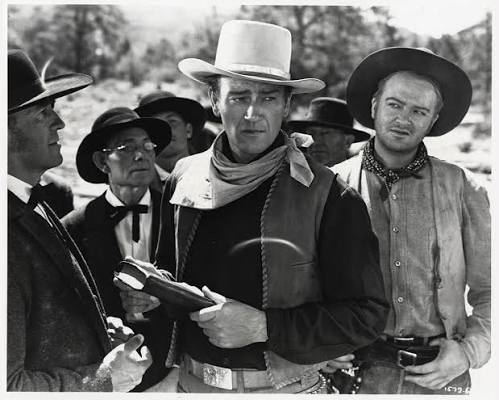
John Wayne was on the cusp of his career peak when he struck off on his own and produced and starred in “Angel and the Badman,” a project written and directed by James Edward Grant, who’d become Wayne’s confidante and go-to screenwriter in later decades.
They made this burly Western for B-movie specialists Republic Pictures in what might be said to be Wayne’s “last B Western,” and one of his best Bs.
He was breaking free from his overbearing mentor, John Ford, if only for a moment. He wasn’t yet tying his fate to the tastes of action auteur Howard Hawks. But he, Grant & Co. filmed in Ford’s favorite “Monument Valley” locations and included players who’d become famous as members of Ford’s stock company — Bruce Cabot and Hank Worden among them.
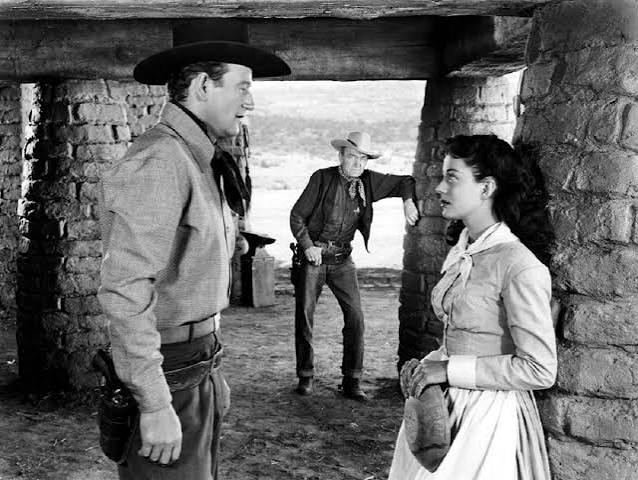
And Wayne saved a plum part for Harry Carey, a star character actor from early silent Westerns who gave Wayne a lot of his moves, poses, wardrobe choices and the like — many of the ingredients that came to define Wayne’s onscreen persona. Check out the pose Carey strikes in the shot above that uses Wayne and Gail Russell to frame the silent screen legend in the background. We’d see versions of that in Ford Westerns, most famously “The Searchers.”
Sprawling, violent and serio-comic, with lots of Western lore, Western tropes and Western “types,” “Angel and the Badman” would kickstart a stretch in which Wayne would take on a string of roles that would redefine him for all time.
And as it’s been remade for stars Zachary Levi, Meg Fraser and Tommy Lee Jones (in the Harry Carey role), I thought I’d get around to it.
John Ford fans quickly evolve into Western snobs, with only a few other filmmakers (Hawks, most prominently) meriting our attention. But “Angel” would prefigure “Shane” and “Three Godfathers,” inspire Harrison Ford and Peter Weir’s “Witness” and pay homage to Ford in scenes, shot selection and composition.
If Grant was no John Ford, he and The Duke damned sure knew how to imitate him. At times, it seems all that’s missing is an accordion and a rendition of hymns like “Shall We Gather at the River?”
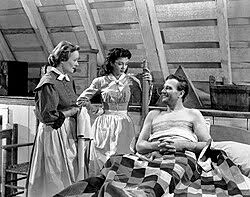
The sentimental story picks up our “Badman” (Wayne) after he’s escaped some bit of violence. Falling off his saddle at the Worth Ranch, he insists on going to the town telegraph office to get off a land claim message before he collapses, bloodied, into the care of young Penny (Gail Russell, a delighful foil for him).
The Worths (Irene Rich, John Halloran, with Stephen Grant, the writer/director’s son, as little Johnny) are Quakers, kind-and-helpful by faith. They bring the notorious Quirt Evans (Wayne) back to life.
Pretty soon the man named for something you whip horses and boys with is throwing his weight around to “help out,” and yet softening, just a little, in the presence of righteous pacifists.
“Each human being has an integrity that can be hurt only by the act of that same human being and not by the act of another human being.”
But trouble is on the way from the desperado Laredo (Cabot), He has history with Quirt, and a beef with the guy.
“Hey, why don’t we just bust in?”
“Because bustin’ through doors with Quirt Evans on the other side ain’t my idea of a healthy pastime.”
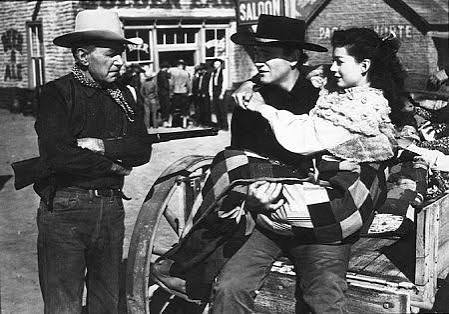
The script meanders a bit, with Quirt alternately courting and then matchmaking for darling Penny, laying low and then starting saloon brawls, fighting rustlers over a herd that he may want to rustle himself, mooning over Penny and sparking with “dance hall gals” and sometimes even listening to the aged marshal’s (Carey) sage advice.
“Only a man that carries a gun ever needs one.”
This isn’t a great Western, but it covers a lot of bases and a lot of ground. It’s sentimental and sweet, downright cute when it isn’t violent. And it’s gorgeously atmospheric thanks to the dusty locations and livestock — cattle, horses and actors — trotted through them.
If you’re going to remake a John Wayne “classic,” it’s probably a better idea to pick his last B-movie than to aim for “True Grit” — unless you’re the Cohen brothers, and Jeff Bridges is signed on.

Rating: “approved,” violence, sexual inuendo
Cast: John Wayne, Gail Russell, Irene Rich, Joan Barton, Bruce Cabot and Harry Carey.
Credits: Scripted and directed by James Edward Grant. A Republic Pictures release now in the public domain and free on Tubi, Roku, Pluto, other free streamers.
Running time: 1:40



