Movie Review: Life and emotions come in “Waves”

waves1.jpeg

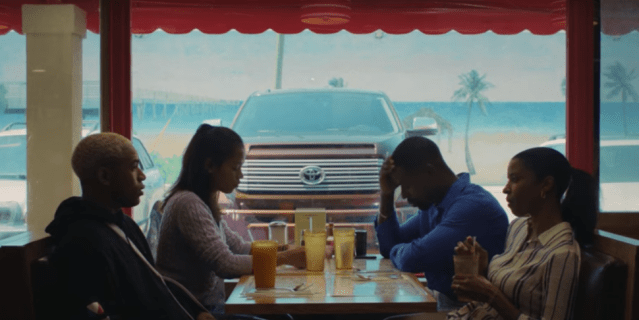
Intimate, evocative and lurid, “Waves” captures the heat of youth and the fog one family navigates through as parents try to guide two teens to adulthood in Greater Miami.

Writer-director Trey Edward Shults, in a major departure from his best known work, the Aussie apocalypse horror tale “It Comes at Night,” tells this story in densely saturated colors, with a swirling camera, seamless stream-of-conscience editing and a soundtrack — music sung along to, voices muffled, then brought into focus — to match.

The melodramatic first two acts play out pro forma, predictably but with intense feeling as Tyler (Kelvin Harrison Jr.), an upper middle class high school senior who wrestles, plays a little piano and loves on his girlfriend Alexis (Alexa Demie), and endures the loving but judgmental glower of his “We are not AFFORDED to the luxury of being ‘average'” father (Sterling K. Brown).

But “predictable” goes out the window with a third act that feels more like an overlong epilogue, taking the story from its climax and beyond, meandering into grace notes that point to how people go on and grow after a life-shattering event.

Tyler’s training regimen at school is rigorous enough. It’s when he gets home that “that extra mile” is covered. His taskmaster dad puts him through more reps in their home gym, and a post-match debriefing and coaching on the mat he’s laid out in the garage.

Homework? That comes next. And yet he has time for Alexis and tomfoolery with his friends after all that. The illusion of it all, the thin margin the kid is working with, is hinted at in his careless driving, rambunctious sing-alongs with his boys or Alexis, a camera spinning between them capturing joy, harmless fun and a lot of unbelted seatbelts.

That margin of error evaporates in ways we can see coming, even if a car wreck isn’t one of them. And the “push through it” pressure Tyler is living under means there’s no communication with his family when the wheels start to come off — an injury here, a girfriend crisis there.

Sister Emily (Taylor Russell) is all but ignored until Taylor’s crisis comes to a head. We then get to watch her sort her own life out and face the same stark choices he did as she finds a beau (Lucas Hedges) and the life-altering temptations of teenagers all over America. Will she make better choices?

The young players shine, ably getting across the emotional confusion of youth, the impulsiveness, and the stubborn unwillingness to communite with their elders. These are buttoned-down performances with flashes of temper, regret and guilt.

But it is Brown, of TV’s “This is Us,” who pops off the screen, pop-eyed in intensity, full of life lessons, directions and heavyweight parenting. He revels in the weightlifting bonding (with mirrors to peacock in front of) with his boy, stares at him with an unnerving focus. This is “toxic masculinity” with a loving touch. Ronald runs the family construction company, and whatever he and wife Catherine (Renée Elise Goldsberry) agree on financial and childrearing matters, he is hellbent on raising a young MAN.

An opening credit — Damien Van Der Cruyssen is “colorist” on “Waves” — speaks volumes about Shults’ stylistic intentions here. He’s borrowed Harmony Korine’s production designer from “Spring Breakers” and put Trent Reznor and Atticus Ross in charge of the score. The screen size changes aspect ratios as hypersaturated blues tint interiors, with neon-colored parties and grey overcast afternoons evoking the grim discipline of training.

It’s all a bit much, as the picture’s two halves are in no way equal, and the post climax scenes, reaching for “healing,” tend to soften the film’s blows. The emotions stick, but feel rather flat after the tension and release of the opening scenes.

That robs “Waves” of the gut punch we feel coming, even after the anti-climax has slow-walked out of the gate.

3stars2

MPAA Rating: R for language throughout, drug and alcohol use, some sexual content and brief violence-all involving teens

Cast: Kelvin Harrison Jr., Taylor Russell, Alexa Demie, Renée Elise Goldsberry, Lucas Hedges and Sterling K. Brown.

Credits: Written and directed by Trey Edward Shults.  An A24 release.

Running time: 2:15

Posted in Reviews, previews, profiles and movie news | Comments Off on Movie Review: Life and emotions come in “Waves”

Movie Review: “Frozen 2” melts down

froz1

Channeling one’s inner five year-old girl isn’t much help when considering the thin charms of “Frozen 2.”

It plays like an animated musical built around forgettable tunes and impressive animated effects that were cooked up before the script was decided on. And that script, by co-director Jennifer Lee? Undercooked, with heaping helpings of self-help speak shoved into tiny tots’ faces.

Odd moments of Josh Gad‘s giggly magic snowman Olaf — who breaks into pointless, random laughs, just like your stoner roomie in college — and a couple of funny tunes, including a proposal song rendered into a “Bohemian Rhapsody” with reindeer backing lovesick suitor Kristoff (Jonathan Groff), don’t break the visually and emotionally flat spell this Journey to Nowhere casts.

Magical Queen Elsa (Idina Menzel) and her mortal spitfire of a younger sister Anna (Kristen Bell) have the run of Arendelle. But a song their dead mother sang them about a river “which holds the answers” and a troubled land “as north as you can go,” a place hidden by a menacing, magical mist, sticks in their minds.

An ancient betrayal and wrongs never made right won’t touch Arendelle, right? Even if “nothing is permanent.”

The snowman doesn’t fret about such things. He’s too busy making age jokes, the “OK, Boomer” cracks of a fairytale jester — to the sisters.

“I can’t wait until I’m ancient and I can worry about important things.”

But there’s a voice only Elsa hears, a siren’s call of warning. When a cataclysm strikes the kingdom, she resolves to find closure, to visit the mist and venture, in song, “into the UNknoooooooown!”

Anna won’t be left behind. That leaves poor Kristoff with a ring and no right moment to pop the question. One of the few lightly amusing bits here is how he repeatedly says the wrong thing, and she blows up that wrong thing into self-criticism and a Federal case.

Just as in real life.

Their collective mission on this vague quest is to “Do the next right thing.” Olaf’s mission is to entertain one and all with his vast knowledge of trivia — “Did you know that wombats poop squares?”

Anything to get him off his endless collection of Tony Robbins “self-actualizing” quips.

froz2

The land of Northuldra (If any Northuldrans want to correct my spelling of their homeland, have at it.) is a place and a people of perpetual fall. So we’re really NOT in “Frozen” territory here at all, are we?

The songs, by by Kristen Anderson-Lopez and Robert Lopez of “Frozen” and “Coco” fame, include a folk lullaby, a couple a classic rock-tinged tunes including that “Lost in the Woods” tribute to Queen. And one with a lyric unique to the entire history of animated films for children.

“Hello darkness, I’m ready to succumb.”

Welcoming the end of the movie, where the tunes place so few demands on the Great Menzel and plucky Ms. Bell is one thing, but welcoming death?

There are new “Earth Giants” (rock monsters) to fear. And there’s a new critter, a fire-gecko, for the plush toy crowd.

Yeah, it’ll earn a cool $billion. But seriously, if “Frozen” was lukewarm mush to anyone over the age of eight, “Frozen 2” is mush that’s melted.

1half-star

MPAA Rating: PG for action/peril and some thematic elements

Cast: The voices of Kristen Bell, Idina Menzel, Josh Gad, Jonathan Groff, Evan Rachel Wood, Sterling K. Brown, Alfred Molina, Jeremy Sisto and Martha Plimpton

Credits: Directed by Chris Buck and Jennifer Lee, script by Jennifer Lee, A Walt Disney release.

Running time: 1:43

Posted in Reviews, previews, profiles and movie news | Comments Off on Movie Review: “Frozen 2” melts down

Next screening, an Oscar contender: “Waves”

A South Florida father trying to guide his kids to a better life, young love. A trailer that gives you just enough.

Posted in Reviews, previews, profiles and movie news | Comments Off on Next screening, an Oscar contender: “Waves”

Netflixable? Vikander has to move to Japan to hear the “Earthquake Bird”


bird2

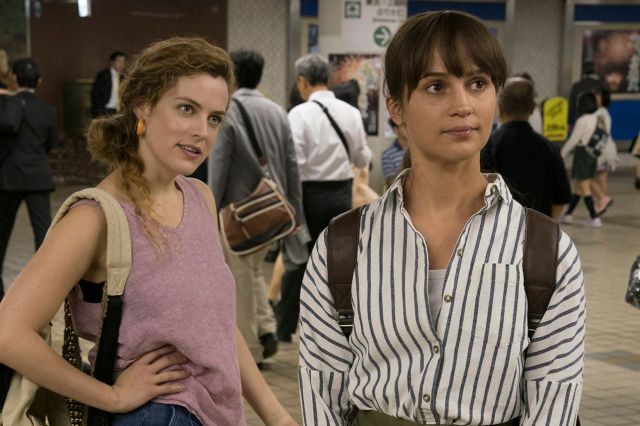
There’s little forward motion or narrative drive to “Earthquake Bird,” a moody whodunit set in 1989 Tokyo. But Oscar winner Alicia Vikander and director Wash Westmoreland (“Still Alice,” “Collette”) almost render that deficiency moot.

It’s a chilling exercise in isolation, woven out of muted tones and low light, lifted by a fearsomely guarded turn by Vikander, playing a Swedish emigre accused of murdering an American woman.

Vikander is Lucy Fly, a young translator and loner who, when we meet her, is picked up by the police — at work — because of a headline that’s in the days papers. “Body part found in (Tokyo) Bay.”

Her unemotional cool makes trying the old “good cop/bad cop” with her a dicey proposition. The older officer (Kazuhiro Muroyama) uses the testy younger one (Ken Yamamura) as translator for their interrogation. They discuss strategy, in Japanese, in front of her. They have no idea what she does for a living.

“Be careful,” she purrs, in Japanese (with English subtitles). “I understand EVERthing.”

Her day long third degree is the frame that the film’s flashbacks, and flashbacks within flashbacks, tell the story within.

The missing American woman, Lily, (Riley Keough) was forced on Lucy by a mutual friend (Jack Huston), a bon vivant who thinks nothing of inconviencing Lucy with an easily underestimated looker who has moved to Japan, on impulse.

Lily can’t really support herself, doesn’t like much of the food, can’t speak the language and is angling for work as a bartender. Of course Lucy will help her find an apartment. On-the-make Bob (Huston) is banking on it.

We see that meeting, and another first encounter that spins off a police query. “Do you have a boyfriend?”

Teiji takes Lucy’s picture, on the street, and uses his tactlessness as an introduction and a dinner invitation. He is tall, brooding, mysterious and handsome. She is smitten. FYI, Teiji is played by Naoki Kobayashi, a Japanese pop idol. No shock there. He looks like a pinup.

The flashbacks prompted by threads of questioning take Lucy through her relationship with the standoffish but sexy Teiji, who says “Tell me everything” at their every meeting. His own secrets? Aside from him being from the provinces, workings as a noodle chef and pursuing (pre-digital) photography as a passion, he gives little away.

“You must trust me,” he smolders.

That relationship is lopsided. He photographs Lucy incessantly. Every time she stands up for herself, she apologizes.

And Lily is more imposition than friend. Lucy politely invites her along to everything she and Teiji have going on, not that he’s that into going out in public with either of them.

Lucy’s brooding nature has an origin story. “Death follows me,” she tells him (if not the cops, later). “It always has.”

There’s something cagey about her interaction with the police. She’s not quite toying with them, but she’s not volunteering much, either. It’s as if she’s expected something like this to happen, has carried that weight before. She can feel responsible even if she isn’t guilty. And she’s not saying, one way or the other.  

Westmoreland anchors “Earthquake Bird” firmly in the realm of period piece. We glimpse Lucy at work, coming up with subtitles for the Ridley Scott thriller of that era, “Black Rain” (Scott’s company produced “Earthquake Bird.”).

This is pre-Internet Tokyo, pre-cell phones. The cops can’t do much homework and research on the principals, here. Mail from the U.S. takes eight days to get there. And in a flashback that could only be set in 1989, Lucy and the others hike near Mount Fuji.

“Did anyone bring a camera?” No. Ancient history.

The “bird” of the title is one that you can only hear sing in the deathly still silence after an earthquake. What will it take to make Lucy “sing?”

The film’s resolution, and really its third act, is so frustrating that it rather spoils much of what has come before. It makes the subtle story in which not a lot happens (and little that’s not predictable) feel malnourished.

But even if this film of a Susanna Jones novel makes a middling whodunit, it’s still a fine vehicle for Vikander, an actress of quiet reserve and inner fury. She and the exotic setting lift “Earthquake Bird,” even if it never fully takes flight.

2half-star6

MPAA Rating: R for some sexuality, full nudity and brief language

Cast: Alicia Vikander, Naoki Kobayashi, Kiki Sukezane, Kazuhiro Muroyama, Jack Huston and Riley Keough

Credits: Written and directed by Wash Westmoreland, based on the novel by Susanna Jones.  A Netflix Original.

Running time: 1:46

Posted in Reviews, previews, profiles and movie news | Comments Off on Netflixable? Vikander has to move to Japan to hear the “Earthquake Bird”

Movie Review: A dying granny, family grudges, a “triggered” student, a lot goes on “After Class”

class1

The holiday season seems like the perfect time for “The Messiest Dramedy of the Year” to show its face. That’s what “After Class” is, a movie that grabs at a lot of themes, subtexts and characters and doesn’t really wrestle any of them into shape or into submission.

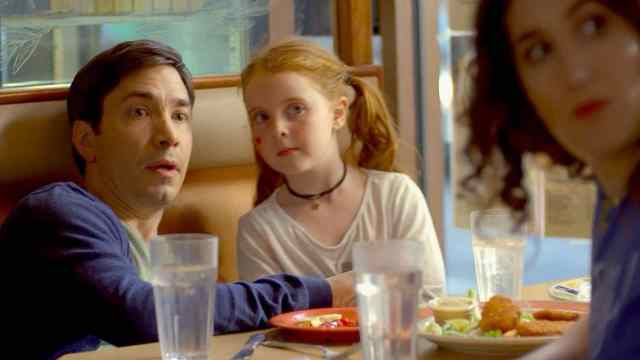
It’s still a fun mess to watch, and a fine showcase for Justin Long, who plays the harried and harrassed “adjuct professor” of writing whose smarts and sensisity collide with his arrested development and quarrelsome, noisy New York Jewish family.

We see the “trigger” moment when it happens. We don’t have to know this film was first titled “Safe Spaces,” before Adam Carolla ruined that phrase forever with his recent documentary.

Josh is engaging with his college writing students, bantering, treating them as adults and equals. A young woman has written a short story based on real-life experience that the class has attacked. Josh probes to find out what interesting details she left out of her account of a bad date. We don’t need to see the class’s mass-exchange of side-eyes to know what he doesn’t. He’s crossing a line.

He gets what he’s after, entirely too enthusiastically — creepily. But it’s all good. “We’re WRITERS. We get to turn these embarrassing, painful things into art! Write that HURTS!”

Thus begin his endless meetings with the college dean and (perhaps) representative. It starts with “You’re new here” and veers into “Some of these students can be very sensitive” and meeting by meeting, it’s all downhill from there.

Not a good time for Josh. He’s not making ends meet, his podcasting pest of a sister Jackie (Kate Berlant) pesters her way into his apartment, which he shares with a sexy Italian grad student he met in Florence (Silvia Morigi).

And his grandmother (Lynn Cohen, of “Feast of the Seven Fishes”) is dying. That’s got the whole family on edge.

Mom (Fran Drescher) is at her wit’s end, ready to divvy up Grandma’s furniture and possesions, even though she’s in the hospital and “better.” Her ex-husband, their dad (Richard Schiff) has remarried, won’t visit this woman who was “like your own mother.” Jackie isn’t on speaking terms with him.

Brother David (Michael Godere) is squeezing bedside vigils in between business meetings and his suburban family.

They all get along, after a fashion. But they bait each other endlessly. Every discussion turns load, with a lot of people shouting at once.

And there’s this professional crisis that Josh can’t charm or good-intentions he way out of.

class2

Writer-director Daniel Schechter did the kidnapping Jennifer Aniston farce “”Life of Crime,” and if anything, he’s taken on more items to juggle here. Too many more.

But here’s what I liked. He forces Josh to explain his predicament to the Italian, who doesn’t “get” it because he didn’t have sex with a student or do anything remotely that offensive.

“You’re European, it’s different over there!”

Schechter may park Josh in the middle of the “triggered” era and its “cancel culture.” He may write and cast some of the same shrill stereotypes of today’s easily-offended college student as the documentary “No Safe Spaces.” The kids here are mouthy, belligerent, self-absorbed and self-righteous.

The little darlings — gay or straight, sometimes black, often female — are perpetually outraged and quick to cross lines they themselves would flip out if anyone but themselves crossed them.

“Thank you so much. But we don’t need your hashtag right now.” She’d say “OK, Boomer,” if she was talking to a baby boomer.

Josh’s writing class might be interrupted by a student whipping out a cell phone to video him as the student sets out to provoke a fight. Josh’s writing seminar has assorted outraged young women of color exploding with accusations of sexism, racism and homophobia, and patting themselves on their backs for “calling you out” when their chief beef is “I am sicking of f—–g straight white men!”

Um. OK.

Josh, an arrested development case at 38, is shocked that “college wasn’t like this when I went.” But he’s just an earlier part of the slide down the slippery slope that created them. We can see this extended childhood even in his own parents. And the whole slope is even clearer when we meet the very young son of his dad’s second-marriage . The kid is rude, impatient, defiant and out of control.

Decades of “treat your kids like adults” parenting has produced clingy, abrasive offspring who don’t respect authority, life experience or expertise. His students call Josh by his first name, and a lifetime of being empowered, allowed to think that whatever attitude or opinion they have is as valid as those with more experience of the world, has made them hyper-sensitive, emboldened and dispectful.

That’s an interesting message to slip into the middle of a lightweight ethnic family comedy about kids, grandkids and great grandkids who haven’t grown up, and a doting grandmother about to leave this world.

There are laughs and moments of warmth. And there are annoyingly familiar confrontations that have a grounding in legitimate cultural grievances, but which a lot of funny shouting cannot resolve, during or “After Class.”

2half-star6

MPAA Rating: unrated, profanity, sexual conversations, off-camera drug use

Cast: Justin Long, Kate Berlant, Fran Drescher, Lynn Cohen, Silvia Morigi, Richard Schiff.

Credits: Written and directed by Daniel Schechter. A Gravitas Ventures release.

Running time: 1:33

Posted in Reviews, previews, profiles and movie news | Comments Off on Movie Review: A dying granny, family grudges, a “triggered” student, a lot goes on “After Class”

Franchise fatigue has set in this year. ‘Charlie’s Angels’ is proof

That’s what is missing from the Variety analysis linked below. The notion that the audience is not merely tiring of “tired” franchises, but that something broader might be in play.

A year filled with “unoriginals” which have flopped —“Shaft,” “Terminator: Dark Fate,” “Men in Black: International,” “Doctor Sleep” and now “Charlie’s Angels”— suggest audiences tiring of the same old stuff, remade. Disney is making bank by duly remaking animated classics, and endless iterations of the same Marvel formula, to say nothing of beating “Star Wars” to death, Sony won’t let go of “Spiderman,” Warner’s and Batman, MGM and Sony with James Bond. They should all be shaking in their boots and hunting for original content and not established brands.

The writing’s right there, on the wall an on their bottom line.

https://variety.com/2019/film/box-office/charlies-angels-box-office-flop-1203407429/

Posted in Reviews, previews, profiles and movie news | Comments Off on Franchise fatigue has set in this year. ‘Charlie’s Angels’ is proof

Next screening? “Frozen 2”

Disney has been pitching this sequel as more an action adventure cartoon than a musical.

But of course there’s music in”Elsa: The Next Mission.”

Let’s hope it’s a dazzler. Hasn’t been the most epic fall for animation on the big screen.

Posted in Reviews, previews, profiles and movie news | Comments Off on Next screening? “Frozen 2”

Movie Review: “When Lambs become Lions” takes an African view of the poacher/wildlife guardians conflict

lambs1.jppeg

Desperation collides with duty in “When Lambs Become Lions,” a docudrama set in the wildlife parks of Northern Kenya.

That’s where poachers and National Reserve Game Rangers play for keeps in their struggle over Africa’s last elephants.

Jon Kasbe’s film depicts an arid land where the locals struggle to survive, where seeing the benefits of eco-tourism is difficult and where the president’s words about protecting “out national heritage,” that “To us, ivory is worthless unless it is on our elephants” isn’t a view shared by all.

We meet “X,” an ivory selling middleman who brags to the camera crew following him that he is “like a king” in his corner of Kenya. He can feed his family, spoil his kids with presents.

“I never do the killing myself,” he says (in English and Swahili with English subtitles). That’s what his hired hand Lukas is for, to mix up the toxic frog poison that he dips his arrows in, paralyzing elephants so that he cut their tusks off before they’ve finished dying.

A few still photographs note the grisly, barbaric nature of the work. But on land where nothing can be easily cultivated, what are poor people to do? X can’t drive by a small herd on the road without asking Lukas, “How much do those tusks weigh?” He’s got buyers who crave the white gold.

The men who stand between X and Lukas and the elephants are the Rangers, men with a measure of empathy for the wildlife and a ruthlessness all their own that they call on to preserve it.

Asan is one of them, a young father with another baby on the way who knows that “Out here, we’re all hunters…Poachers hunt the elephants, and we hunt the poachers.”

Lukas thinks “these Rangers are not human,” pointing to river rocks where he says Rangers tie prisoners up “so that the crocodiles can eat them.”

When the Rangers fall upon some poachers, the pummeling and kicking — “Confess the truth!” — is the “good cop” approach. The unit commander acknowledges that when they catch poachers red-handed, the verdict is “bullet on the spot.”

“When Lambs Become Lions” follows the two points of view — in one scene, X waves off the camera crew as a Ranger doesn’t want to be filmed — as we learn that Asan and X are cousins. And the pressures of their environment and their obligations to their families will either bring them into conflict, or lure them into an alliance.

X knows just the right questions to ask.

“Do you have enough money?”

Kasbe says he spent four years embedding himself with real poachers and Rangers engaged in this conflict, and conjures up a film that plays much closer to a thriller than the “documentary” he insists it is.

The performances, the dialogue, the melodrama of rising suspense as X’s buyer pressures him for more product even as the Rangers close in, feel scripted and performed. Asan jokes to his wife that his son, play-acting with a stuffed dog toy that he’s “killed,” says “If he becomes a poacher, I will have to kill him!”

The camera placement is feature film dramatic with perfect lighting — blocked, maybe even story-boarded.

Perhaps there is a braggart poacher who’d love to be followed by a documentary crew without fear of discovery or prosecution. The more logical conclusion is that ex-poachers and ex-Rangers were involved, staging domestic arguments over overdue paychecks, panicking when nearly caught in the act.

So I’d bet good money that “When Lambs Become Lions” is a solid, engrossing docudrama — staged and acted — not, as its director claims, a documentary. That still doesn’t rob the film of its simple power, the suspense of wondering just who will turn on whom, and if elephants will be killed in the bargain.

2half-star6

MPAA Rating: Unrated, with violence, some profanity, smoking.

Credits: Directed by Jon Kasbe. An Oscilloscope Labs release.

Running time: 1:16

Posted in Reviews, previews, profiles and movie news | Comments Off on Movie Review: “When Lambs become Lions” takes an African view of the poacher/wildlife guardians conflict

Documentary Review: Italian photographer survives “Shooting the Mafia”

Shooting the Mafia - Still 3

She didn’t take up a camera until she was 40, and became, she says, “the first woman (news) photographer in Italy.”

But it’s where Letizia Battaglia took up her art and trade and who she pointed her camera at that have made her famous.

“Shooting the Mafia” is about her decades-long quest to document the crimes of “La Cosa Nostra,” the Mafia, in her native Sicily in the blood-stained capital of Salerno.

When she started taking those photos, first for the local newspaper, L’ora del Popolo” (“The Hour of the People”) that she was “forced into another world,” Battaglia, now 84, says in the film. She’d capture crime scenes — first in black and white, later in color.

“Your first murder never leaves you,” she growls in between puffs of her omnipresent cigarette.

The stark poetry of black and white images of the aftermath of violence remind one of the work of New York street photographer Weegee.

But Battaglia would photograph the survivors, women shocked with grief at the loss of a husband, father or — too often — child.

“Photographing trauma is embarrassing,” she confesses (in Italian with English subtitles). You’re working, pointing your camera at suffering, getting close because changing lenses misses the moment. You’re intruding, assaulting the already traumatized.

She captures street scenes of tweenage boys, smoking and playing poker, affecting the tough guy guise in imitation of the local thugs. “The killer is a symbol for them.”

She attends funerals, where the killers or those who ordered the killings are sometimes mixed in with the mourners, where some of the grieving are plotting revenge.

And she goes to court when the real murderers, the Mafia bosses who order the killings, many of them in hiding for 20-40 years on an island where “no one sees anything.” This, more than anything else, has earned Battaglia death threats, reducing powerful, swaggering mafiosi to just another well-dressed hood, handcuffed to a couple of cops — humiliated.

Veteran documentarian Kim Longinotto incorporates footage from Italian and early American TV documentaries about the Mafia to flesh out the history and the criminal organization’s thorough corruption of Sicilian life.

She goes into Battaglia’s personal life as well, an unhappy early marriage that ended her education and thwarted her dreams, the many men that followed — most of them much younger than this strong, courageous icon of resistance to literal “mob rule.”

Battaglia got into politics, got her hopes up when crusading magistrate Giovanni Falcone went to war with the Mafia in the 80s, and was so devastated by his murder she could not photograph it.

Scores of police, and virtually every prosecuting judge who took on the Mafia, were murdered over the decades Battaglia photographed this world.

The history and the personal life details flesh the film out a bit. But the picture is at its most engaging when it focuses strictly on the woman and her dogged work, showing her photographs in the Mafia stronghold of Corleone (go figure), using images to shake her neighbors out of their complicit silence.

It takes guts to take on the mob in a place where its been tolerated for centuries. And sometimes the bravest of those in that fight aren’t in uniform. Some of them are still carrying a Pentax.

3stars2

MPAA Rating: unrated, images of graphic violence

Cast: Letizia Battalgia

Credits: A Cohen Media Group release.

Running time: 1:37

Posted in Reviews, previews, profiles and movie news | 2 Comments

Documentary Review: What comes “After the Murder of Albert Lima” is, at times, hilarious

lima1

The opening moments of “After the Murder of Albert Lima” are where the confusion begins. A Tampa area personal trainer is talking to a couple living on an island in the Caribbean. He puts them on speaker phone.

He’s asking about borrowing guns. They’re offering to give him Haldol so that he can knock somebody out. Maybe they’ll even do the injecting themselves. He mentions plans to “stuff (their quarry) in a suitcase.”

Hells’ bells, what criminal mischief are these rubes cooking up? I mean, “Murder of Albert Lima” is billed as a documentary. Are we watching a mockumentary?

It’s not, though. Filmmaker Aengus James has been invited to listen in as a bunch of amateurs work out the logistics of something that “the movies” make look simple, easy — especially when the “professionals” do it.

But the “professionals” here, a “tracker” (Art Torres) and a “bounty hunter” (Zora Colakovic) project the confidence of the delusional. In their own minds, they’ve got this. But we can sense it in their bravado, signs we recognize in the daily public (political) examples of “the very best people” who cannot hide their rank incompetence.

We can meet Paul Lima, the personal trainer setting this caper in motion, and hear his story. It’s the tragic account of the murder of his Tampa lawyer father on the lawless Honduran island of Roatán (“paradise” for scuba divers, among others). We can see the grisly crime-scene photos, a man shot and dumped in the woods in a place where even if the police cared, they’re ill-equipped to bring the killers to justice.

Paul can tell us of his 13-year quest for justice, the corrupt Honduran court system that let the killer go free for the right bribe. We can hear about accomplices, one of them a friend of his father, killed, and of the good-faith loan (to keep a bakery open) that went bad and triggered all this.

But at the end of the day, ordinary people trying to get justice or revenge or closure on their own, or providing that as a paid service that they’re ill-equipped to deliver, is damned funny.

It’s what the talk show host/philosopher Steve Allen said — “Tragedy plus time equals comedy.” Time has passed. And there is nothing funnier than delusions of competence.

There are fraught moments, secret cameras trying to capture efforts to get close to the killer, Oral Coleman. Paranoid men with pistols and shotguns stand between our team and their quarry. The American couple, the Krims, who want to help, are under death threats themselves. The island is overrun with unsolved murders of Americans.

But when your personal trainer-leader is talking about how they will “‘Weekend at Bernies’ this guy,” when he’s trying to hire a charter fishing boat to smuggle them all to the mainland (on camera) and NOT telling the captain what they’re really up to, with every moment this conspirator or that one dons his “C.S.I.: Miami” sunglasses, with every stakeout that ends with one of the “professionals” getting drunk and passing out, with every accidental discharge of a gun, “After the Murder of Albert Lima” becomes less tragic, more farcical.

“Rookie mistake,” one character will admit. “We’re not prepared for this” another finally confesses.

after2

Filmmaker James has to be lumped in with everybody else, as his filming and “crew” give the would-be kidnappers cover. They’re all making “like a National Geographic kind of documentary.” If this comes off, or goes wrong, there will be blood on James’ hands, too. Or egg on his face.

Fake accents are trotted out for phone calls, nothing goes off “like clockwork” because in the real world life is messy and random, unscripted and not routine.

I’d love to get a gander at the release forms James cooked up for this project. Because as sincere as one and all are — especially Paul, who seems genuinely gutted and often outraged by his inability to get justice (he even got Congress to authorize money to have murders of Americans in Honduras investigated and prosecuted) — the payoff is a movie in which everybody comes off, at least at times, as an idiot.

And good sports or not, who’d agree to let a movie show them in that light?

3stars2

MPAA Rating: unrated, violent images

Cast: Paul Lima, Art Torres, Zora Colakovic, Cindy Krim, Kent Krim, Judy Lima

Credits: Directed by Aengus James. A Gunpowder & Sky release.

Running time: 1:37

Posted in Reviews, previews, profiles and movie news | Comments Off on Documentary Review: What comes “After the Murder of Albert Lima” is, at times, hilarious