Movie Review: Summer love, “Premature” as it often is for a teen

prem.2

Harlem girl, college-bound, entirely too smart for the neighborhood guys who are all “speak ‘game,’ play game, one big game” with their come-ons.

But then Ayanna, the aspiring writer and would-be poet, stumbles into Isaiah, the earnest, smart would-be music producer.

And before you can say, “Uh oh, here’s a white girl,” before you can mutter those three magic letters — “E.P.T.” — this summer romance takes the turn you just knew it would, dammit.

But it’s where “Premature” and director Rashaad Ernesto Green take us after that cliched first and second act that mark this indie drama as “must see.” Reworking a short film he did over a decade ago, sharing a co-writing credit with his muse and star, Zora Howard (also a star of the 2008 short film), we’re immersed in lives, a world and dreams that won’t be just “deferred” if Ayanna (Howard) loses her way. They will be derailed.

Ayanna narrates, in voice over, her feelings about her Harlem life and the swept-off-her-feet interruption that Isaiah (Joshua Boone) becomes.

She’s content to spend this last summer before enrolling at Pennsylvania’s Bucknell U. with her girls, a brassy quartet who make a big show of ogling the “talent” on the park basketball court. They use safety in numbers to keep the teenage boys on their heels, despite their sexual bravado and blunt and cute/crude pick-up lines.

“I got a THING for ‘thick’ girls!”

Look over Shonte (Imani Lewis) or Tenita “T” (Alexis Marie Wint) on the train, and Ayanna is the one who’ll call your bluff when you try to get off at your stop.

“Y’ain’t get number yet.”

She keeps a notebook with her, wears glasses to denote her bookishness, and insists on fidelity from her feckless would-be suitors.

“Is that your girl?”

“We still chill, right?”

“Go chill with her!”

She wears her long braids and glasses like armor and is quick with a brush-off if there’s unwanted attention. If she wants to be cruel, she lets the sweet-talker get deep into his game before dismissal.

But Isaiah has an offhand charm, speaks lovingly about his dead musician father, his musical aspirations, about how his Mama lectured him on which side a gentleman walks on when escorting a young woman down the street.

Ayanna is smitten, a tad too quickly and a bit too overwhelmingly. But that’s what teenagers do, right?

prem3

There’s a line she writes that somewhat sums up the movie and its biggest shortcoming. “We were too young to live this old.”

Everybody and I mean EVERYbody seems entirely too old for the high school-or-just-out-of-high-school world this population lives in.

Ayanna’s poetry about her first big love is polished and adult. “What did I know of my heart before you gave it shape?”

An African-American filmmaker has license to make stereotypical points about inner city kids “growing up too fast,” sexual young men bragging about their babies, very young women hectoring each other not to fall for this one or that one, to learn to “close your legs” if you’ve already had two children before hitting 20.

But making Ayanna 17 when the actresses playing her and her peers are plainly older, street-wise and world-weary, is a blunder. Up everybody’s age by suggesting Ayanna is finally ready to go to school at say, 22, and the picture might work better.

The life around them is deliciously filled-in, with Green and Howard plainly taking their cues from early Spike Lee films in fleshing out the cast and giving them something funny, sassy or slangly to say. Ayanna’s single mom (Michelle Wilson) and her friends — some of them much older — are just as comically crass in the sex talk department as their kids or grandkids are on the other side of the park.

“Who would you ‘give some’ too? OJ, Ike or CROSBY?”

Williams, playing a lonely woman who has drifted from man to man with no relationship sticking, comes off as self-involved, but is still capable of mothering moments when it counts and she’s warning her child about “chasing after those good-for-nothing boys.”

The performances and the milieu, with its colorful colloquial speech and loving if blundering sisterly relationships, is what sells “Premature” and makes it an indie film well worth your time.

It won’t seem wholly original to anybody with “She’s Gotta Have It” and “School Daze” burned into memory. But it’s a lively, lovely and lived-in slice of Harlem life that looks, sounds and feels “right,” even when what we’re seeing is over-familiar to the point of cliche.

2half-star6

MPAA Rating: unrated, explicit sexual content, nudity, alcohol, marijuana involving teens, and profanity

Cast: Zora Howard, Joshua Boone, Alexis Marie Wint, Imani Lewis and Michelle Wilson

Credits: Directed by Rashaad Ernesto Green, script by Rashaad Ernesto Green, Zora Howard. An IFC release.

Running time: 1:30

Posted in Reviews, previews, profiles and movie news | Comments Off on Movie Review: Summer love, “Premature” as it often is for a teen

From the Archive: Interview with “Bird Box” director Susanne Bier — “After the Fire”

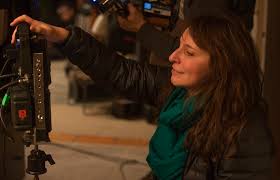
Long before she did “Bird Box,” “The Night Manager” or “Serena,” Susanne Bier was a Danish director to watch. “After the Wedding” and “In a Better World” marked her as someone with a distinct perspective and a long career ahead of her.

Here’s an interview I had with her in 2010, From the Archives.

Things We Lost in the Fire is an actor’s showcase, a quietly gripping drama of death, grief, guilt and addiction. Already there is talk of Oscar nominations for stars Halle Berry (as a grieving widow) and Benicio del Toro (as her late husband’s junky friend).

And one thing we know about “actor’s pictures” is that it takes a special sort of director to helm them. Susanne Bier is a Dane who finds herself much in demand in Hollywood. Her most recent films, somber but witty dramas that wrestle big emotions under the covers, have garnered festival awards and international acclaim, and Hollywood interest in the remake-rights.

“There’s nothing (here) to suggest that Bier…had to compromise her style in order to work in Hollywood,” notes Variety critic Todd McCarthy. But don’t tell her the film has “Danish-Scandinavian” sensibilities unless you want to get a rise out of her.

Bier, 47, has made a dozen films in 15 years and her directing star is on the rise. Brothers (2004), a homefront Afghan War drama which Hollywood is in the process of remaking, followed her first notable Danish export, Open Hearts (2002), and her most recent film festival and arthouse cinema hit, After the Wedding, played all over America.

We reached her in New York.

Q: So how did Hollywood find you? Which of your films got their attention?

Bier: (British filmmaker) Sam Mendes (the American Beauty director, producer of Things We Lost in the Fire) saw Open Hearts and Brothers and he sent me the script and took me to meet with Dreamworks. And while we were meeting, After the Wedding came out. I loved the script, but I’m not sure why they thought I’d be right to direct this.

Q: Do you see anything particularly Danish in the story, in the sensibility?

Bier: I think that universal sensibility applies here. A Dane can do this story of an American family, a family tragedy, and people in Greece or India will understand it, too.

Q: I talked with Halle Berry last spring for another film, and she recalled having to fight to get this part, making an inter-racial couple at the heart of the film, something she says that you or the studio hadn’t considered. She had to fight for it. True?

Bier: When I became attached to the movie, I met with many actresses. I was concerned for the character, Audrey. She’s so closed-down, and I was afraid that she’d seem cold. I wanted to find an actress who was very passionate and warm, in person, who could sort of hide that.

Halle is that way.

When I met her, I had no doubt.

Q: Were you a fan of Benicio’s work?

Bier: Oh yes, for years.

Q: He seems quite different here. What sorts of things did you do to bring out this vulnerable, likable side of him? Bier: He is very subdued, very clear, in a way. His pacing is very specific. There’s a clarity to him which I think serves his part, but who was loved by his friend (David Duchovny) this man we know so little about, well.

Q: What did you know about substance abuse support groups, which is something Things We Lost in the Fire gets into?

Bier: I knew nothing about this world, because I don’t have an addictive personality. But I was very intrigued by it and wanted to explore it. Benicio’s character functioning within that world of self-help fascinated me. He’s sober and serious, and yet also a little amused by it.

Q: Speaking of mystery, this movie doesn’t give away a lot. We don’t get all the answers, all the connections between characters, all the back-story.

Bier: I was drawn to this as a love story with this very uneven couple. They’re all these closed-off people, disconnected. And had they not had this tragedy, there would be no chance in the world that they’d ever get the chance to know one another.

But by the end of the movie, they mean a helluva lot to one another.

I thought of a back-story for the characters, and each of the actors thought of a back story. But none of us told each other what they thought that back story would be. Part of the fun of movie should be secrets. You open one door, go into the next room, and you should want to continue. The joy of the film is that all these characters have all these secrets. Quite intriguing.

Q: It’s a movie getting Oscar buzz right now.

Bier: Well, if you say so! Ha ha! But of course every director thinks her actors are brilliant and should be nominated.

Q: What do you think constitutes ‘an actor’s director?’ You seem to be one.

Bier: I trust the actors. A lot. And I love surprises. I can’t be more happy than when a performer does something that is so truthful and unexpected.

So there’s a lot of collaboration, flexibility on the set. But there are also unspoken things. I’m just waiting for them to surprise me and delight me.

Q: Hollywood wants to remake your work. And unlike many of your peers, from Denmark, Spain, where have you, you’re not letting yourself be trapped into doing your own remake. Why not?

Bier: For me, every movie has its own moment. I’ve already done Brothers, and Open Hearts and After the Wedding. They’re remaking all of them, I think, eventually. Every day, I show up on the set totally curious. I would not have that curiosity with a movie I have already done. That takes away my greatest creative strength.

Right now, I am looking for a comedy. There are funny moments, I hope, in all of my movies.

Posted in Reviews, previews, profiles and movie news | Comments Off on From the Archive: Interview with “Bird Box” director Susanne Bier — “After the Fire”

Next screening? Blake and Jude are in “The Rhythm Section”

The trailers for this shout “JANUARY thriller,” and that’s a good thing.

It’s a great month to release a picture with no Oscar pretenses, an action film. Mark Wahlberg knocked out a couple, before he was sentenced to Netflix.

Everybody has had lots of chances to see the Oscar nominated films. Most of the rest of what is released is part of the “January dumping ground” for movies that have no box office prospects.

This one stars Blake Lively, the “New American Sienna Miller,” and a guy who used to be married to the original British Sienna Miller.

Perverse casting? A little bit.

Director Reed Morano made her be wit”Handmaid’s Tale,” and Sterling K. Brown headlines the supporting cast.

Posted in Reviews, previews, profiles and movie news | Comments Off on Next screening? Blake and Jude are in “The Rhythm Section”

Book Review — Ian McKellen comes to life on the page in “A Biography”

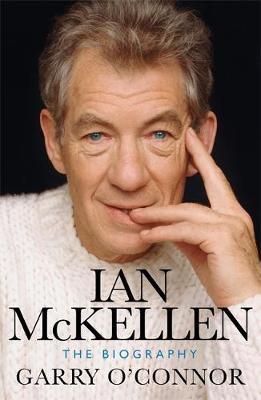
ian1

One of the delights of the third act of Sir Ian McKellen’s life and illustrious career has been throwing dinner parties, sometimes in swank restaurants here or there — often in the ancient and storied pub he owns, The Grapes.

He invites old friends, colleagues from film and a lifetime in the theater, wines and dines the lot. And at the end of the evening, as related in Garry O’Connor’s “Ian McKellen: A Biography,” he stands up at head of table, grins and makes a sweeping, theatrical gesture and utters the words everybody fumbling for the check is delighted to hear.

“Gandalf PAYS!”

Indeed he does. O’Connor may track, in quick vignettes, sketches and the like, the long life of the knighted thespian, heir to Olivier and leading interpreter of Shakespeare for his generation. But cinematic glory — and great wealth — didn’t show up until he became Gandalf the Grey — or the White — in Peter Jackson’s “Lord of the Rings/Hobbit” pictures.

O’Connor is a contemporary of McKellen’s, an old friend from the theatre who became a biographer of some note — publishing books on Laurence Olivier, Paul Scofield, Peggy Ashcroft and Alec Guiness, among others. As such, he has just enough biographer’s distance to tell a complete story of the man’s life — pick at his foibles and celebrate his true triumphs.

The opening chapter is O’Connor visiting Sir Ian to enlist his help, and not getting it. How very McKellen, one who has deigned not to write an autobiography, “modestly” refusing to pitch in on a deep dive into his career, his personal story, his life of activism and his victory lap — the post-Magneto (“X-Men”), after-Gandalf celebrity that has made him a public figure still revered in some quarters — but adored far and wide for his fan-friendly projects.

I’ve never seen him on the stage, and first noticed McKellen in “Scandal,” the 1980s British drama about the Profumo affair that crippled the British government in the 1960s.

I’ve interviewed him several times over the years, first when he took his shot at putting his Fascist “Richard III” on screen, something of a breakthrough for him — finally a film star in his ’50s. We bickered over the “virtuouso villainy” of rhe character.

O’Connor’s more intimate acquaintance makes him a fine choice for charting the rise of the Master Thespian, the frustrations of not equaling Olivier on the big screen — never winning an Oscar still gripes him — and the late life glories that have consumed the last twenty years.

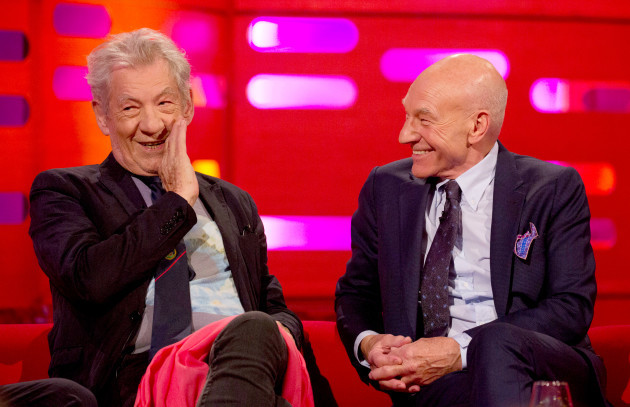
He kept up a friendly rivalry with his contemporary Derek Jacobi, was stalked (successfully, ahem), by the young Rupert Everett and with his “X-Men” and later “Waiting for Godot” co-star and chum Patrick Stewart teamed-up to become the great chat show/public appearance and occasional shared acting gig “bromance” of our day.

Just adorable, the both of them.

ian4

O’Connor’s book is awfully inside baseball, as we say on this side of the pond, when it comes to theatrical name dropping through McKellen’s pre-film-fame decades. If you don’t know that “Cambridge Mafia” of actors, directors and playwrights who came up with McKellen you may need to hit Wikipedia every page or two.

But it’s insightful in capturing McKellen’s strange accent, the swallowed, plummy locutions that seem to stem from geography, childhood illness and perhaps a recognition that he could be the baritone to Olivier’s tenor.

McKellen’s “coming out,” putting himself in the middle of the public debate over British conservative efforts to revive versions of the country’s anti-gay statues, and doing it at a time when few of his stature dared speak up, plays as heroic and decisive. He was a formidable debater against the forces of repression. He didn’t make his sexuality his identity, and thrived after letting that side of himself into the limelight.

One time I interviewed McKellen was for a story on Magneto, a “villain with a legitimate beef with the world.” The Marvel villain is a Holocaust survivor, remember. O’Connor so discounts the character (monosyllabic words, dull dialogue save for his scenes with Stewart) that he misses the impact that franchise-impacting character had. Sure, these were Wolverine movies. But Magneto was defined for all time by McKellen.

O’Connor shares Tolkien film anecdotes (not many), and seems on less sure footing in these chapters. He found a few anecdotes shared between McKellen and screen legend Christopher Lee — but botches Old Dracula’s age by ten years and rather misses the boat in the glories of McKellen’s read on the much-traveled, intrepid wizard.

The hat, the pipe, the beard, the quizzical voice, the staff all were mere props. Three perfectly-played words made his take on Gandolf sing, and made him a screen immortal.

“FLY, you fools!”

Ian McKellen: A Biography, by Garry O’Connor. St. Martin’s Press. 356 pages, $29.95.

Posted in Reviews, previews, profiles and movie news | Comments Off on Book Review — Ian McKellen comes to life on the page in “A Biography”

Movie Preview: A bipolar rom com? “INSIDE THE RAIN”

Rosie Perez and Eric Roberts are the familiar names in this bipolar college kid drowning his troubles at a strip club tale. We are intrigued.

Posted in Reviews, previews, profiles and movie news | Comments Off on Movie Preview: A bipolar rom com? “INSIDE THE RAIN”

Movie Preview: Mick Jagger in “THE BURNT ORANGE HERESY”

Fine art and the art of stealing it are touched on in this one.

Posted in Reviews, previews, profiles and movie news | Comments Off on Movie Preview: Mick Jagger in “THE BURNT ORANGE HERESY”

Netflixable? For the love of a woman, he makes “L’ascension (The Climb)” up Everest

climb1

The French comedy “L’ascension (The Climb)” is so cheerful and cutesie that pounding it would be like kicking a puppy.

Everybody grins. True love is given its ultimate test. And even if one questions the “sight gag” motives of the French for putting a Senegalese -Frenchman in the Himalayas, it’s still an adorable fish-out-of-water variation. It works.

It’s a heavily fictionalized version of a real-life event. They’ve changed the name, the ethnicity of the climber, shoved in a romance and invented all the dialogue. But basically, the story of Samy Diakhaté (Ahmed Sylla),  a resident of “the estates” (projects) and a member of the unemployed working-poor of Le Courneuve — a fellow with zero climbing experience attempting to summit Mount Everest, is true. It just happened to somebody of different ethnicity and name.

We meet Samy as he loads up his backpack, catches a ride in his dad’s taxi, and sets out for Nepal.

“Try and go all the way, this time,” is his father’s (Denis Mpunga) way of saying goodbye. I mean, he loves his 26 year-old unemployed son and all. But the kid has follow-through issues.

Much of that is due to circumstances. Unemployment is a way of life where they live, especially for African emigres.

Samy’s mates give him a lift to the station and urge him to prove that “We’re not good for nothing (in French, with English subtitles).”

Samy’s journey has flashbacks folded into it that show how he took on this quest. There is this woman…

Nadia (Alice Belaïdi) likes him enough to go out with him. But “What have you done?” she wants to know. He’s got no ambition, no accomplishments and no plans. She’s very sweet when she dismisses him, but still, it’s “Get back to me when you do.”

“I’d climb Mount Everest for you!”

That’s a promise he rather perfunctorily, in this screenplay, sets out to keep. He is laughed out of banks when he tries to get loans, but a clothing manufacturer decides to sponsor him. And FM Radio Nomade kicks in the rest, provided he calls in updates.

That’s how Nadia finds out that he’s undertaken love challenge. All her friends are like “Ooo, so romantic” or “Wasn’t there an EASIER way to get rid of him?”

Nadia is…impressed.

Director and co-writer Ludovic Bernard intercuts scenes from Samy’s family, Nadia’s supermarket clerk workplace and Radio Nomade with Samy’s progress. Each stop along the way has its altitude and location listed in a graphic — “Kathmandu (Nepal), 1400 meters.”

Samy’s lied about his climbing experience and bought his gear at a local discount store (apparently). He has the flippant arrogance of youth about this quest. And what he doesn’t know could kill him, or deny him the chance to get far enough into the journey to succeed.

The grousing climb-guide Jeff (Nicolas Wanczycki) has to give all his attention to Samy, ignoring the experienced Australians, Germans, Brits and Koreans of his group. But this delightful Sherpa, whom Samy names “Johnny” (Umesh Tamang) for all the t-shirts the guy wears with the image of the “French Elvis,” Johnny Hallyday, on them does all of Samy’s heavy lifting, smiling all the way.

If Samy can stop griping — “We’re running! We’re not even taking in the views!” — and learn “one breath, one step,” and every other mountaineering thing he’s never learned, maybe Jeff and Johnny can get him to the top.

It’s a cheesy, cheerful little bauble of a movie where we get lots of second-unit footage of the mountains, but little sense that the actors are suffering from the extreme cold one endures to climb them.

Samy becomes a phenomenon via the radio station’s interviews cheerleading him on. Magazines, the national news soon follow. His romantic quest played up by one and all.

But nobody — not the radio station, not TV or print  — bothers to interview the woman who inspired this journey. Don’t they have journalism schools in France?

The obstacles are obvious and never cross the line into life-threatening. The conflict back home is contrived and Nadia’s warming to Samy in absentia feels abrupt and invented.

Probably because it was and is, because so much of this story is just “story” and didn’t actually happen. Samy meets no mean people, no villains or cheats on his way.

The Nepalese and Sherpas come off as unfailingly honest and supportive.

But Sylla is an absolutely charming lead, a fish adorably out of water. He makes Samy amusing in his naivete, earnest in his heartsickness for Natalie and laugh-out-loud funny as he grumps and stumbles and fails — and stops to feed candy to musk ox.

You can’t say there’s more to “The Climb” than there is. But what’s here is a cute time-killer. Not every movie about Everest has to end with Josh Brolin’s frozen corpse stuck on the North Face.

2stars1

MPAA Rating: unrated, marijuana joke

Cast: Ahmed Sylla, Alice Belaïdi, Kévin Razy, Nicolas Wanczycki, Umesh Tamang

Credits: Directed by Ludovic Bernard, script by Ludovic Bernard and Olivier Ducray. A Mars/StudioCanal/Netflix release.

Running time: 1:43

Posted in Reviews, previews, profiles and movie news | Comments Off on Netflixable? For the love of a woman, he makes “L’ascension (The Climb)” up Everest

BOX OFFICE: “Gentlemen” clear $11, $23 million behind “Bad Boys”

So it was “Bad Boys for Life” winning this third weekend in January at the box office, managing a robust $34 million, per Box Office Pro.

“1917” cleared the $15.8 million mark.

“Dolittle” earned $12.5 million.

“THE GENTLEMEN” came on just over $11 ($11.03M Weekend (Est.)
2,165 Screens / $5,095 Avg.)

“THE TURNING” did over $7.3 million opening on 2571 screens, a $2839 average.

“Little Women” will clear the $100 million mark in the US and Canada by midnight next Friday.

“Parasite” is officially the biggest but boutique studio Neon has ever had. It passed “I, Tonya” and the $30 million barrier with a $2 million weekend.

Posted in Reviews, previews, profiles and movie news | Comments Off on BOX OFFICE: “Gentlemen” clear $11, $23 million behind “Bad Boys”

Movie Review: “Incitement” condemns those who inspire an assassin

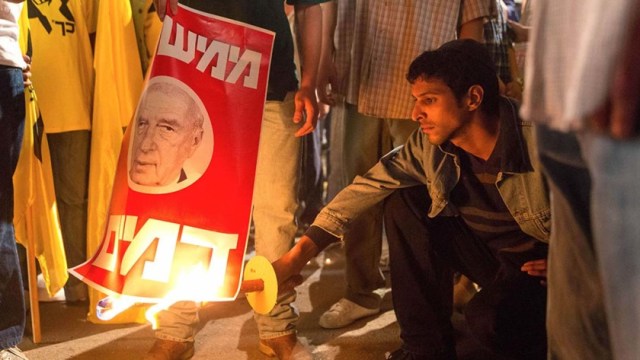
incite1

The intense but clean-cut young man slows his Beetle down at an Israeli Army checkpoint on a rainy night.

He’s going to “the funeral” he says. When the soldier takes a breath to ask more questions, perhaps search the car, the driver puts him at ease.

“It’s OK, bro,” he says in Hebrew. “I’m a Jew.”

But that Jew was Yigal Amir, and that funeral was for Baruch Goldstein, the Israeli American physician, zealot and mass murderer who had shown up at the Cave of the Patriarchs, a Muslim holy place in Hebron, put in his earplugs and shot 154 Palestinian worshippers — 25 fatally.

And to Israeli Jews like Amir who showed up on that rainy February night in 1994 , he was a hero.

“Incitement” is a riveting Israeli docudrama about the chain of events that led Amir, an intense, fanatical ex-special forces soldier turned law student, to assassinate Israeli prime minister Yitzhak Rabin, a murder that directly led to decades of right wing rule in Israel, much of it by the indicted, corrupt darling of Israel’s religious right, Benjamin Netanyahu.

Yehuda Nahari Halevi depicts Yigal Amir in all his many colors — intense, “focused like a laser” on the law, on “the most beautiful girl” on the campus of Bar-Ilhan University, Nava (Daniella Kertesz ) and on Rabin and the Oslo Peace Accord.

He hates the Accord, the 1993 Clinton-negotiated pact that aimed to set a path forward for ending decades of bloody conflict between Israel (Rabin signed it) and the Palestinians (represented by Yasser Arafat).

At home, Yigal and his mouthy mama (Anat Ravnitzki) echo the rhetoric on posters, graffiti and by the screaming protesters they see on TV — that Rabin is a “traitor,” a “murderer” and that Jewish Law has a response for that. The hate runs deep between mother and son. The Palestinians are “ragheads,” and any time Yigal runs into an old army buddy, the phrase “The Executioner” pops out to describe his ruthless treatment of Palestinians.

His Torah scholar father (Amitay Yaish Ben Ousilio) doesn’t join in their rants.  He and Yigal share a beautifully-written debate that has all the fury and self-righteousness of youth hurled against the wisdom of age, experience and far deeper-learning.  Dad won’t hear of “this demonic government” in his house. Mom, on the other hand, is sure her boy “will be the greatest,” whatever he decides to do with his life. Wink wink.

“Incitement” is about rhetoric, racism, courtship rituals and religion, and director and co-writer Yaron Zilberman (“A Late Quartet”) sees to it that each has its moments in the complex portrait of Israeli culture and one-man’s radicalization that he creates.

Amir’s family are Yemeni Jews, defensive — looked down on outside of their community. Yigal is “Gali” at home, but meeting Nava’s family, he gets the third degree. She seems quite tentative about this full-court press toward “engagement” that the “laser-focused” Yigal is giving her.

Yigal’s Mama expects no less. Those are “settlement” Jews, “hypocrites.” He’ll never be good enough for them, she hisses.

The word “incel” crept into my mind as I watched Yigal try to recruit a “militia” to take over defending territories that Israel was going to withdraw troops from thanks to Oslo. He arranges religious history tours that he fills with classmates — potential militiamen. But only his militant brother and a fellow interested in Yigal’s sister sign up.

These guys fume and scheme and buy guns and even procure explosives (from a soldier, no less) for a planned mosque attack, hoping to “mow down” Palestinians, “Chicago-mob style.” Would a little attention from the opposite sex divert them?

When so many eligible women from their corner of the Judaism spectrum are like Margalit Har-shefit (Sivan Mast), maybe not. She’s the daughter of a conservative rabbi, so maybe she isn’t as independent as she first comes off.

Yigal seeks affirmation from any number of rabbis, looking for clarification of Jewish Law and its tenets — “Law of the Pursuer” and “Law of the Informer.” Those are the justifications these raving rabbis are shouting in public for “revenge” or “punishment” of Rabin for pursuing this peace deal with the people who blow up buses on a regular basis. Questioned in person, most equivocate, one even admits “I was joking around.”

With posters of Rabin in Palestinian garb, or a Nazi uniform, flooding the streets, what harm could calling for his death in a sermon cause? Kidding!

Yigal’s mother Geula is here to unravel the “tribal” schisms among Israeli Jews, the “secular” vs “ultra-orthodox,” Ashkenazi/Sephardic” splits that fuel resentment and hatred for “The Other.”

Every tit-for-tat killing, bombing or incident after Goldstein’s massacre just makes their case, in the minds of the committed. The generous use of TV news coverage, interviews and speeches in the film show Rabin struggling to keep the majority of Israelis on board this “new way,” and the sinister opportunism of Netanyahu, showing up at every fresh incident, fanning the flames.

Movies about assassins (“Nine Hours to Rama,” “The Gandhi Murder”) rarely get this deeply into the life and conditions that inspire a political murder. “Incitement,” which swept last year’s Israeli Academy Awards and was Israel’s entry as “Best International Feature” for Hollywood’s Oscars, manages to be both thorough, damning and fraught throughout.

We know what’s coming. So do a LOT of people around this guy, some of whom took him seriously, one or two who figured “You’re all talk.” Zilberman makes no bones about it. “Lone gunman” isn’t an apt description here, if it ever is. Violent words can lead to violent acts.

And violent acts, even by a supposed “lone gunman,” change history — especially when there are people who openly celebrate his violence, or brazenly pretend that it never happened.

3half-star

MPAA Rating: unrated, scenes of graphic violence

Cast: Yehuda Nahari Halevi, Daniella Kertesz, Amitay Yaish, Ben Ousilio, Anat Ravnitzki and Sivan Mast

Credits: Directed by Yaron Zilberman, script by Ron Leshem, Yaron Zilberman and Yair Hizmi. A Greenwich Entertainment release.

Running time: 2:02

Posted in Reviews, previews, profiles and movie news | Comments Off on Movie Review: “Incitement” condemns those who inspire an assassin

Do Oscar voters even watch the nominated movies?

In an interview with Variety,
Carey Mulligan suggests Oscar Voters Need to Prove They’ve Seen the Movies.

She has a point. I think most of the winners reflect a movie the Academy by and large has seen. It’s the films that should be winners or didn’t even make it to contention which suffer tje dirty secret of Tinsel Town.

These people — Carey Mulligan included — don’t watch movies.

https://t.co/4MfqzL96aP https://t.co/05AGILvxLs https://twitter.com/Variety_Film/status/1221219331377254400?s=20

Posted in Reviews, previews, profiles and movie news | Comments Off on Do Oscar voters even watch the nominated movies?