OSCARS: The front runners polish that “Perfect Acceptance Speech”

I haven’t heard a “perfect” speech from Zellweger this time around. But I really only have her faintly sarcastic Golden Globes “thank you” to go by.

But Dern, Pitt and Phoenix have been saying the sorts of modest, touching and amusing things that make thinking of anyone else making that speech Oscar night hard to do.

Interesting take from The Hollywood Reporter at the link below.

https://www.hollywoodreporter.com/news/oscars-brad-pitt-science-perfect-acceptance-speech-1273985

Posted in Reviews, previews, profiles and movie news | Comments Off on OSCARS: The front runners polish that “Perfect Acceptance Speech”

Movie Preview: Dickens discovers Diversity — “The Personal History of David Copperfield”

Nothing like a little color blind casting (Dev Patel in the title role, etc) and the director of the dark comedies “In the Loop” and “Death of Stalin” for breathing life into a musty old Charlie Dickens morality tale.

Hugh Laurie, Tilda Swinton, Peter Capaldi and Ben Whishaw are the stars.

This trailer is laugh-out-loud funny, so brace yourself for a spit take. No drinking while watching.

Posted in Reviews, previews, profiles and movie news | Comments Off on Movie Preview: Dickens discovers Diversity — “The Personal History of David Copperfield”

Movie Preview: “Fast and Furious 9”

The sentiment steps to the fore for this latest “Fast & You Know What” trailer. All Diesel, All Rodriguez?

Well, and Oscar winners Theron and Mirren.

May 22

Posted in Reviews, previews, profiles and movie news | Comments Off on Movie Preview: “Fast and Furious 9”

Next screening? “Gretel & Hansel”

I don’t know if Orion Pictures previewed this fright fest for critics on some locales. I just know I’m catching it opening night and hoping for the best, like everybody else.

Curious to see Alice Krige as another ghost, another villainess with the mostest.

Posted in Reviews, previews, profiles and movie news | Comments Off on Next screening? “Gretel & Hansel”

Netflixable? Old friends remain “Close Enemies (Freres Ennemis)” in this Matthias Schoenaerts thriller

close1

We charter members of the “I’d watch Matthias Schoenaerts in ANYthing” Club (Hellooo ladies.) will have see our loyalty tested, just a tad, with “Close Enemies.”

This French thriller (“Freres Ennemis”) may have a great, grey look, gritty milieu and be in a genre you love as much as I do. And you may find Schoenaerts a fascinating performer, great screen presence and all that (again, GUILTY). But man, this cops vs. drug dealers tale, with its constant almost meaningless motion, its tedious unnecessary detail, its betrayals and intrigues puts the “con” in convoluted.

It’s 90 minutes of thriller spread out in a 110 minute package.

Two buddies in “the life,” Imrane (Adel Bencherif) and Manuel (Schoenaerts) are drug smugglers whose “partners” in the allegedly post-gang world of Paris and its suburbs, are the Reyes Gang.

The “like-brothers” pals have children, and a job — getting dope from Conakry (Guinea, West Africa) to Tangiers to France. Imrane is looking to tidy up the operation, make a big score.

Unknown to “Manu,” though, Imrane is an informant. Driss (Reda Kateb, who was in “Zero Dark Thirty” and “A Prophet”) grew up in their neighborhood, and he’s a cop who has “turned” Imrane.

Manu isn’t told this until AFTER they’re hit, abruptly, just after making that big score. The killers were not people they knew, stole some of their drugs and shot everybody else in the car. Only nimble Manuel gets away by the skin of his teeth.

Director and co-writer David Oelhoffen (“Far From Men”) chases Schoenaerts through basements and down streets with a hand–held camera, letting him stop just long enough to wash the blood off his face in a mud puddle.

Who did this? Everybody thinks Manu did — especially the “family” of which Imrane was an official member, Moroccan Arabs led by wizened Uncle Raji (Ahmed Benaissa).

Homicide does, too. But Driss works in narcotics, and he’s inclined to use the turn of events — and the loss of his informant — to turn Manu and finish the job Imrane started.

“You always said we’d die young,” Manu hisses at him (in French, with English subtitles). “You were right. Now f— off!”

The movie is Manu haplessly fleeing murder-attempts, ducking from safe-house to the apartment where his estranged girlfriend (Gwendolyn Gourvenec) is raising their son, stumbling into others under suspicion and wondering who will get to him first.

We also track the less interesting police point of view — all the surveillance, Driss trying to keep rival divisions in the department off Manu’s case.

That’s all there is to this, just “I’ve got to clear my name and find the REAL killers,” and staying alive long enough to manage it.

But the picture wanders all over the place — literally — piling up locations and stalling out as it does. Manu is a poor sleuth and a piss-poor interrogator.

We can’t see the logic in him fingering who he does as the one tipping off the killers, and his two-fisted Q & As with suspects are always “Why’d you do this?” rather than “Did you do this, and who helped you?”

Schoenaerts is as riveting as ever, and he has to be. The movie sinks every moment he’s not in it.

Oelhoffen fritters away any momentum the picture almost develops by having characters stop for an espresso, swap cars, stumble into each other and generally get nowhere for the better part of an hour.

The grand finale is pretty grand and worth the wait, but the big payoff leaves a mystery which, if you’ve been paying attention (not as easy as you might hope), you (and I) will have a solid theory about.

Still, it’s good to see Schoenaerts in this sort of sordid story (hunt down “Mustang” to see him as a more convincing and American criminal), even if there are sequences where he’d be more entertaining reading the Paris phone book.

2half-star6

MPAA Rating: unrated, graphic violence, drug content, some nudity, profanity

Cast: Matthias Schoenaerts, Reda Kateb, Adel Bencheriff, Gwendolyn Gourvenec

Credits: Directed by David Oelhoffen, script by Jeanne Aptekman and David Oelhoffen. A Netflix release.

Running time: 1:51

Posted in Reviews, previews, profiles and movie news | Comments Off on Netflixable? Old friends remain “Close Enemies (Freres Ennemis)” in this Matthias Schoenaerts thriller

Movie Review: “Cane River,” a landmark in African American indie cinema, newly restored

Horace B. Jenkins made his romantic melodrama “Cane River” a couple of years before Spike Lee made his breakthrough first film.

It arrived a decade before Julie Dash’s seminal indie drama of people and a place, “Daughters of the Dust.”

But Jenkins died just after finishing “Cane River” in 1982, and the movie never enjoyed an official release — until now.

It never had the chance to make an impact in its day, but as an artifact, it’s almost as interesting as a look back in time as it is a work of grown-up romance, serious cultural debate and forgotten history.

The story could not be more corny. Peter Metoyer (Richard Romain) is the handsome son of middle class members of the First Family of Cane River, Louisiana. They’re Creole, “the Forgotten People” of mixed-race of the region. His ancestors included the Frenchman who built Melrose plantation and the freed-slave woman Monsieur Metoyer married.

Peter’s tall, a star athlete fresh out of college who just told the New York Jet “No thanks” when they drafted him into the NFL.

“The closest I’ll get to the ‘pros’  is the prose I’ll put down with pencil on paper!”

Peter’s come home to a hero’s welcome in spite of that. He is independent enough to be “a farmer aspiring to be a poet.” He takes horseback rides around the old homestead, sits under and ancient oak and fills his journal with insipid “See the Morning Sun” verse.

And then he meets the lovely Maria Mathis (Tommye Myrick), who works in the tourist attraction that the old plantation has become. That raises eyebrows, even among the white busybodies who run the tours through this historic site.

“You Creoles are different people,” one huffs. “You wouldn’t associate with the likes” of Maria, her blue collar hatchery-worker brother, “Brother” (Ilunga Adell) or her mama (Carol Sutton).

Maria and her family are Negroes from Nachitoches (pronounced “NACKitote”), not Creoles. Their skin is dark. Fair-skinned Catholics like the Metoyers kept dark-skinned Mathis ancestors as slaves 125 years ago. No wonder they became Protestants.

cane

That’s the conflict at the heart of the film — class, history and skin color. We see high school drop-out Brother struggling to get by at the hatchery and hear Maria’s plans to leave this provincial backwater, where everybody’s trapped in their social place, for Xavier University in New Orleans.

As for falling in love with Peter, Maria sees trouble, and not just from her “They’re not LIKE us” mother.

Peter may be smitten and determined to forget all that, but that’s a mountain to climb in 1982 Cane River and Natchitoches — “YEAH, I’m a Metoyer! Now what does being a damned Metoyer have to do with it?”

“Do you HAVE to curse?”

Yes, he says. Yes he does. Anything to lift this dialogue out of its incurable banality.

There are other points of conflict, but they’re barely addressed at all. The acting is often flat, and outside of the five leads (Barbara Tasker is Peter’s snobby sister), is downright amateurish. The period-popular rhythm & blues on the soundtrack (by Leroy Glover) is so quaint that it takes some getting used to.

The only way to look at this film is as part of the indie cinema that was being born around it at the time. Victor Nuñez, who went on to make “Ruby in Paradise” and “Ulee’s Gold,” made similarly geographically-authentic, if crude, films such as “Gal Young’Un” and “A Flash of Green” at around the same time.

Perhaps Jenkins would have gone on to make more sophisticated movies. When Peter takes Maria to visit her future college in New Orleans, Jenkins captures time-capsule-worthy images of a gritty, sordid Big Easy that was swallowed by tourism long before Katrina all but washed the city away.

He made a movie well within the rating standards of the day, a regional African American romance where characters joke “Free at last, free at last” about getting out of this backwater, where “slave quarters” were still standing and where college-educated people like Peter could start to protest about “my people” being erased from history by writers, academics and the little old white ladies who scrub the African American story right out of the big local plantation.

“Dated,” quaint and tentative it may be. But Jenkins’ themes and big ideas make “Cane River” a debut film with promise, ambition and social currency.

2half-star6

MPAA Rating: unrated, sexual situations, mild profanity

Cast: Richard Romain, Tommye Myrick, Carol Sutton, Ilunga Adell and Barbara Tasker

Credits: Written and directed by Horace B. Jenkins. An Oscilloscope Labs release.

Running time: 1:45

Posted in Reviews, previews, profiles and movie news | Comments Off on Movie Review: “Cane River,” a landmark in African American indie cinema, newly restored

Movie Review: Lively keeps a murderous beat in “The Rhythm Section”

sect7

Director Reed Morano keeps her camera tight on star Blake Lively throughout “The Rhythm Section.” The “Handmaid’s Tale” veteran knows where her meal ticket is, knows that Lively is worth halting filming to have a baby or heal up from a hand injury, which delayed this production.

But that pays off handsomely in this generally crackling vengeance thriller. It is a stylish, gloomy blur of close-ups, hand-held chases, the screen retreating in front of Lively as her character stalks, stumbles, sprints and staggers from one moral dilemma to another.

There are quarries to be stalked, to-the-death fights to survive — barely — and a bomb that’s sure to go off.

And the most bracing and realistic (Sorry, “Fast/Furious” fanatics.) car chase since “The Transporter” pounds an exclamation point on the picture. The star may be the star, but here’s an action director who pops off the screen, too.

Lively dresses down and drags us through the moral descent of a young woman whose family died in a plane brought down by a bomb. Winding up in a flophouse London brothel, an addict selling her body for a fix, isn’t rock bottom. Deciding to take the lives of those who planned and carried out the attack that murdered her parents and siblings is a hard decision for any feeling, thinking and once-moral person.

Stephanie goes by “Lisa,” now. The freelance reporter (Raza Jeffrey) who lures her out of the brothel isn’t doing her much of a favor by telling her that crash wasn’t an accident. But the damage is already done.

“You’re another victim. You’re just not dead yet.”

Stephanie/Lisa gets just enough information and cash from the journalist to do what she decides she must. But when she drops in on the bomber, she loses her nerve.

That’s how she ends up in the clutches of reporter Proctor’s “source,” a mysterious ex-operative code-named “B” and located on remote Scottish loch, reachable only by GPS coordinates.

Jude Law brings a fierce brutality to this guy, just a shadow manhandling the interloper in the dark, just two commando boots in Bear Grylls pants standing over her crumbled body, on the floor where he left her.

He wants nothing to do with her caper, has no interest in training her. He keeps cuffing her, knocking her about and testing her. Law does this with such relish you wonder what his shrink would say, him co-starring with a Sienna Miller (his ex) look-alike and all.

“B” is where Stephanie gets the intel, the means and the opportunity to do what she — like Prince Hamlet — knows she must do — murder the murderers. He declares his skepticism — “In the end, you’ll still be you.” She’ll lose her nerve, in other words. But he teaches her to “Get your ‘rhythm section’ under control — sorted.”

“Your heartbeat is the drums. Your breathing is the bass.” Get rhythm. Get calm.

The film’s flash and tension are a great cover for a script that is absurdly reliant on “deus ex machina” (“god in the machine”), that ancient Greek theatrical shortcut to make the implausible plausible.

Here, we’ve got deus MI-6 “training/intel” guy, deus financier, deus ex-CIA fixer in Spain (Sterling K. Brown). The decision to have Stephanie/Lisa take on the guise of a dead Russian assassin is both pointless and wholly illogical. Add that to the list.

But Moran never loses the urgency even when the plot loses the thread. Dashing from London to Spain to Tangier to Marseilles and New York, she punishes Lively almost as much as Law, and her star gives us just enough “I could/would NEVER do that” moments to immerse us in her quest and put us her in shoes.

The lyrics aren’t all that. But in an action film, it’s tempo that matters. “The Rhythm Section” never loses the beat.

2half-star6

MPAA Rating: R for violence, sexual content, language throughout, and some drug use.

Cast: Blake Lively, Jude Law, Sterling K. Brown, Raza Jeffrey and Max Casella

Credits: Directed by Reed Morano, script by Mark Burnell. A Paramount release.

Running time: 1:49

Posted in Reviews, previews, profiles and movie news | Comments Off on Movie Review: Lively keeps a murderous beat in “The Rhythm Section”

Movie Preview: Imogen Poots and Jessie Eisenberg are trapped –literally — in the suburban maze of “Vivarium”

Posted in Reviews, previews, profiles and movie news | Comments Off on Movie Preview: Imogen Poots and Jessie Eisenberg are trapped –literally — in the suburban maze of “Vivarium”

Movie Preview: Scottish Catholic schoolgirls get into mischief at “Our Ladies”

A period piece, from the ’90s, music by Bowie and the forgotten sounds of the day.

Posted in Reviews, previews, profiles and movie news | Comments Off on Movie Preview: Scottish Catholic schoolgirls get into mischief at “Our Ladies”

Movie Review: Comrades fight to honor the ultimate sacrifice in “The Last Full Measure”

measure3

Sentiment and cynicism wrestle each other into submission in the Medal of Honor story, “The Last Full Measure.” In writer-director Todd Robinson’s “too much is never enough” hands, sentiment wins the day. And then it does a victory lap and spikes the ball in the end zone for good measure, all but spoiling the impact of his movie with anticlimaxes.

Robinson, better known as a producer, rounded up a star-studded cast of award winners for a script that gives every single one of them grace notes, a veritable master class presented by William Hurt, Samuel L. Jackson, Christopher Plummer, Ed Harris, John Savage and in his final film, the late Peter Fonda.

Those acting grace notes almost rescue a generally graceless and lumbering combat/post-combat drama.

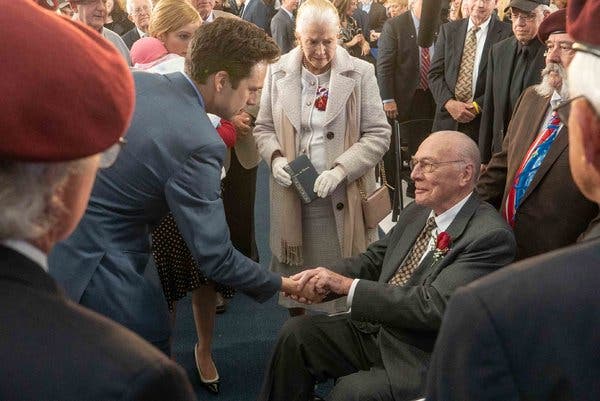
Most of them played aged veterans of the early days of the Vietnam War, survivors hellbent on seeing to it that an Air Force Pararescue medic who served with them but a single day, and who saved many of their lives, be given the Medal of Honor over three decades after his death.

Sebastian Stan plays a D.C. “government lawyer about to be unemployed” when we meet him. Scott Huffman works for the Air Force, and the Secretary of the Air Force (Linus Roache) has just announced his resignation. It’s 1999 (NOT “an election year,” as several characters say in the script) and Huffman is given one last thankless task by his career-public-servant boss (Bradley Whitford, poster boy for “cynicism on the screen”).

He’s got to review this long-dormant case of a recognized war hero, William Pitsenbarger. He was decorated with the Air Force Cross, but those who served with him in that firefight in 1966 insist that was “downgraded” from the honor they think he deserved.

“Take a few days, go hear some war stories,” kick the process down the road for the next person who has Huffman’s job is the thinking.

But not everybody he talks with is as compassionately insistent as his Air Force Pararescue comrade (Hurt) or as touching as the late airman’s parents (Plummer and Diane Ladd). The vets are not necessarily helpful.

One (Jackson) tosses his tape recorder away the moment he’s tracked down. Another, a school bus driver (Harris), stages their meeting at a gun range where he works off lingering aggression by emptying the mag on an M-16.

“It was one day — decades ago…”

And then there’s the loner in the hills (Fonda), married to his nurse (Amy Madigan), a paranoid PTSD patient who keeps watch and hunts at night and sleeps by day, because that’s what Vietnam did to him, “SIR.”

“I haven’t slept in the dark in 32 years, SIR!”

Huffman is the cynic who fumes over “today’s adventure in post-traumatic exorcism,” but who learns — from their stories, related in combat flashbacks — the meaning of “sacrifice” and “valor.”

His experience of Vietnam is that of a 30ish career public servant, married (Alison Sudol plays his wife), with a son and a baby on the way. He’s seen the movies, in other words. He uses “Apocalypse Now” references, seeing one vet as a “Kurtzian burnout.”

Those flashbacks show us why. They are chaotic, gory and harrowing. It was an ambush and a near-massacre.

British actor Jeremy Irvine plays the version of Pitsenbarger that his brothers-in-arms remember — a guy who dropped out of a chopper into a firefight, refused to leave until the wounded were all out ahead of him and with all the explosions and bullets whizzing by him, never flinched or ducked.

I started my movie reviewing career at the height of what the late critic Roger Ebert labeled the “This time we WIN” Vietnam War movie era, and there are hallmarks of revisionist movies like “Hamburger Hill” and others tossed in here, for good effect.

Jackson’s former Lt. Takoda tells a story of returning home to a rough bar where “dogs and ‘baby-killers'” weren’t allowed.

Paperwork is lost because “This IS the government, after all.” Hints of a conspiracy are dredged up, and politicians play political games with the legislation necessary to confer this medal before the dead soldier’s parents die of cancer and anything else that gets you in old age.

That’s the “cynicism” that the movie traffics in, a form of pandering to the aged, conservative veterans who are the film’s target audience.

In scripting this, writer-director Robinson shows why his producing career (Ridley Scott’s “White Squall”) is more storied than his directing one (“Phantom”). The interviews don’t generally advance the case for the “MOH” (Medal of Honor) or the story. The film gets sidetracked, repeatedly, and when it finally reaches its climax, goes on and on and one after it, manipulatively working overtime to wring tears out of the viewer.

There’s little sense of forward motion to any of this.

And then John Savage shows up, and gives the picture a final grace note to complement those provided by Hurt, Plummer, Harris, Jackson and Fonda.

It’s a crying shame Robinson didn’t have the instincts to wrap the picture up more quickly after that. Because aside from Savage, the highly-fictionalized third act of this “inspired by the true story” is a mess more concerned with agenda than good storytelling.

2stars1

MPAA Rating: R for war violence, and language

Cast: Samuel L. Jackson, Sebastian Stan, Jeremy Irvine, Christopher Plummer, Diane Ladd, Amy Madigan, William Hurt, Ed Harris, Bradley Whitford, Linus Roache, John Savage and Peter Fonda

Credits: Written and directed by Todd Robinson. A Roadside Attractions release.

Running time: 1:50

Posted in Reviews, previews, profiles and movie news | Comments Off on Movie Review: Comrades fight to honor the ultimate sacrifice in “The Last Full Measure”
