Bingeworthy? “Lambs of God” surprises, startles and jolts — start to finish

lambs2

If only all limited series were as strange, surprising, literary and darkly delightful as “Lambs of God.” This Aussie-made tale of nuns, an intruder priest, crimes and history, ghosts and miracles is equal parts “The Beguiled” and “Agnes of God.”‘

And the entire enterprise, based on Marele Day’s novel, is passing strange, Gothic magical realism stirred to life by a top flight cast in the starkest of settings.

All my gripes about current trends in the genre, that these series start too slowly and dribble out the plot points and jolts to maximize the Time Spent Watching, are tossed aside in four brisk, grim, darkly-funny and even moving episodes now streaming on Topic.com.

Essie Davies of “The Babadook,” Jessica Barden of “Scarborough” and “Penny Dreadful,” and the great Ann Dowd (“Handmaid’s Tale,” “American Animals”) are three surviving Sisters of St. Agnes, nuns cloistered on an island off the British coast.

Their version of Catholicism is barely recognizable. They pray to their “Heavenly Mother.” Their rituals to “My queen, My mother” adhere to a calendar that includes “hair day” (a trimming), “sheering day” for the sheep, and when Sister Iphegenia (Davies) has a vision, “killing day.” That’s when Sister Margarita (Dowd) sings to a lamb they will kill for food and as a sacrifice.

They drink the dying lamb’s blood, as well.

They watch for newborn lambs that they decide are the reincarnation of this or that Sister who left this world. Novitiate Carla (Barden) is the most enthusiastic about this tradition.

It’s pretty clear that their disconnect from the world is years and years long, that they’ve drifted back towards paganism. The semi-ruined convent, accessible only at low tide, is primitive and ancient and we have plenty of time to wonder if this is some thread of Medieval Catholic history we’ve forgotten, or if these three have survived an Apocalypse.

That’s when the first jolt arrives. A man, dressed in black, curses his way through the brambles up from the beach. He is a priest, Father Ignatious (Sam Reid of “Belle” and ”
The Astronaut Wives Club”). He’s a little put out being here, and a lot put-out finding them here.

“Don’t TELL me you don’t have electricity,” he gripes, opening his flip phone. It’s 1999, and the Bishop’s secretary has shown up to look over a long-forgotten church property.

The series is about what the church wants with this place, what Father Ignatius tells them and hides from them, and what sort of drastic actions they take to preserve their “heretical” way of life.

It’s a “haunted island,” where visions of long-dead nuns appear to the Sisters. Will the rude and imperious Father Ignatius see them, mollify them and bring the trio into the (still) 20th century?

There are intrigues at the Mother Church, where the Bishop (John Bell) complains that they can ill afford “ANOTHER scandal.”

And there’s a man hunt, or priest hunt. Ignatius has a semi-estranged sister (Kate Mulvaney of “Hunters”) in AA, who wonders where her brother has got off to. Tracking the anal retentive sibling to his departure point, cussing out the lazy constable (Daniel Henshall) who is slow-off-the-mark on the missing-persons beat, may get us somewhere.

Or not.

The arrogant, aloof Ignatius isn’t just missing. He’s in peril. And his efforts to divide and conquer the trio to affect his escape may not be taken well.

As Ignatius suffers and the sisters have their visions, see ghosts and experience flashbacks telling us how they got there, “Lambs of God” grabs us by the tenterhooks, making us puzzle out what might come next.

The acting is stellar across the board, but Barden is the standout here. Carla is utterly naive to the ways of the world, gobsmacked that Father Ignatius smokes (“Dragon,” Sister Margarita cautions.) and can blow rings, that he has a gadget that makes music (1990s ringtones) and channels voices.

She sees her first male genitalia when Ignatius passes out from their “Stay at Home” herbal tea. A Biblical reference is all Carla can summon up for the sight.

“Baby Moses in the rushes!”

Dowd’s Margarita is the truest of the true believers, and the most menacing.

“I can SMELL your deceit, Ignatius!”

There’s violence and intrigue, sex, sacrilege and singing in Latin in this tight and tense melodramatic thriller. The New South Wales settings nicely substitute for the Cornish coast, the supernatural touches often have down-to-Earth origins.

And the surprises never cease, making this that rare “limited run” mini-series that delivers big moments in every episode, keeps us guessing and keeps us watching without the teasing and padding-out too many streaming shows go for these days.

3half-star

MPAA Rating: unrated, with violence, sex and profanity

Cast: Essie Davies, Jessica Barden, Sam Reid Kate Mulvany and Ann Dowd.

Credits: Created and scripted by Sarah Lambert, based on the novel by Marele Day. A Topic.com release.

Running time: Four episodes @54 minutes each.

Posted in Reviews, previews, profiles and movie news | Comments Off on Bingeworthy? “Lambs of God” surprises, startles and jolts — start to finish

Netflixable? French thriller shows that to “Get In,” you’ve got to get past the squatters

get5

“Get In” is a taut, troubling and topical French thriller almost utterly undone by its over-the-top finale.

In movie buff shorthand, it’s a John Schlesinger’s “Pacific Heights” that devolves into Sam Peckpinpah’s “Straw Dogs” — devolves, and keeps on devolving.

Aurélien Molas and Olivier Abbou’s script gets into issues of masculinity, race, bullying and a justice system that fails to deliver justice.

At every turn, history teacher Paul, played by Adama Niane (“Gang of the Caribbean”) is pushed, misused and tested. It started before the movie begins. His marriage to Chloé (Stéphane Caillard of TV’s “War of the Worlds”) is in trouble. And then, after a nice long road trip vacation in his father’s old RV, they’re denied entrance to their home.

As outrages go, that’s primal. Not only has the recently-evicted couple — Sabrina (Marie Bourin) was their nanny — changed the locks and denied them entry after house-sitting for them. They call the cops and Paul is roughed up and taken in when he is understandably outraged at how his kindness has been repaid.

This “true story” takes the family into the French legal system, with judges kicking the decision hither and yon — that’s what covering your bases and having a “contract” with the house sitter gets you — days becoming weeks and then months.

Their lawyer is all reassurances, “They have no right to be there” and “You’ll get your house back, I assure you.” And yet, “You can’t evict them” and “The council bans evictions in the winter.” As they’ve been warned by the cops, “Don’t try to do this by yourselves — three years in prison” well, what are they to do?

Paul, given to storming out of meetings or, in the case of the marriage counselor, skipping them altogether, is increasingly outraged.

We think, “How far can he be pushed?” But we, like his wife, like Sabrina’s hulking husband Eric (Hubert Delattre) size up the thin Franco-African and say, “What’re you gonna do about it?” (in French, with English subtitles).

The RV park where they have to stay might have the answer. Mickey (Paul Hamy) is a rough character. But we can see the look he and Chloé share, even if Paul doesn’t notice.

They have history. And judging from his tattoos, and hers, it was rough and ready. Mickey is bad news all around as he talks Paul into “guys’ night out,” drinking strip club binges topped off with a little redneck animal cruelty.

Yeah, totally a thing in France, too.

Mickey taunts Paul — “You’re a victim because you decided to be one.”

Chloé shrugs with a “You don’t get it. We can’t do anything. So accept it.”

Will he be goaded into action by Mickey, or tamed into putting the marriage and their family first and hoping for the best from a court system that doesn’t guarantee that?

Director Abbou and his cast make us furious on Paul’s behalf, then fearful of Paul’s actions. The conversations with the squatters are all “No comment, no comment…You need to LEAVE.”

Paul ends far too many talks with legal figures with the phrase “You can’t be serious!”

Paul’s attempts at resisting this incessant bullying — even his bigger students in class figure they can push him around — make us feel his futility.

As this isn’t America, Paul can’t drive straight to a gun store to even up the odds. Just having this thought it part of the film’s troubling way of playing with the psyche.

“Get In,” titled “Furie” when it was released in Europe, works on you and works on you and builds towards something that the finale suggests is the true consequence of crossing that line into violence.

You can’t control it. Once unleashed, it consumes you, your enemies and those you love.

Not a bad parable for our times, with “might makes right” and “superior firepower” increasingly the rule as first justice and fairness break down, then civility, then law and order.

But the Big Finish here looks like something horror studio Blumhouse would cook up. “Get In” doesn’t get quite all the way in because of it.

stars2

MPAA Rating: TV-MA, graphic violence, explicit sex, nudity, alcohol and drug abuse

Cast: Adama Niane, Stéphane Caillard, Paul Hamy, Marie Bourin and Hubert Delattre

Credits: Directed by Olivier Abbou, script by Aurélien Molas and Olivier Abbou. A Netflix release.

Running time: 1:37

Posted in Reviews, previews, profiles and movie news | Comments Off on Netflixable? French thriller shows that to “Get In,” you’ve got to get past the squatters

Movie Review: “Cry Havoc,” and let this dog slip into VOD while no one was watching

havoc2

Ever wondered how legendary screen tough-guy Charles Bronson would handle himself in a torture porn film?

Me either. But wonder no more.

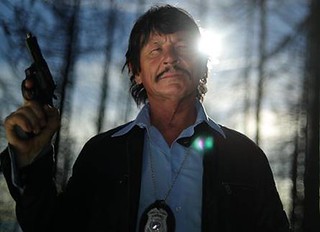
Writer, director, cinematographer and editor Rene Perez cast a Bronson look-alike in “Cry Havoc.” He dyed Robert Bronzi’s hair Bronson-black, gave him a Bronson Fu Manchu mustache. He dressed Bronzi in Bronson black leather, with early ’70s bell bottom pants, no less.

He puts Bronzi in a ’66 Chevy Nova, a very Bronsonesque (undersized) muscle car.

And he turns this guy loose on the mountain west compound of a villain called “The Voyeur,” who “casts” ambitious young females to be in his non-existent “Terror Mountain” reality show.

It’s as terrible as it sounds, largely because it’s pretty obvious that Bronzi was looped so that he’d sound more like…Charles Bronson.

“Seen this girl?”

Classic Bronson one-liner.

The Voyeur (Richard Tyson, wisely bearded, as he wouldn’t want anybody to recognize him in this abortion) captures his “contestants'” slaughter on his many CCTV cameras.

“Pain is the only real truth in this world,” he growls to an empty room. But not for long. An ambitious blonde Iowa TV reporter (Emily Sweet) has agreed to his conditions for an interview — no revealing where he is, and oh, wear this white ball gown to the interview.

Miss Weaver is the last one to figure out she’s merely the latest contestant.

There’s this monster on the mountain, a hulk in a wired-together skin-mask of the Michael Meyers variety, skull and mask covered in more fencing wire. “Havoc” lumbers about with saw blades, shears and axes, hacking up and disemboweling women.

“It” The Voyeur says, “is a force of nature. It simply…was. Like a storm.”

They met in prison, and well, the rich murder freak just HAD to have this “It” he names “Havoc” (Shakespeare, “Julius Caesar,” Mark Antony’s “let slip the dogs of war” speech) for his little “experiment.”

havoc

Bronzi-Bronson plays a cop hunting for that one particular “girl” who’s disappeared on that mountainside. He doesn’t care how many NRA minions of The Voyeur he has to go through to find her.

It’s a movie of waking up, screaming bloody murder, trying to slip the locks or knots, and generally failing. But even if you/they DO escape, it’s only temporary. Wanton slaughter ensues.

Pointless and ugly is the blurb review of this one.

But Perez does set up a thought experiment of his own with this enterprise. What is it that makes an action movie star, that separates John Cena from Brian Bosworth, Terry Crews from Shaquille O’Neal?

Bronzi summons up the right nostalgia, and the primitive staging and non-“acting” give “Cry Havoc” the feel of a Bronson B-movie of the late ’70s.

It’s all manufactured, even if he did his own re-recording of his voice on set (I can’t tell that, only that he was looped later). But stumbling through a forest shooting people in a squinty-eyed daze does not make you Charles Bronson. The charisma and talent it took to make bad movies watchable just isn’t there.

1star6

MPAA Rating: unrated, graphic violence, nudity

Cast: Robert Bronzi, Emily Sweet, J.D. Angstadt and Richard Tyson.

Credits: Written and directed by Rene Perez. A Midnight release,

Running time: 1:25

Posted in Reviews, previews, profiles and movie news | Comments Off on Movie Review: “Cry Havoc,” and let this dog slip into VOD while no one was watching

Classic Film Review: A horse and hellions — “The Belles of St. Trinian’s”

trin5

The novelty of “The Belles of St. Trinian’s” might be the sight of Alastair Sim in a dress.

The cinema’s defining Ebeneezer Scrooge and a mainstay of postwar British comedies and dramas — he had the title role in the original “An Inspector Calls,” and Hitchcock hired him for “Stagefright” — he took on two roles, as siblings, in this 1954 farce.

But the life of the party here would be the inmates in this asylum, the brash, bedlam-inducing hellions of St. Trinian’s School for Young Ladies. They gamble, cheat, manufacture “bathtub gin,” cross and double-cross one another and leave mayhem in their wake. They’re the reason this comedy is so beloved it has warranted revivals and remakes in the UK over the decades.

It seems the stiff upper lip Brits couldn’t get enough of teen girls behaving badly in a “Stalag 17” styled school comedy.

The plot — a sultan (Eric Pohlmann) needs a place to park his youngest daughter, seeing as how he’s had to “allow the Americans to build their airbase” in his kingdom. Memories of GI mischief during WWII had not been forgotten by the British screenwriters.

St. Trinian’s is recommended, conveniently located near the stables where the sultan’s racehorses are boarded.

Little Fatima may not know what she’s in for, but the residents of town (Stanstead Abbotts, Hertfordshire) sound the fire alarm, board up their store fronts and flee when the train approaches to deliver the students for the fall term.

The local constable locks himself in his cell.

When the girls pelt out of the passenger cars, we see why. They’re unruly, uncontrollable and unstoppable. Miss Millicent (Sim) and her staff (Hermione Baddeley, Balbina, Joan Sims, Renee Houston and Betty Ann Davies among them) barely even try.

The school’s broke and in disrepair, but having a sultan’s daughter could get the staff and local vendors paid, if they play her “pocket money” right.

Millicent’s gambler-brother Clarence (Alastair Sim again) has his own designs. He’s re-enrolled his brassy, streetwise daughter (Vivienne Martin) so that she can befriend young Fatima (Lorna Henderson) and get the skinny on her daddy’s star stallion, Arab Boy, for the upcoming Gold Cup “hunting” (steeplechase) race.

With all the crime and graft and general misbehavior that has nothing to do with education going on, the police send a policewoman (Joyce Grenfell) undercover, taking a job as “sports” mistress, to catch all these miscreants in the act. Or acts.

Hey, when the school motto is “In flagrante delicto,” what would you expect?

The kids set booby traps and pull pranks.They run all manner of scams via their “go between,” the trenchcoated hustler Flash Harry (George Cole, hilarious) who was hired as a teen gardener’s assistant but “disappeared” into a life in in the hedges in 1940. Harry places bets, bottles and sells their chemistry class “bathtub gin” and is fixer for whatever schemes they cook up.

The field hockey team never loses at home, and not just because they play rough, disable the referee and jeer the opposing team without pity. The girls make their home end goal “two feet smaller” than their opponents. Try scoring in that.

There are cliques and factions, which become clearer when Clarence and his daughter Arabella conspire to get Arab Boy out of the Gold Cup, by hook or by crook.

That’s Arabella’s idea, by the way.

Other girls have money on Arab Boy to win. So it’s game on, with the hapless adults mostly bystanders in the shenanigans to come.

The film’s Cockney touches and the screeching underclass accents of the young ladies (one of the jokes) may move you to turn the closed captioning on.

You don’t want to miss throwaway lines like “Listen, rabble,” and “put the screws on the old custard” and hear the undercover policewoman described as a “copper’s kick, in skirts.”

It’s not “holly jolly pulse-throbbing” for the first hour, as the set-up is set up and we’re treated to single scene sight gags, like the booze and smoke filled teacher’s lounge (they don’t bother hiding this from the young “ladies”), the school inspectors who came and were corrupted and kept as a veritable harem of the French teacher (Balbina) and her salon.

It was a daring movie for its day, almost racy for its 1954 depiction of “young ladies” doing what needed to be done in still-“Broke Britannia.”

Director Frank Launder was better known as a screenwriter (Hitchcock’s “The Lady Vanishes”), but he put the very first “Blue Lagoon” on the screen in the 1940s, and made a cottage industry out of “St. Trinian’s” comedies as a director.

The third act here is why “The Belles of St. Trinian’s” is held in such regard, to this day. It’s a near riot of action, climaxing with a restaging of the “Zulu Wars” in the crowded halls of a tumbledown manor house turned boarding school for girls.

stars2

MPAA Rating: “Approved”

Cast: Alastair Sim, Joyce Grenfell, George Cole, Vivienne Martin, Hermione Baddeley and Eric Pohlmann

Credits: Directed by Frank Launder, script by Sidney Gilliat, Val Valentine and Frank Launder. A Film Movement release.

Running time: 1:31

Posted in Reviews, previews, profiles and movie news | Comments Off on Classic Film Review: A horse and hellions — “The Belles of St. Trinian’s”

Netflixable? Jerry Seinfeld has “23 Hours to Kill”

seinfeld

“Jerry Seinfeld: 23 Hours to Kill” puts him in a black suit and tie, but opens with him diving out of a helicopter to get to the (Beacon Theater) show.

So yeah, it was supposed to coincide with the opening of a new James Bond film, “No Time to Die.” But COVID19 shut that down.

And yeah, not leaving out his famous “going out/gotta get BACK” bit about the audience, hailing the audience’s “degrees of difficulty” in going out, getting the tickets and coming to the show seems…unfortunate.

But the most successful stand-up comedian of all time didn’t get where he is by sweating out a re-edit. As he tucks into his and his audiences’ many-years-long relationship, “going through life together” with fans knowing EVERYTHING there is to know about him, his riches, his family, his cars and his life, he hurls the only rhetorical question that matters.

“I could be anywhere in the WORLD right now,” he says, voice-cracking. “If you were me, would you BE up here hacking out another one of these things?

He was 65 when he taped this and just turned 66 at the end of April. Expecting him to let a global pandemic ding his “Didya ever notice?” mastery is laughable.

As indeed is the special. Maybe later there’ll be a future one talking about COVID19, if it’s ever funny. For now, Seinfeld is talking about the familiar. As dated as some of this feels, thanks to a changing world, the nostalgia value of an “OK, Boomer” comic isn’t to be under-estimated.

Marriage? Got a “girlfriend? That’s whiffle ball! Married guys play with full clips and LIVE rounds!”

Bits about “the tone of my voice” arguments at home feeling like he’s been drafted into high school glee club, about family vacations, “Or as I like to call them, ‘Let’s pay a LOTTA money to go fight in a hotel!”

Buffets? “Why don’t we put people that are already struggling with portion control into some kind of debauched ‘Caligula’ food orgy of unlimited human consumption!”

He’s out-of-date and out of step in a social media and now socially-distanced age — “I feel like a BLACKsmith up here, to tell the truth. Why don’t I just text you the whole thing, save us all an hour?”

But that’s kind of the point. It’s been impossible to watch him the same way after he did that documentary “Comedian” years and years ago. We know how much craftsmanship went into building this act, the clubs he tried out new material in, the road warrior that he remains, polishing those bits, dealing with interruptions like the elder stand-up statesman he is.

“LOVE you, Jerry!” from a fan in the audience elicits an “And I love you! That”s my ideal type of intimate relationship. I love you. You love me. And we never meet.”

He knows he’ll get a laugh when he screeches, and does a lot more “your annoying friends” voices than we’ve heard in the past. He lies down on stage, launches into bits about the “only two types of reviews” there are for ANY experience, these days — “It’s GREAT. Or it SUCKS.” And the difference? There is none. Everybody’s life sucks.

“My life sucks, too. Perhaps not QUITE as much.”

I could see how this material could rub the housebound, especially traumatized New Yorkers, the wrong way. But he has a lot of license with that audience.

When he’s calling out the disconnected but cell-addicted and their “friends,” he’s as on-target as he’s ever been. Oh yeah, you’re “close” to every single one of them. He’s seen you “scroll the names on your contact list like a gay French king,” dismissing all these “favorites.”

Hopefully, our current sorry state as a civilization will have the luxury of getting back to laughing at these trivialities anew. And if not, we’ll always have these old Seinfeld-at-home-on-the-stage movies –on Netflix — to remember how it was back when selfie-seeking friends who turn “picture bullies” at every social gathering were all we had to worry about, back when “dinner and a show” were totally a thing.

3stars2

MPAA Rating: unrated, a little profanity

Cast: Jerry Seinfeld.

Credits: Directed by Joe DeMaio. A Netflix release.

Running time: :58

Posted in Reviews, previews, profiles and movie news | 1 Comment

Movie Review: On the road with a pool cue and “Walkaway Joe”

joe2

“Walkaway Joe” is a somber, reflective road drama about fathers and sons, mistakes and legacies.

Not a lot happens. The hook is the mythic pool hustling that’s been the bread and butter of many a down-and-out tale told on the big screen. And the story arc is even shorter than the road trip involved — across a chunk of Louisiana, climaxing in New Orleans.

But it’s a fine showcase for a couple of outstanding character actors, David Strathairn and Jeffrey Dean Morgan, even if it’s actually star vehicle for Julian Feder (“A Boy Called Po”).

Dallas (Feder) likes closing down the local bar’s billiards tables with his old man, Cal (Morgan). The kid may be 14, blind to the old man’s faults and oblivious to his need to slip out the back door before “last call” before somebody he owes money to shows up. He still figures he’s got a shot at following the old man into the family profession — pool shark, like Cal and Cal’s daddy before him.

His mother (Julie Ann Emery) says that cutting school to do that isn’t an option, that keeping the kid out late is no way to “be his parent and not his playmate.” Her griping goes in one of her husband’s ears and out the other.

“He’s doing fine.”

Cal doesn’t get mad. He doesn’t raise his voice. When mother and son come home, all they find is a note.

“I won’t be back this time.”

That leads to the mother-son row that has the teen throwing a couple of things in a pack, strapping his pool cue to it and bicycling off to Baton Rouge (Laplace, Louisiana is the filming location) to find his Daddy at a favorite haunt — Fatty’s.

The old man’s debtors are looking for him, too. Lucky for the kid he catches a ride with drifting RV dweller Joe (Strathairn).

The kid lies about his family and imposes himself on Joe, who sees every mistake Dallas makes and every mistake he made with his own kid (it’s implied) along the way.

“It’s a goooood thing you’re not going to live long enough to reproduce,” he lectures. Sullen Dallas can admit his bigger screwups, but Joe is always there to top off the non-apology.

“That was 75 miles PAST ‘stupid.'”

Actor turned first–time director Tom Wright (George’s African American boss on “Seinfeld”) doesn’t have a lot of incidents to work with in Michael Milillo’s first produced feature screenplay. The drama is more innate than action-oriented, although there are hustles that go awry and debt collectors capable of violence.

There’s more menace in Joe’s eventual meeting with Cal than in any fight. Morgan summons up his tough guy persona with just a look, a pause, an introduction not acknowledged.

Strathairn’s Joe wears his story on his face. Few scenes establishing the past that put Joe here, his own parenting track record, are necessary. The Oscar nominee and Emmy winner just “is” this guy, his every regret, Joe’s impatience with a kid that he won’t let himself hope is his own last chance at “parenting,” even if it’s temporary.

Feder doesn’t look 14, but the character is certainly written as naive, hotheaded and impulsive. He plays Dallas with a few cards hidden, as if there’s hope for redemption. But his accent and decision to mumble his lines make his Southern drawl a slur and nigh on impossible to decipher far too often. Any “good lines” he has are often swallowed in the performance.

The story hews closely to formula (expect a BIG GAME). But the Deep South pool hall milieu, the lived-in characters and the top drawer supporting players make “Walkaway Joe” worth sitting still for and watching, all the way through the credits.

stars2

Unrated: Violence, alcohol, teen smoking.

Cast: Jeffrey Dean Morgan, Julian Feder, David Strathairn and Julie Ann Emery.

Credits: Directed by Tom Wright, script by Michael Milillo. A Quiver release.

Running time: 1:29

Posted in Reviews, previews, profiles and movie news | Comments Off on Movie Review: On the road with a pool cue and “Walkaway Joe”

Documentary Review: Think you know “Showgirls?” “You Don’t Nomi”

Lurid and louche, instantly awful and the quintessence of filmed “camp,” “Showgirls” rode to screen infamy when it rolled into theaters in 1995, greeted with almost universal derision and disdain.

It blurred the line between overwrought acting and incompetent acting. It is a movie about misogyny by the cinema’s greatest misogynists. Its earliest label might have been the most apt — a “cocaine” musical, a cynical, delusional piece of NC-17 titillation wrapped in some idea of “feminism” shared by the pervy sexists who made it and the Hollywood that released it.

But then the gay community embraced it, drag queens started vamping out sequences as part of their act. Alternative publications looked at it through auteurist, feminist or queer eyes as midnight movie audiences and home video fans watched it over and over and over again.

If you didn’t see “You Don’t Nomi” coming, you should have. If Stanley Kubrick’s “The Shining” triggered obsessives around the world, leading to the fascinating “deep dive” documentary, “Room 237,” hell, if “Bronies” (“My Little Pony” cultists) can inspire musicals and a documentary about their devotion, then why not a wholesale reevaluation of “Showgirls” as not just a “s— film,” not just a “cult film,” not so much a “lost masterpiece” as a “masterpiece of s—?”

“You Don’t Nomi” takes its title from “Showgirls”‘ leading lady a small town dancer (Elizabeth Berkley) who leaves dreary, hypocritical Rural America for the bright lights, skin and lap-dancing of Vegas.

Filmmaker Jeffrey McHale doesn’t just find a new generation of critics to ridicule those of us who panned the picture when it came out. He interviews (all off-camera, heard in voice-over) people who have written books of poetry about it, staged drag shows based on “Showgirls,” who adapted “Saved by the Bell” (the tween-TV comedy Berkley was previously known for) and its aftermath (“Showgirls”) into a stage musical.

We hear — a LOT — from critics and others who have made this picture’s reevaluation a calling card. And McHale builds his documentary around their arguments, generously sampling from director Paul Verhoeven’s preceding career, and the greatly-diminished screen resume that followed “Showgirls.”

Yes, Verhoeven started laughing at himself very early in the backlash, accepting Razzies for the film’s disastrous reception. And yes, he’s embraced the various re-interpretations, the appreciations built on the long arc of his career, the motifs he returned to again and again, the “mirror” his mirror-filled glitterball in the abattoir “satire” was holding up to America and to world culture.

The film came out in post-Clarence Thomas/then-current Bill Clinton sex scandal America, “a pretty fraught moment.” The Dutch Verhoeven’s penchant for gymnastic, theatrical sex (“Basic Instinct”), graphic violence (“Robocop”), stylized acting and arch dialogue (“Starship Troopers”), for shots of women vomiting, rape scenes and excess all came home to roost here.

People laughed out loud at the ugliest moments when “Showgirls” came out. It was never intended as a comedy, but has been embraced since as “a type of comedy you can’t make on purpose.”

Seattle critic Adam Nayman has turned the film into a cottage industry, writing “It Doesn’t Suck: Showgirls” books, doing the voice commentary for anniversary edition DVDs and Q & As with Verhoeven as he rides this wave. He’s the dominant voice in “Nomi.” A few older critics remember panning the picture or thinking more of it than most at the time of release, and a few younger women critics complain about and rationalize the picture’s misuse of African American characters and Verhoeven’s career-long way of abusing women on the set or on camera.

Verhoeven paid for his sins, and screenwriter Joe Eszterhas — all but forgotten in the doc after the first 20 minutes or so — never amounted to much after “Showgirls” either. At least the ageing director got to make “Elle” and “Black Book” in Europe and live long enough to see this reviled bomb find an audience and a place in the culture.

I’ve interviewed him several times over the years, and would heartily agree with the film’s assessment of his prescience about fascism’s return (“Robocop,” “Starship Troopers”), a sort of Decline of the Roman Empire decadence that exposes American sexual/gender hypocrisy (“Showgirls,” “Basic Instinct”). He was always the first to admit the film was supposed to be serious, even as he’s been quick — desperately quick — to embrace its camp reinterpretation.

And it’s gratifying to see Berkley get the tiniest smidgen of — respect isn’t the word — appreciation for what she did in the film’s two hours of near-hysterical “acting.” Verhoeven rightly tries to take the hit for that. It’s the performance he says he wanted, just as Volker Schlöndorff wanted Elisabeth Shue to give us a bad actor’s idea of what “playing a role” looked like in “Palmetto (1998).” Berkely’s career never recovered, and if there’s justice and a lawyer in the the house, a buck from every download and Bluray sale of “Showgirls” should go to her.

“You Don’t Nomi” makes some points, misses the mark attempting to make others, but keeps us entertained as it encourages film buffs to view “Showgirls” within the framework of a filmmaker’s career, to accept that notion that “An artist is someone pounds the same nail, over and over again.” It wasn’t an aberration, but perfectly representative of Verhoeven’s canon. And yes, he did put everything in there “for a reason.” The big argument one can have with these obsessives is that “Not a SMART reason” has to be considered as a possibility.

Otherwise, “Hudson Hawk” rises to the top of the pantheon.

I was reminded of a Verhoeven’s many stomach-turning moments before and after “Showgirls” via a flash of “Black Book” torture here, some “Total Recall” violence there, the queasiness of alien vivisection in “Starship Troopers.” Yes, “Showgirls” was the “unsexiest sex movie” of them all. Kind of gross, to be honest.

But sure, like a lot of critics, I held on to MGM’s companion glossy “book” after the movie released at the time. I mean, one doesn’t toss glossy books, does one? Nude pictures and what not?

If there’s a failing to the documentary, it’s in making light of the “changing tastes” argument for the film’s creation and reception.

But you don’t have to agree with the thesis, with every talking point burnishing the film’s status, to enjoy seeing these obsessives make their case.

“Showgirls” is camp-defined, “failed seriousness.” It is a “sex cartoon.”

And if there’s a pantheon of overwrought, female-centered films of disrespected, disregarded and troubled women, movies rediscovered by and heralded by the gay audience, “Showgirls” and Berkley deserve to be right up there with Patty Duke and “Valley of the Dolls” and Faye Dunaway and “Mommie Dearest.”

3stars2

MPAA Rating: Unrated, cinematic violence, nudity, simulated sex, profanity

Cast: Paul Verhoeven, Elizabeth Berkley, Gena Gershon, Joe Eszterhas, the voices of Adam Nayman, Haley Mlotek, April Kidwell, many others

Credits: Written and directed by Jeffrey McHale. An RLJE release.

Running time: 1:32

Posted in Reviews, previews, profiles and movie news | Comments Off on Documentary Review: Think you know “Showgirls?” “You Don’t Nomi”

Preview: So is Netflix taking “Space Force” seriously?

Kudrow and Malkovich, Lynch and Willard and Carell.

“Serious” doesn’t figure into this series, premiering May 29.

Posted in Reviews, previews, profiles and movie news | Comments Off on Preview: So is Netflix taking “Space Force” seriously?

Classic Film Review: “School for Scoundrels,” (1960) — Brit funnymen at their funniest


Alastair Sim came along entirely too soon to made his mark in any film version of “Lord of the Rings.”

And more’s the pity, because if ever was an actor who looked at home with a pipe and had the ostentatiously hairy ears for it, it was Sim, the devilishly funny character actor who was, for generations, the definitive Ebeneezer Scrooge.

He’s the focus of a new Film Movement BluRay boxed set collection of Brit comedies of the ’40s, ’50s and ’60s, the most famous of which is the last, “School for Scoundrels,” a glorious victory lap for the old “Ealing Comedy” style, even though Ealing Studios didn’t release this one.

If you’re only familiar with the brash, profane and in-your-face Jon Heder, Billy Bob Thornton remake (2006), here’s the quaint and ever-so-proper British farce that inspired it, a film of the Stephen Potter novels about a place where “losers” (men) learned to stop losing, to “one-up” rather than “one-down” in the game of life.

It’s deliciously dry and droll, subtly slapshticky and timelessly topical in all those male gender expectations way.

Ian Carmichael, straight man in many a classic British comedy, perhaps best known for being the definitive Lord Peter Wimsey in the detective series of the ’70s, is Henry Palfrey, a 40ish executive in charge of an accounting firm who shows up at Mr. S. Potter’s (Sim) School for “Lifemanship” is the town of Yeoril.

It’s where “underdogs” learn to become “top men,” where Mr. Potter and his instructors teach “the science of being one-up on your opponent at all times.”

Henry’s first meeting with Potter gives away his game — as in he hasn’t one. A quick exchange of greetings becomes a deft play on status, who is “Potter” and who is “Mr. Palfrey” or simply “Henry.” Henry’s so whipped he doesn’t even realize when he’s been whipped.

My round, I think,” “MISTER” Potter twinkles at the oblivious Henry.

“Frankly Mr. Potter, I’m a failure!”

“Noooooooooooo.”

A flashback shows us Henry’s fortune stumble into “a girl,” his status at the office he’s allegedly running, being taken at a car dealership (“The Winsome Welshman,” run by Dennis Price and Peter Jones) and finally LOSING “the girl” (Janette Scott) after an upstaged date at a tony restaurant, and a head-games tennis match, both of which he manages to be “one-upped” in by the pushy cad Raymond Delauney.

“Hard cheese, old boy!”

As Delauney is played by that mustache-stroking rotter Terry-Thomas, you could see how that would happen. Raymond oozes “class,” or at least the snobby British version of it — reading the menu in French, ordering for “the table,” sticking Henry with the check, and then getting him on the tennis court where he can psyche out his inferior in front of “the girl” and further show him up with his new “Bellini” roadster (Astin Martin DB3S).

The car deal Henry, trying to compete, is hoodwinked into looks rather like “a Polish stomach pump,” Raymond cracks.

Henry is desperate enough to take “Lifemanship” classes from Mr. Potter, a course in “Gamesmanship,” another in “Clothesmanship,” “Carmanship” (how to deal with salesmen) and most importantly “WOO-manship,” the art of wooing and winning the fair lady.

The bulk of the movie is Henry’s effort to transition “from the theory to the practices.”

The Hollywood remake of this story brought a clever wrinkle to it by having our loser have to face off with his teacher (Billy Bob) in the quest for “the girl.”

Here, Sim is the wry teacher, observer and co-conspirator in Henry’s makeover and search for revenge. He’s delightfully droll, first scene to last.

Terry-Thomas was every American kid’s idea of a British villain in comedies of the ’50s into the ’70s. A leer, and gap-toothed shark’s grin and a “Drat” and “Bloody Hell!” (“LANGUAGE, sir!”) could reduce you to stitches.

The settings and set-ups in this Robert Hamer comedy — he is most famous for “Kind Hearts and Coronets” — show us an England of bowler hats and London buses, posh French eateries and Old School schools and clubs where the worn tennis nets and outdated manor house clubhouse scream “TRADITION,” and remind one and all that World War II did not to equalize the classes. Oh no, old boy. Not in the least.

“School for Scoundrels” doesn’t finish as well as it starts, and one can see where those remaking it felt at liberty to try and tighten it up, heighten the comic conflict. Director Hamer was an alcoholic and died just a couple of years after this came out, and needed co-directing help from others. just to finish “School.”

The movie achieves “classic” status by virtue of its influence as a style of class-clash comedy lives on in the wittier moments in the action franchise “Kingsman” and the like.

Eagle-eared viewers will recognize the voice of “The Book” from the famed “Hitchhiker’s Guide to the Galaxy” radio and TV series, Peter Jones. He’s one of the hustlers unloading “a 1924 Swiftmobile” on hapless Henry, who needs a car to impress the lady.

And Terry-Thomas and Sim remind us why they became brand names in British comedy, carving out niches that made each immortal — one an over-groomed exemplar of “Why we hate the upper classes,” the other content to grin through though ever-so-English teeth, never ever trim his ear hair, and give us lessons in how to throw the other bloke off his or her game, the only lecturer whose take on the Biblical creation of “Adam” is worth hearing out.

“Thus, the first loser was born.”

3stars2

MPAA Rating: “Approved”

Cast: Ian Carmichael,  Janette Scott, Terry-Thomas, Peter Jones, Dennis Price and Alastair Sim

Credits: Directed by Robert Hamer. Script by Patricia Moyes and Hal E. Chester, based on the Stephen Potter novels. A Film Movement release

Running time: 1:34

Posted in Reviews, previews, profiles and movie news | 1 Comment

Well, if it’s guaranteed to save you when you run with the bulls in Pamplona…

Posted in Reviews, previews, profiles and movie news | Comments Off on Well, if it’s guaranteed to save you when you run with the bulls in Pamplona…