
Harrison Ford and CGI dogs and wolves.
I guess that story about Grumpy Harry, that “They hadda tie a bone around his neck to get the dog to play with him,” is true?
😁
Harrison Ford and CGI dogs and wolves.
I guess that story about Grumpy Harry, that “They hadda tie a bone around his neck to get the dog to play with him,” is true?
😁
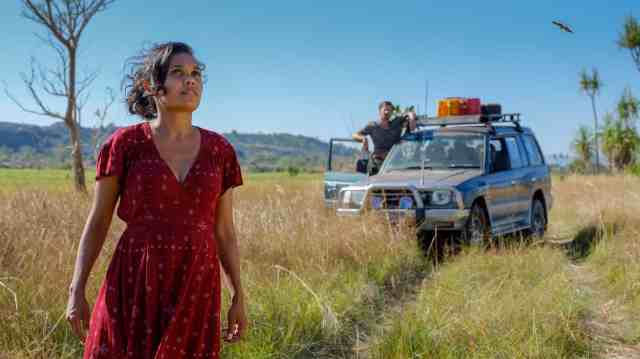
You can’t get more Australian than a romantic comedy with a walkabout, an Aboriginal wedding, a heaping helping of Oz slang and some serious sight seeing in the wonders of the little-filmed Northern Territory.
Or as they call it Down Under, Australia’s “Top End.” Thus, our story’s title, “Top End Wedding.”
Lauren and Ned live in Adelaide, a couple of attorneys — one newly-promoted, the other a prosecutor who has no heart for the job.
Ned (Gwilym Lee, who played guitarist Brian May in “Bohemian Rhapsody”) proposes on the day he quits, and the day Lauren (Miranda Tapsell of “The Sapphires”) wins over her boss, aka “Cruella de Vil.”
That boss (Kerry Fox) gives Lauren just ten days to do the deed and honeymoon. Lauren has this notion of going “home” to marry, so that’s going to be tricky. Trickier? Ned hasn’t had a chance to tell her he’s quit, and when they get to Darwin, her Dad (Huw Higginson) is morose.
Her Mum has buggered off, and he’s at home, wearing pajamas all day and weeping in the pantry, listening to“If You Leave Me Now” over and over again.
Mum is a Chicago fan. But where did she go?
We’ve seen, in a prologue, the inciting incident of long ago when young Daphne fled her own wedding on the Tiwi Islands. She’s been estranged from her family ever since. Lauren grew up without learning her native language. She can’t make the same mistake. They MUST find Mum.
Daphne’s trail isn’t hard to follow — a trashed resort hotel room (the hotel is shaped like a crocodile) here, a hook-up with a French pilot giving helicopter tours of Kakadu National Park there.
But that hunt isn’t the only strain on the couple. Who’ll plan their wedding with them traipsing hither and yon in Dad’s “ute” (SUV), dipping into stunning canyons and connecting Lauren with her Aboriginal heritage?
In the movie’s most absurd touch, it’s that over-organized/workaholic boss, who isn’t so “Cruella” after all, who is summoned.

It’s as frothy as you expect a movie like this to be, with misty-eyed moments of re-connection with “my people” mixed with a bawdy “hens party” with bridesmaids and bride drinking from penis-shaped straws and eating “budgie” (penis) shaped cake.
Weepy Dad and tactless future son-in-law? They’ve got “Die Hard” and “footie” on the telly.
The running gag with the sappy Cetera-era Chicago song, the “French” pilot who isn’t (French), the campy Tiwi Island taxi driver who, like everybody else there, is “your family” set the tone.
“I’ll see’ya ’round, like a ringworm!”
There’s touching native choral music, and a cute variation of The National Anthem (“Down Under” by Men at Work”) and oh-so-much-Aussie/Aboriginal slang.
“OY! You MOB! Shut yer’holes and get your rings in the car!”
There aren’t many surprises, but the amusing bit players, throw-away lines and general “feels” that “Top End Wedding” leaves you with put it over. There are laughs, sure, but who doesn’t cry at weddings?

MPAA Rating: TV-14, bachelorette party gags
Cast: Miranda Tapsell, Gwilym Lee, Kerry Fox, Huw Higginson, Elaine Crombie , Shari Sebbens, Dalara Williams, Jason Desantis and Ursula Yovich
Credits: Directed by Wayne Blair, script by Miranda Tapsell, Joshua Tyler. A Samuel L. Goldwyn release.
Running time: 1:42
I have a theory about that…
Heath Heine, Rick Haak and Jon Cotton star in this Mar. 10 release
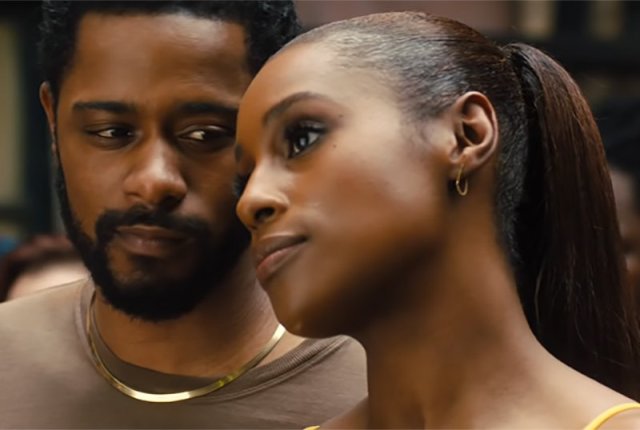
There’s a casual charm and sophistication to “The Photograph” that harks back to an earlier era in film romance.
The locations are striking, the characters upwardly-mobile and cultured. She’s a curator at the Queens Museum, daughter of a photographer-artist, he’s a treasured reporter at a national magazine. They dress the part, live well and debate music, when they’re not getting personal. The love affair gives away its chemistry through eye contact — wide-eyed stares — but the lovers never let us forget this is a meeting of minds.
“I don’t want to say the same thing I’ve said to another woman.”
“I broke up with my last boyfriend when he proposed.”
Writer-director Stella Meghie (“The Weekend”) lets her camera lose itself in the devouring eyes of Issa Rae and Lakeith Stanfield. She loses herself in those awkwardly-long close-ups, so much so that never have to wonder why this serene, sexy romance starts to drag. And drag.
But it’s cute, and a decent story and a couple of dreamy performances put it over.
Michael is in Louisiana, interviewing a local waterman (Rob Morgan) about the impact the BP oil spill and hurricanes have had on his work, when he sees the photograph. It was Isaac’s long lost great love. She was a photographer, and they lost touch “after she took off…or I let her leave.”
Something about the way he pauses and his eyes drift makes Michael shift the focus of the interview. And when he gets back to New York, he digs into this Christina Eames. And that’s how he meets Mae (Rae), the photographer’s daughter.


Flashbacks show us the gentle struggle between young Christina (Chanté Adams) and young Isaac (Y’Lan Noel). He’s settling down, she’s casting her eyes where they need to go if she wants to make it as an artist.
In the present day, Michael shyly only-not-really asks the woman he’s interviewing about her just-died mother out.
Smooth. And unprofessional. But it’s a movie, right?
The two romances are developed in roughly parallel sequences — Christina longing to break out of her bubble, pushed out by her single-mom, Mae and Micheal facing buppy versions of the same predicament, a job that might break this promising thing up before it starts.
The little comedy that’s here stands out because of the dreamy, mooning nature of the romance. Lil Rel Howrey plays Michael’s brother, a middle class married man who pokes his ladies’ man brother in the ribs every chance he gets (and is the only character in the movie to curse). The biggest laugh comes from one of brother Carl’s tween daughters, who spills the beans with just a slack-jawed look when quizzed about Michael by Mae.
Courtney B. Vance plays Mae’s fatherly father, sage advice about her “just a woman, with flaws” mother.
Meghie gives the film a feminine perspective that goes beyond the “let’s not rush things” pace of the picture. Conversations turn intimate in an abrupt flash, brothers and girlfriends from work over-share.
None of that stops the movie cold, but that lack of pacing robs it of urgency and heat.
A tiny quibble — the “talented” art photographer’s photography is flatly-lit, staged filler, with all the photos sampled looking as if they were shot in a day or two.
The silky jazz and R & B soundtrack weaves a spell and builds a mood that sustains
But in the end, it’s up to Rae (“Insecure”), at her most glamorous, and Stanfield (“Knives Out”) at his most romantic to put this over. And as they do, “The Photograph” develops into something rare in the movies this and most Valentine’s Days — a romance that feels romantic.
MPAA Rating: PG-13 for sexuality and brief strong language
Cast: Issa Rae, Lakeith Stanfield, Lil Rel Howrey, Chanté Adams, Courtney B. Vance and Y’lan Noel.
Credits: Written and directed by Stella Meghie. A Universal release.
Running time: 1:46


Delayed and re-designed after early trailers had fans of the video game “Sonic the Hedgehog” up in arms, the end product movie adaptation isn’t remotely as bad as one might fear.
Sure, it’s very very VERY small-child friendly, with a cute fuzzy (digitally animated) hero and fart jokes. And little else.
And maybe it’s churlish to point out — as many are — that casting James Marsden as the human who must aid alien Sonic in his quest is entirely too similar to the role (matching scenes, even) Marsden played opposite a rebellious CGI teen Easter Bunny in 2011’s human-plus-animated-co-star flop, “Hop.”
Lovely Tika Sumpter of the “Ride Along” movies (and “Southside with You”) is “the wife,” and has nothing to play. Nor does legendary character actor Neal McDonough, as the head military man on the scene when the hedgehog knocks out the power to Green Hills, Montana. That’s where Marsden’s Sheriff Tom Wachowski whiles away the hours wondering if his radar gun works.
Until Sonic shows up. Sonic, you remember, is very very fast.
But eventually Jim Carrey makes his entrance as the villain, all mustache and ego and wild-eyes and gadgets and insults, and things turn funnier. Because nobody gives better comic villain value than Carrey.
“I’m the TOP BANANA in a world of hungry little monkeys!”
The origin story starts Bambi-sad, with Sonic chased off his home world, losing his owl caregiver in the process but bequeathed a sack of gold rings.
He can use these to wormhole his way anywhere — across town or across the universe. Remember, this IS based on a video game of Japanese origin.
Sonic, voiced by Ben Schwartz of “Parks & Rec” and the funny stand-up comedy dramedy “Standing Up, Falling Down,” settles into a blue alien hedgehog cave that he fills with cast-off decor from all around, wearing mismatched sneakers that he wears out with his sound-barrier-chasing speed.
Sonic. Get it?
Sheriff Wachowski is longing for a change of scene. He and his veterinarian wife pine for the excitement of San Francisco, leaving Montana, “where the men are men and the sheep don’t mind,” to the sheep.
Sonic spies on the locals and nicknames the sheriff “Donut Lord” for obvious reasons, until that night they cross paths, Sonic gets on the wrong side of a tranquilizer dart and he makes the power go out for miles in every direction.
He can do that.
The Marines (McDonough) are not enough of a response to this. Veteran alien hunter and government-connected scientist and “psychological tire fire” Dr. Ivo Robotnik (Carrey) shows up in the coolest Freightliner this side of “Universal Soldier.”
And the mad chase is on.
Carrey’s pop-eyed villainy takes many forms. He whistles “Ride of the Valkyries” as he tracks the alien. He threatens humans like the sheriff, but begins with insults.
“I was spitting out formulas while you were spitting UP formula!”
He does experiments in his vast tractor trailer while dancing to his jam –– “Where Evil Grows” by The Poppy Family. Yes, Dr. Robotnik, like Carrey himself, must be a Canadian Baby Boomer to summon up that one.
He’s all quips — “Eeny, meany miny MAYHEM,” and puns — “You just sit there and be You…sless!” — and killer drones.
What “Donut Lord and the Blue Blur,” aka hapless small town sheriff and hedgehog, stand a chance?
Schwartz doesn’t bring much other than youthful (ish) bubbliness to the voice-acting, Marsden probably figured out the “Hop” connection AFTER his agent did and Carrey can only do so much.
This isn’t the best film to make one’s feature directing debut with. But Jeff Fowler had an animation research job on “Where the Wild Things Are,” so he’s just happy to be here. It’s doubtful anybody else could have gotten more out of this limp script.
But I dare say hedgehog-sized tykes — say seven-and-under — will be tickled enough by this to make it a late-winter sleeper.

MPAA Rating: PG for action, some violence, rude humor and brief mild language.
Cast: The voice of Ben Schwartz, with James Marsden, Tika Sumpter, Neal McDonough and Jim Carrey.
Credits: Directed by Jeff Flower, script by Patrick Casey and Josh Miller, based on the SEGA video game. A Paramount release.
Running time: 1:39
“Top End of the Country,” they call it.
Yeah, a lot of it burned, too. But not before this interracial rom-com was filmed. Looks cute.


Desperation has rarely been as quiet as Mirella Pascual plays it in “Whisky,” an understated character study in loneliness that is one of the most celebrated films to ever come out of Uruguay.
This 2004 jewel is about routine, life going on without living and the sudden introduction of a wild card that may or may not change things forever.
The set-up is sit-com gimmicky. Marta (Pascual), faithful assistant manager of the tiny sock factory Montevideo owned by Señor Jacobo Köller (Andrés Pazos). She is there, waiting for him to open up the place every AM, and stands by the time-clock as the employees leave at night — checking their bags to ensure nobody is swiping socks.
Jacobo inherited this as the family business, and one year ago, his other died. That’s prompted a letter to his long-estranged brother Herman in Brazil.
It’s time for the matzeibe, the unveiling of the tombstone. Maybe brother Herman should finally come home. But when he says he will, Jacobo is in a fix. He hasn’t improved the factory, with its lint-caked wiring and lighting fixtures, in decades. He drives an ancient Peugeot that he has to massage into starting, dresses down and has let the house go.
Herman, married with two daughters, will spend the whole visit showing him up. Could Marta maybe come stay at the house for a few days?
The whole “pretend you’re my wife” thing is left unsaid. That’s how long these two have been in each other’s company. She may go home by herself and go out to the movies alone. But she’s also been tending to his needs — coffee, bookkeeping, maintaining morale in the ranks.
A lot for a 50something woman hollowed out by loneliness to manage. But she knows the man better than he knows himself. All she needs is his mother’s wedding band, a single photo of them together, and it’s game on.
Herman (Jorge Bolani) turns out to be the brother with all the personality. Being around the two of them just highlights Jacobo’s bitter resignation, his anti-social tendencies. There’s a lot of chatter over meals and the like. But Jacobo isn’t in on it.
Even taking his brother to a soccer match is a trial and requires trash-talking fakery Jacobo isn’t really up to. Marta is more conversational (in Spanish, with English subtitles). But even she slips up with the odd, deferential “sir” used in an inappropriate way.
And then Herman talks them into letting him stay a little longer.
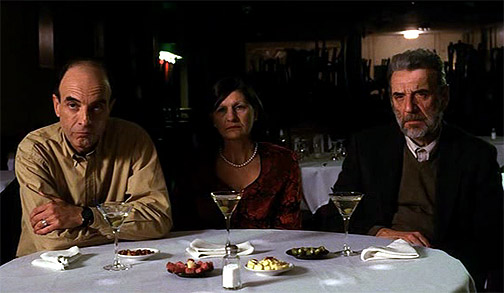
There’s a romantic comedy buried under a lifetime of overlooking each other in this situation and in these performances. It’s just that the little dress-up/put-on-make-up-and-pearls makeover changes Marta, but it doesn’t dent Jacobo.
The subtlety in the performances begins with the script, which never ever “tells” us something when it can let the actors “show” it instead.
The pace won’t be to every taste, and the frustration built in here is more deflating than unbearable. Even a trip to Uruguay’s tourist-trap coast can’t shake the gloom, the routine Jacobo won’t break no matter how much Marta comes out of her shell.
I’m not sure how this played in Latin America, but in North America the sense of the difference between “surviving” and “living” is what stands out. And that keeps “Whisky” — the only whimsical thing about it is the title — in the memory, on a pedestal and still held in great esteem decades after its release.

MPAA Rating: TV-MA, adult situations, alcohol, smoking
Cast: Andrés Pazos, Mirella Pascual, Jorge Bolani
Credits: Directed by Juan Pablo Rebella, Pablo Stoll, script by Gonzalo Delgado, Juan Pablo Rebella and Pablo Stoll.
Running time: 1:38
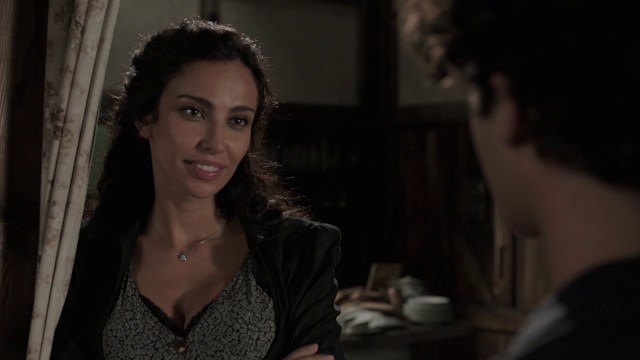
All most screenwriters ever want, the old Hollywood joke goes, is the chance to direct. “All You Ever Wished For” is thus cautionary on multiple levels.
Writer-director Barry Morrow scripted “Rain Man” and the teens-build-a-solar-car-for-teacher Halle Berry comedy “Race the Sun” back in the last millennium. “All You Ever Wished For,” his directing debut, feels even more dated than that.
It’s a corny cannoli of a comedy, a tale of a dying mountainous Italian village where no one marries because the place is under a Gypsy curse.
The locals all speak English with 1940s Hollywood Italian accents and the occasional “Andiamo!” and “BASTA!” thrown in. The town cute and quaint, all livestock rustic with barely a sign of modern civilization — and no cell service.
And the guys who show up to “break the spell” are a rich, spoiled American women’s accessory firm heir and the three old school Mafiosi who have kidnapped him, and then gotten lost.
They all wake up in this gorgeous setting and fall in love with the first living, breathing thing they see. For Aldo (Duccio Camerini), it’s a timeworn farm-woman. For Bambo (Massimo De Lorenzo), it’s a hunky local laborer. For Cetto (Fabrizio Biggio), it’s a dairy cow.
Yup. Udderly ridiculous.
Our hero, bratty Tyler (Darren Criss of “Glee”) has the bad fortune to tumble for the defiant, don’t-need-no-man Rosalia (Mãdãlina Ghenea of “Dom Hemingway”).
“Who ARE you? I LOVE you!”
Rosalia, “like her name, she breathes fire” he is warned. Maybe if he can convince his Dad (James Remar) to send HIM the ransom, instead of his hapless kidnappers, he can impress her with cold, hard cash.
“You, Tyler, cannot AFFORD me!”
Mob Boss Don Rossi (Remo Gerone, who played Enzo Ferrari in “Ford v. Ferrari”) won’t mind. Right? Right.


It’s a silly little nothing of a movie, picturesque, with only the supporting players showing us much in the way of screen charisma. And they’re just supposed to be local color. The mayor sleeps in the buff, in his mayoral sash.
The blind priest (Claudio Bigagli)? He’s the one narrating the story. Sort of. Such as it is.
A lot of people went to a lot of trouble to cast, build, travel and shoot this thing, and while the overall tone has a nice whimsy to it, I only laughed twice.
Once when the kidnappers accost Rosalia, looking for a place to spend the night.
“I share my bed with NO man! And never THREE!”
The other laugh you’ll have to find for yourself.
The movie isn’t much, but I’d love to visit the location.
MPAA Rating: unrated, mild violence
Cast: Darren Criss, Mãdãlina Ghenea, Claudio Bigagli, Remo Gerone and James Remar
Credits: Scripted and directed by Barry Morrow. A Film Movement release.
Running time: 1:27
Anjelica and Bill, Benecio, Tilda and Willem and Owen and Liev and and Frances M. and Elisabeth and Cecile and Lea and Timothee and Saoirse and Adrian and Jeffrey Wright!
And EVERYbody else.
Hot. Damn. July 24.
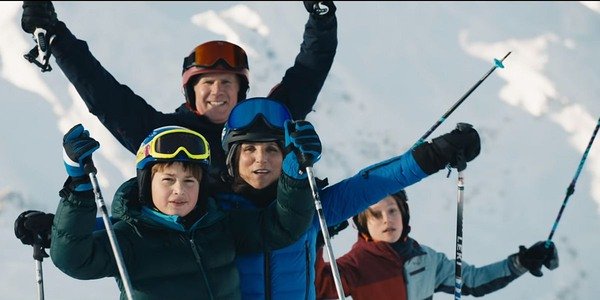
“Downhill” is a reminder that one isn’t required — by cinematic law — to faithfully remake a Scandinavian darker-than-dark comedy about a marriage buried when a husband flees an avalanche that might have killed his wife and family.
“Force Majeure” was so Nordic, bleak and soul-searching that you could be forgiven for wondering, “Wait, this is a ‘comedy?'” at any point in its two squirm-inducing hours.
When you cast Julia Louis-Dreyfus and Will Ferrell in your remake “Downhill,” and make it half an hour shorter, plainly you’re going for a lighter touch. “Downhill” suffers mightily in direct comparison to the intensity, physical and emotional peril of “Force Majeure.”
But it’s funny. Dark and funny. That it still hits, however lightly and more hopefully, the dark undercurrents of a marriage derailed by selfishness, distracted lack of commitment and the shocking realization that he’s not born to self-sacrifice the way she is — and she now gets that — is almost a bonus.
Pete is a real estate agent glued to his phone even though he’s arranged this stupidly expensive trip for Billie (Louis-Dreyfus) and the kids in the Austrian Alps. It’s not like he’s distracted by work. There’s a younger colleague out living it up with his new girlfriend, traveling in Europe at the same time.
Pete must be envious, even though he’s got the beautiful lawyer-wife and two sons who got their mom’s good looks. Even though they’re in one of the most beautiful winter wonderlands on Earth, ‘”the Ibiza of the Alps,” their bawdy, too-helpful concierge (Miranda Otto, hilarious) tells him.
Pete’s in mourning for his dead father and Billie is being super-understanding. He’s booked them into a not-that-kid-friendly resort, which is worth an eye-roll. He’s dismissive of how dangerous the steep slopes are, at the soft European grading system for them — “their ‘black’ (most difficult) is our ‘blue.'”
She indulges him. That’s what couples do.
But those avalanche cannons that are the opening image of the film are there for a reason. They trigger avalanches in a controlled fashion so that snow buildup doesn’t bury the paying, skiing customers. It’s just that one lunchtime cannonade brings snow all the way down on the Stanton family as they’re dining, apres le ski, al fresco.
All of the other tourists “ooh” and “ahhh.” They’re snapping pictures. “Perfectly normal” Pete shrugs. Until the tidal wave of snow bowls them all over. Well, not Pete. He’s grabbed his phone and ducked out of danger while she had the presence of mind to try and shield their sons (Julian Grey and Ammon Jacob Ford).
One unfortunate departure from “Force Majeure” here is the level of peril. It is lessened. We’re allowed to consider that Billie, shocked and appalled, might be over-reacting.
But Pete knows what he did. And over-reaction or not, she is simply gobsmacked at what she’s witnessed. She doesn’t have to coach the kids into reacting the same way. They saw it, too.
“Dad ran away!”
The vacation then becomes a “Where do we go from here?” experience, Billie reaching for “We need some time” to talk this through, Pete reaching for any distraction — dining with the unfiltered concierge and her — husband? Latest ski resort pick-up?
Dreyfus has a lifetime of sitting on eye-rolling fury just long enough for it to utterly boil-over. Ferrell’s got the nervous, beady-eyed panic thing down pat.
Actors turned writer-directors Nat Faxon and Jim Rash (“The Way Way Back”) let us revel in the transition these two play out, from herding the kids and optimizing the trip, to grasping at distractions and/or exit strategies.
Watch the way Billie takes hold of the “This idiot is cavalier about our safety” thing when Pete has them on the pad, rushing them off to go heli-skiing. “Hurry,” the copter’s booking agent tells them, the rotors turning. “The weather’s changing.”
“The weather’s changing? WAIT! Changing to WHAT?”
Louis-Dreyfus bores laser-bolts through Ferrell in these later scenes, until the outrage finally can be contained no longer.
Hashing this out in front of Pete’s young work pal (Zach Woods) and his “hashtag” crazed hippy girlfriend (Zoe Chao) is less than ideal. But Rosie GETS it and shares her outrage.
Giving Otto several scenes, with her every loopy Teutonic locution laugh-out-loud funny, pays off. Pairing up sexually-frank Charlotte with PTSD Billie on a ski-lift is worth the price of admission — “Zo, zexually, you have been all ze blocks around?”


You have to judge what’s on screen in front of you in a remake, and “Downhill” is no doubt not the movie “Force Majeure” was. The shorter run time makes for a brisk choppy story that skims over the gradual meltdown and gets straight to it. Nuance is lost.
Some of the “Hollywood” touches are funny, kind of in-character, but jarring.
But there is real pleasure is watching these two interacting, the chaotic banter that both Louis-Dreyfus and Ferrell have mastered, the shorthand they bring to “long-married couple” and shock this “incident” has given them both.
If you want to see “Force Majeure,” rent it and stream it. If you want to see two terrific comic talents circling around it in something lighter and funnier, then “Downhill” it is.

MPAA Rating: R for language and some sexual material
Cast: Will Ferrell, Julia Louis-Dreyfus, Miranda Otto, Zoe Chao, Zach Woods
Credits: Directed by Nat Faxon and Jim Rash, script by Jesse Armstrong, Nat Faxon, Jim Rash, based on “Force Majeure” by Ruben Östlund. A Searchlight release.
Running time: 1:26


