Movie Review: The wear and tear of “The Aerialist” dancer’s life

aerial3

We got a glimpse of the stage dancer’s hard, short professional life in “A Chorus Line.” But for a taste of the serious wear and tear, the brute strength, debilitating injuries and career-crushing ageism facing the women and men in tights and leotards, check out “The Aerialist,” one of the most revealing movies about the dancer’s life ever made.

Gymnast, dancer, aerialist and actress Dreya Weber and her director/ex-husband Ned Farr made this sequel to “The Gymnast,” which captured the dancing and Vegas acrobatics after-life of a former Olympic hopeful Jane Hawkins (Weber).

That film captured Jane at 43 — well-past the average show dancer’s lifespan. In “The Aerialist,” the woman her colleagues nicknamed “The Hawk” is a veritable legend, “the oldest aerialist in rock’n roll,” her neighbor Dan (Stef Tovar) jokes as he gives another life-saving massage. “You know how dumb that sounds?”

She won’t accept that. Jane has rejoined “The Family,” the longtime stage dancers and aerialists who liven up the concerts of rock-pop legend Aurora (Monique Parent) on her “last tour.” This tightknit group, reminiscent of Taylor Swift, Beyonce or Madonna’s accompanying dancers (Madonna’s even called themselves “The Family,” if memory serves), has been together 20 years. All they need to do is rehearse the routines and get in tour shape with choreographer Spencer (Bernard White), and on the road they go — subletting their LA and/or Vegas apartments, traveling the world, one venue at a time.

But Spencer’s short-tempered and panicked, yelling even at his aerial director and friend, Jane.

“It’s fine,” she says.

“It’s not. ‘It’s’ back.”

He’s too sick to carry on. Jane is put in charge of getting everybody ready, but that lasts for just a day as a hot new choreographer with “the vision” shows up. Xavier, “Call me Z” (Kelly Marcus) has zero experience dealing with the safety issues and physical demands of rope, ring and Spanish Web performances. He starts getting people hurt the minute he walks in the door.

The Family is in open revolt. Jane is humiliated and enraged and more physically imperiled than anybody else, being the oldest. Something’s got to give. Does Aurora know about this?

But the generic and only mildly-interesting surface intrigues are not what lift “The Aerialist.” It’s the story of a dancer on her last legs, shoulders and fingers that holds our interest.

Given a lift home by her “Gymnast” aerialist co-star Serena (Addie Yungmee) lets them compare wounds and war stories. Seeing Serena limp off shows Jane as she’s not yet willing to see herself — practically crippled by work she’s barely able to manage any more.

The massages, consultations with a doctor, tape she covers up and injuries she hides from the punk “Z” are an extra level of “performance” that goes into her day.

There’s no HR department in rock’n roll. Z can get away with his snide “back in the day,” cracks, suggesting how dated they and their dancing are, his  “This is no longer The Dinosaur Tour” and “Eat your Wheaties, lose some weight, drink your Ensure” insults.

Some won’t put up with that. Some will. Don’t take that “Family” nickname too seriously. Because business is business, ESPECIALLY in show business. aerial4

The romantic/marital/sexual wrinkles in “The Gymnast” are replaced by those provided by a reporter (Morgan Bradley) demanding that The Hawk “let me IN” to her inner secrets for a too-revealing profile. Others tell the reporter bits of Jane’s story, and Jane herself summarizes her career — a 1980 Olympic hopeful, but the Olympics were boycotted, hopeful again in ’84 and ’88, “But life for me started when I learned how to fly!” — when she can spare a second.

And then there’s the singing star’s daughter (Victoria Meade), a go-fer during rehearsals until Jane finds more appropriate work for her to do.

But the melodramatic script isn’t the draw here. It’s the demanding artistry, the behind-the-curtains peek at how the dancing/flying sausage factory of pop concert tours are pieced together.

What’s worth watching and considering is the athleticism, bravery and calling of the dancers, just needing that next gig, just wanting to hang on to their careers a little longer, just wanting another chance to show “what I did for love.”

stars2

MPAA Rating: unrated

Cast: Dreya Weber, Morgan Bradley, Kelly Marcus, Victoria Meade,Thunderbird Dinwiddie,  Grasan Kingsberry  and Stef Tovar

Credits: Written and directed by Ned Farr. An Indie Rights release.

Running time: 1:4

Posted in Reviews, previews, profiles and movie news | Comments Off on Movie Review: The wear and tear of “The Aerialist” dancer’s life

Movie Review: Once more, into the breech — “The Trip to Greece”

greece3

Steve Coogan and Rob Brydon reunite for one more comic travelogue in “The Trip to Greece,” retracing the steps of the mythical Odysseus in a land steeped in history.

As indeed are our co-stars — retracing ancient steps and an ancient relationship. That’s the joke these four “Trip” movies — the long-standing, easy-going (sort of) hate-love relationship that’s developed over the decades between the relatively famous but insecure funnyman Coogan (“Philomena,” the recent “Greed,” filmed in Greece) and the less-famous, needier and “always on” Brydon (“Blinded by the Light,” “Swimming with Men”).

They first worked together (and with director Michael Winterbottom) on “24 Hour Party People,” Coogan’s first big break in film when it came out in 2002. Brydon also appeared on one of Coogan’s Alan Partridge TV series (Coogan played a hapless, self-important and downwardly mobile chat show host, then DJ, etc.). But it was their semi-improvised rapport-rivalry on Winterbottom’s hilarious “Tristram Shandy: A Cock and Bull Story” (2005) that inspired Winterbottom to pair them up for these travelogues.

Put two funny, competitive comics — with egos and a rich store of celebrity impersonations at their their disposal — in a Land Rover, Mini Cooper or what have you, and send them on “a newspaper travel assignment” to The Lake District of Britain (“The Trip”), and later to Italy and Spain.

They eat, drive, experience relationship or personal crises as they travel from one tony hotel/4-star eatery to the next, bickering and mimicking and competing along the way.

That lengthy prologue feels necessary on this review because that “history,” invented basically for the cameras, is THE running gag in these films, the thing that makes them hilarious to the initiated.

If you don’t know that history or don’t like the prickly Coogan or exhausting Brydon, this isn’t for you. There isn’t enough scenery and history (and there’s a bit) to make this a proper travelogue, even though it is scenic and is historic and there may have been more of “that” in the TV version of this decade of British TV specials-turned-into-feature films for the international market.

I find them hilarious, and I think this fourth and “final” outing in their “trilogy” is the funniest since the first.

The “odyssey” they set out on barely holds their attention as they bring an “Innocents Abroad” disdain to overly-ruined ruins, straight off.

“There’s not to lot to see here, when you think about it.”

They begin in Troy, in Turkey, and trek to Ithaca by sailboat and Land Rover, ferry, on foot and even swimming as they visit the Temple at Delphi, Nestor’s Palace, Pylos, Lesbos, Stagira and the Caves of Diros.

The jokes kick in with a recognition of Coogan’s recent (mild) success playing Stan Laurel in the “Laurel & Hardy” bio-pic. We’re treated to his impish Laurel and Brydon’s wheezing Batman villain Bane in in a “Laurel and TOM Hardy” gag.

The dinner table banter devolves into dueling Roger Moores, Sean Connerys and Dustin Hoffmans, Brydon (a better mimic in most cases) “casting” Coogan as they do.

“Try it AGAIN Steve. I REALLY want you for this part.”

The obligatory reference to the role that Coogan used to worry (in “Tristram Shandy” AND “The Trip” films) would be all he’s remembered for is a shouted “A-HAAA,” Alan Partridge’s signature sign-on. Yes, even in Greece he gets that.

But as they remember Lord Byron’s most proud moment, swimming the Hellespont, Coogan’s left that fear behind.

“Thing you’re most proud of…?”

“My SEVEN BAFTAs (British Oscar/Emmy prizes)!”

“I think the thing I’m most proud of would be my children…”

“Because you don’t have ANY BAFTAs, do you?”

And on and on it goes, Brydon intoning poetry and snippets of “The Odyssey” (or maybe the Roman epic “The Aeneid”) in what he insists is Sir Anthony Hopkins’ voice, but which sounds more like Richard Burton.

They riff through “Mutiny on the Bounty,” make male member “salami” jokes about the naval Battle of Salamis,” and reach for a Bond villain baritone, or Roger Moore as James Bond, every chance either of them gets.

“I think, Mr. Bond, you enjoy staying in the Hotel Lesbos as much as I!”

The little jab of “reality” here is Coogan’s updates from back home about a “Damien Chazelle film” that he’s up for, and the health of his dying father. Brydon, the more settled family man (unlike in one earlier “Trip”), is angling to get his wife (Rebecca Johnson) to fly over and join him after the “assignment.”

That “Who is happier?” contrast has merely to be suggested, as it has been a subtext of all their films. Is the “star” content, or is it the minor star/settled family man?

Coogan revives his “stop motion animation” and “dubbed soundtrack” tricks, Brydon his infamous “little man in a box” voice.

And there’s singing, because of course there is. Here, it’s a definitive rendition of a certain British Olympics film’s title tune, as well as a debate on the falsetto merits of the vocal stylings of Frankie Valli and Barry Gibb.

“Grease is the time, is the place, is the motion
Grease is the way we are feeling…”

Because what else would Rob Brydon hear in his head when Steve Coogan offers him a free trip to the birthplace of Western Civilization?

3stars2

MPAA Rating: unrated

Cast: Rob Brydon, Steve Coogan, Rebecca Johnson, Claire Keelan, Kareem Alkabbani

Directed by Michael Winterbottom, An IFC films release.

Running time:

Posted in Reviews, previews, profiles and movie news | Comments Off on Movie Review: Once more, into the breech — “The Trip to Greece”

Bingeworthy? “White Lines,” from the creator of “Money Heist”

lines1

Sometimes, I swear, it’s like the creators of these limited-run series are paid per minute of screen time that they convince the streamer to give them to tell their story.

A woman learns that her beloved brother — missing for over 20 years — was murdered. She flies to Spain to see the body, and to the isla of sin, Ibiza, the last place anybody saw the handsome young DJ alive.

If feature filmmakers could get to the solution in 100 minutes, what’s the extra incentive for the creator of “Money Heist,” Alex Pina, to spread it over 500?

Yes, another rant about filler, teasing and wasting screen time to get to a story that would be more compelling if told in a much more brisk pace.

But call “White Lines” a guilty pleasure, a decadent dip into Ibiza affluence, drugs, night club/casino turf wars undertaken by rival families, reopening old family wounds, and run-ins with the law. Because every single episode has one or two big grabber moments, even if they’re surrounded by lapses in logic, soap operatic excesses and twists designed to do nothing more than, say it with me, “Drag this out.”

Here’s the first grabber, 40ish Manchester librarian Zoe (Laura Haddock of the “Guardians of the Galaxy” franchise) turns away from the Spanish police inspector who has just told her that they don’t investigate suspicious deaths more than 20 years old, and runs to weep over the mummified corpse of her missing brother.

Axel was supposedly in India, his friends said. But here he is, buried in Almeria, not that far from Ibiza, where he’d become a star DJ. How he died will become clear soon enough. Who did it, or who knows who did it in the focus of “White Lines.”

Zoe was shattered by her older brother’s abandonment. She sends her husband by to Manchester alone, blows off the protests of her retired cop dad (Francis McGee) and starts tracking down those still on the island of Ibiza (filmed on Mallorca) who knew Axel.

Flashbacks to “Manchester, 1996” relate the life and sister Axel (Tom Rhys Harries, last seen in “The Gentlemen”) left behind, and pick up his early days, making his mark and meeting friends and lovers in in Ibiza.

A running gag — everybody and I mean EVERYbody, from monied power brokers to old mates to the families that struggle for real-estate (and nightclub) dominance on the island asks “Do YOU know who killed Axel?” to pretty much everybody else.

Zoe isn’t even there, and unless all these people are lying, they’re wondering the same thing she is. Her showing up just amps up pressure of the uncomfortable questions.

A second repeated gimmick — Zoe Facetimes with the shrink (Maggie O’Neill) she saw for years after Axel disappeared. She’s not just talking about recurring issues. She uses her chats with Yoana to bring us up to date on all emotional barriers she’s breaking through, laws she’s breaking and the “white lines” she’s straying from in her new “be brave” ethos. Kind of a cheat way to “bring the viewer up to date,” but there you are.

She wonders what aging fellow DJ Marcus (veteran character player Daniel Mays, the LAST guy you’d think of as a club DJ, but convincing) knows, what the club-connected/family “enforcer” Boxer (Portuguese actor Nuno Lopes, all silky menace and sexy machismo) might be able to tell her, and what Kika Calafat, of the rich club-owner Calafat clan (Boxer’s employer) might have to say.

Marta Milans of “Money Heist” makes Kika a sexy “wild child” pushing 40, remembering her “first love,” Axel. A hole in her story? Axel seduced her away from another young Ibiza prince of two turntables and a microphone. “First love? Umkay, SECOND love!”

There are other characters, further intrigues. And every episode’s “Well, not seen THAT before” moment adds to the collection of grabbers.

Intimations of incest, a murder with a claw anchor, dogs stoned on cocaine that a dealer has spilled on the lawn, a “white line” he hides by putting a child’s soccer goal on it, an insane car chase (on an ISLAND) hurling cocaine out of an ’80s VW Golf convertible, a torture session or three, a drug trip in a sweat lodge filled with hallucinogen-laced frogs, a harpooning to end a torture session — I mean, you can’t say this doesn’t have a lot of fun or jolting moments.

“Nervous?”

“Yes. To be honest, it’s my first orgy.”

And as dull as the endless trips BACK to the club, to the office ABOVE the club, to beaches, the ancient lookout tower/fortress, to marinas and mansions, can be, as banal as much of the dialogue is, there are pearls that pop out of the filler.

“If you live like a god when you’re 20,” aging DJ Marcus sighs, “how can you be happy after that? Good times are always behind you.”

I appreciate the scattering of laughs, the novel, over-the-top dips into violence (Romanian drug dealers are the scariest) and the sheer loopiness of certain decisions, actions and leaps of illogic. And Haddock conveys a nice sense of pluck, damage and recklessness as Zoe.

I can’t say I think “White Lines” (in English, and Spanish with English subtitles) is “Golden Age of Streaming TV” material. But I can say it kept me around.

2stars1

MPAA Rating: TV-MA, graphic violence, drug abuse, sex, nudity

Cast: Laura Haddock, Nuno Lopes, Marta Milans, Daniel Mays, Belén López Angela Griffin, Francis McGee and Tom Rhys Harries.

Credits: Created by Alex Pina. A Netflix release.

Running time: 10 episodes @ 50 minutes each

Posted in Reviews, previews, profiles and movie news | Comments Off on Bingeworthy? “White Lines,” from the creator of “Money Heist”

Classic Film Review: The Who’s “Tommy,” pre-Broadway, in all its garish glory


The unalloyed delight in dropping into “Tommy” 45 years after it cinemas is hearing and seeing Jack Nicholson sing (respectably on key) and vamp his way through “Go to the Mirror!”

Only Ken Russell (“The Music Lovers,” “Altered States,” “Lair of the White Worm”) could pull off that coup.

The “rock opera” that surrounds it? It’s as lurid, weird, dated and prophetic as the day it came out.

The highlights for young film/Who/rock fans way back when, clinging to the familiar in an obscure, allegorical and trippy musicals, aren’t the treat they were in 1975.

Tina Turner‘s “Acid Queen” pulls out all the stops, and then some — WAY over the top. Elton John as The Pinball Wizard, the second, third or fourth choice for the role (depending on who you read) that produced the movie’s hit single is so confined by the platform boots/stilts of his costume that he becomes a still-life.

The “story” is murky enough to allow for interpretations that don’t match creator Pete Townsend’s intent. The precipitating incident, for instance, young Tommy’s WWII bomb pilot dad’s “death” at the hands of his mother (Ann-Margret, all-in) and Mom’s replacement (Oliver Reed) for five-years-dead Dad (Robert Powell), works better as a metaphor than a literal murder.

I mean we’ve seen the plane go down, seen no warning that he’s been alive but badly-burned for years and years, Tommy sees him in his sleep then stumbles across him being “killed” by Frank (Reed) and Mum? Metaphor. Tommy could still be rendered “deaf, dumb and blind” by the double trauma without a literal murder.

So much of the rest of the movie is already allegorical, most prophetically The Preacher. Russell cast Eric Clapton — of the “Clapton is God” graffiti of the day (late ’60s, when Townsend composed the two-LP opera) — as The Preacher, guitar slinging leader of the Cult of Celebrity (Marilyn Monroe, specifically).

Tommy’s (Who lead singer Daltrey) walled-off-from-the-world soul finds his one means of expression, pinball in that pre-video game era.

His image and fame are exploited by Frank (Reed has a couple of songs, and hits no recognizable note in any of them), a veritable Mama Kardashian of his day, as Tommy’s Mom suffers, clings to her boy and spirals into addiction.

Russell, a filmmaker who became famous for his excesses concurrent with the making of “Tommy,” wallows in them throughout — vibrant (’60s) colors, Ann-Margret’s character rolling around in chocolate and baked beans mid-breakdown, spectacles great and small cataloguing British history from The War through the ’50s, into the ’70s marching cultishly towards 1984.

tommy5

The film, like the album on which it is based (and which became a more coherent (well, somewhat) Broadway musical in the ’90s, earned brownie points for its ambition at the time. Not many loved it, but a few appreciated it.

Now, as eye-popping as it remains, as charmingly wretched in its excesses, it feels quaint — like a snapshot of the ’60s taken with ’70s technology viewed nostalgically from the Reagan/Thatcher era.

They don’t make’em like this any more. And the only person to let Jack Nicholson sing since was Nora Ephron in “Something’s Got to Give.” More’s the pity.

2stars1

MPAA Rating: PG, drug content

Cast: Ann-Margret, Oliver Reed, Roger Daltrey, Tina Turner, Elton John, Eric Clapton, John Nicholson, Keith Moon, Pete Townsend, John Entwistle

Credits: Directed by Ken Russell, script by Ken Russell and The Who.

Running time: 1:51


Posted in Reviews, previews, profiles and movie news | Comments Off on Classic Film Review: The Who’s “Tommy,” pre-Broadway, in all its garish glory

Movie Review: AOL chat awakens a Catholic girl’s hormones “Yes, God, Yes”

yesgod2

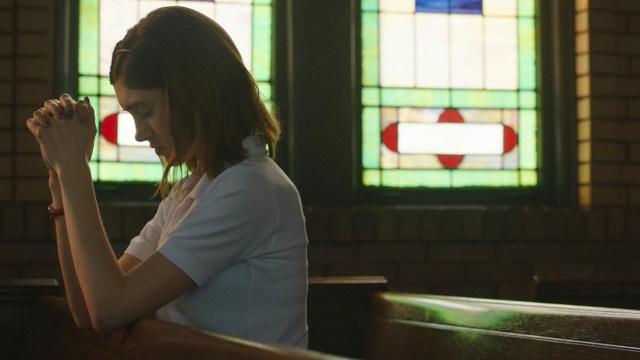
Writer-director Karen Maine’s first gained notice with the short film that became the feature “Obvious Child,” a comedy about an abortion. So a movie about a Catholic schoolgirl’s intellectual and sexual awakening during the AOL era is pretty tame stuff, by comparison.

“Yes, God, Yes” doesn’t have the built-in laughs that casting a comic (Jenny Slate) as its star pretty much guarantees. But Maine still manages to find gold, silver mostly, in the over-mined teen “coming of age” genre. It’s a comedy of nervous giggles of recognition, a few good laughs and enlightened compassion in the darnedest places.

It may seem as if Alicia’s “problems” start with a high school rumor. You know the type, the ones that sully or exaggerate somebody’s sexual reputation with a “she put out at a party.” Skinny, shy Alicia (Natalia Dyer of “Stranger Things”) is told by her prettier and judgier best friend Laura (Francesca Reale of “Stranger Things”) that everybody is saying Alicia “tossed salad” with Ward in a stolen moment at a party.

“It’s all over school!”

As “school” is a Catholic high school where 16 year-old Alicia is a favorite of the teacher’s, that’s a problem. The daily messaging, delivered in “Morality” class — “Have you watched the ‘partial birth abortion’ video yet?” — and everywhere else, is “God is always watching!”  The most sophisticated lectures on sexuality are passed along by Father Murphy (Timothy Simons of “Veep”).

“Guys are like microwaves,” always ready to go and over and done with in a flash. “Ladies are like conventional ovens. They require…preheating.”

But as naive as Alicia is — “I don’t know what salad dressing even MEANS” (it’s defined in an opening title) — she’s not as behind the curve as she seems. When he gets homes, she boots up her personal computer and drops in on AOL Chatrooms.

There, she can hide her inexperience and ignorance behind a screen name, and get in over her head in a flash with the likes of “hairychest1956” or “backseat lover81”

“Wanna cyber?”

A world of shared porn and self exploration awaits.

But peer pressure at Alicia’s high school points her in the opposite direction. You’ve got to go to a four-day “Kirkos” retreat with classmates, upper class group leaders and nuns and priests supervising group sessions, beatifically smiling peers (Alisha Boe and Wolfgang Novogratz) confiscate phones and watches (“You’re on JESUS’ time here!”) and conformity is practiced, urged and enforced with little side servings of Catholic guilt.

yesgod1

Maine doesn’t turn any of the adults here into cartoon ogres. There are Catholic martinets (Donna Lynne Champlin) and stern, judgmental clerics, and parents who just sort of do what they’ve always done, “for the sake of the children,” of course.

But bus-riding to camp with “a reputation” makes Alicia a bit of a rebel. She hides her second-gen cell-phone (this is set pre-9/11 2001 or so) because, you know, it uh, vibrates.

And being an outcast lets her see things, that the straight and narrow aren’t always straight or as narrow-minded as they seem.

The kid cast do well by the collection of high school “types” they play, but Dyer is a wide-eyed revelation. She’s meek on the outside, Aubrey Plaza (sexually carnivorous) on the inside, and for all the judgment heaped on her for something she hasn’t done, she’s not going to let that cow her as she’s figuring out what she wants to do, and whether or not she should care what dogma or authority thinks of it.

It’s a terrifically drawn character and Dyer lets us believe she’s figuring it out as she goes, harboring less guilt every step of the way.

“Yes, God, Yes” (streaming in July) doesn’t tackle a trigger topic like abortion. But Maine’s still made a teen sex comedy with heart, smarts and subtlety that Netflix, which owns this genre, rarely bothers with.

stars2

MPAA Rating: R for sexual content and some nudity

Cast: Natalia Dyer, Francesca Reale, Timothy Simons, Wolfgang Novogratz, Donna Lynne Champlin and Alisha Boe

Credits: Written and directed by Karen Maine. A Vertical release.

Running time: 1:18

Posted in Reviews, previews, profiles and movie news | Comments Off on Movie Review: AOL chat awakens a Catholic girl’s hormones “Yes, God, Yes”

RIP Lynn Shelton, Godmother of “Mumblecore,” director of “Little Fires Everywhere”

Actress/actor turned director Lynn Shelton, whose “Humpday,” “Your Sister’s Sister” and “Laggies” helped define to chatty/semi-improvised subgenre called “mumblecore” by some, has died.

A blood illness, undisclosed, took her at a far-too-young 54. That’s her with “Mumblecore” Godfather Mark Duplass, her “Humpday” (2009) star.

She did a lot of TV (“Mad Men,” “Love,” “GLOW”) and enough indie films to make her mark in her few years as a director.

Her final series was “Little Fires Everywhere,” a Hulu hit just last month.

She collected “Someone to Watch” and John Cassavettes Awards at the Indie Spirits.

She worked with Kiera and Reese and Kerry and Alison Brie and Rosemarie DeWitt and I cannot recall a bad performance in anything she ever directed.

The last film of hers I reviewed (I also watched and reviewed “Little Fires”) was her Marc Maron (her life partner) collaboration, “Sword of Trust” just last summer.

And when I say “classic actress/actor turned director,” I mean somebody who came to Hollywood to work in front of the camera because they knew they were beautiful enough to get casting directors’ attention, who never broke through to stardom but paid attention on sets and used what they learned to move behind the camera.

Go on any set and you see gorgeous men and women location managers, ADs, script supervisors and the like. Ask them their story and it is not unlike Lynn Shelton’s. But she learned the craft and had a fresh take on what dialogue should sound like.

“Mumblecore” was the result — improvised, natural chatter.

She fit that actress-turned-director mold to a T, and helped invent a whole new generational style of dramedy that launched Greta Gerwig and the Duplass Brothers to fame, among others.

Well done.

Posted in Reviews, previews, profiles and movie news | Comments Off on RIP Lynn Shelton, Godmother of “Mumblecore,” director of “Little Fires Everywhere”

Documentary Review: Old home movies reveal a horror “in the background” in “Rewind”

We’ve probably lost our ability to be shocked by allegations of sexual abuse that turn out to be true.

The American statistics are staggering — one our of four girls are molested before they turn 18, one out of six boys.

So the revelations, when they come in “Rewind,” don’t have the jolt that they did in “Capturing the Friedmans,” or even in the mini series about the widely-publicized crimes of R. Kelly and Michael Jackson.

But this film, directed by one of the victims in a family torn apart by generations of abuse, gets to you from the haunted home video images of a seriously unhappy little boy.

“I don’t want to curse my parents,” little Sasha, who looks to be nine or ten, pouts to the camera. “I don’t want to HATE my parents!”

But Sasha, a once-promising child identified as “gifted,” suddenly acting-out, lashing out, hurting his little sister Bekah, has gone through something. “Rewind” uses those home movies, hours and hours of them shot by his PBS videographer father Henry, to piece together the unhappy events that flipped that switch in Sasha.

As Henry remembers in Sasha’s film, “You didn’t film things that were bad” in your home movies. “You filmed celebrations, happy occasions.” You could only find the unhappiness and the sinister actions creating it “in the background.”

The adult Sasha interviews his parents, mother Jacqui, a graphic designer, and father Henry and paints a portrait of suburban dysfunction that prefigured the tragedy that hangs over Sasha and little sister Bekah’s lives.

Jacqui complains that Henry was tuned out — showing up very late to her Sasha’s premature birth because “he was out buying a video camera.” Henry’s obsession “became a wall tween my husband and my family.”

Jacqui acted-out against Henry’s obsessive video recording, bowing out of the shot. We also hear her cursing her little boy in one instance.

The “mystery” is set up as Henry was so intent on documenting everything, he’s either some sort of pervert, or he was blind to what was happening to their very young kids at the hands of someone the children know.

That’s the MO of pedophiles. They prey on children they know, have access to, family members included. Henry got LOTS of video of the criminals.

“Rewind” has Jacqui take the role of the parent who catches on, who questions her son, questions the first doctor they take him to with signs of sexual injury. Talked out of “reporting” that by her pediatrician, she tries to draw Sasha out. And failing to get through, she takes him to a therapist.

Dr. Herbert Lustig kept the kid’s files, and we see them as Sasha revisits the man who who told him, “If you can’t describe what happened, can you draw it?

“Rewind” is a textbook case of what happened, how it played-out within a still-callous legal system (powerful people get involved), the injustice money can buy perpetrators, and how the molested often turn into molesters themselves.

There’s nothing wrenching on screen, no grim confrontations with the criminals, just sobering memories from guilt-ridden parents, members of the legal system remembering the case and helping recreate Sasha’s gutsy, blunt tweenage to teenage testimony.

The revelations come relatively early, and the trauma of a child having to go through what any accuser has to endure — endless repetitions and re-interrogations (traumatic, and case-damaging in many instances) — becomes the focus of the film’s final third. Sasha, keeping most of the focus on himself, lets that become the movie.

“Rewind” arrives at a point in time where we’re beyond being shocked, where we despair that even the heroes aren’t heroic enough or quick enough to act, and real justice for the victims seems an illusion.

But films like this are important reminders that we’re not doing enough, that the social stigma that prevents us from acknowledging the extent of the problem is still there, and that no amount of brushing aside, “normalizing” or letting off with probation the sexual predators among us should let us forget how horrific and traumatic these crimes remain.

stars2

MPAA Rating: Unrated, graphically described sexual abuse subject matter, profanity

Credits: Directed by Sasha Neulinger.  A Grizzly Films/PBS “Independent Lens” release.

Running time: 1:26

Posted in Reviews, previews, profiles and movie news | Comments Off on Documentary Review: Old home movies reveal a horror “in the background” in “Rewind”

Movie Review: What might be out there in “The Vast of Night?”

vast2

“The Vast of Night” is a mystery wrapped in an enigma and boxed up in an homage to “The Twilight Zone.”

It’s a beautiful, gloomy and nostalgic film whose “The truth is OUT there” answers may be obvious, and whose long, monologue-driven set-up will test your patience. Seriously.

The first twenty minutes, a series of showy, walking/chattering tracking shots through small town America in the late 1950s gathering darkness, is marred by one of the epic under-enunciations of the post-Brando era. Co-star Jake Horowitz rushes and mutters his lines, and being photographed from behind and like everybody else, in shadows, you can’t make out more than a quarter of what he says.

Plucky teen switchboard operator Fay (Sierra McCormick) breathlessly tags along with him and blurts out “Why do you CHANGE your voice” when he’s on the radio?

Because, dear girl, no manager, even at WOTW in BFE New Mexico, would let him on the air if he can’t be understood.

The opening frames this story with a Rod Serling impersonator introducing tonight’s installment of “Paradox Theatre,” and for the first time, first time feature director Andrew Patterson transitions from a chic ’50s cathode ray tube showing us black and white images to our New Mexico setting (in widescreen, dimly-lit color).

It’s the opening game of basketball season, and “everybody in town” is eating take-out in their car in the parking lot, waiting for Cayuga High to take on an Indian reservation school in the town’s tiny Quonset hut gym.

Cayuga Falls, by the way, was where Rod Serling lived. It was the name of his production company, the one that made “The Twilight Zone.”

Everett (Horowitz) is the cock-of-the-walk in this tiny berg, swaggering in with his Buddy Holly glasses and Ricky Nelson vest to set up the radio station’s recording of the game, maybe help with a wiring problem that may be a repeat of “that time a squirrel chewed through it,” every single person in town wonders.

Fay, in her cats-eye glasses and ponytail, eagerly tags along. She’s got this new tape recorder and wants Everett to show her how it works. They proceed to “interview” people in the parking lot as practice, for her and him. She’s sweet on Everett, and he indulges her prattling on about several years of articles from various science magazines — “radio controlled cars, vacuum tube transport” — all of which will be around before “the year 2000.”

Eventually, she drops back in for her nighttime town switchboard operator job, and “Everett ‘The Maverick’ Sloane” drops behind the mike to spin records on the “Highway Hits” show.

“That’s the word from the bird.”

Fay hears it first, this mechanical, rhythmic static on her switchboard. Everett records it and plays “a sound bouncing around the valley tonight” to his listeners, looking for answers. Maybe they’d rather hear a live broadcast of the game which for some reason the station is tape delaying. But when we hear the rube in charge of recording and reciting his version of “play by play,” maybe not.

But this is when “The Vast of Night” settles in to solve its mystery. A long call from a guy who used to be in the military recognizes the static, but “everybody only knows ‘pieces’ (of any military secret) in the military, so nobody would know the whole thing.”

Something is “out there,” in the sky, at “Sputnik heights.”

Everett and Fay abandon their posts and dash around in the dark, looking for answers.

Patterson’s movie, working from a script by newcomers James Montague and Craig W. Sanger, cloaks all this mystery in 1950s small town nostalgia. The camera captures the eeriness of empty streets and the hominess of a place where everybody knows everybody else, and person-to-person gossip was the Snapchat of its day.

McCormick and Horowitz, suggesting a young Sam Rockwell at times, have great chemistry, with Fay’s fangirl babbling the quintessence of smart girl/small town girl charm.

The great achievement of “Vast of Night” is to revisit how utterly “out there” Serling’s “Twilight Zone” would have been in its day, even in the Atomic Age, when UFO mania was born and peaked.

But the film is a triumph of tone over substance, of aural aura over clever writing. Patterson blacks out the screen, here and there, or zooms in on an old wooden radio cabinet, letting us swim in the storytelling we’re hearing over the air. The most coherent moments are like a filmed radio play.

Still, even back then, mysterious radio (or phone line) sounds and “lights in the sky” would have people wondering if “The Day the Earth Stood Still” was coming.

That said, it works, sucking you into its “vast night” and taking us all back to an innocent time where the future was endless possibilities, “radio” was how a small town kid punched his “ticket out of here,” and TV took you to “another dimension…the middle ground between light and shadow, between science and superstition.”

stars2

MPAA Rating: PG-13 for brief strong language

Cast: Sierra McCormick, Jake Horowitz, Gail Cronauer

Credits: Directed by Andrew Patterson, script by James Montague, Craig W. Sanger. An Amazon Studios release.

Running time: 1:31

Posted in Reviews, previews, profiles and movie news | 1 Comment

Documentary Review: Put down your phone! (After reading this review of “Screened Out”)

screened2

Everybody’s got a story of when we first recognized the addiction — usually other people’s and not our own.

A concert where phone alerts interrupted the music, church, classrooms overrun with teens unable to keep the screen out of sight.

For me, it was a Toronto Film Festival in about 2002. I’d be in previews of movies destined to open around the world over the next few months, screenings packed with industry officials and filmmakers, and you could barely focus on the action on screen without this sea of tiny blue-greenish screens.

“Crack-berries,” we called them. They’re remembered, even today, in Jon Hyatt’s new documentary, “Screened Out,” about what some medical experts and academics are loathed to call an “addiction” (“compulsion,” a few call it) but ALL agree is a rising social ill of our age.

Hyatt’s legion of experts, advocates, pediatricians and others fret over how “screens” are eating up everybody’s time, but most especially our children’s. “Neglectful” distracted parents can’t bother to watch Missy’s swim lesson or focus on Junior on the swing-set — checking that screen.

And the kids? They are literally “rewiring your children” (Dr. Nicholas Kardaras, teen addiction expert) through the engineered dopamine rush of cell-phone apps purpose-built to hook us with “the bottomless feeds” of new thoughts, information, “likes” and the like, and video games “that go on forever.”

In just a few years, first world cultures (at least in this hemisphere) have seen attention spans — our ability to focus without having a gun held to our heads — have shrunk from 12 seconds to eight seconds.

A handful of Facebook alumni — higher ups such as Sean Parker — have sounded the alarm in public appearances (Hyatt gets no one from the industry on camera himself).

Dr. Hilarie Cash of the screen-addiction center Restart in Seattle (clever, clever name) declares “If they hold our attention, they can sell us stuff.” So the Twitters, Facebooks, Instagrams and Snapchats hire behavioral psychologists and others to ensure that each new piece of their “experience” is designed to do just that.

We meet no one who admits to doing this work.

Hyatt’s film starts out as a personal memoir, a voiced-over “Super-Size Me” about trying to get hold of his own addiction and convince his wife to limit or eliminate screen usage by their small children.

After all, the cream of Silicon Valley — where most of this addictive-app innovation is achieved — send their kids to the pricey Waldorf of Peninsula School, where screen access is severely limited, an ethos the educators send home to the tech titans whose little darlings they’re turning into the Next Elite.

But this personal memoir idea and home enforcement thing is played down as Hyatt, hitherto a writer and director of short films, loses himself in his experts.

screened3

He talks to teens and gets some revealing admissions about the Fortnite addicts in their ranks, the ways screens are eating up their study (concentration) time and their sleep.

The advocates he interviews are from Common Sense Media and Screenstrong–Families Managing Media, and echo what the academics and medical professionals say about what this removal from direct social interaction is doing to our empathy and ability to connect, relate and understand others.

Are we headed into a dark age when everybody is “on the spectrum,” thanks not to a genetic condition but to all the cunning manipulation by companies with the resources that billions of subscribers and the advertisers that come with that audience have at their disposal?

The jury’s out on that, but not on the growing concern “Screened Out” scratches the surface of. It may feel one-sided, cursory or incomplete, lacking focus (put the phone back down, Hyatt) and myopic. But it lays out the parameters of the problem, the “social validation feedback loop” of effort, attention and “rewards” that these successful cell phone app businesses manipulate in ways that are insidious and destructive to society.

And “myopic refers to the cross section of America Hyatt devotes his film to. Either there are no children and parents of color concerned with this, and no Black experts in the field, or Hyatt neglects to talk with them. Maybe 100 voices, and scores more faces, and the only Black people in this are models — illustrative faces in playgrounds or what have you.

I sense a wide-open field (Minority Communities and Social Media Use and Addiction) for enterprising researchers to dive into. And if there already are members of Latin and African American communities researching that, maybe Hyatt will figure out a little “inclusion” makes a universal concern seem actually, you know, universal.

stars2

MPAA Rating: unrated

Cast: Jon Hyatt, Melanie Hempe, Nir Eyal, Nicholas Kardaras, Alex Pang, Jean Twenge, Hilarie Cash, Michael Rich and Sid Bolton

Credits: Written and directed by Jon Hyatt. A Dark Star release.

Running time: 1:11

Posted in Reviews, previews, profiles and movie news | Comments Off on Documentary Review: Put down your phone! (After reading this review of “Screened Out”)

Movie Preview: Horror coming in June, when “Darkness Falls”

Suicides that might be…murders?

Shawn Ashmore, Daniella Alonso, Gary Cole and Lin Shaye are the names in the cast.

June 12.


Posted in Reviews, previews, profiles and movie news | Comments Off on Movie Preview: Horror coming in June, when “Darkness Falls”