Classic Film Review: “Caro Diario” earns a “virtual” premiere, and a fresh look

caro3

Here’s what you remember about “Caro Diario,” Italian actor/director Nanni Moretti’s “diary,” essay, love poem and comical elbow in the ribs of his beloved homeland.

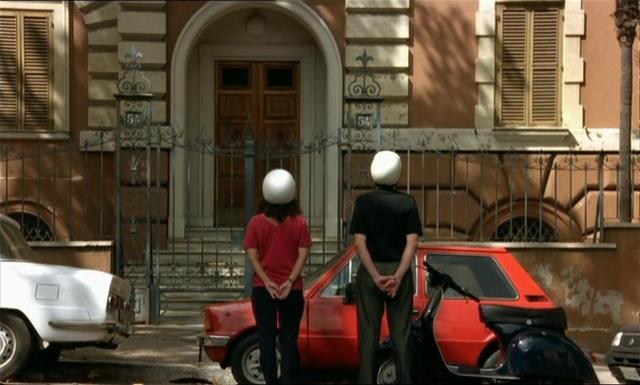
You remember the movie’s long, languorous opening chapter, just narrator, host and tour-guide Moretti “On My Vespa,” scootering from one Roman neighborhood to another, commenting on the stereotypes of each.

Bourgeois Casalpalocco is where one finds — or found 30 years ago when this film was made — German cars, new money and the blasphemy of “pizzas in cardboard boxes,” the mocked, characterless and (back then) poorer Spinaceto, where Moretti spends just long enough to agree with a guy he sees leaning against a crumbling industrial wall, “It’s not so bad,” Olympic Village (1960), Garbatella (1927), Montverde — each has its charms and its stereotypes.

The then-40 year-old Moretti riffs on the state of cinema, how the movie theaters in Rome “are closed for the summer” except for porn, martial arts and homemade Italian melodramas.

He ducks into theaters, mutters at the screen (in Italian with English subtitles) and obsesses and despairs over the savage thriller, “Henry: Portrait of a Serial Killer. He reads a review of that one and ponders the critic who wrote it.

“I wonder if whoever wrote this has a moment of remorse just before going to sleep.”

He even runs into “Flashdance” star Jennifer Beals and “In the Soup” and “13 Moons” (starring Jennifer Beals) director Alexandre Rockwell, with Beals — in fluent Italian — trying to brush off the pushy beardo in the dorky scooter helmet and shades, and telling Rockwell (in English) that “I think this guy must be a foot maniac.”

This comic travelogue is like a “Manhattan” era Woody Allen starring in an Italian/Roman version of Richard Linklater’s “Slacker” — droll, scenic and adorable. Moretti — this is his only well-known film — is a delight at showing how delighted this exercise makes him feel, “dancing” on his Vespa as he wheels down stradas and boulevards, whimsically thinking what his voice-over commentary on Garbatella will be.

The rest of the movie? Maybe, if you saw it when it came out (1993 in Italy, 1994 in the US), you were struck by a series of ferry visits to the Italian islands of Alina, Lipari,  Alicudi, Panarea and the volcanic Stromboli.

That’s where his American soap opera-obsessed traveling companion insists Moretti quiz American tourists about what’s coming up (Italy used to get American TV shows and movies months later) on “The Bold and the Beautiful,” a shouted, language-barrier soap dissection that takes place on the lip of a volcano.

“Alicudi makes narcissists,” Moretti opines, because “everybody lives alone” and “everybody has just one child.” A montage of  Italian brattery, indulged toddlers taking over the family telephone, makes that point.

“A party in honor of ‘bad taste'” is dodged, a persistent village mayor insists that they’ll be able to work in the quiet of his island hamlet, when of course they won’t — the film will make one nostalgic for travel, and wonder when today’s grounded globetrotters will get around to ruining these places, all over again.

What you might have forgotten if this new “virtual premiere” (streaming on Film Movement) is not your first encounter with Moretti’s near-masterpiece, is what a dull, pedestrian third act it finishes with. “Doctors” the chapter is called, and its about the convoluted, second, third and fourth opinions of Italian medicine.

If you’re coming to “Caro Diario” for the first time, you may want to preserve its travelogue charms and whimsy and check out after one or two lame doctor visits/”I have this itch” gags, before the movie’s overall effect is spoiled.

3stars2

MPAA Rating: unrated

Cast: Nanni Moretti, Renato Carpentieri, Giovanna Bozzolo, Alexandre Rockwell and Jennifer Beals.

Credits: Written and directed by Nanni Moretti.  A Film Movement release.

Running time:  1:41
Posted in Reviews, previews, profiles and movie news | Comments Off on Classic Film Review: “Caro Diario” earns a “virtual” premiere, and a fresh look

Movie Preview: “Reel Redemption” examines faith based (Christian) films and their place in the culture

The rest of the title of this Faith TV production has “Rise of Christian cinema” in it, and while the timing may feel a little late (peaked a couple of years ago), this is a natural for a movie about movies documentary.

Lots of clips from Biblical films, past and present, illustrating the history — from stories from the Bible and biographies of saints to famous and everyday people of faith to the angry victimhood of the “God’s Not Dead” era.

Posted in Reviews, previews, profiles and movie news | Comments Off on Movie Preview: “Reel Redemption” examines faith based (Christian) films and their place in the culture

Movie Preview: Animated”STARDOG AND TURBOCAT” has the voices of Charlie D’Amelio, Luke Evans, Bill Nighy

No Pixar pics during the pandemic, no Sony or DreamWorks. No interest in SCOOB!” What do you think? Should I review this one? Love that Bill Nighy

Posted in Reviews, previews, profiles and movie news | Comments Off on Movie Preview: Animated”STARDOG AND TURBOCAT” has the voices of Charlie D’Amelio, Luke Evans, Bill Nighy

Documentary Review: The strange relationship that develops between “The Paint and the Thief” who robbed her

painter2

One day in 2015, two men went into Oslo’s Galleri Nobel and stole two large photorealistic paintings by Barbora Kysilkova, a lightly-regarded Czech emigre newly-settled in Norway.

There was surveillance footage of the crime, one guy in a hoodie, the other in a stocking cap, taking the rolled up paintings to a garbage can and spiriting them away.

They didn’t get away with it. The men were identified from the CCTV video and arrested. The paintings? Not recovered.

But in the courtroom, waiting for the trial to begin, Kysilkova screwed up her courage and went over to where defendant Karl Bertil-Nordland sat and asked him the two questions that were bugging the hell out of her.

“Why did you take those two paintings,” in other words, “Why me?”

“They are very beautiful.” Everybody’s a critic, and tattoos, drug history and arrest record be damned — “Bertil” knows what he likes.

“What happened to the paintings?”

“I can’t remember.

Kysilkova may or may not have planned what she was to say next, but “I’d love to make a portrait of you” is what comes out of her mouth.

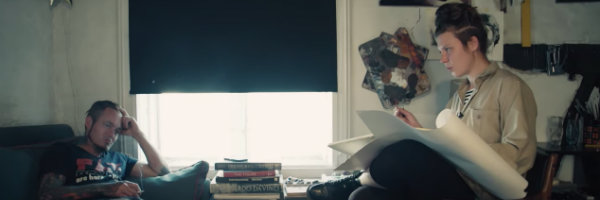
There is audio of this exchange which underscores drawings that illustrate the unofficial, unsanctioned courtroom meeting. Documentary filmmaker Benjamin Ree (“Magnus”) heard about this and thought  “There’s a movie in that.”

“The Painter and the Thief” is his unusual exploration of art, the artistic temperament, empathy and compassion, a film about the human willingness to “see” and need to “be seen.”

It’s the sort of film you’d never expect to see or expect to be made in the United States. As Ree captures their out-of-courtroom meeting in a coffeehouse, and then sits in as a shirtless Bertil poses, covered in ink (“Snitchers are a Dying Breed”) as Barbora sketches him as they chat, an American might rightly wonder, “Why isn’t he in jail?” The longer the film goes on, the more we wonder.

The painter and the thief are studied and interviewed separately, and together, by Ree. We see the relationship develop, get a hint of each person’s backstory — the haunted painter with a taste for the dark side, the more-articulate-than-he-seems drug addict and petty thief.

An accident interrupts the relationship, and as a DWI is involved, we see Bertil do more time for that than he apparently did for swiping two paintings.

Bertil wonders if this “paint-your-portrait” come-on is “a trick.” Barbora’s Norwegian boyfriend is put-out and wondering if this clingy, “I don’t remember” robber isn’t more destructive to her than she realizes.

“She sees me very well,” Bertil admits (in English, and Norwegian with English subtitles). “But she forgets, I can see her, too.”

But our cynicism about this odd, overly-tolerant and weirdly compassionate pairing, and what having a camera in the room does to alter the dynamic, is given its own test when she reveals the portrait to Beril. He is shaken and moved to tears.

painter1

Things turn even more complicated as the film progresses, with the viewer never quite sure if Bertil is lying, if he sold her paintings and spent the cash on a drug binge. But Barbora is not the naive model of empathy she seems, either.

Bertil’s many injuries from his near-fatal car accident are reduced to body parts, in her field of vision.

“You have big nail holes, from the ROMANS!” She has simply GOT to paint the “stigmata” on his hands.

The film’s muted, Scandinavian tone means there won’t be any explosions. We just see the odd testy protest that she’s avoided asking him directly “What did you do with my paintings?” when he complains that she’s pestering him. And we hear the futile pleading of her “boyfriend” in front of a couples counselor about this “destructive” and “dangerous” thing she’s allowed herself to become entangled with.

What we’re left with is a fascinating glimpse of the myopic mania for “inspiration” of the artist, and a look at a culture where compassion and restitution (apparently) carry more weight than “punishment’ for the thief.

3stars2


MPAA Rating: unrated, profanity.

Cast: Karl Bertil-Nordland, Barbora Kysilkova

Credits: Directed by Benjamin Ree. A Neon release.

Running time: 1:44

Posted in Reviews, previews, profiles and movie news | Comments Off on Documentary Review: The strange relationship that develops between “The Paint and the Thief” who robbed her

Movie Review: Hawkes, Lerman and Ireland shine in “End of Sentence”

Truth be told, “End of Sentence” doesn’t get you, straight out of the gate.

It’s downbeat, and the father-son rift acted out by Logan Lerman and John Hawkes feels contrived, more something dictated by the script and the near archetypes the two play.

But then this story of a sullen, just-out-of-prison son (Lerman, of Amazon’s “Hunters” and the tank movie “Fury”) who wants nothing to do with his doormat Dad (Hawkes of “Winter’s Bone” and “Three Billboards” and “Peanut Butter Falcon”) finds its way to Ireland. It’s where the husband promised to spread his cancer-stricken wife’s ashes when their boy got out of prison.

And even though that road picture/father-son “bonding” premise has a hint of the over-familiar about it, the movie lifts off, finds its heart and wit and transcends its potential.

It happens in a bar, after the quarreling father and son — each has issues, each blames the other for a BIG hidden hurt — have given a lift on their cross-Ireland trek to a bar pick-up (Sarah Bolger) the son has taken a fancy to.

There’s a band in the pub, as is sometimes the case in Ireland, ALWAYS the case in movies set there. And they launch into a song and Jewel joins in on The Pogues’ “Dirty Old Town.”

Clouds are drifting across the moon
Cats are prowling on their beat
Spring’s a girl from the streets at night
Dirty old town
Dirty old town

We’ve seen father Frank’s leeriness about giving her a ride, belligerent punk Sean’s insistence on it and Jewel’s sweet way of consoling a man who has lost his wife, who has started to doubt he’s even the father of this miscreant kid, who realizes that this whole trip is just another instance of somebody imposing what they want, their will, on him.

That moment puts an exclamation point on her kindness, lets her explain why she’s doing it — “You make a girl feel dignified” — and signals an abrupt turn for the better as the movie finally starts upending expectations and reveals its charms.

Producer (“What Maisie Knew”) turned director Elfar Adalsteins, working from a Michael Armbruster (“Beautiful Boy”) script, makes everything that the first act contrives to set up have some little payoff by the finale.

Maybe the opening bursts of hostility, where Sean refuses to let his father visit him in an Alabama prison — only his mother — his muttering to the guard who wonders “Who’s that?” about this man Sean won’t let pick him up at “End of Sentence” that Frank is “Nobody,” still seems extreme.

Maybe the bullying kid, testing and pushing around his old man, seems — in not justified, at least understandable.

A curious, unsettling Irish way in a Dublin bar that provides nothing but more doubts and few answers to Frank’s doubts, and a road trip that has the odd adventure and the occasional bittersweet connection to the late Anna’s past provide the build-up.

But it is Bolger, best-known for her work in the biker gang series “Mayans M.C.,” whose introduction may be sketchy and back-story a tad too pat, whose character raises the stakes and whose turn in a simple, formulaic scene gives “End of Sentence” the life it needs, just with a song.

stars2

MPAA: unrated, mild violence, profanity

Cast: Logan Lerman, John Hawkes and Sarah Bolger.

Credits: Directed by Elfar Adalsteins, script by Michael Armbruster. A Gravitas Ventures release.

Running time: 1:36

Posted in Reviews, previews, profiles and movie news | Comments Off on Movie Review: Hawkes, Lerman and Ireland shine in “End of Sentence”

Mark Duplass on colleague, friend and Mumblecore icon Lynn Shelton

Sweet Variety piece on director Lynn Shelton, getting close to her special contributions to indie cinema.

https://t.co/K42GGS1zci https://t.co/llvNZjsYLj https://twitter.com/Variety_Film/status/1263112382462611457?s=20

Posted in Reviews, previews, profiles and movie news | Comments Off on Mark Duplass on colleague, friend and Mumblecore icon Lynn Shelton

Movie Preview: Nikolaj Coster-Waldau checks into a Hotel for Suicides, “Exit Plan”

You probably wrote their ad campaign, just based on the headline.

“You check, but you never check out.” Very “Hotel California,” in Europe. Without the “f—–g Eagles, man.”

A June 12 release.

Posted in Reviews, previews, profiles and movie news | Comments Off on Movie Preview: Nikolaj Coster-Waldau checks into a Hotel for Suicides, “Exit Plan”

Preview:”Space Force” final Trailer

Netflix puts Steve Carell in charge of “Space Force ” Seems so right.

Posted in Reviews, previews, profiles and movie news | Comments Off on Preview:”Space Force” final Trailer

Documentary Review: A comic and her peers talk about the “Funny Pains” that make memorable stand-up

About six minutes into “Funny Pain,” a stand-ups-talk-about-stand-up documentary focused on Wendi Starling, I thought — “Wait, did she die? Is that what this is, a tribute?”

The Jorgy Cruz film is slap-dash, and seems locked in on Wendi’s life and work in 2015. She rushes her words, frantic, almost exhausting to listen to off-stage. Another sad clue?

And if you know anything about her, what she’s famous for, it’s the “manic, mentally-ill and in a mental hospital” material, riffed from real life, or it’s the “gang rape story.” So thinking she passed away isn’t mean or completely out of left field. Lot of tragedy in the news. Might have slipped by me.

Hearing her breathlessly patter on about “the first time i was hospitalized” and the “I’m so tired” mantra of people who burn the candle at both ends, then listing what she did the last 36 or 48 hours, mention her “black out” drinking and how cocaine used to be a part of her life and her act, then launch into some semi-vicious hatred for the audience (a stand-up ethos) and acknowledging her bipolar tendencies with what her teachers and parents USED to think — “I just get hyper, sometimes” — you think, “messed up.”

How can anybody be that wired and survive? Perhaps exhaustion got her, or worse. She’s had a few series shown in places, well I couldn’t tell you where they aired. “High Land Parking?” “Recycled Babies?” She’d have to be close to 40 now, right? A lot of comics have psychic damage and this insane drive and some don’t get out of there alive if they fall short of their “make it by 35” dreams.

Then the film shows Starling riffing on suicide, onstage and off, and how using that word impacts your involuntary hospitalization and you figure “Yeah, that’s it. This is going to be like a Bill Hicks thing.”

You check Wikipedia for an obit, and hell, she has no page. Sad.

But no, the morbid thoughts just come from the way she comes off in “Funny Pains.” We see her manic and we see her when she’s down. VERY down.

It’s a relief when the film’s last few minutes catch up with her in 2019, co-hosting a sort of sketch comedy dual act, hitting all the podcasts, writing and co-writing, working hard to never use that dated Every Comedian’s Dream cliche — “I just want to get a pilot.”

Still, Starling does kind of recede into the background of her own “film,” which fills a lot of screen time with the thing everybody from Woody Allen to Seinfeld has taught us that comics live for, the group BS session after a show, in a friend’s living room (Shabby chic and IKEA?) or in an empty New York Comedy Club.

With Nikki Glazer and Rick Vos and Yamaneika Saunders and Mehran Khaghani and Krystyna Hutchinson around, even if one or two of them say, with Starling present, how “real” she is and how “brave it is to do a bit” like her more-chilling-than-funny “rape story,” she gets a lost in the mix.

As some of these sessions have people speaking off-mike, and the film’s organizing principle is feeble and we get the idea that the “2019” material was an afterthought, we come back to “slapdash.”

So my apologies to the artist for thinking she was dead. But entrusting your image to director Jorgy Cruz? Maybe not the safest bet.

The biographical stuff, slipping in here and there, has some interesting anecdotes. There are hints of an unconventional childhood, mother abandonment, then lying her way onto a stage in Boca Raton for the first time (by accident) where she used the little she learned watching “Seinfeld” to good enough effect (recreated in a murky blur) that she realized this was where she belonged.

The analysis of when to trot out “sure thing” openers, how to read the room by the degrees of enthusiasm that “sure thing” generates, when an audience is so touristy (maybe not even native English speakers) that this is when you “try out new bits,” new jokes, because “Who cares about them?” at this point, are all interesting and astute takes on the craft of stand-up.

We hear about her “two day jobs” but never what they are. We don’t see enough of her working to get the sense of how she generates material, but she recognized early on that “When I’m talking about super-real stuff, it works.” Hearing her generic New York vs. LA banalities is enough to make you hope something “real” is coming up soon.

She’s self-aware enough to realize she can’t let the “rape story,” the “mental illness” stuff, her acknowledgement of her “black out drunk” years (We even see her giggling drunk, at one point.) become “gimmicky.” What else ya got?

The film is so all over the place that the comedy seems that way, too. “Funny” gets at her various “issues,” but doesn’t have enough good, solid comedy to make us care.

And since she’s already confessed that “I don’t like crowd work (questioning the audience for bits) “because I don’t give a s— about you guys,” we’re starved for some reason NOT to return the favor.

1half-star

Cast: Wendi Starling, Nikki Glaser, Krystyna Hutchinson, Yamaneika Saunders , Jim Norton, Bonnie McFarlane

Credits: Directed by Jorgy Cruz. A Passion River release.

Running time: 1:30

Posted in Reviews, previews, profiles and movie news | Comments Off on Documentary Review: A comic and her peers talk about the “Funny Pains” that make memorable stand-up

Movie Review — “American Trial: The Eric Garner Story”

trial3

“American Trial: The Eric Garner Story” is a righteous cause supported by a very bad idea, but a bad idea (a docu-drama) executed about as well as could be expected.

The “cause” is getting us to take another look at a 2014 case, an unarmed, overweight black man tackled, arrested and put in a choke hold by cops intent on arresting someone for selling loose cigarettes on a Staten Island street corner.

It was, as lawyer, legal scholar and Fox News talking head Alan Dershowitz says, an “alleged offense so trivial” as to beggar belief, with consequences — Garner died from injuries suffered during that illegal (NYPD banned “choke hold”) — that could not have been more dire.

A Staten Island grand jury elected not to recommend prosecution of NYPD officer Daniel Pantaleo, the man who applied the chokehold, and has never released the transcripts of the evidence seen and heard and their deliberations.

If you’ve seen the video of the arrest, four officers surrounding the gigantic, protesting Garner, nobody once saying “I’m gonna have to write you a ticket,” taking the man to the ground to the shouts of “I didn’t do NOTHING, no no no NO NO I can’t breathe, I can’t BREATHE,” a phrase he gasps out eleven times, you can’t ever forget it.

“Excessive force,” you think, at the very least. “I just saw a man murdered” might be a reasonable conclusion, too.

The case, one of a distressingly large number of such cases (continuing to this day) of armed cops killing unarmed civilians, became a national flashpoint. “I can’t breathe” T-shirts made it all the way to the NBA.

Anything that brings attention back to this seeming injustice is justified, right?

But filmmaker Roee Messinger elected to do it via a movie, a “What if there’d been a trial?” take on the case. This is the “very bad idea.” Messinger decided to make a docu-drama, not a documentary.

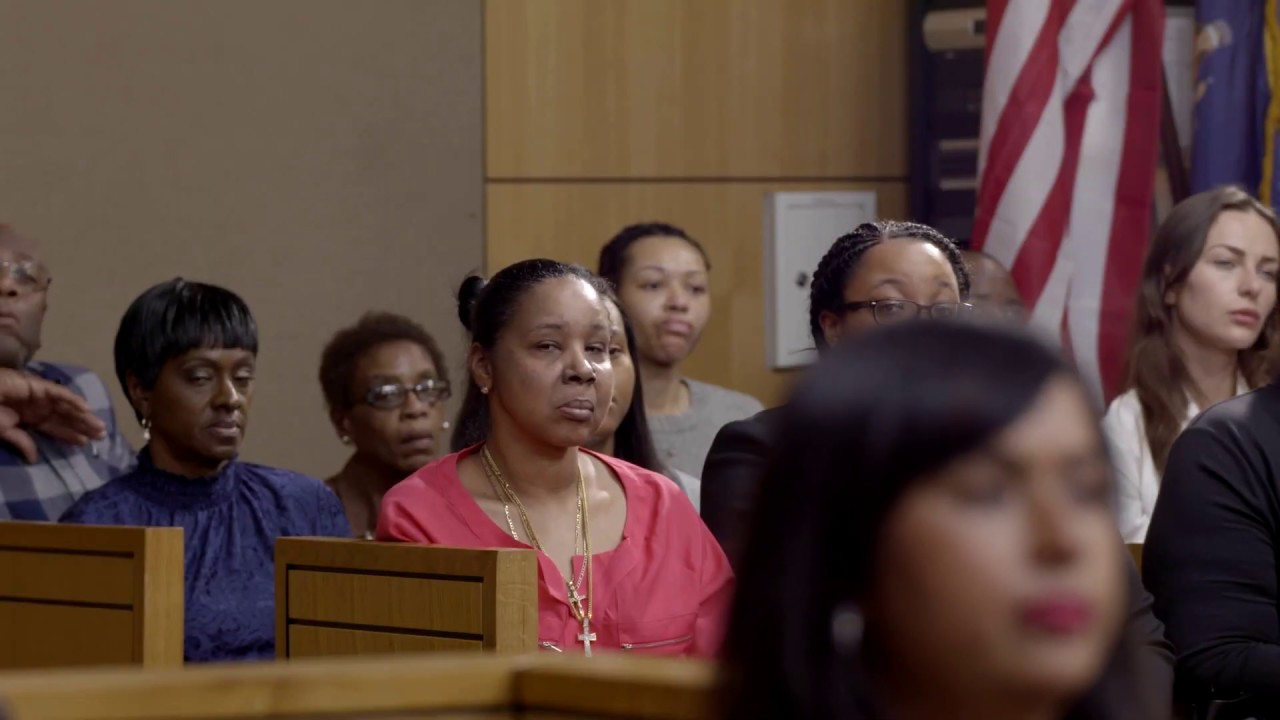
Using the known evidence, attorneys hired to prosecute and defend the case, a lawyer hired to play a judge, real witnesses — Garner’s widow, Esaw, a friend, retired NYPD officers and medical examiners speaking on behalf of the defense and the prosecution, and an actor hired to be Pantaleo (Anthony Altieri) — inventing pre-“trial” interviews and a rented courtroom, Messinger runs a mock trial.

And while that can be a most instructive exercise for training law students, it makes for generally dull and a disastrously deceptive “what might have been” made in pursuit of “justice.”

Blending in actual news coverage of the trial, footage of LeBron James and teammates in Garner “I CAN’T BREATHE” jerseys, then-President Obama speaking out, TV talking heads talking up the subject, just amplifies the crime against objective truth.

If you don’t remember who said what (Republican Rep. Peter King is here), how do we know what was really said, and what’s imagined for the cameras? An opening “nothing was scripted” here explanation doesn’t cover it.

What can we believe?

Compounding the film’s problems is the fact that most of it consists of this mock trial. Legal junkies obsess over big cases — Casey Anthony and George Zimmerman here in my (Florida) neck of the woods, for instance. But like most court cases, this is visually and dramatically dry and dull, with factually defensible testimony and spurious “objections,” cursory opening remarks and perfectly logical and believable closing statements.

You’re here to try decide the guilt or innocence of “Danny,” the actress/lawyer playing the defense attorney intones, “NOT here to decide ‘Black Lives Matter.’ They do.” She quotes Martin Luther King Jr. and Gandhi, too.

I could totally see and hear that happening. But it didn’t. It hasn’t. And “American Trial” seems a blundering attempt to change that fact.

Movies have turned a spotlight on injustices before, and some — the various documentaries on the West Memphis Three, Errol Morris’s “The Thin Blue Line” — have led to justice being done. Such films often include recreations of the crimes being discussed.

But here’s a tip somebody should have passed on to filmmaker Messinger before he rounded up the GoFundMe cash to make “The Eric Garner Story,” which really isn’t” The Eric Garner Story,” by the way.

You want to move the legal system, you stick with the facts and the compelling tragedy and grave injustice those facts support.

Nobody EVER got a new trial, a re-hearing in the bright light of public opinion, via a docu-drama.

1half-star

MPAA Rating: unrated, disturbingly violent video

Cast: Esaw Garner, Alan Dershowitz, Anthony Altieri

Credits: Directed by Roee Messinger. A Passion River release.

Running time: 1:40

Posted in Reviews, previews, profiles and movie news | Comments Off on Movie Review — “American Trial: The Eric Garner Story”