
They have a little girl
Daddy did something he got away with. And the house Knows…
They have a little girl
Daddy did something he got away with. And the house Knows…
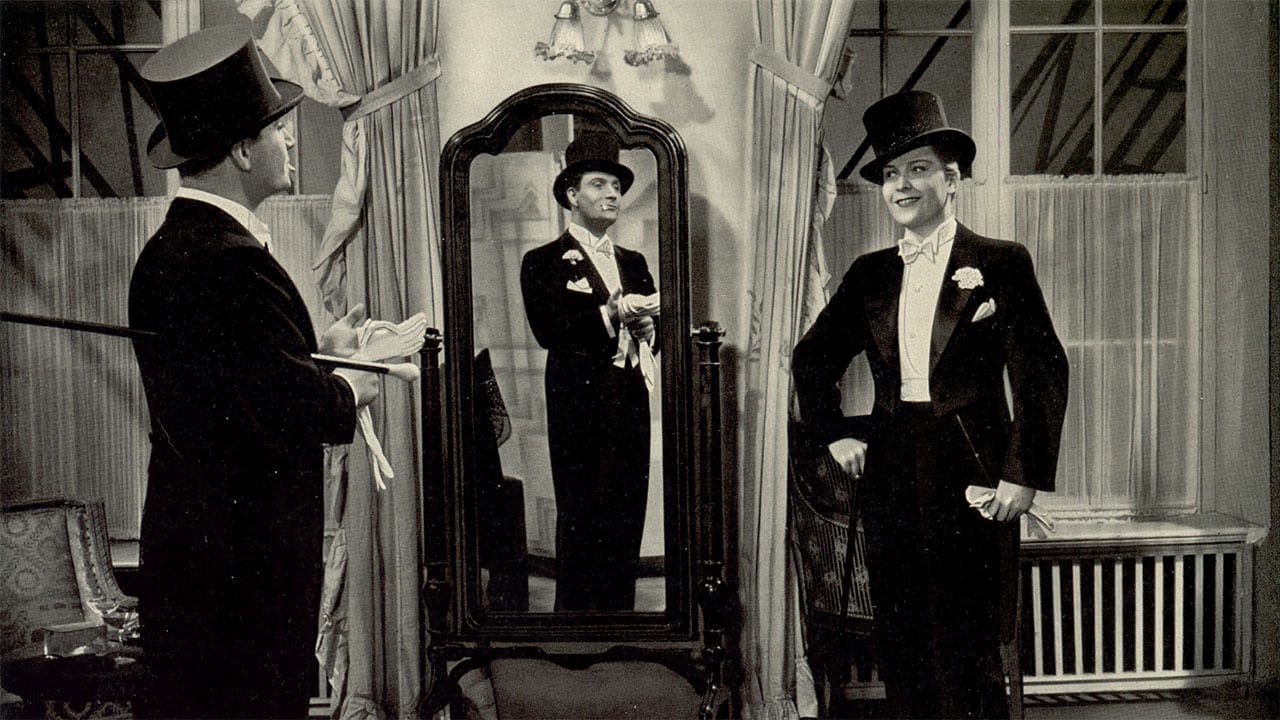
The 1982 Blake Edwards farce “Victor/Victoria” was a landmark in the mainstream cinema’s treatment of gay subject matter on the big screen, and a giddy, Oscar-winning blockbuster to boot.
Not remotely as daring as the French “La Cage aux Folles” (1978), it still did something no Hollywood film had managed to do before — draw millions of Americans into a movie where “gay” wasn’t a crime, a punchline or a mental illness.
So why not have a Pride Month revisit of that film’s 1930s antecedent, the “daring” 1933 German musical “Viktor und Viktoria,” a last blast of cross-dressing whimsy to escape Weimar Germany as the Nazis came to power?
“Viktor und Viktoria” doesn’t have the overt sexuality of the Hollywood film that came 50 years later. The words “gay” and “homosexual” are never used, no overtly gay character is so-identified. So there’s little of that dishy, swishy hilarity that the legendary Robert Preston brought to the Julie Andrews/James Garner film.
The music is different. Franz Doelle and Bruno Balz were replaced by Henry Mancini and Leslie Bricusse.
But “Viktor” is a giddy delight in its own right, with bouncy tunes including a Spanish number that later became “The Shady Dame from Seville” in Hollywood, as well as sight gags and slapstick reminiscent of the just-vanquished silent film era and delightful star turns by the leads.
It’s a landmark of Queer Cinema partly by reputation, but mainly because of its remakes. This 1933 film was remade in French in 1934 (“Georges et Georgette”) and English (“First a Girl”) in 1935.
Fifty years later, the world was “ready” for the definitive remake.
A young, down-on-her-luck light opera coloratura (Renate Müller) can’t land a job with her pleasant but thin voice. And a seriously hammy actor (Hermann Thimig) is having the same trouble, only he lies to keep up appearances.
The lie is exposed when Susanne and Viktor re-meet at the Automat (cheap self-serve lunch counters, the rage in the 1930s). And then she spies one of his publicity photos. It isn’t just Hamlet and William Tell that Viktor insists he’s famous for. He can camp it up in a dress, when the need arises.
In this streamlined comedy, we don’t see the “Eureka” moment and aren’t treated to the coaching and “makeover” that turns Susanne into “Viktor…IA.” The two just show up at the vaudeville theater, dodge prying eyes as she/he changes into costume.
And then, the grand debut, a clumsy, forgets-her-lines vamp through this moon-eyed song about going back to Spain, finding love in Madrid, and tumbling into the orchestra pit as she does.
Director Reinhold Schünzel turns this scene into a knock-about riot, with the campy Viktor sitting with the orchestra, coaching Susanne/Viktoria on the stage, grabbing and taking over instrument after instrument and conducting, getting the music up to the tempo that works for this number and this act.
After all, it’s HIS number and HIS act that she’s performing.
One hint of multi-octave showing-off and one Big Reveal (the wig comes off) later, Viktoria is a star, a sensation signed to tour “Romania, Turkey, Italy, England” all the “Berlitz” (language school) countries.
On the British stop on the tour, she does her number in English. But that’s when she falls in with German expats, including ladykiller Robert (Anton Walbrook of “49th Parallel” and “The Red Shoes”). Can she keep her secret, even as she’s falling in love?
Can Robert believe he’s smitten with a very pretty “young man?”
The script it basically an operetta, lines and lines of dialogue (not all of it) are sung, exposition delivered in recitative, sung “live” on set — “I can sing, I can laugh, I can dance. I’m lacking much in finance.”
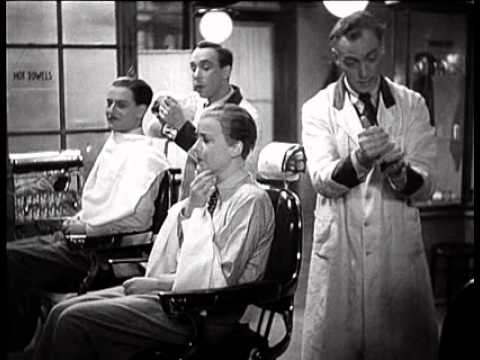
Müller and Walbrook are quite amusing in the “Let’s do things a couple of guys on the town do” scenes — smoking, drinking whiskey (Check out how Müller sidles onto a bar stool.), getting a shave at the barber’s and getting in a bar brawl at a waterfront dive.
The screenplay strips some of the sexual confusion Robert is feeling (much the way “Victor/Victoria” did) too early for this to really reach any sort of cutting edge treatment of sexuality.
Mastermind Viktor isn’t homosexual. He pines for another woman on the tour, who lusts after Viktor–IA.
But all the women ogling the quite-feminine Viktor–IA in the bar (inspiring the riot), the gender embarrassment the act creates in the audience, get the message across. This isn’t “Cabaret,” but for a lark of a cross-dressing musical, it’s an eye opener.
And go to the biographical links of the star and her director to learn the costs of questioning gender roles and mores and speaking out through the arts in a fascist regime.
The restored “Viktor und Viktoria” returns, via virtual cinema (visit your local arthouse cinema website) for Pride Month. If you liked the Julie Andrews version, you’ll get a kick out of this.

MPAA Rating: unrated
Cast: Renate Müller, Hermann Thimig, Hilde Hildebrand, Friedel Pisetta and Anton Walbrook
Credits: Written and directed by Reinhold Schünzel, music by Franz Doelle, lyrics by Bruno Balz. A Kino Classics “virtual cinema” re-release.
Running time: 1:39
Grant Judd Apatow this.
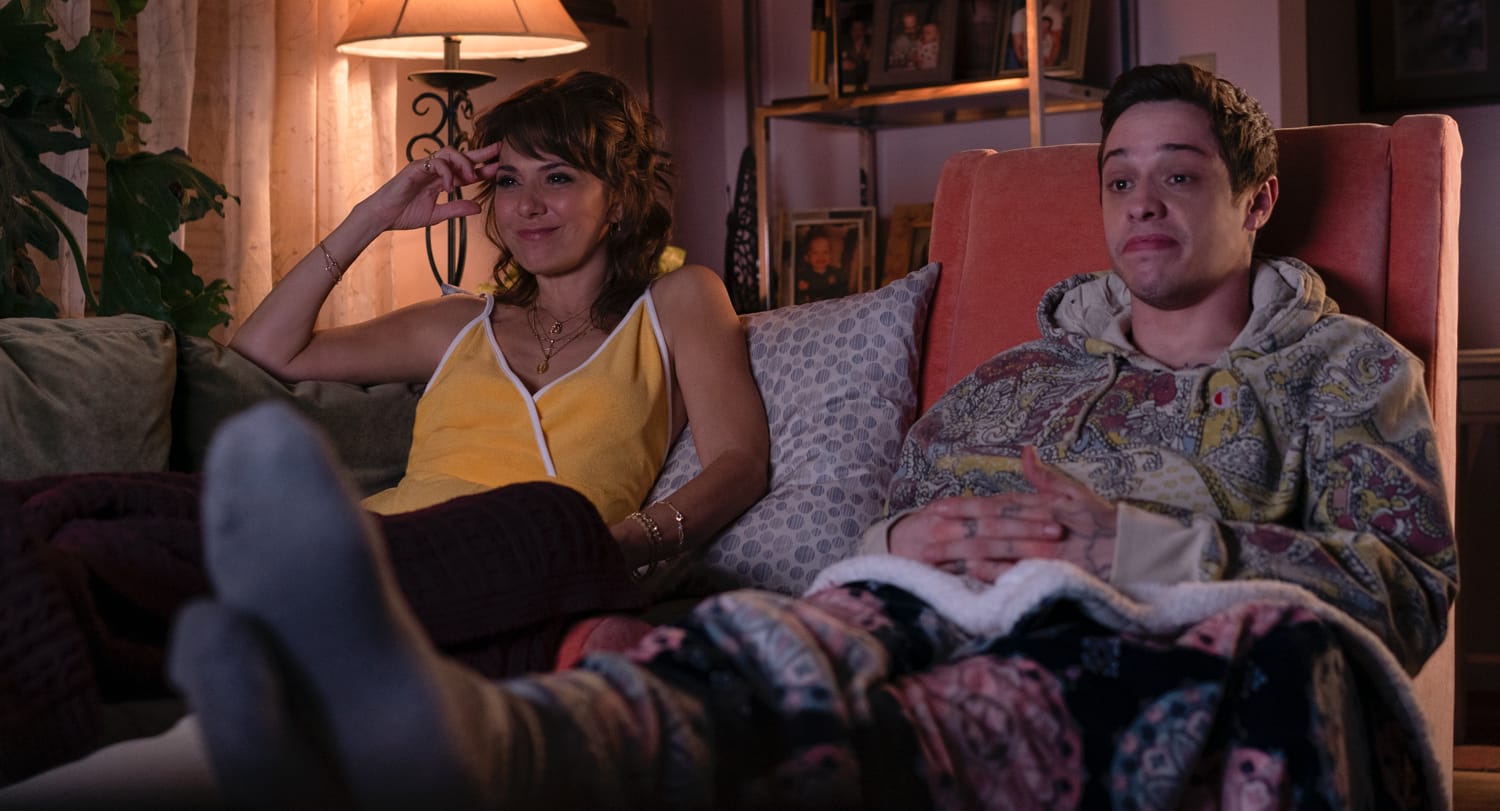
Pete Davidson, perhaps the quintessence of “comic as acquired taste” as a member of the cast of “Saturday Night Live,” grows on you during “The King of Staten Island.” By the third act of this highly fictionalized riff on Davidson’s life story, the son of a New York firefighter killed on 9/11, you understand something of what it’s like to grow up carrying the weight of a martyred hero on your shoulders.
Whether that’s enough to alter one’s overall impression of “King” comes down to your tolerance of Apatow’s inability to edit, to kill his (limp) “little darlings,” scenes that don’t add laughs, drive the story or greatly deepen our understanding of the hero’s journey. And Davidson’s inability to carry a comic or serio-comic feature film, proven in the slightly-funnier if less consequential “Big Time Adolescence,” figures in the equation, too.
We’re some 100 minutes into the picture before the grating, gauche Davidson — and his character, Scott Carlin — achieves “Well, we should cut the kid a break” status. Apatow pictures always run long, but here the thin laughs make us reach “All RIGHT already” far too soon.
Scott is well into his 20s, unemployed and almost unemployable, still living with his widowed Mom (Marisa Tomei) and sister (Maude Apatow), who is about to graduate and head off to college and frets over her morose big brother.
“Be nice to MOM!”
Scott has a cannabis crew (Moises Arias, Lou Wilson, Ricky Velez), here primarily to illustrate Scott’s aimlessness, and serve as punch lines for his insults — “Look, ‘Fat Kanye,’ shut your pie hole!” — and as sounding board for Scott’s BIG IDEA.
“Ruby TatTOOSdays!” Get a tattoo while you eat?
First, aspiring artist Scott has to develop tattoo skills. He practices on his friends. And then he’ll need backers but well, it’s not likely he’ll ever clear that first hurdle.
He has a sometime sex partner/might-be “girlfriend” (Bel Powley), but it’s hard to have a relationship when you’re depressed, with Crohn’s Disease and ADD so severe that he has almost zero impulse control.
That’s how he decides to tattoo a random child he and his pals run into one afternoon. That’s how the kid’s raging dad, Ray (Bill Burr, who steals the movie) meets his mother — chewing her out because “You didn’t even RAISE him.”
But when Ray finds out who the kid’s father was, he softens. When he cools off, he realizes this is a pretty widow he’s bawling out. Dating begins, and maladjusted Scott has one more thing he cannot cope with on his “Things to not get over” plate. Ray is also a firefighter.


No, the movie doesn’t take necessarily take the predictable turns you expect from here on out. More credit to Apatow. But when you’re throwing in scenes from a part-time restaurant job for Scott (which exist to set up a single funny bit), firefighters bonding moments, the on-and-off “girlfriend” thing, Mom’s pursuit of happiness and Scott’s desire for destruction — his and others’ — a little of what your throw against the wall just might stick.
Burr does. The talented Powley almost does. Tomei doesn’t embarrass herself.
The jokes are of the miss-miss-or-hit variety, like explaining the symptoms of Crohn’s Disease in scatological and gross detail.
“Hey, I’m just trying to spread awareness.”
Scott’s self-deprecation at every point — “I’m just stupid…I’m just an a–hole.” — doesn’t make him endearing, just self-aware.
But they’d all have to turn in their union cards if they couldn’t get some sentimental, lump-in-the-throat moments over a dead 9/11 firefighter. A streamlined script that got rid of a some of the random and zeroed in on that (Steve Buscemi plays a fellow firefighter) would have helped.
As it is, the best thing to happen to “King of Staten Island” was the high-profile digital release COVID 19 gave it. Davidson’s fans will find it, and Apatow devotees. But let’s just say Davidson’s renewed threats to quit SNL (“Nobody there likes me.”) stopped at around the time he saw a final version of his latest movie star vehicle.

MPAA Rating: R for language and drug use throughout, sexual content and some violence/bloody images
Cast: Pete Davidson, Marisa Tomei, Bel Powley, Bill Burr, Steve Buscemi.
Credits: Directed by Judd Apatow, script by Judd Apatow, Pete Davidson and Dave Sirus. A Universal release.
Running time: 2:16


The Polish word for “consent” is “zgoda.” In Italian, it’s “consenso.”
But mere translations don’t do justice to the chasm that separates them in meaning from how that word is used in “woke” North America. Not if the Polish film with an Italian setting “365 Days (365 Dni)” is any measure.
This is a laughable “Fifty Shades of Grey” kidnapping porn mafia picture — softcore, of course — about a hunky Sicilian mob boss (Michele Morrone) who spies a beautiful tourist on the day his father is assassinated. He recovers from the shock (and the bullet that passed through Daddy and his him) to pursue her, drug her and take her prisoner five years later.
When Polish hotel marketer Laura (Anna Maria Sieklucka) wakes up, she’s been taken from her brutish, inattentive boyfriend and dropped in a world of extravagant wealth, crime and cruelty. And it’s all happened on her birthday.
So, Massimo. You have some explaining to do!
“When your entire life is based on taking everything with force,” he purrs (in English, although Italian and Polish also pops up), “it’s hard to react in a different way.”
He’s going to take her liberty away for one year, one year “for you to fall in love with me.” He’s going to take her shopping — a lot. She will “take part in an adventure that fate has given you.”
Laura is all “I’m not your PROPERTY!” She sees the SOB commit murder. And we’ve already seen him force himself on the stewardess on his private jet.
Black on black wardrobe, smoldering good looks and Italian perma-stubble aside, this Massimo is a beast.
“I won’t do anything without your permission,” he insists. “I lose my vigilance when I’m around you,” he whines.”
“Don’t PROVOKE me,” he repeats, again and again — as they’re showering together, nude sunbathing, and he’s showing off his Christian Grey bondage bed and calling in a hooker to “show you what you’re missing.”
It’s a good thing “LOL” means the same thing in Polish and Italian.

“365 Days” is slick, shiny and insanely silly softcore, with a situation that beggars belief at most every turn. Laura’s protestations are weak, her attempts at escaping half-hearted.
But all this affluence and induglence and this seriously-cut Sicilian with his “Want to TOUCH it?” come-ons? Irresistible. Apparently.
The direction is competent, but no kudos are owed the co-directors as they’re also responsible for the godawful script.
Here’s a “romance” that sets women back 50 years and makes anybody (like me) take back every ugly thing we wrote about Dakota Johnson and that guy whose name I’ve already forgotten and those awful “Fifty Shades” movies.
Good looking people acting badly while playing reprehensible characters? That’s 365 shades of “gówno,” as they say in the Old Country.

MPAA Rating: TV-MA, drug abuse, explicit sex, profanity
Cast: Michele Morrone, Anna Maria Sieklucka, Bronislaw Wroclawski
Credits: Written and directed by Barbara Bialowas, Tomasz Mandes, based on a novel by Blanka Lipinska. A Netflix release.
Running time: 1:53

The Japanese broadcaster NHK has a spot on many US cable systems, and on PBS affiliates’ HD alternate programming channels.
This documentary series is now mixed in with the news, music and travel programming that it carries.
Exquisite detail, fascinating agony that he and his team go through to make these hand drawn anime films.


A pervy lump of a landscaper gets his revenge by putting on the tights and lacing up the boots in “Wrestlemassacre,” a splatter film perfectly summed up by its title.
It’s an amateurish abomination of a splatter thriller thrown together by a filmmaker with access to a bunch of wrestlers, current or retired, and clumsily filmed somewhere in Pennsylvania, by the looks of things.
Not that any town’s putting up billboards advertising that fact.
The plot? Randy Sanchez (Richie Acevedo) is a put-upon loser who pines for Becky (Rosanna Nelson), who is dating one of his employers, deadbeat Owen (Julio Bana Fernandez).
Randy’s caught ogling somebody’s circus-grotesque girlfriend, put on leave from work, picked on by one and all and humiliated at the wrestling camp run by the aged Boogie (Jimmy Valiant). His retired-wrestler Dad (Josip Peruzovic) berates him as “an idiot.”
And as we’ve seen he talks to himself, and hears voices from a preacher on the TV, we know what’s coming.
He goes from being “the only undocumented Mexican groundskeeper in the state” (“But I’m CUBAN!”) to neck-snapping, finger-biting-off, arm-ripping avenger.
Gore-fans are made to endure an hour of “back story” to get to the geysers of fake blood. Well, aside from the obligatory chase a naked woman and her beau through the forest in the opening scene.
We’re treated to cross-dressing fake TV commercials, where performers can’t figure out their sight-lines and the edits don’t match, to a preacher who blows the pronunciation of “evangelical” to wrestling and fights that look awful, and acting acting that is far, far worse.
“Are you SERIOUS?”
“Serious as a rectal prolapse!”
The one plot element here that has a tiny bit of promise is the wrestling camp, and that was touched on by “Peanut Butter Falcon.” Google “wrestling camp” and you’ll see they’re all over the place, especially the rural South.
The one gimmick Brad Twig had going for him was rounding up all these colorful also-rans from the world of the ring — generations of them.
It’s a crying shame this is the movie he came up to use them in.

Cast: Richie Acevedo, Julio Bana Fernandez, Jimmy Valiant, Tony Atlas, Jimmy Flame, Manny Fernandez, Josip Peruzovic and Rosanna Nelson
Credits: Directed by Brad Twig, script by Matthew L. Furman and Brad Twig. A Wild Eye release.
Running time: 1:41
Paging all “Redskins,” “Braves” and “Indians” fans…

COVID numbers are spiking in states like Texas, Florida Michigan and NC and others.
But theater owners expect everybody to open by July 17 just to cash in on Christopher Nolan’s “Tenet.” Unless Warner Brothers blinks.
https://www.indiewire.com/2020/06/tenet-july-17-theaters-open-1202235450/

Its notoriety may be more historical than erotic, almost ninety years after its release. But the German drama “Madchen in Uniform (Girls in Uniform)” retains its subtle power to move, a dated but still impressive landmark in queer cinema history.
The sexuality is implied, the repression overt, the style may not be stodgy or stagey but is plainly dated. Yet that one big speech suggesting that what the world long knew as “The Love That Dare Not Speak Its Name” wasn’t the abomination religions had long decried it to be still packs a punch.
Set in a German girls boarding school just before World War I, it chastely relates the sexual awakening of an orphaned teen of the ruling Junkers class. And the woman who unintentionally drives that awakening? The teacher all the girls have a crush on.
The headmistress (Emilia Unda) preaches “Discipline, not a life of luxury” (in German with English subtitles) to her staff and her large student body. “Hunger and discipline will make us great again!”
She’s a dictator, and with her martinet assistant, presides over a school of lectures in the classics, languages, drama and the Bible, of hymns and privation and rules.
“No letters without prior approval…Hair must be tight.” Uniforms, with aprons must be worn at all times.
And “Books are verboten!”
Sad-eyed Manuela (Hertha Thiele) takes all this in. But her classmates mock the authoritarians behind their backs. Ringleader Isle (Ellen Schwanneke) gives Manuela the real skinny. You’re in Miss von Bernburg’s dorm? Lucky thing!
“Just don’t fall in love” with her. ALL the girls do.
Every longing gaze from the kind, softly-lit von Bernburg (Dorothea Wieck) provokes silent sighs. But that kiss on the forehead good night?
“Wunderbar!”
And no matter how many warnings the headmistress lays on her staff, to “keep your distance” and how fraternizing “leads to infatuation,” Miss von Bernburg won’t be hard on her kids. She’s not listening to the rhetoric.
“The Fatherland needs people of steel!”

As daring as “Madchen” (and its 1958 Franco-German remake) are supposed to be, there’s not so much as a lip bitten in unspoken desire. But the signals are all here — girl-bonding in the locker-room, a motherly swat on the bottom that registers more delight than surprise, moon-eyed close-ups.
OK, that touch by director Leontine Sagan (“Showtime”) is obvious.
Tame as it now seems, “Madchen,” restored and re-issued via virtual cinema streaming (check your local art cinema’s website) is still a movie of prescience, poetry and honesty, essential viewing for anybody interested in the cinema as bellwether of change and indicator of the cultural cutting edge.

MPAA Rating: unrated
Cast: Hertha Thiele, Dorothea Wieck, Ellen Schwanneke and Emilia Unda.
Credits: Directed by Leontine Sagan , script by Christa Winsloe and Friedrich Dammann, based on the play by Christa Winsloe. A Kino Classics/Virtual Cinema release.
Running time: 1:30

 Movie Nation