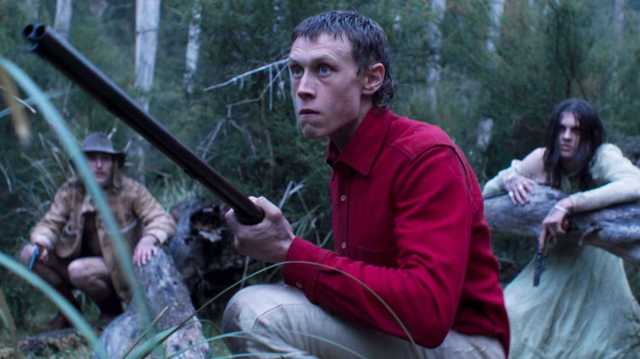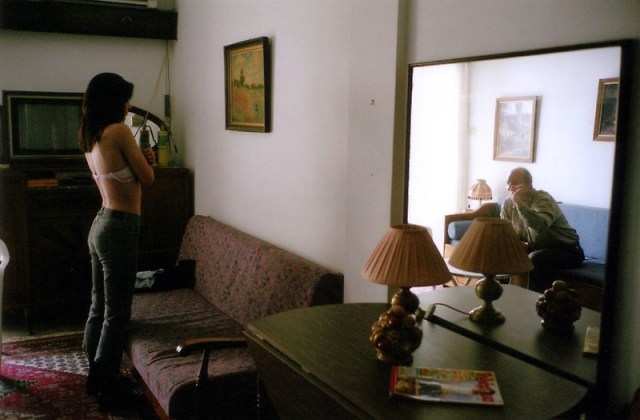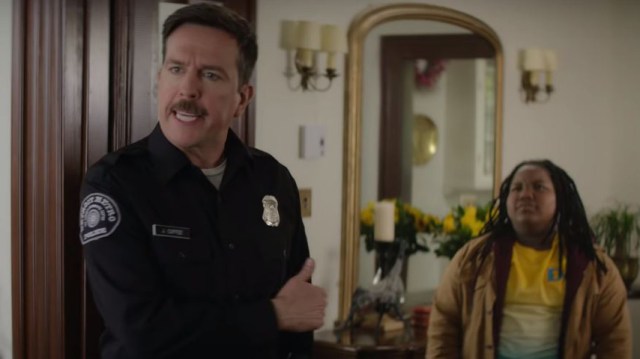
Thriller from IFC due out Sept. 18. Looks creepy enough to get the job done.

“Straight Up” is the quippiest, most quotable romantic comedy of the year.
There’s no arguing over that. The proof is in the patter, all of it played at “on the spectrum” speed.
“You’re the nicest person.” “I’m not. I always lie to homeless people. I always have chance. I just don’t give it to them.”
“I thought I saw Amy Adams at Trader Joe’s. But it was only Isla Fisher.”
“I feel like Sandra Bullock in ‘The Blind Side’ — making dreams come true!”
“What if this is like that movie, ‘As Good as It Gets?'” “What if ‘Something’s Got to Give,’ like that movie, ‘The Day After Tomorrow?”
Writer-director and star James Sweeney, in remaking a short film of his, attempts nothing less than a re-imagining of the “gay BFF” cliche for a non-binary age. And while I can’t say that he necessarily pulls that off, he’s made a sparkling romance where the connection is all about the cute, and compatibility.
Sweeney stars as Todd, a tech worker and “professional house sitter” living, lovelessly, in L.A. He’s in therapy. He speaks in those clipped, perfectly-formed but breathlessly-delivered phrases that the movies and “The Big Bang Theory” have conditioned us to accept as autistic-smart.
But being smart, squeamish about all sorts of things (most having to do with bodily fluids and functions), fastidious and speaking like that got him labeled, early on.
So he’s lived his life figuring he’s gay. Only, maybe not. He can’t seem to connect with any same-sex partners and finds the various sex acts required repellent. So maybe he’s not gay. His shrink (Tracie Thoms) isn’t sure, either.
“I’m not PAYING you to laugh at me.”
“Your PARENTS pay me!”
Todd is always tidying up stores, or reshelving library books. People ask him “Do you work here?” a lot. That’s how he meets Rory (Katie Findlay).
Their banter is informal, quick and simpatico in the extreme.
“One can like ‘Gilmore Girls’ and not be gay!”
He figures he needs to get that out there. But they’re Cary and Kate, Will & Grace together. Both of them feel it.
She’s an aspiring actress whose improv class, where she almost instantly and almost-always crosses a line, should be telling her to take up stand-up comedy instead. He’s happier house sitting (and “organizing” when he does) than whatever college trained him to do.
Rory and Todd click. They’re chatty, clever, adorable and — here’s the tricky part — aridly asexual together.
How can this work out? He’s confused, she’s slow on the uptake even if she isn’t “gay blind” the way “America was in the ’60s” or South Carolina is today.
His friends, the vain, ditzy and flirtatious model Meg (Dana Drori, hilarious) and the aggressively sexual and gay Ryder (James Scully) are ready to put them to the test.
His parents (Betsy Brandt and Randall Park) are eager to name the date. Well, she is. Dad? Casting Randall Park as Todd’s dad is so perfect that we’re invited to see his sexual identity role model right there in front of us, fey, funny and “confused,” which have long been Park’s screen specialty.
Throw in “racist” (a classic Park touch) and you’ve made your character a scene-stealer.
“Straight Up” wrestles with its messaging, which bogs the picture down. It takes a few predictable turns, and some predictably unpredictable ones. But Sweeney maintains the manic patter even when the pacing flags.
As a leading man, he’s playing more of a “type” than a character. Yes, this guy could have taken the lead on “The Big Bang Theory” had Jim Parsons auditioned out. Yes, this is like a “Will & Grace” reboot without the flaming or the bitching or the bitchy flaming.
Findlay has a “This year’s Mary Elizabeth Winstead” vibe about her — verbose, with a vocal fry, sexy more by default than demeanor.
Needless to say, everybody’s timing — leads and supporting players — has to be spot-on for “Straight Up” to come off. Which, for the most part, it does.
Findlay and Todd don’t necessarily sell us on what they’re selling here. But they’re so cute together we buy into them as a couple, sales resistance be damned.

MPAA Rating: unrated, sex scenes and sexual situations, profanity
Cast: James Sweeney, Kate Findlay, Dana Drori, James Scully, Betsy Brandt, and Tracie Thoms and Randall Park.
Credits: Written and directed by James Sweeney. A Strand release on Netflix.
Running time: 1:36

“The Incoherents,” a comedy about four pushing-50 white New Yorkers “getting the band back together,” has the perfect, dismissive put-down for Generation X.
Because if “OK, Boomer” is out there, why should the MTV Kids get off Scot-free?
A post-punk “alt rock” band trying to crash into a scene where 20something hipsters raised on whatever the hell “the kids are listening to these days” has got to be read to take its lumps, right? So the hipster lead to Sex in HD challenges the middle-aged men following his act on stage with the only insult that matters.
“Here we are now, entertain us.”
In an otherwise drab, light but not-quite-humorous misfire of a Midlife Crisis Comedy, the lone really good line stands out.
Bruce (Jeff Auer, who also wrote the script) is married, with a suburban split-level and the two kids that come with that, a paralegal whose amusingly tone-deaf boss (Robert G. McKay) and all the younger people on the staff think nothing of dumping all their work on him.
But in his dreams, he’s got David Coverdale hair, groupies — the works. Odd, because back in the ’90s, The Incoherents were more of a Soundgarden/Replacements that never made it. Big hair never figured into it.
Bruce’s midlife crisis needs an understanding wife (Kate Arrington), who’d like to re-enter the work force as a graphic designer. Bruce can’t see it, but myopia is one of the symptoms of “mid-life crisis.”
Drummer Tyler (Casey Clark) is losing his mind, playing for weddings in Hoboken (where much of this was shot, even though it’s set in New York). His brother, Keith (Walter Hoffman), the bassist, is comfortably miserable working in city planning and zoning. So “The Hamiltons” are back in.
But convincing guitarist Jimmy (Alex Emmanuel) is the hard part. He’s the one who wanted it the most, the one most hurt by lead-singer Bruce’s “plan B” bail-out over 20 years before. Jimmy has a bar, “just booze and music, the basics” he tells a caller who wants to book it for a reception. Music memorabilia covers the walls, including his guitars.
Will he take them down off that wall for “one last shot?”

Not enough is made of the quixotic nature of the bandmates’ quest, of the disconnect between their lives “now” and what they guys are trying to recapture.
Regaining their sound is effortless. Just a rehearsal or two (’80s movie fixture Annette O’Toole is the cackling cynic who rents rehearsal studios to suckers like The Incoherents) and they’re on stage, revisiting their “hits.”
O’Toole and McKay are cast members who make the most colorful impressions. The band members have a moment, here and there, but are generally colorless.
The tunes are serviceable, but too far-removed from their time to feel relevant and not far-enough removed to seem “fresh.”
“Big bellies of pigs…can neeevvveerrr be full” doesn’t have fan-following built into it.
And that’s kind of the point, that their type of music, and the “club dates/record deal/wide exposure/fame and riches” music model is gone. This discussion, a big part of the third act with their blunt, bluff, dinosaur of a manager (Vincent Palmberti) and a legendary promoter (Amy Carlson of TV’s “Blue Bloods”) having to explain music in the social media era to these Gen X fossils.
That’s more interesting than amusing. Bruce’s office life is more standard issue comedy fodder, but the jokes there are thin and that story under-developed, as is the family friction that this musical midlife crisis engenders.
It’s not awful, and not utterly “incoherent.” But the comedy isn’t broad enough to come off, and white male midlife wish-fulfillment fantasy (Jimmy’s pursued by a fetching Boston blogger/band-booker half his age) is seriously passé.
“The Incoherents,” as a “getting the band back together” comedy, was never going to amount to much more than an idle, not-unpleasant movie you sit through, but don’t really enjoy.
In movies, and in bands, you ignore the challenge inherent in a put-down at your own peril. “Here we are now, entertain us.”
![]()
MPAA Rating: unrated, sexual situations, alcohol, profanity
Cast: Jeff Auer, Kate Arrington, Alex Emmanuel, Casey Clark, Robert G. McKay, Walter Hoffman, Vincent Palmberti and Annette O’Toole.
Credits: Directed by Jared Barel, script by Jeff Auer. A Loaded Barrel release.
Running time: 1:43
About the nicest thing one can say about “Elvis from Outer Space” is that it’s no “Bubba Ho-Tep.”
I mean, if you’re gonna vamp “The King,” you need more than a title and a premise, that Fat Elvis was rescued by the CIA and turned over to aliens who took him to a planet in the Alpha Centauri system where he got young, entertained the rest of the universe a bit, and fretted over a love child he never acknowledged and felt the need to return to Earth, aka Las Vegas, to look her up.
You need a half-convincing Elvis. Throwing him (George Thomas) into an Elvis impersonator contest with even less convincing Elvi doesn’t help.
Having them all cover “new songs” because you couldn’t afford to buy the rights to any legit music from the Elvis catalogue is just another way to remind us you had no money to make this.
And we’ve already seen the second year animation school “aliens.” We already know that.
“I hate supercilious aliens from Alpha Centauri!”
A witless script, inept direction, joyless performances and puzzling “Why would anyone think making this was a good idea?” question hanging over it are all that holds “Elvis from Outer Space” back.
It’s not so bad it’s good, not bad-funny or bad-sad even. It’s just bad.

Cast: George Thomas, Diane Yang Kirk, Lauren-Elaine Powell, Alexander Butterfield and Martin Kove
Credits: Written and directed by Marv Z Silverman and Tracy Wuishpard. A Giant Pictures release.
Running time: 1:31

“The Outpost” is a straight-no-chaser account of a real-life battle during America’s Afghan War.
Cinematically, it’s “Zulu” or “The Green Berets,” with a heavy dose of the Afghan War documentary “Restrepo” for realism. It is chaotic, noisy and bloody, a movie dusted with “The Fog of War,” because this is how firefights really happen, and sometimes they blow up into full-fledged battles.
PRT (Provincial Reconstruction Team) Kamdesh was a base shoved into a mountain valley, surrounded by peaks and cliffs all around, so vulnerable the rotating Army units serving there nicknamed it “Camp Custer.”
We’re introduced to it through the eyes of new men assigned there, including stoic Staff Sgt. Romesha (Scott Eastwood) and hotheaded Sgt. Carter (Caleb Landry Jones), who was briefly in the Marines and isn’t shy about reminding the rest of their unit about that.
They’re here to win “hearts and minds,” get cooperation from and help protect the locals. But as events leading up to The Battle of Kamdesh demonstrate, this place is more about “blood and guts.”
Sniper fire and mortar fire directed from everything overlooking the camp makes it perilous. Taliban-sympathizing locals use visits to photograph and mark the camp’s vulnerable points. The “A of A,” Army of Afghanistan “trainees” among them are of suspect value and uncertain security risk.
The lead-up to the battle story is framed in chapters titled after commanding officers, “KEATING” being the first. He’s played by Orlando Bloom, and when Keating is ordered to get an MTVR, heavy-duty over-sized truck to a point 13 miles away, he takes the wheel for the dangerous mission, leading the convoy himself.
That leads to a new commanding officer, and so on down the line through the film. The “random” attacks grow in intensity, the base is slated for closure, that closure is delayed. And Sgt. Romesha takes a patrol out and basically lays out the way he would attack it, predicting the firefight to come, a rich tradition in combat films.
The early acts of this two hour-plus drama are littered with shootouts and strained, exaggerated Army trash talk, “with our shield of ON it” “300” references, “SOMEbody’s gotta win this war” and the like. Carter rubs so many men the wrong way he gets into a shouting match in the MIDDLE of an attack.
“I will NOT argue and fight at the SAME time! SIR!”
Director Rod Lurie (the “Straw Dogs” remake) fills the screen with intertitles — helpfully identifying every soldier by name, annoyingly stating the obvious “Landing Zone” and “Command Post” and “Barracks.”
Once things blow up and hundreds of Taliban pour in, the tempo and urgency pick up. The lay of the land, the horrors of fighting an enemy shooting and swarming in from all sides make the battle itself a maelstrom — white hot here, other men sheltered, getting pep talks, yelling into the radio and frantically trying to figure out how and where to respond — and Steadicam tracking shots put us into the fight, as confused as the men doing the shooting are.
A super-realistic touch — soldiers quaking at being ordered to or simply, by necessity, having to dash hither and yon for ammo, wounded comrades or to take up positions under a hailstorm of bullets and RPGs.
“The Outpost” is a movie without much of an agenda, aside from the military picking a stupid place for a base, maintaining it for (Afghan) political reasons and inadequately supporting it when all Hell broke loose.
It’s main fault is the slack time leading up to the battle, the bored soldiers playing “waterboarding” and exchanging advice “Don’t think of your wife” until you’re on your way home. There were 79 U.S. personnel there (and 42 Afghan allies, all but written out of the story) and at times, it seems like every one of them was cast as a speaking part.
So there’s clutter leading up to the “cluster-f–k” of a fight, and chaos afterwards.
“The Outpost” is still an engrossing and immersive look at an isolated battle in “America’s Longest War,” a representative bloody stalemate in a country where that’s the best most of those fighting there can hope for.
![]()
MPAA Rating: R for war violence and grisly images, pervasive language, and sexual references
Cast: Scott Eastwood, Caleb Landry Jones, Bobby Lockwood, Kwame Patterson and Orlando Bloom.
Credits: Directed by Rod Lurie, script by Eric Johnson and Paul Tamasy. A Millennium/Screen Media release.
Running time: 2:03

It’s often said “I’d rather watch an interesting failure by (name a famous filmmaker here) than passable entertainment from anybody else.”
That motto earns another workout — after misfires by Scorsese and Spike — with Atom Egoyan’s latest. “Guest of Honour” sees the Armenian-Canadian filmmaker touching on some favorite themes. Guilt, remorse and atonement turn up in many of his films, the good (“The Sweet Hereafter,” “The Captive,” “Remember,” “Ararat”) and the not good at all (“Exotica,” “Where the Truth Lies”).
A striking young woman (Laysla De Oliveira) comes to a priest (Luke Wilson), asking that her late father earn a funeral at the priest’s church. As neither her nor her father were Catholic churchgoers, the good father needs a chat to get details, a feel for the man he will eulogize.
What follows, after some wistful small talk about how Dad “took care of my pet rabbit,” is a veritable confession. She’s been in prison. She wanted to be there because she felt she deserved it. And perhaps it was a way of not just atoning for her own “sins,” but in getting back at her father.
That sets us up for a story told in three timelines. There’s the distant past, Veronica’s childhood, her parents’ seemingly happy marriage and Dad’s dreams of a string of restaurants, followed by her mother’s illness and death. Then there are the events leading up to Veronica’s imprisonment, with the third thread being the “present,” conversing with the understanding priest, revealing a LOT more than would ever come up in a brief “What to put in the eulogy” interview.
It’s a tried and true structure for a film, but a problematic one in this case. It’s the first seriously unsatisfying element in a movie that almost sets out to frustrate expectations.
But it’s still fascinating a myriad of ways only a seasoned filmmaker could manage.
Dad (David Thewlis, terrific as always) abandoned his restaurateur dreams and became a restaurant inspector — sympathetic but firm, a stickler for rules.
“Everything made in here goes out there,” he tells a protesting chef being cited for a dirty kitchen. “And THAT’S who I’m here to protect!”
Is he the paragon of ethics and compassion he seems to be? Veronica and her tale of woe are meant to make us question that.
She was “the hot young teacher” in a music school. There was in incident involving students, a damaged and obsessed bus driver (Rossif Sutherland, yes, another member of Donald Sutherland’s family), a “prank,” a suicide and…
Egoyan sets us up for a lot of possibilities here, shifting points of view as we follow the inspector trying to get to the “truth” of why she ends up in prison, the ethical lines he may cross there suggesting lines he might have crossed earlier.
The restaurant scenes (one featuring bunnies, to be served by Arsinée Khanjian, Egoyan’s actress/producer wife) are fascinating dissections of the compromises and excuses of chefs and restaurateurs and the easy-to-abuse absolute power of an inspector.
Thewlis knows how to play characters we can’t quite make up our minds about, and this guy has some experience interacting with people, questioning and leveraging his position to get answers about why Veronica is in jail.
The Brazilian De Oliveira gives Veronica the entitlement of the beautiful. She knows how men and boys react to her, doesn’t shrug off the driver’s “hot young teacher” label, and is practiced in the art of dismissing unwanted attention.
But the mystery of Veronica’s “guilt” that may actually be remorse, or even punishment, is left fuzzy. Her cruelty is what we see. The notion that she’s condemning of misreading her father just hangs there.
And the “closure” of “confession” to this priest isn’t anything of the sort.
Egoyan doesn’t wrestle these issues into shape, the framing device seems like the first idea for “telling” this story when a second, third or fourth should have been considered.
That makes “Guest of Honour” more unsatisfying than bad, more polished than it could be in many ways, but sloppy in ones that count — namely the script. It’s a textbook case of a “fascinating failure.”
![]()
MPAA rating: unrated, adult subject matter, profanity
Cast: David Thewlis, Laysla De Oliveira, Arsinée Khanjian, Rossif Sutherland and Luke Wilson.
Credits: Written and directed by Atom Egoyan. A Kino Lorber release.
Running time: 1:43
I like the way this trailer plays to the #Blacklivesmatter moment.
Two Oscar winners — Jennifer Hudson, Forest Whitaker — with Marlon Wayans and this clever bit of casting, Marc Maron as the pushy/charming producer and genius-BEHIND-the-genius Jerry Wexler — are the highlights of this cast.
The director of the winning “Jessica Jones,” a couple of screenwriters not listed on the IMDb page (yet) and that cast give this December release some promise.
“You have to disturb the peace, when you can’t get no peace.”
(UPDATE: Roger Moore’s review of the “Crowdpleaser” “Respect” is here.)
Whatever the craftsmanship, the skill with which the story is told, a documentary is only as riveting as its subject — be it some odd business or hobby, or a character it’s built around.
And that holds true for mockumentaries, scripted films meant to look like a non-fiction piece of reality, as well.
The first hour of “Skyman,” a portrait of an Apple Valley, California man haunted by an alien “visit” as a child, convinced that “visitor” is returning on his 40th birthday, is overwhelmed by the banality of the ordinary, working class and seemingly deluded life whose story it tells.
A generally flat performance doesn’t help when we’re seeing and hearing interviews meant to flesh in how Carl Merryweather (Michael Selle) lives, how his life has turned out and how much this event when he was ten shaped his life.
A psychologist tries to explain the mental traits of someone claiming to have met or been abducted or even “probed” by aliens, vouch, someone who “may be just a little bit lost.” A friend and a former employer vouch for Carl’s character even if they note he’s always been a little off.
And the sister he lives with (Nicolette Sweeney) alternately defends him and indulges him.
But the film hangs on actual interviews with Carl, and a third act finale that finally gives away the artistry and suspense-building skill of “Blair Witch Project” co-director Dan Myrick, who delivers an ending that can’t up for the first 70 minutes.
Because what comes through in that long, tedious buildup — sitting down with Carl and his sister, following Carl to a UFO convention in McMinnville, Oregon (an annual May highlight of the McMinnville calendar), trailing Carl as he buys gear he needs and preps for his birthday “reunion” — is a sense of a documentary filmmaker who doesn’t know the best questions to ask, what to leave in, what to edit out, and how much patience the average viewer has with watching “filler.”
See Carl unplug to fridge in his hotel room because he’s “sensitive to electromagnetic current.” OK, we get it. Do we need the set-up of following him down the hall, ducking into his room, and everything that comes before that payoff?
See Carl clumsily question a published “visitor” expert on his book about arcane details of the weather, exact location, etc. of that man’s experience. The guy can’t recall every specific, perhaps making a point Carl threw out there to excuse alien encounter narratives, that “there’s truth in the inconsistencies.”
He’s obsessed. We also get that. And the colorful cosplay going on all around him at the festival (Darth Vader, in a kilt, on a unicycle playing “Scotland the Brave” on his bagpipes) isn’t distracting him.
There’s dead time in and around every introductory scene, and everything that doesn’t drive the “They’re coming back for me” narrative makes “Skyman” — 10 year-old Carl’s description of who he saw — feel like it’s ambling through quicksand.
His sister (more animated, conflicted and revealing) confesses that “For the longest time, I thought it was a cry for help.”
The occasional moment of drama from her, the camera-caught side-eyes of his equally-indulgent pal (Faleolo Alailima) don’t make up for making us sit through outtakes which a “real” documentarian would have left on the cutting room floor.
“This gas station has the best beef jerky!”
Selle finally makes Carl interesting enough to watch in that finale. But every scene he underplays before that sucks the life right out of “Skyman.” Embittered encounters with locals he’s known all his life, a pointless visit to the Integratron and other sites shown in the “real” UFO doc “Calling all Earthlings,” about UFO cultist George Wellington Van Tassel, desert treks to bury this or set up that are all played in the same flat note.
Knowing that to be the case, you’d think the editing strategy would have been different. Knowing the subject matter and genre (UFO docs are almost as common as Holocaust recollections), you’re not going to “surprise” the viewer with “I was visited when I was 10 years old.” Why burn so much screen time establishing how “ordinary” Carl is, other than this signature, all-consuming event of his past?
There are desert shots, night-vision treks and a few images that stand out. And as I mentioned, the finale eventually delivers something of a payoff.
But as alien encounter documentaries or mockumentaries go, “Skyman” is boringly earthbound.
![]()
MPAA Rating: unrated, profanity, smoking, alcohol
Cast: Michael Selle, Nicolette Sweeney, Faleolo Alailima
Credits: Written and directed by Daniel Myrick. A Gravitas Ventures release.
Running time: 1:33
Yeah, we could all totally see her as this, right?
Jacki Weaver also stars.