Netflixable? Beware the ad for the LA “1BR”

Here’s the buy-in moment for “1BR,” a “forced-to-join-a-cult” thriller given a healthy dose of horror movie torture porn.

New tenant Sarah has awoken after a few sleepless nights of banging noises have kept her awake in her (supposedly) one bedroom apartment. She smells smoke. There’s something in the oven, and seeing as how she wasn’t supposed to have pets here, we fear the worst.

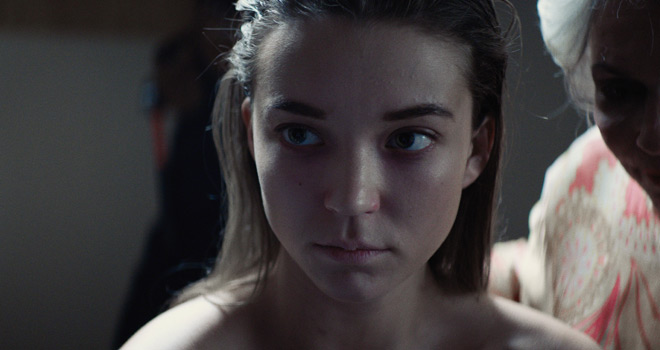
Sarah sees the worst. Sarah is assaulted. Sarah is taken hostage. And contrary to what a normal human reaction might be to any one of these might be, Sarah shows us her poker face. No freaking out at what’s happening to her, entirely too little crying in horror at what’s been done to her furry companion, no frantic struggle through the shock.

Just Nicole Brydon Bloom, not giving away if her hole cards give her that full house.

That’s a HUGE hole in the center of this sadistic and sedate debut feature from writer-director David Marmor. Some of it works, little bits of misdirection here and a full-blooded finale there.

But Bloom, in what should be her big break, gives us nothing to hold onto, little to root for and a passive turn that is partly how the character is written but mainly the blank-faced range of the heroine.

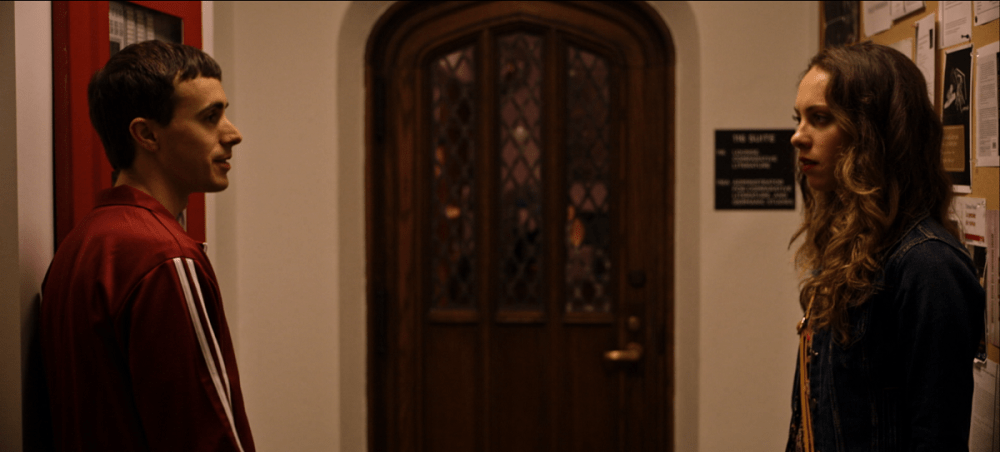
Sarah moved to LA “to start my life over.” She’s taken a temp job and she has a place to stay. But the ad for the Asilo del Mar is too enticing. Who cares that she has to lie about having a pet on the application? Yes, she has only a temp job, and one of the couples she meets there is a doctor married to her lawyer. “This should be out of my price range” never enters her mind.

And apparently she flunked high school Spanish. “Asilo del Mar” means “Asylum by the Sea.” Who names an apartment block that?

Jerry, the manager, maybe? He’s played by Taylor Nichols, who first came to fame thirty years ago in “Metropolitan,” playing an earnest thinker who could talk your ear off, even back then.

That’s handy, because that’s what’s going on the night when Sarah stops being a tenant and starts becoming a member of “The Community.” Jerry talks a bit, and threatens a bit more.

Sarah under-reacts to every insane thing, from injections and “stress position” with cheesy pop music torture, or other stuff involving a hammer.

“It’s not crazy,” she’s assured. “It’s science.” She’s being “conditioned.”

My jaw dropped. Bloom’s never does.

Jerry, with the aid of everybody else in the complex, doesn’t just commit physical violence against Sarah. He sadistically breaks her will with words.

“Sarah, no one’s coming for you.”

Is she cunning enough to escape? Does she have the will to try?

The test of the movie is whether we’ll instinctively root for the standard white-girl-in-jeopardy and accept the physical abuse, mental anguish and humiliations Sarah must endure before figuring out if she can fight back. Because Bloom? She gives us nothing.
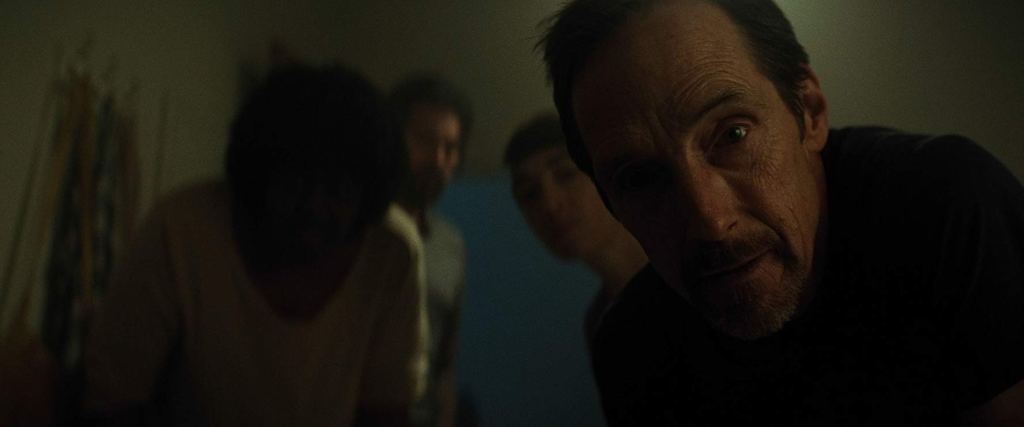
The other characters are quickly sketched in — the elderly failed-actress neighbor (Susan Davis), the creepy one-eyed guy (Clayton Hoff), the hunk who keeps inviting her to cook-outs and dinner parties (Giles Matthey), a would-be support system that includes a Dad (Alan Blumenfeld) she’s semi-estranged from, and a brassy co-worker (Celeste Sully) who is everything mousy, meek and passive-faced Sarah is not.

None of them really pop off the screen as potential heroes or villains. Nichols stands out, and that’s about it.

I don’t like to single out actors as being the reason a film fails, and maybe this was Marmor’s doing — not getting terror or dread out of his heroine. But this is dull, unengaging acting in service of a slow-footed story that marches through some over-the-top “conditioning” towards a pretty inevitable conclusion.

MPAA Rating: TV-MA, violence, profanity

Cast: Nicole Brydon Bloom, Giles Matthey, Taylor Nichols, Susan Davis, Alan Blumenfeld, Celeste Sully

Credits: Written and directed by David Marmor. A

Running time: 1:30

Posted in Reviews, previews, profiles and movie news | Comments Off on Netflixable? Beware the ad for the LA “1BR”

Movie Review: A Pandemic is the perfect time to re-release “The Hole (Dong)”

Deadpan, surreal and pandemically prophetic, Tsai Ming-liang’s “The Hole (Dong)” didn’t make much of a splash, globally, when it premiered in 1999. A droll fantasy-musical about loneliness, plumbing and a virus spread by cockroaches who makes people act like cockroaches, it’s nothing if not strange.

But here it is, earning NY and LA virtual premieres because whatever we avoided in the film’s fictional version of New Year’s Eve, 2000, it’s biting us on the butt right now.

A cascade of news reports, only heard/never seen, set up the problem. There’s a new “Taiwan Virus,” and evacuations have been ordered in assorted hotspots. But the residents of this one run-down apartment building aren’t complying.

The Man Upstairs (Lee Kang Sheng) lives in 804, just lying around in his untidy whiteys smoking when he isn’t running his ground-floor grocery stall. He’s listened to the many news reports and apparently decided to ignore them.

But the pounding at his door isn’t an eviction or government-ordered evacuation. It’s a plumber. There’s a leak downstairs. Could he take a look?

Next thing we know, he’s knocked a hole in the floor, fixed nothing, and left. Yeah, it happens there, too. And as big a mess and inconvenience as it is for The Man Upstairs, for The Woman Downstairs, it’s a nightmare.

She (Yang Kuei-Mei) has water issues. The wallpaper is peeling, puddles are everywhere. You prepare for a pandemic — she has stacks and stacks of wet wipes — and then THIS happens. Perpetual rain outside, drips everywhere inside, especially when the fellow in 804 uses the toilet. Her water? On and off.

“The Hole” is about their solitary efforts to cope with this nightmare of plumbing, pandemic and near solitude.

He spies on her through the hole on his floor, and once even vomits through the hole. She blasts him with bug spray, barges in on him in his market stall and demands that he stick around for the plumber, a plumber she can never land an appointment with.

“Do you think you’re the only plumber around here?” she yells into the phone (in Chinese with English subtitles). We get a feeling she’s just glad to have a conversation with somebody. Anybody.

He, at least, has a cat he feeds downstairs at his market.

And every so often, our story is interrupted for a little Chinese lip-synching as The Lady Downstairs turns up in a decorated hallway, or stage-set elevator, dressed up in wig, heels, gloves and cheongsam, putting on a show.

Sometimes she has backup lip-synching singers. Sometimes, The Man Upstairs figure into the fantasy.

Is it hers, or his?

There’s a soundtrack mostly filled with news reports, a rising level of frustration and a growing sense of despair as these two disconnected people try to cope with miseries that are just the cherry on top of their slice of lonely cake.

Are there worse fates than succumbing to a disease that makes you skitter across the floor like a roach? Probably.

Tsai Ming-liang (“Rebels of the Neon God,” “What Time is it There?”) suggests that isolation is one of those fates. And he takes his sweet time making that simple point, creating a mesmerizing and deliberate if never-quite-poignant fairytale allegory about the hole in modern lives.

“The Hole” goes down easily, even if we’re distracted by exactly where The Woman Downstairs found all those lovely, coveted wipes.

MPAA Rating: unrated

Cast: Yang Kuei-Mei, Lee Kang Sheng

Credits: Directed by Tsai Ming-liang, script by Tsai Ming-liang,Yang Pi-ying. A Big World Pictures release.

Running time: 1:30

Posted in Reviews, previews, profiles and movie news | Comments Off on Movie Review: A Pandemic is the perfect time to re-release “The Hole (Dong)”

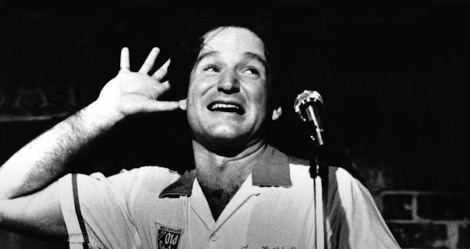
Documentary Review: The life and last days of Robin Williams, “Robin’s Wish”

On August 11, 2014, the world got a bit sadder and a lot less funny. That’s the day we learned Robin Williams, the great, mercurial talent of his generation, had died.

His death by suicide added to the shock, until we thought about it. Manically funny and wistfully melancholy, a man who’d battled addiction and other personal demons, it wasn’t just the media that leapt into speculation about what drove him to hang himself.

It was rare, in interviews, to not have his sad side show up. I know I saw it the few times we talked. The “unhappy, depressed clown” narrative gained a foothold, even among those who loved him. Those who didn’t wondered what drugs he had in his system.

But we were all wrong. He didn’t know, his wife didn’t know, his doctors had thought Parkinson’s and depression, and they were wrong. It wasn’t until that fall that the coroner’s report showed what had really gone haywire in his brain.

“Robin’s Wish” is a documentary that expands on the interviews his widow did once that diagnosis — “Diffuse Lewy Body Dementia” — became known. It’s a film that chronicles his decline, the panic he felt over it, what friends, neighbors, colleagues, his handler for his many USO tours and his widow, Susan Schneider heard and saw and could not understand.

Despite his access to neurologists and some of the best healthcare America has to offer, Williams didn’t realize that he was “at the mercy of something he could not control…and didn’t know about,” his director in the “Night at the Museum” movies, Shawn Levy explains.

One of the medical experts here lets Williams, those close to him and even those treating him off the hook by noting “the last thing they think of is a degenerative brain disease.” And he had “the worst case of it I had ever seen,” notes Dr. Bruce Miller of the Memory and Aging Center of UC-San Francisco. The post mortem evidence was stark.

“Robin’s Wish” quickly sketches in Williams’ career, his brief stay at Juilliard where he studied Shakespeare but “would make up lines in iambic pentameter…X-rated lines,” in rehearsals, where he befriended Christopher Reeve and actor Stanley Wilson (seen here), his connection to stand-up and the Mill Valley theater where he still performed it, on occasion, close to his Tiburon, California home.

David E. Kelley, creator of Williams’ final TV series, “The Crazy Ones,” Levy and others marvel at the explosions of wit, the endless riffing on takes, “every one of them different, a lot of them…gold” on movie and TV sets, recording the genie in Disney’s “Aladdin.” Being “that Robin Williams” made his sudden decline doubly alarming because he never wanted to let people expecting him to bring the fun down.

The stated purpose of the documentary is to ensure that no one still harbors those notions of a rich, successful comic taking his own life through self-destructive addictions or impulses. “Suicide,” we’re told, is far-too-often the end result of the onset of this Diffuse Lewy Body Dementia. I like what his friend, the comic and filmmaker Bobcat Goldthwait says in a radio interview included in the documentary.

“His brain was giving him false information,” making Williams manic, insecure, unable to remember lines, giving him a left-arm tremor and making him think “I’m not me.”

The film’s narrow focus and heavy reliance on his third wife, Susan Schneider and the lack of testimonials from his three children, gives “Robin’s Wish” an odd aftertaste, especially when you remember the legal fight over his estate where “Robin’s wish” was that his children inherit pretty much everything. The title itself seems like a final shot in that battle.

But zeroing in on Robin’s disease, his decline and what she and a few others close to him observed, with plenty of medical explanations, make this brief film feel complete, in its own way. What they’ve made is a solid, medically sound and emotional final chapter in a life that touched many, one that deserves to be remembered for how he really lived and what truly caused his death.

MPAA Rating: unrated

Cast: Robin Williams, Susan Schneider, Mort Sahl, Shawn Levy, Stanley Wilson, David E. Kelley and Bobcat Goldthwait

Credits: Directed by Tylor Norwood, script by Scott Fitzloff and Tylor Norwood. A Vertical release.

Running time: 1:17

Posted in Reviews, previews, profiles and movie news | Comments Off on Documentary Review: The life and last days of Robin Williams, “Robin’s Wish”

Documentary Preview: “Black Boys” on NBC Peacock

This portrait of the black male experience comes to the Peacock streamer in early Sept.

https://www.blackboysfilm.com/trailer

Posted in Reviews, previews, profiles and movie news | Comments Off on Documentary Preview: “Black Boys” on NBC Peacock

Movie preview: “THE SUICIDE SQUAD 2”

Ok. Director telling us we’ll be surprised.

Totally impartial. But we’ll see.

Posted in Reviews, previews, profiles and movie news | Comments Off on Movie preview: “THE SUICIDE SQUAD 2”

Documentary Review: Paralympians as Badasses, “Rising Phoenix”

A teenage fencer survived meningitis, which scarred her face and took her arms and legs.

“How can you live without arms or legs?” she cackles, in Italian accented English. Her condition just merits a shrug and a teenaged “S— happens!”

A sprinter survived losing a leg to machete wielding fanatics in the Burundi Civil War, and saw his own mother butchered in front of him.

The archer holds the bow with his feet and draws the string with his teeth.

“This is how I am,” he chuckles. “Merry CHRISTMAS.”

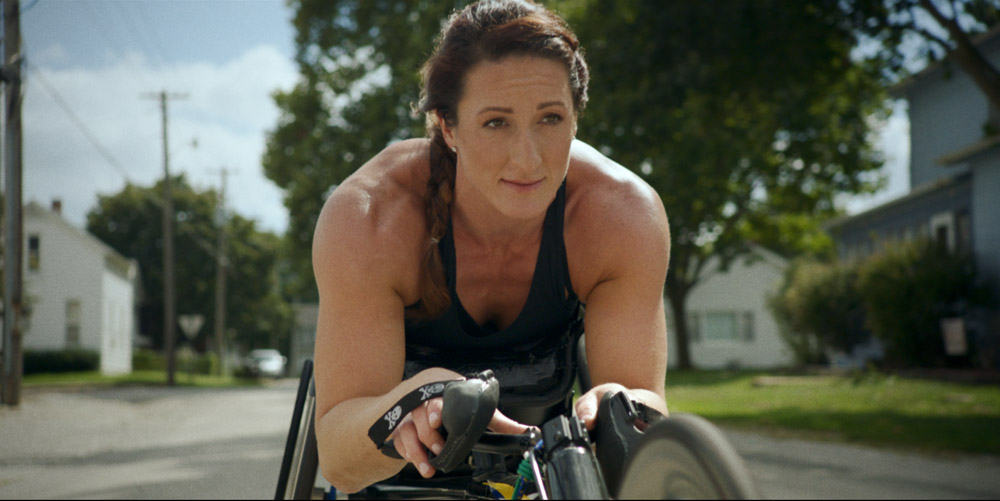
A weightlifter may have no legs, and until Beijing had to host a Paralympics, was among the millions of invisible disabled in the People’s Republic. A wheelchair sprinter was born in the former Soviet Union, which also was reluctant to admit “We have disabled people here.” She came to fame as an American paralympian.

“Everybody has a story,” Xavier Gonzalez, a member of the International Paralympics Committee, says. And in the case of paralympians, that story is going to be touching and triumphant.

Because as the athletes in “Rising Phoenix” put it, they’re the real “superheroes” among us, people who have overcome physical limitations to physically excel, human beings who fight prejudice and dismissal every day, and who aren’t afraid to punch back.

There are athletes all across the spectrum of sport who would kill to have a documentary portray them as heroic, epic and badass as Ian Bonhôte and Peter Ettedgui paint the superstars in “Rising Phoenix.”

Ryley Blatt, Australian wheelchair rugby star, the “Blattering Ram” of the sport still called “Murderball,” is one. Ellie Cole, a single-legged swimmer from Oz is another.

“Everybody in Australia has to swim,” she shrugs. It’s just that for her, “I was swimming in a circle” with just one leg “for a while.”

The film is a cornucopia of stories like theirs, legions of athletes shaking off “disability” as a label, donning “cheetah blades” and running with them.

“Phoenix” covers the history of the Paralympics movement, from its German Jewish emigre founder and those first 16 “men injured in the war” (WWII) games in London, to assorted triumphs (London, 2012) and debacles (Atlanta, 96, and Moscow refused to host them during the tainted 1980 Olympics), to the Rio games, which had a little of both.

For a fairly generic sports documentary, “Rising Phoenix” still manages a few thrills, some moving moments and a lot of sports action — blind soccer, armless swimming or ping pong, wheelchair fencing and all manner of other games and races competed on wheels.

And to a one, the athletes get the “superhero” treatment, lit like Greek gods, photographed in stunning slo-motion, celebrated with musical fanfares and profiled in the most delightfully unfiltered and sometimes profane ways.

MPAA Rating: PG-13 for thematic content, brief violent images, some strong language, and for brief suggestive references

Cast: Ellie Cole, Matt Stutzman, Jean-Baptiste Alaize, Ntando Mahlandu, Andrew Parsons, Cui Zhe, Bebe Vio, Jonnie Peacock, Ryley Blatt, Tatyana McFadden, Xavier Gonzalez and The Duke of Sussex

Credits: Directed by Ian Bonhôte, Peter Ettedgui. A Netflix release.

Running time: 1:44

Posted in Reviews, previews, profiles and movie news | Comments Off on Documentary Review: Paralympians as Badasses, “Rising Phoenix”

Movie Review: Birth to dotage in a single day, “Tom of Your Life”

There’s no mistaking “Tom of Your Life” for anything other than an indie comedy of singular vision.

A daft, sometimes dizzy and occasionally sentimental dash through relationships, parenting, morality, and life experiences packed into a story of a boy born and magically aging “four years, every hour on the hour” through his life over one long day, it is one filmmaker’s One Big Idea for a movie.

Jeremy Sklar goes by “Jer,” here, and for his debut feature film, he wrote, directed and did the music for a picture he also co-stars in, at least for the third act. That’s when he takes over the role of “Tom,” a child kidnapped from the hospital by a manic, unstable and abrasively funny nurse named Jess (Baize Buzan).

The best thing Nurse Jess ever did in her drug-abusing/restraining-ordered life was grabbing this potential science experiment and taking him out into the world for one eventful and often funny day. She stuffed tiny Tom (Levi Emerson Paul) into a garbage can, calmed him as she wheeled him to the parking lot, lying to anybody she met, and lit out.

She feeds him, takes him horseback riding and watches him age through two other actors (Judah Abner Paul and Joshua Paul) at the end of his first and only bicycle lesson.

Next thing you know, Tom (Dominic Rescigno) is in a track suit bugging her about sailboats (he saw a picture) and “maybe trying driving?”

“You’re not old enough…or maybe you ARE!”

He promptly ditches her and races to a strip club — because PUBERTY!

And so it goes through this long day, Tom aging (Sklar takes over at a going-to-seed 30), taking his first ever boat ride, a Chicago river tour, “a floating sidewalk of elderly people,” gulping his “first alcoholic beverage,” first sex, first hit of cocaine, first-ever poker game…

His first ride on the El is his first-ever encounter with a person-of-color. Fiftyish and tactlessly fascinated with “Your skin, what happened?”

All along this fast-moving day of stumbling from one adventure to another via extreme close-ups, we’re given insights into Jess’s fury. She has a purse full of pills and a pipe and has an unhealthy thing for older men — one of whom was her hospital boss (Paul Tigue), the other who pulled the trigger on a restraining order. She’s…unbalanced.

“Need a lift?

“Not in your purple piece-of-s— RAPE van, I don’t!”

“That was HURTful!”

Buzan gets across the “not really a parent” thing of the early scenes well. But as she indulges little Tom, and then bigger and older Tom, her frazzled turn becomes sympathetic, as if she took Tom at four because she was good at math, and has a heart.

Sklar, as the eldest Tom, looks more and more like Tom Sizemore the older and paunchier and greyer he gets. It’s a fun performance with a hint of mortality to it.

There are more random funny encounters than just the guy trying to give Jess a lift, the foul-mouthed farmer who gives horseback rides and the hooker Tom finds on the Internet.

It doesn’t all work, and “Tom of Your Life” kind of grinds to a halt for a spell. But with every loopy scene, every underscored country-ish ballad Sklar croons on the soundtrack — “This is flyover country. They fly over…the BEST.” — you know you’re in the hands of a filmmaker who knows exactly the message he wants to get across and the tone he wants to set.

And if that means he takes every job in the production save for catering, so be it.

MPAA Rating: unrated, drug and alcohol abuse, sexual situations, profanity

Cast: Baize Buzan, Jeremy Sklar, James Sharpe, Judah Abner Paul, Joshua Paul, Dominic Rescigno and Paul Tigue

Credits: Written and directed by Jeremy “Jer” Sklar. A Gravitas Ventures release.

Running time: 1:31

Posted in Reviews, previews, profiles and movie news | Comments Off on Movie Review: Birth to dotage in a single day, “Tom of Your Life”

Documentary Review: A bio-tech investor with a gift, and a curse — “The Blech Effect”

The come-on for “The Blech Effect” is a bit of an eye roller.

He might “find a cure for Alzheimer’s, IF he can stay out of prison.” Words to that effect “sell” it, but a documentary premised on that is, well, rubbish.

The “hero” here is a bi-polar New York investor who has financed bio-tech companies with such success that he once hit the Forbes 400, worth some $300 million back in 1992.

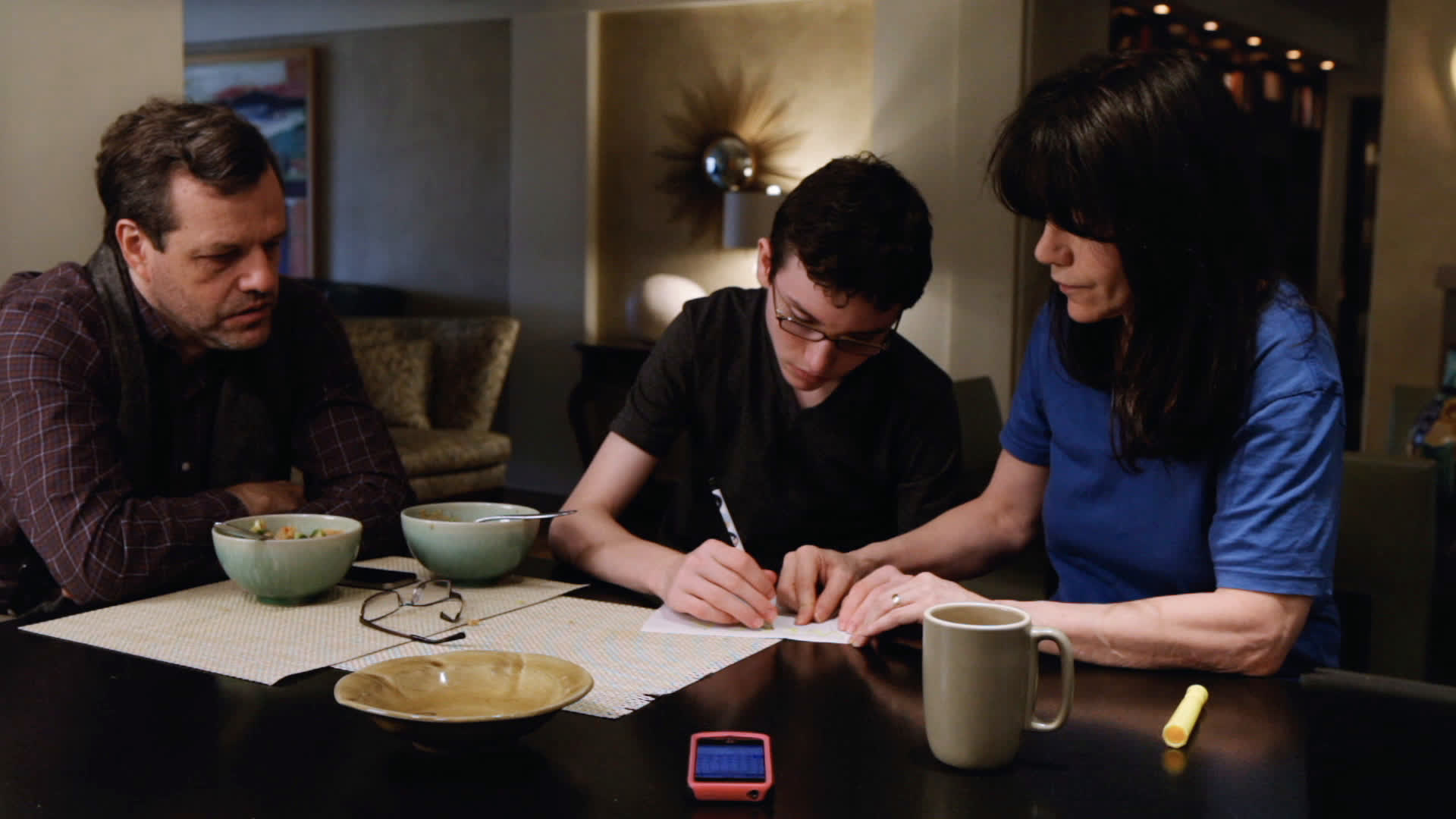
He’s not worth that when the film catches up with him. He lost it all and was busted for securities fraud/stock manipulation in the ’90s. When filmmaker David Greenwald introduces David Blech to us, the disheveled, medicated and morose Blech is hoping for a “Hail Mary.” He’s got a big piece of a bio-genetic start-up with a genius scientist on board and patents that could lead to a new treatment for Alzheimer’s.

But however Greenwald wants to burnish the guy’s image, giving him “credit” for something people he has invested in might develop, showing us “the roller coaster rides I’ve taken my family on,” a family that includes a long-suffering wife and a possibly autistic son (his diagnosis changes), Greenwald runs up against the same wall Blech does. The guy’s a bore.

Blech’s been a clever investor, at times, and a dope at others. He has “a grandiose vision of who I am.” And he’s a scofflaw, looking at prison time for “playing” with the stock market. He’s at the end of his tether, and whatever Greenwald figured he could get out of this story, he’s basically bought into that “grandiose vision.” We don’t have to.

“I had turned Wall Street into a casino,” Blech admits. Decades ago his illness and choice of career collided and he’s developed a full on gambling addiction, with stock trading his “game” of choice. He’s co-founded or sometimes bought into companies which he always sold before they have a breakthrough and explode in value, earning and losing millions when he could have held fast and had billions.

So yeah, he’s a lot more Gambler’s Anonymous case study than Jonas Salk. As such, he’s modestly interesting as a documentary subject, but never compelling.

We don’t get to sit in on his GA meetings, only hear him work the phones for money and time, listen to his wife Margory lament his “destabilizing influence on the family.”

You feel bad for their then-14-year-old son, whose diagnosis, therapy and treatments would break many a bank account. You feel a little for the wife, who fell for David’s on-the-spectrum directness.

But the guy fretting, from first frame to final judgment that “my whole world could come crashing down?” Jerks like him bankrupted the country. Cry me a river.

No, not interested in your “Woe is me,” pal. No, you don’t get credit for something a company you helped start invented, especially since in most cases you’d already sold out when the “breakthrough” came.

The film’s close focus on Blech might make for a fascinating dissection of a person with a problem. But there’s too little here to illustrate that. A news clipping here, audio from a courtroom there doesn’t tell the story.

Blech’s is almost the only voice heard in the movie, and after a while, the bipolar fallen investor with a gambling problem is all too easy to tune out.

MPAA Rating: unrated

Cast: David Blech, Margory Blech, Evan Blech

Credits: Directed by David Greenwald. A Virgil Films release.

Running time: 1:27

Posted in Reviews, previews, profiles and movie news | Comments Off on Documentary Review: A bio-tech investor with a gift, and a curse — “The Blech Effect”

Movie Review: Teen love and madness, “Words on Bathroom Walls”

I don’t know anyone diagnosed with schizophrenia, but if it’s anything like its visualization in “Words on Bathroom Walls,” it is the quintessence of terror.

Yes, this adaptation of Julia Walton’s YA novel is a warm and fuzzy teen romance, and yes, some of the manifestations of the hero’s illness have more than a hint of “cute” about them. The film is annoyingly burdened with far too much voice over narration.

Maybe that suits someone who’s living and struggling far too much inside his own head. But the Golden Rule of Cinema is “Show us, don’t tell us” and in the name of all that’s holy, don’t narrate our ears off.

But the madness that descends upon Adam, winsomely played by Charlie Plummer ( “All the Money in the World”) would terrify anyone — swirling inky black smoke covering his surroundings, black bile oozing down windows, chem lab class turning into gravity-defying chaos, and every open door an opportunity for The Voice of Your Doom calling to Adam.

His mental safety net is a further manifestation of his condition. He has gang-banger “body guards” (led by Lobo Sebastian, good) in track suits, wielding baseball bats in his mental defense. A raging libido shows up in the bathrobe and underwear clad stoner Lothario (Devon Bostick) full of advice to the hormonal.

And then there’s the real person from the school he’s kicked out of in the film’s opening scenes. AnnaSophia Robb becomes his blonde, romantic ideal, airy fairy sensitive, a dancing hippy vision (“Dalai Lama meets Coachella”) in his hallucinations.

Yeah, all that falls under “cute.” But director Thor Fredenthal (A “Percy Jackson,” a “Wimpy Kid”) and Plummer do a splendid job of maintaining the tension that someone barely clinging to his sanity lives under. This may be a lightweight primer on learning about your illness, struggling with school and family and yet finding love in the middle of all this. But “Words on Bathroom Walls” never lets us forget the “Good Will Hunting moment” in such a life, under such mental pressure, is terrifying.

Stressed but eternally hopeful Mom (Molly Parker) and the new man in her life (Walton Goggins, playing with our expectations, cast against “type”) get “treatment resistant” Adam into a Catholic School and onto an experimental new drug.

Everybody, even a reluctant Adam, is all-in on a last chance senior year, drugged up so that he can get through the day, desperate to graduate so that he can go to culinary school in the fall. Yeah, “stepdad” is a little worried about the kid having access to knives.

Only headmistress Sister Catherine (Beth Grant) is in on Adam’s secret. But she’ll be watching for signs he’s losing it. His parents are in contact with the shrink he’s always talking to (whom we never see or hear). If he can just make it through the year…

Maybe the cutest, smartest girl in school figures into that. Maya (Taylor Russell) is a brutally blunt valedictorian pre-accepted at Duke, running “side hustles” doing rich private school kids’ homework. Adam? He needs tutoring from “the Bernie Madoff of academic fraud.”

And as they hit it off, we wonder, when’s our lad going to tell her his secret? When will we find out hers? And how long before the tightrope of Adam’s existence droops under the weight and he loses it?

The script is a catalog of mental illness similes, all of them revealed in voice-over. “You entire waking life is an escape room with no exit.” It’s “like having a nightmare while I’m awake.”

The romance is understated, slow, with many missteps mixed in with flippant banter. Food and cooking are blended in, as that figures into Adam’s hopes and his greatest fears.

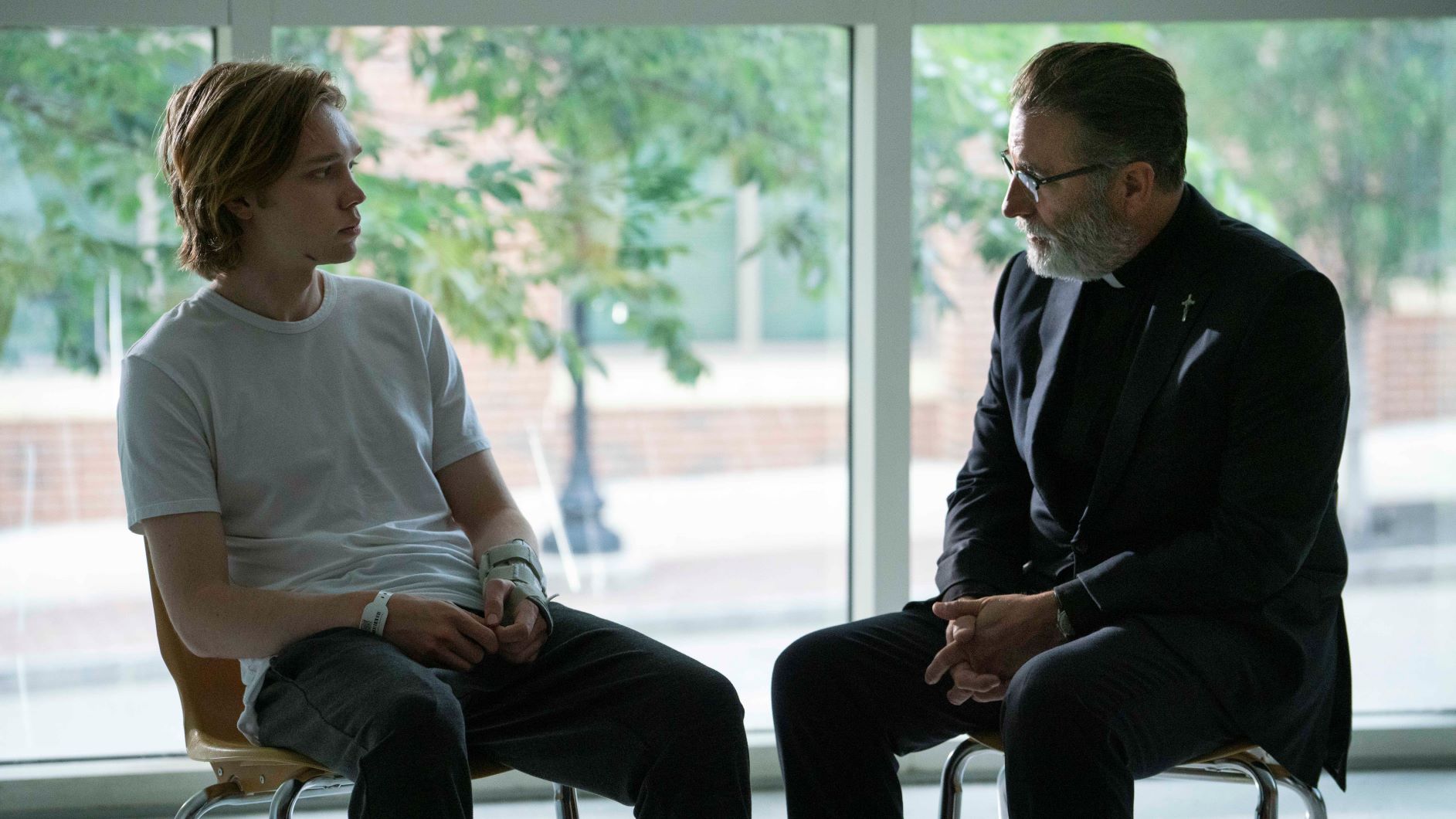
A warm subtext arrives in Adam’s interactions with this new religion that the school exposes him to, all in the confessional with the priest (a twinkling Andy Garcia), who shrugs off the agnostic who sits down and cracks that “the only person who can’t reject you is Jesus, right?”

Whatever precious touches emerge, I have to say “Words on Bathroom Walls” works. The performances are stellar and earn the emotional connection we feel with the characters. The lighter touches — Garcia, Bostick and especially Robb (“Charlie and the Chocolate Factory”), going all Woodstock Stevie Nicks — are a delight.

The fact that this sweet picture is one of the few to reopen cinemas mid-pandemic means it could get a little extra attention. Seeing as how Roadside Attractions, the Witness Protection Program of Film Distribution is releasing it, it can use all the help it can get.

MPAA Rating: PG-13, for mature thematic content involving mental illness, some sexual references, strong language and smoking

Cast: Charlie Plummer, Taylor Russell, Devon Bostick, Molly Parker, Lobo Sebastian, Beth Grant, Walton Goggins, AnnaSophia Robb and Andy Garcia

Credits: Directed by Thor Freudenthal, script by Nick Naveda, based on the Julia Walton novel. An LD Entertainment film, a Roadside Attractions release.

Running time: 1:51

Posted in Reviews, previews, profiles and movie news | Comments Off on Movie Review: Teen love and madness, “Words on Bathroom Walls”

First movie in a cinema since March? “Words on Bathroom Walls”

Boy, for somebody who has spent years of his life in cinemas, it’s been an awkward “cold turkey” break.

So what’s new in the experience?

Ticket buying has been migrating to vending machines or cellphone prepurchase. That’s accelerated thanks to the pandemic.

I glanced at the special cleaning gadget they are employing to keep their theaters low risk.

Several theaters on this area are up selling a “private showing,” just you and friends or relatives in the theater with you. Weird.

Staff at this Epic Theaters multiplex is masked, and has no change. Because they want all purchases done by data mining credit card.

All for their overpriced matinee of a movie from the Witness Protection Program of film distribution, Roadside Attractions.

The movie’s about to start, so phone off time. Just a couple of suburban teens and me to watch a drama about a high school kid coping with schizophrenia.

Here we go.

Posted in Reviews, previews, profiles and movie news | Comments Off on First movie in a cinema since March? “Words on Bathroom Walls”