
Close enough.
Close enough.

Veteran Moroccan director Philippe Faucon (“Sabine,” “Fatima”) conjures up a multi-layered if somewhat melodramatic portrait of immigrant life in modern Europe with
“Amin,” a story of African men working far from home, the stresses they’re under and the network of people depending on their “undeclared” labor in France.
Screen newcomer Moustapha Mbengue has the title role, a 30something Senegalese man doing day labor in demolition, landscaping and construction in his corner of France.
There are many just like him — men from Mali, Algeria, Senegal and Morocco — sharing space in a vast, crowded dorm-like apartment complex, hanging out after hours, living cheaply, sending money home to support extended families there.
Amin is a dependable, conscientious worker. So when he tells friends in the cafeteria where many of them eat in their apartment complex that he’s raising money “for the school back home,” you can take that to the bank.
Yes, he hides the cash in his socks. And “No,” he has nothing to declare to Senegalese customs. Especially not currency. He even makes a speech to the kids at school when he delivers the cash.
That’s pressure that he’s put himself under. There are other pressures he didn’t ask for but should have expected. He and his wife Ayesha (Mareme N’Diaye) have a romantic reunion before he greets his kids the next day. But she’s been working on them.
“Tell your father we want to come back to France with him,” she coaches the three. And they listen. “I can’t cope with your mother,” she gripes about their current crowded living arrangements.
If they knew the razor’s edge he was living on, they wouldn’t push for this. And he’s spare with his details on the privation and hardships he endures.
His brothers have the dream of opening a butcher shop that can employ the entire family, financed by Amin’s savings. In exchange, these two patriarchal African Muslims “keep an eye on Ayesha”. Bullying brother Mohammed even lectures her on not distracting Amin, not messing things up for everybody.
Ayesha’s fears that Amin may let his eye wander in La belle France is all but fated to come to pass. The other woman (Emmanuelle Devos of “Frank & Lola” and “Coco Before Chanel”) is newly-divorced, and has hired Amin’s crew for a renovation project. She is considerate, curious about how they work through the dietary restrictions of Ramadan.
And in this simplistic script, all it takes is her driving him home once or twice to put them in bed together. It’s that abrupt, a bit of dramatic business that embraces all sorts of melodramatic cliches.
What will this added “stress” mean for Amin’s “projects” — building a house, financing his brothers’ butcher shop — back home, the three kids “I don’t get to see grow up (in French or Senegalese “Wolof” with English subtitles)?
What will bring things to a head for Ayesha? And Gabrielle (Devos)? How long will her “no strings” thing last? And how will her ex and her daughter respond?

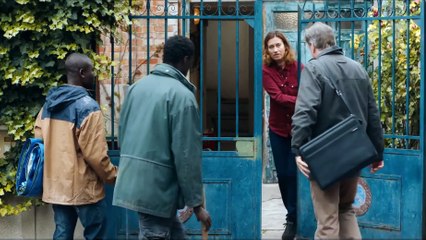

Faucon renders this intimate portrait in compact, tiny strokes. He must have had the idea of making this a broader story, as we see the trials of an older Moroccan colleague (Noureddine Benallouche) who has spent his life “undeclared,” cheating himself of the social safety net of insurance and a pension, making a decent life for the two daughters who stayed with him in France but shattering his marriage back home.
That “This could be Amin down the road” story is barely touched on, and the Senegalese scenes, with N’Diaye’s fierce resistance to being “managed” by her absentee husband’s jerk brothers, feel shortchanged.
I liked the depiction of the complex web of support depending on one man’s overseas labor, the ways his Euros alter lives in the villages outside of Dakar. It’s a story repeated over many nationalities, in almost every hemisphere.
The pitfalls depicted here may be entirely too predictable, familiar to the point of routine. But “Amin” still manages to touch on a wide array of reasons behind economic immigration, and the financial, personal and emotional cost-benefit analysis most who engage in it should weigh before taking the risks.

MPA Rating: unrated, sex, nudity
Cast: Moustapha Mbengue, Emmanuelle Devos, Mareme N’Diaye, Noureddine Benallouche and Moustapha Naham
Credits: Directed by Philippe Faucon, script by Philippe Faucon, Yasmina Nini-Faucon. A Film Movement Plus release.
Running time: 1:31
Movies that bend the laws of space-time without the introduction of a black hole fall more into the realm of fantasy than “Interstellar” science fiction.
It’s why films like this year’s “The Call” or “Frequency,” “The Time Traveler’s Wife” or “Somewhere in Time” should never bog themselves down in “explaining” how a woman moving into a house gets calls from somebody murdered there years before, or a son finds a radio that lets him talk to his dead dad, or why a woman is able to converse with a kid via his CRT TV and camcorder in 1989 and prevent his death in “Mirage.”
Oriol Paulo’s Barcelona-set thriller burns more screen time with characters trying to reason out the impossible than it should, and dawdles in other ways. But the mystery at the heart of it is fascinating and unraveling it is suspenseful, with life-and-death stakes that go beyond merely preventing a murder.
“The flight of a butterfly can be very cruel if it occurs in a place and a time that allows for change,” a character muses in this story (titled “Durante la tormenta” in Spanish), long after we’ve figured out what we’re witnessing is a Spanish tale wrapped up in “the butterfly effect.”
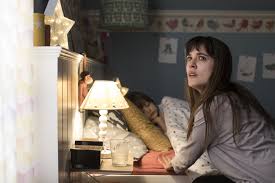
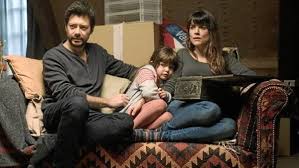
Vera (Adriana Ugarte), husband David (Álvaro Morte) have just moved into a house with their little girl. Tucked in an attic, they find a pre-HD cathode ray tube (analog) TV and VCR. And in the middle of a thunderstorm, Vera sees it flicker to life with images of a tween (Julio Bohigas-Couto) practicing Cyndi Lauper’s “Time After Time” on his guitar.
In his timeline, the kid is keeping himself entertained while his single-mom is at work, and all that’s on TV news is the collapse of the Berlin Wall. It’s 1989.
Vera is chilled to the marrow, as are we, the moment young Nico stares into his set and speaks to her. When she Internet searches the child, she discovers a murder Nico stumbled into that very night, a murderer foiled in the act of disposing of his wife’s body, a discovery that cost Nico his life.
When Vera reaches out again during a storm that mimics the one Nico lived through that night in 1989, she manages to warn the confused and frightened child. And damned if her pleas don’t save his life.
But when Vera wakes up the next day, she can’t pick up her kid from school. Nobody knows a “Gloria.” Dashing into her husband’s office, he doesn’t recognize her.
Nico surviving has changed history. The killer was never brought to justice. And Vera finds herself spilling her story to a sympathetic cop (Chino Darín), getting brain scans, talking to doctors and others about this recent novel that follows the plot of the story she’s telling.
And Vera, who was a nurse before, stayed in med school to become a neurosurgeon in this timeline, even if no one in their right mind would let her open a skull in her present (doesn’t remember finishing med school) state.
She must learn all she can about Nico and what might have changed and figure out how to correct this and get her daughter back, with pretty much nobody in her current timeline helping her or even taking her seriously.
Suspense comes from scenes where we see a little boy trying to reason out how to prevent a murder, or prevent the murderer from covering his tracks.
The script also tosses in lots and lots of twists, this thread making us question this peripheral character’s actions, that one connecting another character to the past and present in ways we don’t see. There’s even a hint of romance, of lovelife paths not taken, delivered in flashbacks.
Is this all in Vera’s head, a novel that’s gotten into her brain and taken over her life? Is she just a fictional character in that story?
“Mirage” takes its sweet time introducing those various wrinkles and seeing to it that too much is tidied up, folded in on itself. But that’s a big appeal of such time-travel/not-space-travel stories, the back-engineering involved.
The script may lose track of Vera’s driving impulse — getting her daughter back. But Ugarte, in a performance fraught with fear, desperation and focus, never does. She makes us believe and makes this work.
That’s the only “explanation” necessary in seeing through this mirage.
MPA Rating: TV-MA, violence
Cast: Adriana Ugarte, Chino Darín, Javier Gutiérrez, Álvaro Morte, Miquel Fernández, Clara Segura and Julio Bohigas-Couto
Credits: Directed by Oriol Paulo, scripted by Oriol Paulo, Lara Sendim. A Netflix release.
Running time: 2:08
This February 12 drama about grappling with the past while the present, being wild and unforgiving, is trying to eat you, give you frostbite or make you starve.
Demian Bichir also stars.

You need to understand a lot of context to fully grasp what filmmaker Anabel Rodriguez Rios is trying to get across in her documentary, “Once Upon a Time in Venezuela.”
She tells the story of the country’s troubles through a waterfront microcosm, the stilt-village of Congo Miramar on the salt water estuary of Lake Maracaibo, downstream from the heart of Venezuela’s oil industry.
The lake is “a permanent black tide” of polluted water and toxic sediment, its shores creeping inward in a morass of weeds and fewer and fewer fish, and almost nothing edible. Rios shows us this rather than “tells” us most of the lake’s maladies. We see a child with an oil-covered turtle talking about “good eating” and not quite understanding how the oil changed that.
And locals, especially partisan political hacks, will only speak of the long-promised “dredging” which nothing, not even an impending election, will speed up and somehow solve their dying village’s problems.
The film shows us a war of wills between single-mom Natalya, a teacher struggling to make do with almost nothing, and political boss/fixer Tamara, who worships at the shrine of the late Cesar Chavez and holds her nose to keep the “Chavistas” in line, ready to vote the way she demands for one of the flurry of power-grabs Chavez heir Nicolas Maduro staged on his way to a dictatorship.
Rios shows us old school “retail” politics, as Tamara calls in local officials to harass the underpaid, under-supplied teacher because either she doesn’t like her politics, she’s not a relative or she isn’t doing enough to raise the next generation of Chavistas. Her excuse (in Spanish with English subtitles) “such a cold person can never be a teacher.” A hectoring bureaucrat lectures Natalya, whom the kids love (where or not they’re learning) on pens not distributed (they don’t work) and government brochures not handed out (the damp rots everything paper).
Tamara, a wheeler-dealer with a smug smirk and persistent manner, declares “I’m fine, as long as I have The Revolution.” She arm-twists voters (“I’m not voting.” “Oh yes you are!”), calls for updates on the dredging that never comes, and as a local mayor hands out cash for votes, she finds out what her voters”really” want — free cell phones.
In a dying town, where stilt houses are moved to deeper water, or abandoned as the inhabitants move on, party boss Tamara seems doomed to reign over a watery ghost town.


Rios captures this watery world of small children who grew up handling skiffs and working the waters, many of them kids being raised by their grandparents. This is like an inner city housing project — mostly the very old and the very young.
She’s found her perfect analogy for Venezuela — a country that mortgaged its soul to the oil that’s killed the lake, an underclass that maintains cult-like devotion to scam artist leaders who promised much, but only concerned themselves with lining their pockets and consolidating power, taking away voting rights and never truly bettering anyone’s life.
But the film cagily circles that message in tentative, scenic storytelling that hammers home the vote-acquiring part of the corruption, but barely touches on the dismissive officialdom whose kleptocracy keeps anything from getting done. Rios is too subtle, and at times, too easily distracted by “local color.”
North Americans can take that kleptocracy analogy to heart, even if — like Maduro — the cultists, voting against their self-interests, their children’s future and their own health, can’t be truly defeated with just one free and fair election.
MPA Rating: Unrated
Cast: Tamara, Natalya
Credits: Directed by Anabel Rodriguez Rios, written and Anabel Rodriguez Rios and Marianela Maldonado. A Topic release.
Running time: 1:39
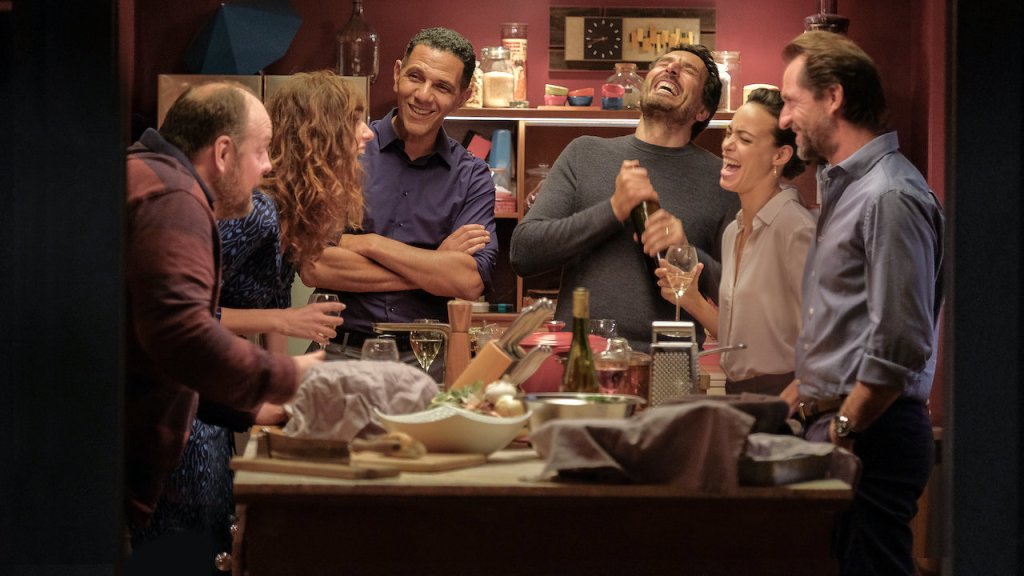
If Netflix had a corporate sense of humor, they’d offer all three versions of this French comedy/melodrama on the service at the same time.
“Nothing to Hide (Le jeu)” is a remake of an Italian film “Perfetti sconosciuti (Perfect Strangers).” I reviewed the Mexican version of this last year — “Perfectos Desconocidos” it is called.
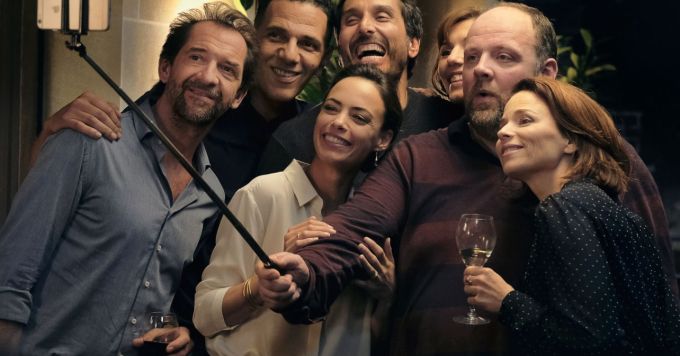
They all use the same set-up, a friendly dinner party that goes awry when they decide to plop their cell phones in the middle of the table and read the next text, share the next emailed photo or put on speaker phone the next call each person gets.
A backhanded slap at global cell-phone obsessions? Sure. But the overt message is “Do you really want to know what your friends/relatives/spouse/children are up to behind your back?”
The French version, adapted by French action specialist Fred Cavayé (“Point Blank,” and he scripted the Russell Crowe thriller “The Next Three Days”) shows its melodramatic touches just as clumsily. But this is probably the funniest of the three versions of this, with pranks thrown in to the night of Life’s Most Embarrassing Moments.
Every one of the seven folks sitting down to dinner at the home of doctors Marie (Bérénice Bejo) and Vincent (Stéphane De Groodt) has something they’re keeping from their significant other their friends.
One guest slips into the bathroom to step out of her panties, more than one is fielding texts that they wouldn’t want anybody to see, one is the confidante of the about-to-turn-sexually active daughter in the family, one is job hunting and freshly divorced, and on down the line.
And on this night of a lunar eclipse, “not for the superstitious” a radio announcer assures us, weird things might be afoot. Mistrust is just the biggest one.
That’s how this cellular “truth or dare” begins. And from this reminder call about a surgery or that persistent series of texts or calls from this boss or that “colleague,” things veer from simply embarrassing to jaw-dropping humiliations.
The occasional prank, tossed into the mix, can either heighten the hilarity or send somebody to their divorce lawyer.
The machinery of this time-tested plot is out in the open, but Cavayé does a decent job distracting us from the gears we can see are about to turn, the nuts and bolts that might come off at any moment.
Lighter running gags include surgeon and would-be chef Vincent’s “with a twist” takes on classic French cuisine. Preparing foie gras with milk? Broccoli puree? “Warm” oysters with squid ink?
The cast splits the workload equally, with Bejo (“The Artist,” “A Knight’s Tale”), Suzanne Clément and Roschdy Zem (“Days of Glory”) making the strongest impressions.
I think I laughed hardest at the very French ways the guests dodged this course of that one, and how to a one they dive into the cheese plate at the end like starvation victims.
The framework here seems a tad clumsier, and the “eclipse” touch sets us up for the most obvious “twist” of all.
But “Nothing to Hide” still manages to amuse and surprise just enough to warrant all those payments to Paolo Genovese, the Italian filmmaker who conceived this easily-translated entertainment in the first place.
MPA Rating: TV-MA, alcohol, profanity, mild violence
Cast: Bérénice Bejo, Suzanne Clément, Stéphane De Groodt, Vincent Elbaz, Grégory Gadebois, Doria Tillier and Roschdy Zem
Credits: Scripted and directed by Fred Cavayé, based on the Italian film “Perfetti sconosciuti Perfect Strangers).” A Netflix release.
Running time: 1:30

I remember looking forward to “Tracks,” a cross-Australia “walkabout” epic, when I saw the trailers back in 2013. But the ever-troubled Weinstein Co. never gave it much of a U.S. release.
But the story of Robyn Davidson’s cross-Outback trek, accompanied by Aussie camels she’d trained and her dog Diggity, lives on, making the rounds of free-TV streamers now, and a movie well worth your while.
Whatever echoes of “Lawrence of Arabia,” “Rabbit Proof Fence” and the less-known 1971 Aussie desert saga “Walkabout,” it’s a fine early showcase for both Mia Wasikowksa, who had already come into her own, and Adam Driver, who was a couple of years away from that when he gave this charmingly awkward performance.
We meet Robyn Davidson as a 20something, an aimless young woman who is moving on from her hippy friends and setting goals. She wants to cross 1700 miles of Australia, from Alice Springs to the sea, on foot. And the idea she pitches to assorted locals is that she’ll capture and tame some of the country’s non-native camels to use as pack animals for the journey.
She sounds determined but out of her depth, especially to assorted folks who work with camels at local tourist attractions. But she takes on indentured servant duties with one to learn all about camels, and secure a few for her later journey.
And when that “right bastard” cheats her, she finds another more inclined to keep his word.
That’s a running subtext of “Tracks,” the racist, brutish redneck nature of rural Australia in the ’70s. Robyn sees this everywhere she looks as she takes various short-term menial jobs that point her towards her goal.
It’s not totally nuts in her mind. Her father did similar treks in East Africa just before World War II. And Australians imported camels for the very purpose she plans to use for them for before abandoning them and watching the dromedaries thrive in a feral state in the country’s vast, dry open spaces.
It’s only when her friends track her down that the quest becomes feasible, and not because they have the money to finance her. They’ve befriended this chatterbox American photographer Rick who, prattling on to impress her, suggests she get a magazine to underwrite the expedition.
When she pitches “National Geographic” and they say yes, on the condition that she rendezvous with their photographer at several points along the way, she realizes her “do this on my own” project has been given a huge helping hand. Rick Smolan (Driver) will be that photographer, Range Rovering in to capture her and her motley crew on their months-long hike.
For someone whose desire is solitude, a personal test that allows her to eschew the human race, that promises to be a source of periodic irritation.


Director John Curran (“The Painted Veil,” “Stone”) gives us a healthy appreciation of the ordeal this was, and its many risks. As one sage Outbacker warns Robyn, “You don’t have to be unlucky to die out there.”
But screenwriter Marion Nelson is more interested in the interior journey, with flashbacks giving glimpses of a shattering childhood that Davidson stoically shook off, the origins of her intense connection to animals and her preference for her own company.
Wasikowksa lets on her degree of commitment to the part, and with a script that doesn’t have her talking to herself, does some of her finest acting in bringing this Australian icon to life. She lets us feel the determination, and the fear and resignation that sets in as the months pass. Voice-over narration taken from Davidson’s article for the Geographic and her later memoir adds poetry to the already poetic picture.
And Driver, in a quirky supporting role, is at his most impressive being just that — supportive, accepting her arms-length connection to him, admiring. It’s damned funny seeing him this gawky and out-of-his-league (and knowing it) in this intense young woman’s presence.
There’s plenty that’s perfectly conventional here, from the salt of the Earth white ranchers who take in “The Camel Lady” to the righteously-stereotyped Aboriginal people who sympathize with and teach her along the way.
But “Tracks,” available on assorted free streamers and elsewhere, still makes for a splendid adventure carried on the backs of a heroic young woman and one of the finest actresses of her generation who plays her.

MPA Rating: PG-13 for thematic elements, some partial nudity, disturbing images and brief strong language
Cast: Mia Wasikowska, Adam Driver
Credits: Directed by John Curran, script by Marion Nelson, based on the memoir by Robyn Davidson. A Weinstein Co. release on Tubi, Roku, etc.
Running time: 1:52
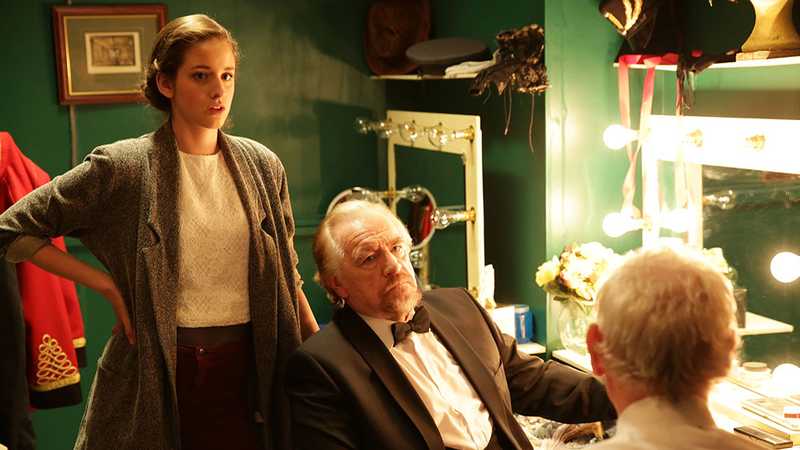
Anyone reveling in his patriarchal venality on HBO’s “Succession” should treat yourself to Brian Cox’s “Thespian in Winter…and Depends” turn in “The Carer,” a tirade of bellowing, blustering delights from the Shakespearean who has played many a villain when Hollywood comes calling.
Yes, it’s a thin comedy, practically a knock-off of the stage play turned screen hit “The Dresser,” only with a home health-care nurse as the Great Actor’s Last Audience. But Cox is one hammy hunk of fun, first scene to last.
Sir Michael Gifford is another of those tyros curdled into tyrants in their dotage whom the Brits so adore. He’s played everything, spent decades doing Shakespeare and everything else for the Royal This and the BBC that. And now he has Parkinson’s and requires in-home care in his ancient manor “pile.”
Of course, the testy, imperious blowhard wants no such thing. His barely-tolerates-him-daughter (Emilia Fox) is ready to send this new candidate home before she’s even met the brute. But Dorottya (Coco König) of the unpronounceable name and Hungarian acting background charms her just enough to get an overnight “trial.”
As she’s been picked for the job by Sir Michael’s doting driver and former theater “dresser” (veteran character actor Karl Johnson), perhaps she’ll work out after all.
Dorottya has trouble with English and Englishisms. She wants to call him “Sir Gifford,” and she introduces herself as his “career.”
“Just my luck” he grouses, getting the joke in that malapropism.
He wants to say she looks like someone he used to know, which as he’s never worked with Debra Winger means he has to think on it (König is a dead ringer for Winger), and no, she can’t answer him in kind.
“I’m too FAMOUS to look like anyone. Other people look like me, if they’re lucky.”
Being an actress, she knows his work and even saw him on tour on the stage. She’s thrilled to be in a house decorated in photos of his great roles and posters of his most famous productions. As if that isn’t enough, he’s inclined to look at his old performances (generously sampled) on video.
He lets himself be charmed, and she finds herself trying her tentative English out when he insists she play Guildenstern to his Hamlet, or what have you. No, he won’t be her teacher, not when she has to clean his bottom thanks to the progress of his illness.
“You have to RESPECT your teacher,” and that’s out, he figures.
So he introduces her as Romanian or Polish or whatever insult suits his fancy, and she takes it.
She copies his expressions and fields his Bard bantering, “all that Shakespeare bollocks,” with a fan’s knowledge, if not a lot of obvious skill.
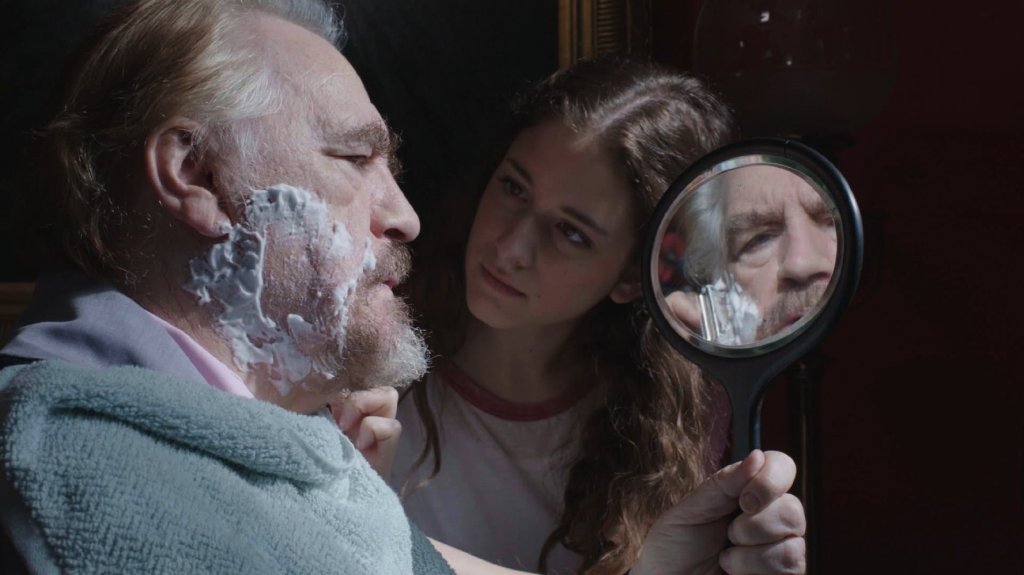
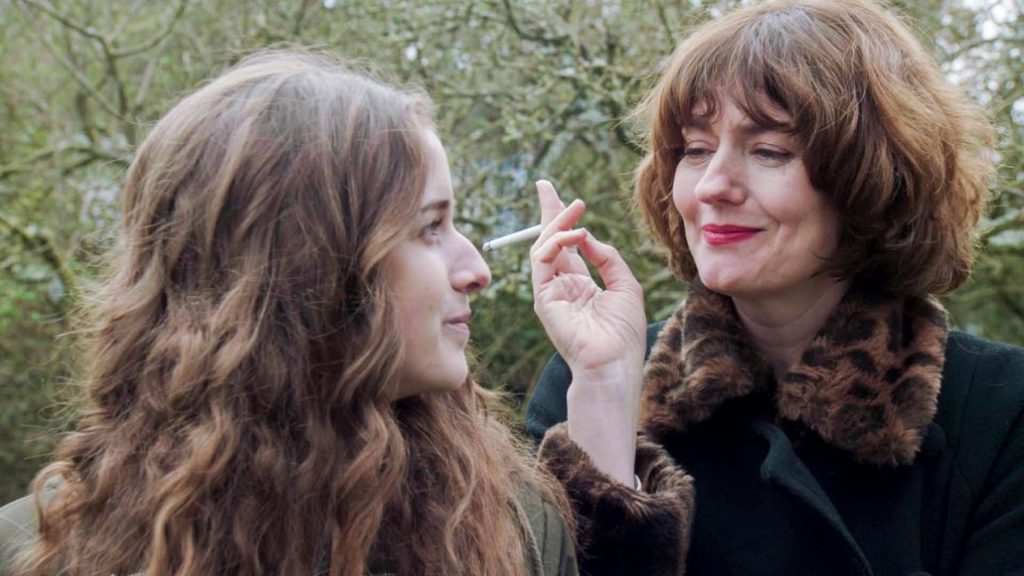
Cox has some warm moments with Anna Chancellor as his long-adoring/long-suffering housekeeper/cook, and Johnson. His turn as Gifford veers between Lear’s fury and Falstaff’s sentimentality.
“Alzheimer’s really should be the province of the young. They have nothing to remember.”
This Hungarian co-production suffers from imbalance between the leads, with Cox so much larger than life that König, who went on to play a no-speaking-lines orderly in the all-star bomb “Assassin’s Creed,” was hopelessly overmatched. But she’s plucky and convincingly under-awed, and that’ll have to do.
But even taking that into account, and the film’s “awards banquet” cliche of a finale, “The Carer” is still good for plenty of laughs thanks to this cuddly-scary and incontinent bear that Cox could play in his sleep, especially since he wouldn’t hear of that because he’s plainly having a lot of fun as he does.
MPA Rating: unrated, profanity, scatological humor, drinking, smoking
Cast: Brian Box, Coco König, Anna Chancellor, Emilia Fox and Karl Johnson
Credits: Directed by János Edelényi, script by Gilbert Adair, János Edelényi. |A Corinth Films release on Film Movement Plus.
Running time: 1:28
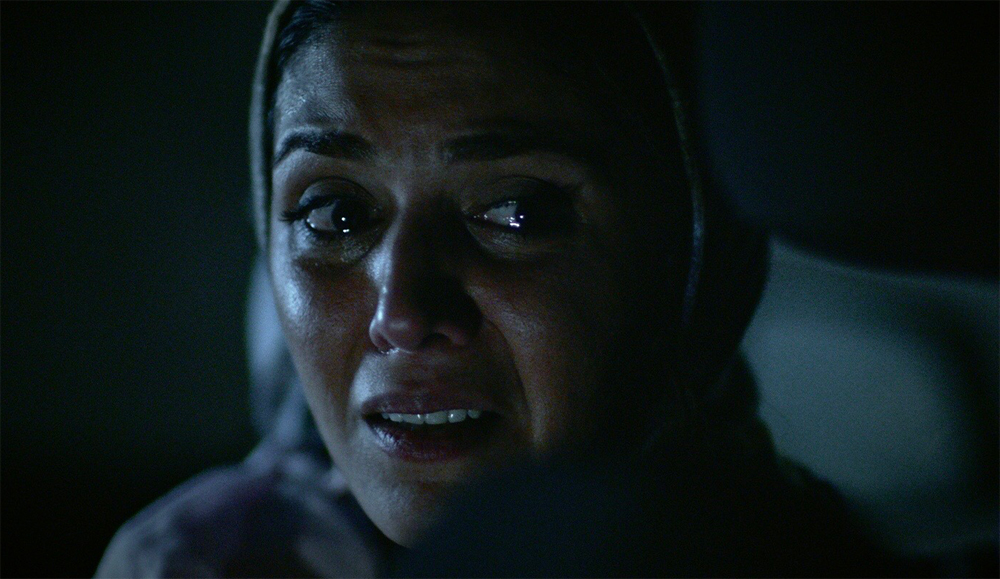
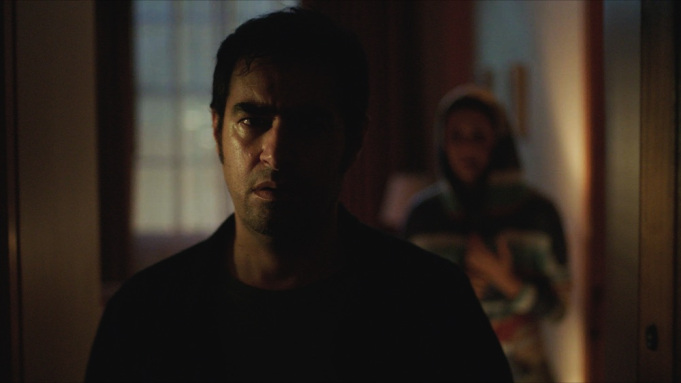
Horror fans know the trope well, that moment when everybody in the story of some supernatural threat or another gets on the same page.
One character is seeing things, hearing things, perceiving a threat. And others, or in a simpler tale, the other half of the couple, has her or his doubts.
“Have you gone CRAZY?”
And then they both see the same thing and the doubter is convinced.
That moment provides the best scene in “The Night,” the moody new feature from Kourosh Ahari (“The Yellow Wallpaper”). It takes a long time to get here, and the “haunted hotel” mood Ahari’s setting up isn’t nearly as chilling as ought to be for a horror movie.
But the jolt of something extraordinary convinces the “Am I still drunk?” husband and his “Are you still drunk?” wife they’re in the middle of something together which they can’t explain or escape on their own, and calling 911 isn’t going to help.
Husband Babak (Shahab Hosseini) had too much to drink, refused to let wife Neda (Niousha Jafarian) and gets them lost on the way home from a Los Angeles dinner party with fellow Iranian expats.
She didn’t see the GPS going wonky. She’s trying to keep their infant asleep, but alarmed at whatever he just ran over. And he’s resigned to just giving up, checking into the hotel they’ve stopped next to and sorting their location and lives out in the morning.
They kept it together at the party, although he was complaining about her to his friends and she expressed her doubts to hers. Now, after years apart (he moved to the US first) they have a baby girl and new lives and the adjustment isn’t the easiest.
The creepy, muttering homeless guy (Elester Latham) sleeping on the old hotel’s stoop should have given them a clue. The night clerk (George Maguire) doesn’t. At first.
But as the bumps through the ceiling wake each up in turn, as strange children keep knocking on the door, as Neda takes the baby downstairs to quiet her, and then Babak does the same — and neither remembers the other doing this — they fret about “stalkers” and wonder what is going on.
The clues? Their Americanized lives include his-and-hers tattoos, and “secrets.” And that desk clerk starts talking about massacres, Puerto Rican hurricanes, Bobby Kennedy’s assassination and “losing a child” might be something more sinister than merely “tactless.”
And the visions — of those children, of a bloody body in the tub — rattle each in turn and force them and the viewer to wrestle with exactly what’s going on here.
The leads are convincing, if somewhat understated. Neither the performances nor the somewhat sedate editing raise the suspense and get across the panic and paranoia that this situation would engender in most of us.
As cryptic as this tale can be, we need a little something to grab hold of to unravel it. Unfortunately, Ahari withholds that for too long, and then over-explains everything once he lets go of the mystery.
“The Night” is chilly, but frustrating in the unfolding and simplistic spoon-feeding in its resolution. A couple of decent jolts and a lot of mild nerve-rattlings is all this watered down “Shining” can manage.

MPA Rating: unrated, violence, smoking, alcohol
Cast: Shahab Hosseini, Niousha Jafarian and George Maguire
Credits: Directed by Kourosh Ahari, script by Kourosh Ahari and Milad Jarmooz. An IFC Midnight release.
Running time: 1:42

The 2008 film “Departures” is a somber drama set against “the Japanese way of death,” the fastidious customs, traditions and taboos dealing with a corpse that society there still clings to.
I couldn’t help but think of that film watching the post-mortem scenes in actress-writer/director Maïwenn’s “DNA,” in which characters weep and bicker, caress and pose for death-bed selfies with their beloved father, grandfather and great grandfather after his peaceful death in a French nursing home.
It’s all kind of comical, and when the arguments descend into storm-off-furious debates over “eco-friendly” coffins and cremation and the religious or secular nature of the funeral to be, it’s almost hilarious.
Because one of the jokes here, in this fairly serious movie about a woman’s search for her heritage and furious feuds with assorted members of her family over that, is we have no damned idea what “tradition” we’re seeing, save for a multi-cultural, multigenerational family making this up on the fly and doing a lot of yelling at each other as they do.
Patriarch Emir (Omar Marwan) suffered from Alzheimer’s, but with a lot of help, produced a book about his history — an Algerian revolutionary who fled to France where he created this family. But his Franco-Algerian/Secular-Islamo-Catholic funeral brings all the fissures within that family to the fore, with people shoving each other away from the pulpit as they impose their vision of what that funeral should be on the deceased, and each other.
Writer-director Maïwenn, whom I remember from the thriller “High Tension,” plays granddaughter Neige, keenly aware that her name is a Francophonish version of something more overtly “Algerian.” She fights with her younger sister (Marine Vacth) and brother Matteo (Henri-Noël Tabary) about their refusal to change plans so that they can be at the funeral. She fights with her mother (screen legend Fanny Ardant) over the religious nature of the funeral, and pretty much everything else. Flippant brother François (Louis Garrel of “Little Women”) wishes she was more laid-back, less “toxic.” Her estranged father (Alain Françon) catches his share of quiet-voiced abuse for merely showing up.
When we see the fight her mother (Ardant) and aunt (Caroline Chaniolleau) over the fabric that will line their father’s to-be-burned-right-after coffin, we see where Neige got her combative streak from.
There’s “fractious,” and generations argue and mourn and put off the nursing home staff and coroner who wants to remove the body, and there are “factions” as they break into groups, each with agendas.
We don’t see a reading of the will, something which — other things considered — is a blessing.
What we do see are pre-cremation rituals, a funeral service that flirts with getting out of hand and Neige trying to get a handle on her identity, going so far as visiting the Algerian consulate to apply for citizenship and going online for a DNA test to tell her where her heritage lies, and which of her family lines is dominant.

Maïwenn does a wonderful job of creating that “difficult” and “needy” “make-a-scene” relative that no one likes very much by the time the body is in the ground or in the furnace. It takes talent to be this unlikable, a woman given to lectures on propriety, “sticking up for” her secular/religion-hating grandpa by shoving religion into his funeral, and dressing, smoking and drinking as if she’s wishing Islamic tradition on everybody but herself.
Garrel is fiesty and bemused as François, who wants this funeral to be a “profound” (in French with English subtitles) experience and who is sure to roll his eyes as the funeral service slideshow plays out in what looks like a Catholic church as Islamic funeral singing and Celine Dion alternate on the mid-service soundtrack.
I’ve been to some funny funerals, but that takes Ṣalāt al-Janāzah.
It’s a pity the movie couldn’t have ended there, its dramatic climax, or shortly thereafter, as DNA results come in for Neige.
As it is, Maïwenn takes us places the story doesn’t comfortably need to go and loses herself in her character’s journey to the detriment of what has been a darkly funny, touchingly human “family” story right up to the epilogue.
As anybody in Vegas will tell you, everything that comes after Celine Dion is anticlimactic.
MPA Rating: TV-MA, smoking, profanity
Cast: Maïwenn, Fanny Ardant, Louis Garrel, Marine Vacth, Omar Marwan, Alain Françon, Caroline Chaniolleau and Dylan Robert.
Credits: Scripted and directed by Maïwenn. A Netflix release.
Running time: 1:30

 Movie Nation