Movie Review: Filmmaker has “One Shot” to get this Navy SEALs “extraction” thriller right

You remember the six-shooter that magically fired 41 times in Westerns of yore, today embodied by a sloppy movie’s “endless” gun clip in combat or cop thrillers?

“One Shot” throws a fresh goof into the cinema fan’s lexicon. It’s the villain transport clown car. In “One Shot,” a single Eastern Bloc troop truck offloads what seems like 127 mercenary/terrorists onto a stony CIA “black island” in the Baltic, armed men of many cultures and languages there to break an accused terrorist out of a “black ops” prison.

We all laugh at all the clowns that pile out of a clown car. I laughed at all the bulky mugs toting AK-47s pouring out from under the canvas flap on this truck, which is a “Stargate” wormhole into Mercenaries-R-Us, from the looks of it.

The gimmick built into this thriller starring B-movie badass Scott Adkins (“Debt Collectors,” “Expendables 2”) is that it’s filmed in a long of long takes, the film buff’s beloved “One Shot.” on display in the movie’s trailers, too, but taken to its logical extreme in a few films over the years, most recently “1917.”

That gets your attention, although in the hands of director James Nunn (sequels to “The Marine” and “Green Street,” “Tower Block”) it is used in ways that doesn’t put the viewer on edge by building suspense.

It’s still impressive, here and there, the sweeping hand-held tracking shots that brings Lt. Harris and three other SEALs and a CIA analyst (“Twilight” alumna Ashley Greene, billed as Ashley Green Khoury here) to “Black Island” to retrieve a detainee (Waleed Elgadi) who might know something about an imminent terrorist attack.

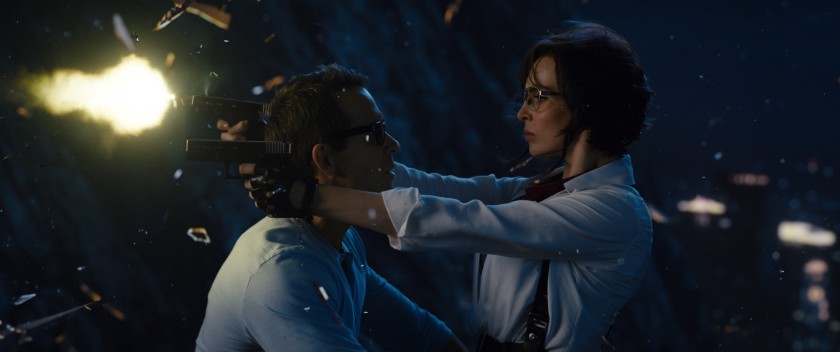
What’s more impressive is the gunplay choreography that sees Adkins shoot his way through scores and scores of villains — first-person shooter video game style — rolling, falling down, tumbling out of explosions, popping this guy and that guy in the head, this other fellow in the knee first so that his head drops down to Lt. Harris’s level for the kill-shot.

The story? It’s a patchwork mess about Lt. Harris and Analyst Anderson running afoul of the base director (Ryan Phillippe) who is hell-bent on not releasing his prisoner to him.

And then the burly bad guys (Jess Liaudin plays their leader) pile and pile out of that clown truck, and the base is mostly wiped out, the survivors holding out with the “person of interest” that both sides covet.

The acting is somewhat indifferent, a risk you run when your technical concern, “How do we get this scene in one long take?” is paramount.

The film stumbles to a halt several times, for arguments, complaints, silly pauses for this or that SEAL to do a Tarantino speech about “When I’m in heaven, before my God” as he’s shooting this bad guy and then that one. And one half in the forward momentum comes when the terrorist leader convinces one of his underlings to Take One for Allah and strap on a suicide vest.

The dialogue is hard-boiled combat film cliches warmed over — “We ain’t leaving any more people here today,” “Nothing wrong with being scared, OK? It’s what you DO with the fear that really counts.”

I could have done without the base second in command (Terence Maynard) sneering about “new administration, new priorities — ‘domestic terrorism,'” as if Jan. 6 and events like it weren’t happening. When everything goes down, he blurts out “Just like Benghazi,” like John Boehner weeping that he’ll die on that phony scandal hill.

But that’s a handy dog whistle for the “One Shot” target audience, I guess. The B-movie they’re targeting for them? Not all that, “one shot” long takes and clever combat choreography notwithstanding.

Rating: unrated, graphic violence

Cast: Scott Adkins, Ashley Greene Khoury, Ryan Phillippe, Waleed Elgadi, Jess Liaudin and Terence Maynard

Credits: Directed by James Nunn, scripted by Jamie Russell. A Screen Media release.

Running time: 1:37

Posted in Reviews, previews, profiles and movie news | Comments Off on Movie Review: Filmmaker has “One Shot” to get this Navy SEALs “extraction” thriller right

Movie Preview: An amped-up teaser for the all-star disaster pic “Moonfall”

Halle and Patrick Wilson, with Donald Sutherland narrating, give us a preview of a mass extinction event, as visualized by Roland “Independence Day” Emmerich.

Feb. 22.

Posted in Reviews, previews, profiles and movie news | Comments Off on Movie Preview: An amped-up teaser for the all-star disaster pic “Moonfall”

Netflixable? It’s back to the bloody Polish boondocks — “Nobody Sleeps in the Woods Tonight 2”

 Whatever the failings of the Polish monster thriller, “Nobody Sleeps in the Woods Tonight,” it’s sequel plunges straight into a goof — an amusingly-gory slice of oscypek or twaróg, the delicacies of the Polish cheese shop.

And then, just as we’re getting a giggle out of the broad characters and ditzy disembowelings, it goes all “Walking Dead,” with monsters who have a “point of view.” The jokes wither as the story goes gooey, touchy and feely. The picture stops dead in its tracks and twaróg goes rancid on the shelf.

“Nobody Sleeps in the Woods Tonight 2” picks up the story the day after the night of the “cabin in the woods” slaughter of the innocents. Incel cop Adam (Mateusz Wieclawek) shows up at his dilapidated rural station where two carbuncled-monsters, creatures created by an oozing meteorite the night before, are locked up.

Zosia (Julia Wieniawa-Narkiewicz), sole survivor of the massacre, is locked up next door.

Not to worry, the gruff sergeant (Andrzej Grabowski) assures the kid. “Special Forces” are coming down from Warsaw. Eventually.

Inexplicably, the Sgt. then takes the shackled survivor to the scene of the “crime.” Inevitably, the Sgt. takes an outhouse break from getting Zosia to walk him through the night’s killings. The meteor oozes some more and the slaughter begins anew.

Adam, who dreams of being a swaggering gunslinger who saves fair Wanessa (Zofia Wichlacz) in his dreams, now faces his cowardice as fellow cop Wanessa rashly sets out to kill their sergeant’s killer and he’s all about “waiting for (backup) Special Forces.”

“We’re the police, aren’t we?” shames him into joining her for an ill-fated night of teaming up with the Polish Proud Boy volunteer “Territorial Guard,” and the folks who run the survivalist Camp Adrenalin.

The cast is game enough, until most of them are buried, or buried under boil-covered prosthetics (the “metamorphosis” scenes are a cool effect).

But we know how all that will turn out.

Director and co-writer Bartosz M. Kowalski sets out to trip up expectations. But he gets so caught up in that he neglects to make any of the gruesome deaths suspenseful or meaningful. Characters are introduced and die — by accident or monstrous heart-snatching — in the most pathetically perfunctory ways. It’s as if he’s gotten the go-ahead for “a franchise,” and is cashing the checks without bothering to concentrate on the film at hand.

This has flashes of “Tucker & Dale vs. Evil” and a few other comically-gory creature features. But Kowlaski loses the thread. Considering the ways the popular-enough-for-kids-watching-Netflix original film went wrong, no one should be surprised at that.

Rating: TV-MA, gross gory and graphic violence, monstrous sex, lots of profanity

Cast: Mateusz Wieclawek, Zofia Wichlacz, Julia Wieniawa-Narkiewicz, Andrzej Grabowski, with Sebastian Stankiewicz, Robert Wabich, Izabela Dabrowska, Wojciech Mecwaldowski and Lech Dyblik

Credits: Directed by Bartosz M. Kowalski, scripted by Mirella Zaradkiewicz and
Bartosz M. Kowalski. A Netflix release

Running time: 1:37

Posted in Reviews, previews, profiles and movie news | Comments Off on Netflixable? It’s back to the bloody Polish boondocks — “Nobody Sleeps in the Woods Tonight 2”

Movie Review: Lee Isaac Chung’s pre-“Minari” drama — “Lucky Life”

Before his Oscar nominated indie hit “Minari,” Korean-American filmmaker Lee Isaac Chung put in his years of making thoughtful, micro-budget indies that played the festival circuit and rarely made much of an impression beyond that.

The streaming/DVD service Film Movement has taken the trouble to acquire the trio — “Abigail
Harm,” “Munyurangabo” and “Lucky Life” — for belated but informative release, giving us the chance to chart the University of Utah alum’s progress up the movie making mountain.

“Lucky Life,” his second feature, is a contemplative, understated drama “based on the poetry of Gerald Stern.” It takes its title from a Stern collection, which Mark (Daniel O’Keefe, who hasn’t made a movie since) narrates from and occasionally reads from to his new wife, Karen (Megan McKenna, whose only other film credit is “Booty Cakes”).

“Dear waves,” Mark reads, “What will you do for me today? Will you drown out my scream? Will you steer me through the fog?”

An apt poem to quote if you’re turning in a seriously conventional “beach house reunion” tale.

Mark and Karen join their friend Alex (Richard Harvell) for the long drive from Brooklyn to North Carolina’s serene and still somewhat uncrowded Outer Banks. Their friend Jason has gotten some bad news, and is in the “quality of life” stage of his cancer. They’re traveling down to say goodbye, for “probably the last time we’ll have together.”

The Christian subtext that is evident in “Minari” turns up here, with the friends talking about praying for Jason, a familiar clerk at a local shop chiming in and Jason himself hitting his knees on one occasion.

The dinner conversation turns from Mark questioned about getting an agent who is pitching his first book, a hint that Mark and Karen are trying to get pregnant and Jason serio-comically complaining that “It’s so sick that people call me because they think that it’s the last time they’ll talk to me.”

There are candlelit ghost stories that wouldn’t pass muster on a Boy Scout campout, subdued beach frolics and “a trip to Ocracoke,” the touristy island only reachable by ferry.

Mark narrates from a poem — “I like to think of floating again in my first home (the womb),” voices are never raised, tragedies occur mostly off camera, the time frame shifts here and there and dinner is served, much later.

And that’s all there is to it. As I said, it’s the epitome of a quiet, thoughtful “film festival” movie.

“Minari” was a worthwhile film that gained added notoriety in a many-titles-delayed/lockdown-COVID year. I thought it good, a heartfelt and in some ways novel take on The American Immigrant Experience, but breathlessly over-praised.

But the fun for a film buff in watching the movies that led up to Chung’s Oscar nominated (it won a Best Supporting Actress honor for Youn Yuh-jung) is seeing a young (he was 30ish when he filmed “Lucky Life”) filmmaker finding his voice, the “same nail” that an artist pounds, over and over, and the lessons Chung learned along the way.

“Lucky Life” lacks the incidents that comprise good drama. It’s so subdued and internalized as to be boring.

The performances are competent, but pitched at a near whisper, and thus come off dull.

There have been stories about AIDS victims, the newly-widowed and the dead-and-dying summoning friends or family for “one last weekend” in the country, at the manor house or on the beach, and “Lucky Life” isn’t a standout of the genre by any means. I thought “Minari” similarly drew on its many predecessors in its subgenre, with enough incidents and colorful characters to make it stand-out.

“Lucky Life” wasn’t so lucky. It’s a classic “film festival” phenomenon, a movie that cinephiles see and give extra attention to simply by virtue of its curated inclusion in “the festival.” The buzz around it is all the more upbeat because of the fest circuit bubble it lives and dies in.

It taught Chung to work his way towards more accomplished actors, people who bring more to a script than they take from it. And he seems to have gotten the hint that basing a movie on poems is a good way to never make it out of “the festival circuit.”

Rating: PG

Cast: Daniel O’Keefe, Megan McKenna, Kenyon Adams, Richard Harvell

Credits: Directed by Lee Isaac Chung, scripted by Samuel Gray Anderson and Lee Isaac Chung, based on the poems of Gerald Stern. A Film Movement release.

Running time: 1:37

Posted in Reviews, previews, profiles and movie news | Comments Off on Movie Review: Lee Isaac Chung’s pre-“Minari” drama — “Lucky Life”

Netflixable? “Hypnotic” trots out tropes, cures insomnia

“Hypnotic” isn’t the first movie about hypnosis and murder. That would be “The Cabinet of Dr. Caligari,” which hit theaters back in 1920.

And it’s not the worst, which has too many candidates to choose just one “winner.”

But while it intrigues and has just enough going to lure one in, it fails to startle, surprise or engage as it trots through every trope common to such thrillers, and reruns every bad line beaten to death by a thousand earlier unworthies from the School of Trite Screenplay cliches.

When a cop character says “Just WAIT for me,” the only response allowed is “We don’t have TIME.”

If the heroine calls her endangered friend with a begging “I need you TURN AROJND, go home and wait for me there,” such friends never do.

And this has to be my favorite, “the Miracle Eye-to-Eye Cure” for  hemorrhaging gunshot wounds and such.

“Look at me look at me LOOK at me!”

It’s a medical miracle that works every time.

It begins with a frightened woman entering an elevator, getting an “unknown” call, and hearing the words “This is how the world ends.” Her worst elevator nightmare ensues. More nightmares will follow.

Jenn (Kate Siegel of “Hush” and a “Ouija” sequel) is drinking and biting her nails, depressed over a breakup with her fiance (Jaime M. Callica) and the reasons for that breakup. Then her bestie Gina (Lucie Guest) introduces her to her therapist at a dinner party.

Dr. Meade changed Gina’s life. Why not give him a try?

“He’s MAGIC!”

Jenn, a computer programmer, can’t help but notice the “therapist” at a patient’s party red flag.

“I follow the rules 99 percent of the time,” Dr. Meade purrs, “Maybe 95 percent.”

As he’s played by Irish actor Jason O’Mara, who voices Batman in all the DC cartoons, he’s forgiven. And eventually, Jenn finds herself in his posher-than-posh office, listening to his pitch. His “magic?” Hypnotherapy. She rolls her eyes.

“Why the judgement?”

But she submits, and as his soothing voice and the pulsing lights he’s set up in his office cast their spell, time flies by.

Soon, she’s got a new job and the “vortex of crap” that Gina used to describe her life seems over.

But she has these dreams, waking up in bed with Dr. Meade. She starts to wonder about “triggers,” even as she’s been reassured that “Only you can control your subconscious.”

Jenn snoops around on the Internet, reaches out to a cop (Dulé Hill of “Psych” and its offshoot movies) who handled the case of a mysterious death of one of Dr. Meade’s patients, and that’s when Jenn starts to “go through some things,” as we say these days.

The mystery isn’t mysterious enough. The threats are palpable but oh-so-predictable. But the manipulations are inventive enough to to pass muster.

If only the dialogue wasn’t so…sleep inducing.

Rating: TV-14, violence

Cast: Kate Siegel, Jason O’Mara, Dulé Hill, Jaime M. Callica and Lucie Guest

Credits: Directed by Matt Angel and Suzanne Coote, scripted by Richard D’Ovidio. A Netflix release.

Running time: 1:30

Posted in Reviews, previews, profiles and movie news | Comments Off on Netflixable? “Hypnotic” trots out tropes, cures insomnia

Movie Preview: Iran’s Best International Feature entry, “A Hero”

Asghar Farhadi earned an Oscar nomination for “A Separation.”

His latest is a tale of debtor’s prison and a two day leave aimed at getting a debtor to wipe away that debt.

“A Hero” comes to North American cinemas Jan. 7, then transitions to Amazon Prime.

Posted in Reviews, previews, profiles and movie news | Comments Off on Movie Preview: Iran’s Best International Feature entry, “A Hero”

Classic Film Review: Anthony Mann pits Robert Ryan against Aldo Ray, feuding “Men in War” (1957)

If you have cable, streaming or broadcast HDTV access to The Western Channel or Grit, Movies! and the like you’re never far removed from stumbling across the work of Anthony Mann, an auteur in the “man’s man” movies corner of American cinema.

His Westerns have risen in stature over the decades, even if “Winchester ’73,” “Bend of the River,” “The Naked Spur,” “The Tin Star” and “Man of the West” aren’t held in the same esteem as the classics of John Ford or Howard Hawks. The Jimmy Stewart Westerns in particular are constantly rebroadcast.

Prestige pictures he made turn up here and there — the flawed “El Cid,” the sturdy “Glen Miller Story” and the more varied early films (pre-1950) turn up occasionally.

Back when film critics were first championing “the auteur theory,” that directors were the true artists responsible for the art of cinema, Mann gained some notice and notoriety thanks to those hardboiled Westerns and a few other gritty genre pieces. But he never rose to the pinnacle of critic Andrew Sarris’s famed “pantheon” of great movie makers, then or now.

His rare venture into combat cinema, “Men in War,” is a Korean War grunts-eye-view movie made shortly after that war ended, filmed, like the much later “M*A*S*H” (movie and TV series) in arid and sunny Southern California (Malibu Canyon).

From the very first scenes, it’s unmistakably a Mann film — self-conscious screen compositions, arresting angles and two-shots, a rough and ready and intimate drama filmed in black and white and littered with close-ups.

It’s a Robert Ryan/Aldo Ray vehicle, posting the two screen tough guys as foils in a platoon sent to secure the elusive Hill 465 in the early months of the conflict.

Ryan is Lt. Benson, something of a humanist, something of a fatalist as he leads men whose names he has to look up in his notebook to remember them into battle.

He has to bark, cajole, challenge and beg his men through firefights and sniper ambushes, a minefield and a final (Hollywood) textbook assault on that hill when they finally reach it. And as he loses soldiers along the way, he loses track of their names.

“Bannon. BANNON!”

“He’s dead, sir.”

“Right now,” he says at one point, “I’ve only got 17 men…”

“FOURteen. Count’em,” the gruff Sgt. nicknamed “Montana” (Aldo Ray) corrects him.

Montana was rushing his shellshocked/catatonic Col. (Robert Keith) to the rear when Lt. Benson’s platoon — having just lost their vehicle — waylay them and commandeer Montana’s rough-and-ready Jeep (There is only One Jeep).

Montana, insanely devoted to his Col., is put out. And he’s not shy about popping off to the frazzled platoon leader who outranks him. Benson wants prisoners, to get an idea of what they’re up against on this 14 mile long quest. Montana is trigger-happy.

“If you’re not sure, shoot first or die first.”

Benson makes Montana offer a cigarette to a North Korean prisoner the Sgt. didn’t manage to shoot.

“What’re you trying to prove?”

“That you’re human!”

The script, by Philip Yourdan and Ben Maddow, has a tense sense of men among men bravado and bluster — Howard Hawkish, at its best.

“All you’ve gotta fight is your own legs,” the Lt. reasons with them as he’s getting backtalk for ordering his shrinking force through an artillery barrage. “Make’em carry you beyond the range of fire!”

His goal, he expresses to another subordinate (Vic Morrow, Nehemiah Persoff, James Edwards, Philip Pine and L.Q. Jones among them), is to just “keep one man alive” through all this, one who will live to tell their tale.

As the bodies pile up and the mission seems more impossible to complete, we wonder if even that modest ambition is a hill too far.

Mann stages the combat scenes the way he blocked Old West shootouts — flanking maneuvers, cover fire, with grenades, a .30 caliber machine gun, a BAR, a bazooka and most inexplicably, a flame thrower instead of Jimmy Stewart and his trust Winchester ’73.

There’s a visual verve mixed in with the stock “types” — Morrow plays a GI who has partially cracked up, Persoff one who loses it mid-minefield.

This isn’t “Saving Private Ryan,” but you can tell Spielberg saw it before his D-Day epic. The quest is similar, the challenges both tactical and moral, the Lieutenant plainly a more educated man than his charges, something the more instinctual Montana dismisses.

There are plenty of moments that wouldn’t pass muster, or get common sense backtalk on the set — the idea that they could have a firefight with some members of a Korean contingent defending the hill that others, close by, defending that same him wouldn’t hear. This happens again and again the film.

The finale is a bit of an eye-roller, if not an outright speechifying, logic-defying bust.

But the riveting performances, the natural dialogue — Asian racial slurs included (but Edwards, of Kubrick’s “The Killing” and Franklin Schaffner’s “Patton” makes this an early “integrated Army” movie) — and the myopic, intimate, grunts-eye-view action make “Men in War” a combat film that reached back to the flag-waving heroism of WWII cinema while pointing the way to the more resigned, cynical war films of the future.

It’s worth checking out, just to remind us that Anthony Mann wasn’t just Mr. Westerns, wasn’t just Jimmy Stewart’s go-to guy in the ’50s.

Rating: “Approved,” violence

Cast: Robert Ryan, Aldo Ray, Vic Morrow, Nehemiah Persoff, James Edwards

Credits: Directed by Anthony Mann, scripted by Philip Yourdan and Ben Maddow, based on a novel by Van Van Praag. A United Artists release now streaming on Tubi, Amazon and other platforms.

Running time: 1:42

Posted in Reviews, previews, profiles and movie news | Comments Off on Classic Film Review: Anthony Mann pits Robert Ryan against Aldo Ray, feuding “Men in War” (1957)

Movie Preview: Sandra Bullock goes to prison as “The Unforgivable”

Oscar winner Sandra B is fresh out of prison, a “cop killer” who did 20 years.

Oscar winner Viola Davis, Vincent D’Onofrio and Richard Thomas co-star in this Dec. 10 Netflix release.

Posted in Reviews, previews, profiles and movie news | Comments Off on Movie Preview: Sandra Bullock goes to prison as “The Unforgivable”

BOX OFFICE: “Dune” takes a dive, “Soho,” “Antlers” and “French Dispatch” underwhelm

A steep Friday to Friday falloff points to “Dune” managing maybe $15-16 million its second weekend.

That’s a 62% dip, and that’s if everything pans out for it Sat and Sunday.

It’s doing ok in theaters, but not great. Considering it’s on HBO Max, probably a wash as far as the bottom line goes.

Deadline.com notes that “Dune” is the most pirated movie on the planet. So there’s that.

“Halloween Kills” will add another $8.75 million. Also underwhelming.

“No Time to Die” will add another $7 million+.

The latest anime “My Hero Academia” installment arrived to no fanfare but is racking up nearly $8 mill in ticket sales and is having the breakout weekend among new releases.

Edgar Wright’s upscale horror tale “Last Night in Soho” may get to $4.3 million and thus be the second best performer among the weekend’s new releases.

It’s in a lot of theaters, as is the arty but more conventional monster movie “Antlers,” which should clear $4 million.

“The French Dispatch” rolls out wide this weekend, and may clear $2, close to $4 million since opening last weekend.

That puts it behind “Addams Family 2,” which has been lit for a month and is still earning close to $3 million per weekend. And WAY behind “Venom: Let There Be Carnage,” which added another $5 million and will pass $200 million domestic before it loses all its screens.

Posted in Reviews, previews, profiles and movie news | Comments Off on BOX OFFICE: “Dune” takes a dive, “Soho,” “Antlers” and “French Dispatch” underwhelm

Movie Review: The Dark Underbelly of “Swinging” ’60s London — “Last Night in Soho”

With “Last Night in Soho,” Edgar Wright takes us back to the oft-romanticized “Swinging London” of the 1960s for the year’s most striking thriller, another jewel in the crown of star Anya Taylor-Joy, the anime-eyed “It girl” du jour.

It’s a breathtakingly ambitious turn for the director most of us discovered with “Shaun of the Dead,” whose credits also include “Baby Driver” and the recent documentary about the art-rock/pop duo Sparks.

Wright immerses us in the lurid neon-lit fashion, beautiful people and “the music of the traffic in the city” of Petula Clark’s hit of the era, “Downtown,” the cafe society pop sound and scene that was concurrent with the rockers and mods of Beatlemania, the Stones and the Who. He gives us a disturbed, aspiring fashion designer (Thomasin McKenzie of “JoJo Rabbit”), whose dreams take her back to the era she idolizes and the whirlwind life of a would-be singer (Taylor-Joy of “emma.” and “Queen’s Gambit”).

And then, after its captivating stars, intoxicating milieu and supernatural thriller elements have lured you in, Wright reminds you that yes, this is indeed a horror film. “Soho” evolves from Hitchcock and Welles to Dario Argento and Brian DePalma, from psychological thriller to Grand Guignol and its cinematic 1960s offspring, “giallo.”

It becomes the most stylish and upscale horror movie in years.

McKenzie is Eloise, a “country mouse” from Cornwall admitted to UAL, the London College of Fashion at the University of Arts/London. She’s introduced dancing, in a haute couture gown of her own design made of newsprint, dancing and preening to the mirror to the McCartney-written pop hit, “World Without Love.”

Her room is a veritable museum of 1960s London, so much so that it seems she’s a part of it. Then we see the digital clock and cars and realize her vinyl collection was handed down to her from her grandmother (“mod” ’60s starlet Rita Tushingham), whom she’s lived with since her mother died.

Eloise is so retro she’s positively bohemian, compared to her hip, conformist classmates. Which is one reason she moves out of student housing and into a relic of a bed-sit, an upstairs flat in a boarding house owned by Ms. Collins (the late Diana Rigg, regal). And that’s when this naive, idealistic and impressionable girl, who still has visions of her late mother, starts dreaming.

It’s the money moment in “Last Night,” Wright’s tour de force fulfillment of Eloise’s fondest wish.

“If I could live in any place, in any time, it would be London in the ’60s!”

She sleep walks into the neon, the bistros and clubs, and finds her alter ego, Sandie (Taylor-Joy) when she looks in 1960s mirrors. She observes and lives through Sandie’s bouffant-haired, designer gowned or mini-skirted singer, her polar opposite. Sandie is confident and on-task, with her stare-you-down eyes on one prize, to be “the next Cilla Black.”

That’s what she tells the “manager” she’s directed to in one posh club. Jack, played by Matt Smith, one of the creepiest Doctor Whos, promises her the world, gets her an audition, and then strong-arms her into “how the game is played.” Sandie’s dream of stardom — she has a pleasant, sexy but somewhat indistinct singing voice, overwhelmed by her sexy confidence — devolves into chorus line burlesque shows for almost all male audiences, and “entertaining” the wealthy, old leches of Britain’s entitled class, greasy old pervs who melt into a blur in her mind.

As Eloise sees this play out in her dreams, she dyes her hair and starts dressing like Sandie. But she awakens each day to an increasingly fraught real-life, alarmed for Sandie, with her rattled state and wild-eyed episodes shaking her “star of the class” fashion design status, if not entirely scaring off classmate John (Michael Ajao), who is sweet on her.

There’s nothing for us to do but worry with her and for her as we await the “snap” we can see coming in the London of “then” and the London of now.

Wright gives “Last Night” the air of homage in casting Rigg and Tushingham, and Terence Stamp (“The Limey”), icons of 1960s British acting, in supporting roles. Stamp swaggers through Eloise’s life as the cockiest of cocky old creepers, just the latest in a series of dangerous men her grandmother warned her about as she packed.

“London can be a lot,” Eloise is told. A lot.

McKenzie and Taylor-Joy are perfectly-paired as alter egos, with McKenzie’s Eloise making herself over in Sandie’s sexier, more self-confident and fashionably assertive image. McKenzie is Carey Mulligan to Taylor-Joy’s Natalie Dormer — cute, meek and introverted contrasted with sexy, worldly and dangerous.

The film’s dark, bloody and expressionistic turn can feel abrupt, and won’t be to every taste. Some story elements fall by the wayside, underdeveloped.

And anybody familiar with the history of the times might smell a lawsuit in its depiction of the unsavory exploitation “game” and its role in making singing starlets such as the one mentioned and depicted, and another suggested.

But in an era in which even “name” directors struggle to get challenging work on the screen, Wright has made a singular leap to the next level of ambition and artistry, and hopefully taken his fans with him.

Rating: R for bloody violence, sexual content, language, brief drug material and brief graphic nudity

Cast: Thomasin McKenzie, Anya Taylor-Joy, Matt Smith, Michael Ajao, Rita Tushingham, Terence Stamp and Diana Rigg.

Credits: Directed by Edgar Wright, scripted by Krysty Wilson-Cairns. A Focus Features release.

Running time: 1:56

Posted in Reviews, previews, profiles and movie news | Comments Off on Movie Review: The Dark Underbelly of “Swinging” ’60s London — “Last Night in Soho”