The child actor stars of “Nightbooks” really “sell” the frights in this Goosebumpy tale of terror. There’s quite a bit of screaming and frantic, gasping weeping at their plight and fear that they won’t survive this predicament or that ordeal.
The effects are decent, the frame for the plot an “Arabian Nights” sort of “Tell me a scar story or die” construction, and the entire enterprise takes on a bookish quality. Books are where the stories are preserved. Books are where the clues lie. Books are how knowledge is passed from one generation of imprisoned kids to the next.
But “Nightbooks” never manages anything that would frighten anyone over the age of 10. It never sheds its “terror with training wheels on” veneer, and simply isn’t entertaining enough to overcome that, the way “Goosebumps” did, on the page and sometimes on the screen.
Considering they had the good sense to cast Krysten Ritter (Marvel TV’s “Jessica Jones”) as the villainous witch, that’s a letdown that’s not just disappointing, it’s surprisingly so.
A “horror obsessed” tween (Winslow Fegley, featured in “Come Play”) storms out of his family’s apartment on his dark and stormy birthday night. He is bound for the basement, determined to toss all his hand-written tales of terror into the furnace. “GARBAGE!” But the elevator leaves him on the wrong floor, in which every empty apartment has its door open and “The Lost Boys” playing on TV. Alex stops, peeks at his favorite scene, takes a bite of pumpkin pie, and wakes up imprisoned by a witch.
Natacha (Ritter) is a demanding she-devil whose hair changes color and whose temper does not improve with every appearance. She orders him to tell her a scary story every night. He will stay in this prison-apartment, subsisting on peanut butter, kept on task and watched-over by her hairless cat, Lenore, who turns invisible at will.
Natacha listens to each tale and sneers, corrects, critiques and — very rarely — encourages his efforts.
We nod our heads in agreement as Natacha blurts out “Stupid!” and “Amateur” and “ODIOUS, a good word.”
The stories are related to us in Alex-narrated voice-over, seen by us as performed by actors in horror makeup on stylized, simple (digital) cut-out sets suitable more for children’s theater than a major motion picture.
Yes, that’s by design, a childish and clever aesthetic choice. But no, the stories — titled “The Playground,” “The Bindweed,” “The Cuckoo Clock,” etc. — aren’t scary or even interesting.
If Alex is to be held here until he becomes the next Stephen King, he’d better learn to shave. It’s going to be a while.
“Every good story hints at truth,” Natacha offers, constructively.
But with his fellow hostage, the smart and cynical Ethiopian-American tween Yasmin (Lidya Jewett of TV’s “Good Girls”) sentenced to cook for the witch (?), Alex schemes and dreams of escape from the vast apartment with no front door. She’s been there longer, and between them, and hints they find in the dust-encrusted library, they might develop a plan.
I enjoyed the film that the new Tom Hanks cranky old man comedy is based on, “A Man Called Ove.” It came out in 2015, and my review of it is linkedhere.
My only concern is that sweet ol’ Ton Hanks won’t be surely enough. Remember, he was the sweetest hitman in cinema history in “Road to Perdition.”
“Ove” became “Otto” and opens in most of the country Jan. 6, this coming Friday.
If you’re a film buff, you should have seen it already.
Let’s face it, film going is devolving into spectacles aimed only at comic book fanatics or horror aficionados.
Movies about cinema are a high profile gasp at providing an alternative this awards season. Babylon,” ” Fabelmans” and “Empire of Light” are shots in the dark at keeping a broader audience engaged and connected to higher minded cinematic storytelling.
And nobody is going to see them.
Can you believe “Maverick” and “Avatar” have Oscar buzz?
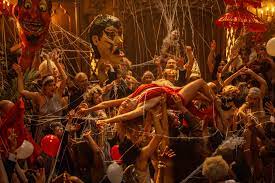
Love it or hate it, “Babylon” has real intellectual ambition.
New Year’s resolution number, go see it if you haven’t, while we still have a choice.
Tyler Perry turns his melodramatic eye on the recent past for his latest, a jazz-and-blues in 1940s Georgia tale titled “A Jazzman’s Blues.”
It’s about race relations under Jim Crow, when miscegenation was a multi-syllable word even the trashiest rednecks could pronounce, when “passing” for white had its perils and when jazz got serious about integration, at least in the cities of the north and west.
Perry’s cooked-up a soapy, sad story of a love-that-could-never-be framed within a little old lady’s efforts to get justice for a murder that happened 40 years before the story’s fictive present — 1987. It’s a musically, dramatically and cinematically flat affair, as Perry leans on the hoary device of having old, exposition-filled love letters read in voice-over, makes little effort hide the fate of our murder victim, whose death isn’t “investigated” at all, and tries to pass off a middling singer as an emerging big band star.
Elderly Hattie Mae (Amirah Vann) picks the right time to hit up lawyer Johnathan Dupree (Kario Marcel) to dig into this case, she figures. He’s running for Congress, and he’s a white candidate trying to prove he’s “not a racist” in rural Hopewell County, where enough Black votes could be the difference come November of 1988.
Her “evidence” about this murder is what she remembers, but more importantly, the letters of the dead man, her son.
Bayou (Joshua Boone) was a sensitive sort, growing up in the Mississippi Delta, dismissed as useless and stupid by his bluesman Dad (J. Roger Mitchell), bullied by his taller, more manly trumpet-playing brother Willie Earl (Austin Scott).
But in those letters, the once-illiterate Bayou lets us hear how he met and fell in love with a fellow outcast, the fair-skinned Leanne (Solea Pfeiffer), nicknamed “Bucket” because her mother dumped her there to be raised by her cantankerous father.
Leanne taught him to read, shared his feelings and was yanked away — as a teen — when the mother who didn’t want to raise her (Lana Young) — showed up to intervene and prevent her Leanne from limiting her life with some poor country boy.
Bayou never lost faith, never stopped writing, even though his letters were intercepted by Leanne’s mother. He and his mother moved to Georgia. He did his time in the Army, came home and started singing in his mother’s juke joint, and pined for his lost love until the day she returned — married to a white man (Brent Antonello), brother to the racist sheriff (Brad Benedict), passing for white herself.
When Bayou’s prodigal brother returns, he has a Jewish emigre and would-be agent (Ryan Eggold) with him. That means Bayou might graduate from singing “Let the Good Times Roll” at his mama’s place, if he can just get discovered.
Yes, the tropes and cliches line up at the door for this pokey, corny and old-fashioned potboiler.
The cast, made up of lesser-knowns and unknowns, doesn’t manage to make most of the characters interesting or the situations that engaging.
The music’s OK, but all over the place in terms of quality. Our “new star waiting to be discovered” couldn’t have won a talent show in any town big enough to be worth mentioning, much less succeeded at a major Chicago club’s showcase.
The entire affair plays out like a middling TV movie, with the “murder” not ever investigated, simply explained via a two hour back story that is the film’s “plot.” Perry barely wrestles with the terror of trying to pass for white in the rural Deep South and brushes by other can’t-miss sources for drama just to keep this drifting movie moving.
There’s no suspense, little that’s thrilling or that justifies any investment in this dawdling melodrama with music. At least Netflix’s accountants are happy. This didn’t cost “White Noise” or “Slumberland” money. But expect them to ask “Madea” to make an appearance next time, if they’re staying in the Tyler Perry business.
Rating: R, violence, drug abuse, sex, profanity
Cast: Joshua Boone, Amirah Vann, Solea Pfeiffer. Austin Scott, Ryan Eggold and Brad Benedict.
Credits: Scripted and directed by Tyler Perry. A Netflix release.
Late March, a more modestly–budgeted musical bio-pic comes our way.
We recognize the ’70s disco and glam rock era icons Casablanca Records signed and rode to glory. The cast of the picture? Aside from Michelle Monaghan and Dan Fogler? Maybe no (Jason Isaacs is also in it).
How cool is it that Sir Anthony Hopkins is “47 years” sober, that he’s 85, and that he shares his New Year’s Eve birthday (TODAY) with Sir Ben Kingsley?
This message reminds us that the Great Drunks of British Acting could have claimed another Burton, O’Toole, Oliver Reed and Richard Harris in Hopkins among their ranks — all, even the longest-lived among them, dead too soon.
And he got sober and lived long enough to win Oscars, become a legend and wish you all a happy new year.
Well, if it took a Henry Selick stop-motion animated horror comedy to put Key and Peele tother again on the screen, we’ll take it.
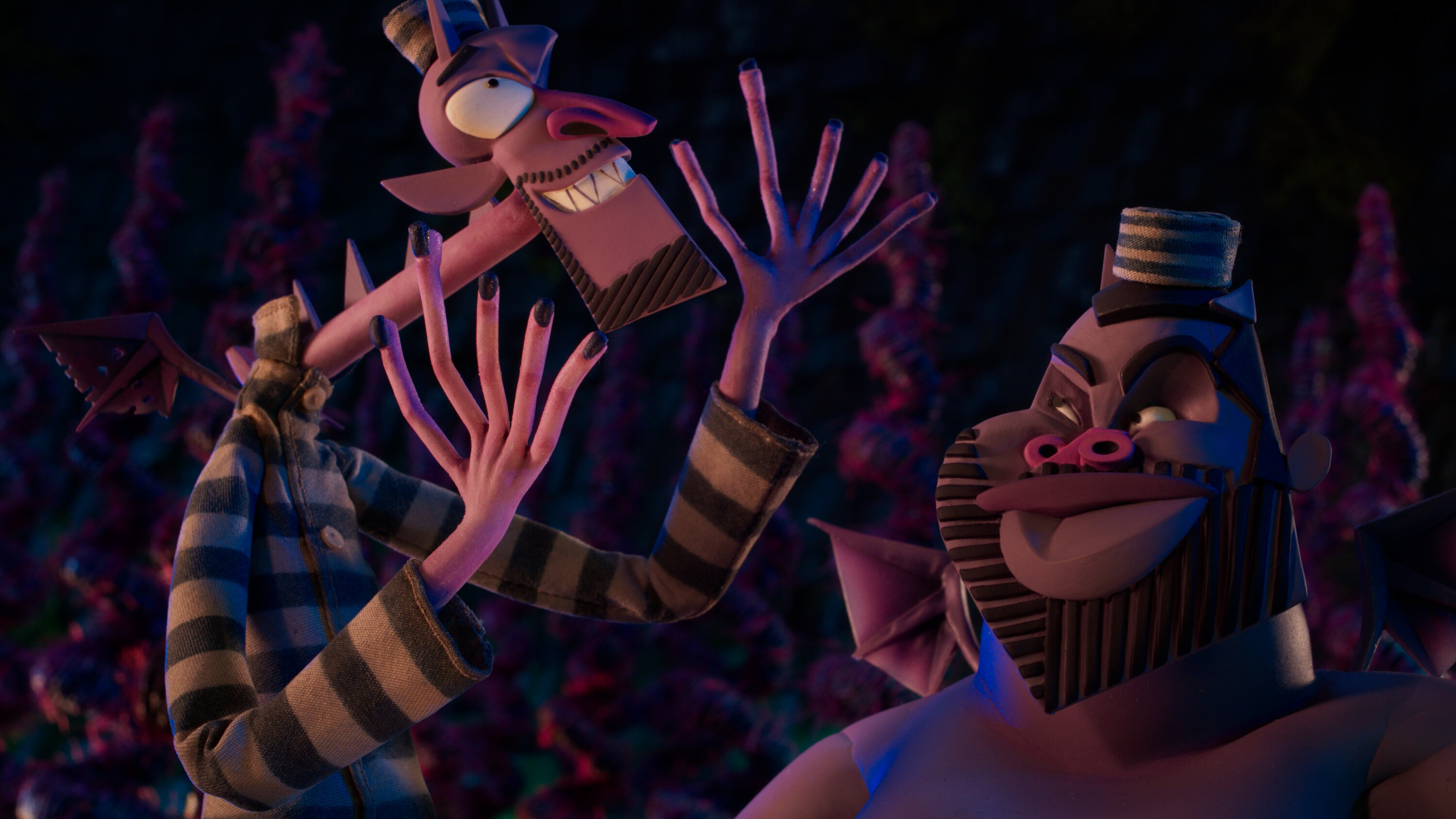
Netflix wrote the checks and the director of “The Nightmare Before Christmas” and “Coraline,” co-adapting a novel with horror hot property Jordan Peele conjures up an animated laugher that is at its funniest when the former team of Peele and Keegan-Michael Key are swapping funny lines in funny voices as the title characters, “Wendell & Wild,” hapless demons who aren’t really the center of the story.
That’s a bit of a letdown in this properly dark, occasionally daft and visually-arresting tween-to-young-adult comedy about death and letting go of the deceased. Oh yeah, it goes there. It’s just not as hilarious or as twisted as you might hope, given the clever folks involved.
A little girl leaves a carnival in Rust Bank, only to distract her Dad on the drive home, causing their station wagon to plunge off a bridge. Mom (Gabrielle Dennis) makes sure Kat (Lyric Ross) doesn’t panic and gets her out of the flooding car. But the child’s last image of Mom and Dad (Gary Gatewood) is of them sinking into the watery abyss.
Years later, we catch up with Kat as she’s headed towards her “do-over,” her second chance. She’s a troubled orphaned teen who can’t stay out of jail. But a new state program gets her enrolled at Rust Bank Catholic School, a once-prestigious institution in a city that’s in its own death spiral.
Father Bests (the legendary character actor James Hong) and Sister Helley (Angela Bassett) would love to keep the doors open. But Rust Bank is in the sites of the Klaxon Korp, whose entitled owners (David Harewood and Maxine Peake) see it as prime real estate for their next for-profit prison.
That’s where “Wendell & Wild” come in. They’re lower-level functionaries in the underworld run but their father, the demonic giant Buffalo Belzer (Ving Rhames). His Satanic pride and joy is his carnival of lost souls, Scream Faire. The sons would love to redesign it into a Dream Faire. And failing that, they get the notion of leaving Hell and setting up their operation in the world of the living.
It’s while they’re tending to the business of restoring their gigantic father’s hair (a follicle seed-drill and hair growing cream operation) that they stumble into their ticket out. That cream brings even the dead and squished ticks in their father’s enormous scalp back to life.
“I bet folks would pay a LOT to come back from the dead!”
Kat, trying like hell to avoid making friends at her new school, where even the rich girls are nice enough to suggest “Prison chic is the next big thing” as encouragement, gets caught up in the prison-building schemes and underworld intrigues thanks to “The Mark” she bears, the dead parents burden she carries, the counsel of her favorite nun and helpful hints from the transgender kid (Sam Zelaya) still stuck at a girls’ school even though he identifies otherwise.
“Wendell & Wild” is based on a story that Selick and horror writer Clay McLeod Chapman came up with and turned into a novel, and it makes for a cluttered, dead end-littered narrative. The title characters want to be and demand to be center stage, but the movie’s far more interested in its “Coraline with Color” teen girl and her story.
That’s how we get into a whole “chosen one” “hell maiden” story, the murderous politics of unscrupulous developers and Kat’s desire to atone for her role in her parents’ demise…by bringing them back to life.
There’s nothing here that couldn’t have worked, all stuffed into the same film. But the dark, dry and whimsical touches of Selick’s best work have their best outlet in the Wendell & Wild scenes, with Key and Peele trotting out their peerless timing to make even bland lines zing to life.
They want to finance their carnival dreams via bringing-corpses-back-to-life?
“We can’t raise the dead!”
“Well, we DO know how to lie!”
“Oooo, I LIKE that plan!”
Rhames is also funny, and Hong can be hilarious.
But the film keeps getting bogged down in teen angst and school and developer intrigues, and that sidelines its funniest voices and funniest characters. The script may score political points, having a transgender character who doesn’t make a big deal out of that transition, nor do his classmates, and commenting on the scammy, corrupt, pro-mass-incarceration for-profit-prison industry.
“You make a pile of money for every prisoner you take. So you pack them in like sardines, provide crap food, crap medical, dangerous conditions, and zero rehabilitation.”
But too little of that plays as comical, or even seems all that promising as fodder for funny.
The arresting, nightmarish visuals and sight gags pay off. It’s just the scanty supply of them that keep a clever idea or three and a novel setting from ever jelling into a movie destined to become an evergreen, a seasonal classic.
So here’s some more unsolicited advice, Netflix. Try again with these guys. They’re onto something, and given another shot, they might just deliver something special.
Rating: PG-13 for some thematic material, violence, substance use and brief strong language
Cast: The voices of Lyric Ross, Angela Bassett, Keegan-Micheal Key, Jordan Peele, David Harewood, Maxine Peake, James Hong and Ving Rhames.
Credits: Directed by Henry Selick, scripted by Jordan Peele, based on the novel by Clay McLeod Chapman and Henry Selick. A Netflix release.
Every film buff has her or his own interpretation of what “Altmanesque” means.
It’s the torrent of words, the hyper-naturalistic dialogue that has everybody talking at once, leaving it to the viewer — with a little help from the sound mixer — to pick out and concentrate on what the most important characters in a scene or situation are saying. A lot of the dialogue is improvised on set, and that simple aural touch gives many of the films their realistic feel, along with a camera plunging us into a seemingly familiar milieu and immersing us in the sights, smells and sounds of it.
He dabbled in a lot of genres, and not every movie Altman filmed fit that style or lent itself to his “Altmanesque” touches. But even in something like “Vincent and Theo,” the Van Gogh picture that preceded his big “comeback” with “The Player,” he could impose his idea of what reality felt like on the frame and in the soundtrack. He was perhaps the most influential filmmaker of his era, and you can see and hear his touches everywhere, on episodic TV, in any cinematic crowd scene, in the movies of Tarantino, Linklater, Paul Thomas Anderson, Soderbergh, the Brit Michael Winterbottom and Mr. “Funniest line on the set wins,” Judd Apatow.
One trademark touch that really stands out in Altman’s grand gambling “bromance,” “California Split,” is the importance of milieu to Altman’s storytelling. In interviews with me and others over the years, he talked about the community he loved to create on the set, and how his archetypal movies mimicked that on screen.
The man loved creating chaos and letting his actors and us make sense of it.
He’d hurl them and us into an Army surgical hospital (“M*A*S*H”), “A Wedding,” a convention (“Health”). He’d visit fashion week (“Pret a Porter/Ready to Wear”), a traveling tent show (“Buffalo Bill and the Indians, or Sitting Bull’s History Lesson”), a live radio variety show broadcast (“A Prairie Home Companion”), a political campaign (“Tanner ’88”), a nascent jazz scene (“Kansas City”) or “Nashville” and an English manor house (“Gosford Park”). And he’d let humans act human, exposing character, story and themes from the chaos that might eventually illuminate the organizing order of life and human behavior.
Elliott Gould, one of the most popular leading men of his day, was a key to Altman’s rise to his 1970s peak. Gould joined an ensemble (“M*A*S*H”), showed off how good he was in buddy pictures (“California Split”) and helped bring Altman and the Altman Touch to classic film noir (“The Long Goodbye”).
Gould, like his “Split” co-star George Segal, was shockingly good at buddy pictures. Segal and Redford chased “The Hot Rock,” Gould and Donald Sutherland made “M*A*S*H” settle into buddy picture rhythms, paired up again for “S*P*Y*S,” and Gould almost made James Caan funny in “Harry and Walter Go to New York. Even Segal’s peak-years rom-coms (“A Touch of Class,” “The Owl and the Pussycat”) felt like buddy pictures, buddy pictures with a hint of sex.
Parking these two in the same picture pays off in pretty much every shared scene of “California Split,” with Gould playing the Jewish tummler here, although both actors took on that guise in films during their peak years, with Segal the better “reactor” and straight man of the two.
Charlie (Gould) is a chatterbox professional gambler, handsome and gregarious but seedy and an adrenalin junky looking for “action,” wherever it might be. William (Segal) is a magazine editor, separated from his wife and deep enough into gambling that his path is sure to cross Charlie’s in their corner of Southern Cal — at the poker room or at “the track.”
Charlie’s literal rough-and-tumble lifestyle — he gets beaten up by the pals of a poker player he humiliates, carelessly mugged on another occasion and crashes with a couple of call girls (Ann Prentiss and Gwen Welles) because he can’t be bothered to own more than one sports coat or rent his own place, even when he’s flush — is what William gets sucked into over the course of a long, indulgent dive into this form of addiction.
There’s the usual Altman love-hate relationship with women and sex here, as world wise Barbara (Prentiss, younger sister of Paula) and Charlie are constantly having to buck younger Susan up after she lets herself fall in love with some client and naively hope for a better, normal life out of what the men always treat as a transaction. Charlie and “Bill” hustle a transvestite client (Bert Remsen) of theirs without a hint of guilt, or prejudice.
And unlike most Altman films, you never lose the feeling that you’re immersed in the reality of the seedy bars, backroom poker games or Reno-sized casinos, which sometimes have actors in bit parts, but rely a lot of real dealers and barmaids and amateurs who seem like real gamblers. The crowd scenes here — at the track, at the fights — are the most realistic Altman ever filmed.
He even gave the cliched “get even with the guy who beat me up” scene Altman comic touches to go along with a degree of “What it worth it?” blood.
“California Split” is a classic “on a roll” gambling comedy, more “Let It Ride” than the tutorial and scary “Rounders,” and very much the inspiration for “Win It All” or the somewhat more straight-laced Ryan Reynolds/Ben Mendelsohn gambling partners tale, “Mississippi Grind.”
Segal’s William is either a chronic loser, or a guy who’s settled into a losing streak — a lost marriage, a teetering career and an increasingly intimate relationship with his bookie.
Gould’s Charlie takes his wins and never really lets us see his losses, which is where William’s complaint “Where do you get your CONFIDENCE?” comes from. We see Charlie snake some woman out of placing a winning bet at the track, a bet which he makes and becomes a huge score. We see him clean up at assorted poker tables, and hear where he went when he disappears for a chunk of the picture as William slides into debt and into trouble at work (a young and pimply Jeff Goldblum plays his callow editor in a single scene). Charlie went to Mexico, and the fact that we’ve seen him with rolls of cash just makes us realize that he’s a social media era gambler before there was social media.
“I’m in Tijuana. I’m at the dog track. What do I know about dogs?”
He only lets us see what he wants us to see.
Throw these two together, soak them in alcohol and flop sweat and let them sing and kvetch their way from Santa Anita to Reno, with Segal playing the straight man to Charlie’s offhand, laid-back but non-stop “Altmanesque” patter.
At a poker club’s table filled with little old ladies, overheard above the bets, antes and banter — “I don’t care how old you are, right in the choppers, lady.”
They sing songs from “Dumbo” and bet on everything from pick-up basketball games to who can name all seven dwarfs.
And when the end of the line comes, it lands with a soft thud. Because in gambling, as in life, there are no hard finales or final curtains, just a “streak” that ends, a chapter that closes and another one begins. There’s always another “40-80 lowball stud game in Reno” on the horizon.
Cast: Elliott Gould, George Segal, Ann Prentiss, Gwen Welles, Bert Remsen
Credits: Directed by Robert Alman, scripted by Joseph Walsh. A Columbia release on Tubi, Roku, Amazon, etc.
Running time: 1:48
Posted inReviews, previews, profiles and movie news|Comments Off on Classic Film Review: Gould and Segal partner in Altman’s Ultimate Buddy picture, “California Split”(1974)











 Movie Nation