
A good punch in the gut to end July, right?
A24 knows horror. This one opens July 28.
A good punch in the gut to end July, right?
A24 knows horror. This one opens July 28.


John Sweet’s not a name you think of when you remember the great actors, or even the lesser ones of Hollywood’s Golden Age. He was a Minneapolis schoolteacher turned sergeant in the Army, training in Great Britain to liberate Europe from fascism when he was “discovered” by the producing/directing duo Michael Powell and Emeric Pressburger,
Something about Sweet’s drawl and lanky, folksy demeanor suggested an idealized GI to the British filmmakers — a blend of “foreignness,” common sense and common decency — so they drafted him into duty on their World War II allegory, “A Canterbury Tale.”
Sweet gives a grand, unaffected “real person” performance in this film, one of several “morale boosting” keep-calm-and-carry-on movies Powell and Pressburger made during the war, a lighthearted, sentimental follow-up to their anti-isolationist classic, “The 49th Parallel.”
It’s a vaguely Chaucer-esque yarn about “pilgrims” — an American GI, a British Tommy (Dennis Price), and a London shop girl (Sheila Sim) enlisted to do farm work in the country — who meet on the train to Canterbury, get off one stop short and tumble into a local crime and mystery.
Veteran heavy Eric Portman is Colpeper, the mysterious local landed gentry now magistrate of tiny fictioncal Chillingbourne, not far down “The Pilgrim’s Way” from the cathedral city immortalized by Geoffrey Chaucer’s 14th century story collection, “The Canterbury Tales.”
When the lost American Sgt. Johnson, ag worker Alison and received pronunciation posh Sgt. Gibbs stop there, Alison is doused by the locally-infamous scoundrel “The Glue Man.” As the magistrate seems to have all the power in town and a few peculiar habits with regards to the visiting soldiers, and no more eagerness to solve the crime than the constable or any other locals, Alison enlists the other “pilgrims” to crack the case, with all eyes pointing to Mr. Colpeper being the culprit.
I mean, he’s played by Eric Portman. Of course he’s the prime suspect.
The sleuthing entails Alison’s taking a farm job and quizzing the locals, Sgt. Gibbs working out the MO of the criminal and Sgt Johnson’s winning ways with the nosy, gossipy local boys, all of whom are busy playing war and providing clues.
The historic road has had a bit of archeological excavation recently, and coupled with this idealized view of the WWII English (Kentish) countryside, we hear a little about English patrimony, the long history of freedom, and cracks about the “tea drinking, left-side driving” and of all things The Domesday Book from cornball Bob, the Sgt. from Oregon.
“Tea? I don’t like that stuff.”
“Sure, it’s a habit, like marijiuana!”
“I’ll take marijuana!”
The “snooping about” and clue-collecting “story” isn’t what’s interesting now, almost 80 years later. It’s this sense of “This is the Britain, the traditions, people and freedoms that we’re fighting for” messaging.
The jokes that still work (one of them Cheech & Chong approved) include cracks about “isolationist” Americans, the Anglo-American language barrier and the wonderful black and white depiction of Kent — thatched barns, rolling fields (traversed by speeding Bren-gun armored personnel carriers) and ancient horse-and-wagon folkways still in use there.
And then there’s the cathedral city of Canterbury itself, and a glimpse of what inspired this “tale” — a war brought home to all of Britain, at one point or another.
Powell was a star director by war’s end, and would go on to make some of the most gorgeous movies ever filmed in color — “The Red Shoes” and “Black Narcissis” among them.
Price enjoyed a long career after this film, Sims only worked for another decade. And Sweet, the soldier drafted into film acting for just a short period of 1944, playing a poster boy American GI of the day, made it through the war and back to teaching school — with a little stage acting on the side — in America.
He’d played the earnest, honest and upright uniformed American come to save democracy and not hit on every English rose he spied in the lcoal pubs and dance halls, a bit of home-front propaganda for pre-D-Day Brits perhaps wearying of the noisy, boisterous and catnip-to-the-ladies Yanks who had “invaded” their “scepter’d isle.”
Who could live up to that “ideal Yank” image? Maybe John Sweet could. He took the $2000 he was paid for his one and only major film role and donated it to the NAACP. He retired to the English-style retirement village “Fearrington” in North Carolina, and died at age 95 in 2011, a model example of “The Greatest Generation.”
“A Canterbury Tale” may not be top rank of films from Powell’s canon. It’s dated in some unflattering ways (a stammerer is ridiculed as “the village idiot”). But it makes an adorably quaint snapshot — complete with marijuana joke — of the war in Britain and an English countryside perhaps properly spoiled by progress and by too many years of TV’s “Escape to the Country.”

Rating: “approved”
Cast: Eric Portman, Sheila Sim, John Sweet and Dennis Price.
Credits: Scripted, directed and produced by Michael Powell and Emeric Pressburger. An Eagle-Lion release on Tubi, Amazon, Tubi, etc.
Running time: 2:04
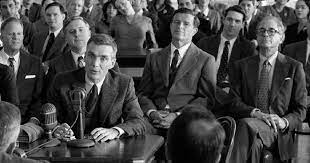
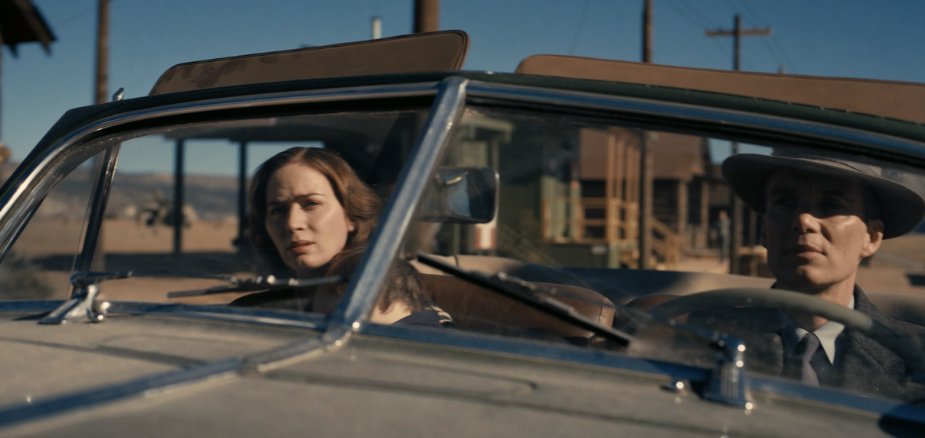

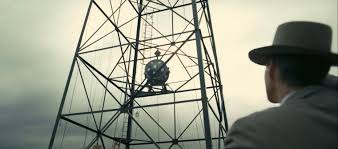
Christopher Nolan turns his considerable talents back to World War II era history for “Oppenheimer,” a biography that plumbs the genius, foibles and moral and ethical dilemmas faced by “The Father of the Atomic Bomb.”
It’s an all-star revisiting of an epic undertaking, the race to build a bomb “before the Germans get one,” envisioned as a cinematic whirlwind of science, history, intrigues and tragedy. Riding on the shoulders of a haunted performance by Cillian Murphy in the title role, a subtly-shaded turn by Robert Downey Jr., the bluff, blunt and funny presence of Matt Damon and a brilliantly brittle interpretation of Oppenheimer’s wife by Emily Blunt, it’s a magnificent film, head-and-shoulders above every other movie of the summer, and not just in its ambition.
Nolan’s script, based on the book “American Prometheus: The Triumph and Tragedy of J. Robert Oppenheimer,” sweeps us through the genius physicist’s academic achievements as the “man who brought quantum mechanics to America,” his mastery of any subject that entered his field of vision, his masterly management of The Manhattan Project, a very smart man’s dalliance in liberal-to-left-wing politics, his humanism and his womanizing.
Murphy’s Oppenheimer has the faraway eyes of a dreamer, with Nolan slipping vivid imaginings of what that mind was “seeing” when he pondered black holes and the physics that runs the universe. And this “Oppie” has the cocksure quick wit and swagger of a someone who knew he was the Smartest Man in the Room, and acted — sometimes recklessly, sometimes humorously — on that confidence.
“Why don’t you have a Nobel Prize?” Army officer/West Point-and-MIT-educated engineer Leslie Groves (Damon) bluntly asks the man he wants to manage the “Manhattan” project when they meet.
“Why aren’t you a general?”
The story is framed within Oppenheimer’s closed-hearing “trial” which revoked his security clearance in 1954, with his critics and defenders facing judgement from the likes of Gordon Gray (Tony Goldwyn) and grilling from judge/prosecutor, Roger Robb (Jason Clark).
And that frame is tucked within another, the Senate hearings of a former Oppenheimer champion and 1950s Eisenhower administration cabinet nominee, Lewis Strauss (Downey).
The thread that runs through those scenes and spreads into the flashbacks that recreate Oppenhimer’s much-documented life story is “Who’d want to justify their whole life?” He can dismiss ill-informed questions about why he didn’t attend the finest physics program in America, at Berkeley, with “Because I hadn’t built” that program yet. But studying in Britain and especially the world’s enemy, Germany, was seen as a red flag in his life story.
Oppenheimer’s attraction to the mercurial, unromantic communist Jean Tatlock (Florence Pugh) is shown, and when this “questionable association” is revisited in his security clearance hearing, their sexual encounters migrate from hotel rooms to his chair in the hearing chambers, both of them naked before his accusers.
The story of Oppenheimer’s life is reflected in the great figures who were his peers — Kenneth Branagh is somberly playful as the great Danish physicist Niels Bohr, Tom Conti is the weary, elderly Einstein, Josh Hartnett is Nobel prize-winner Ernest Lawrence, Benny Safdie is an always-sweaty H-bomb champion Edward Teller.
Through it all, the politics of the era pass by outside the halls of academia and later the hastily-built city of Los Alamos. Oppenheimer knows Marxism and its limitations because he read “Das Kapital” in “the original German.” He supported the Republicans in the Spanish Civil War, because only fascists didn’t, and his brother and sister-in-law became “card carrying communists” and he wouldn’t distance himself from them because they were his brother and sister-in-law.
He loved women, and impregnated and married Kitty (Blunt), whom he met at a cocktail party with her significant other.
“You’re married to Dr. Harrison?”
“Not very.”
And he learned Sanskrit to read the “Bhagavad Gita,” and when the “Trinity” nuclear test blast succeeded in July of 1945, he quoted it.
“I am become death, the destroyer of worlds.”
Nolan shot Congressional hearings and media scrums surrounding the Oppenheimer of the 1950s in the black and white of TV memory, and the epic story of Los Alamos and the life that led up to it in vivid color, folded into flashbacks within these frames.
Nolan’s films are famous for their sound design, and here that’s most impressive in the Trinity sequence, stunning silence underscoring the (non digital) pillar of boiling fire created by the world’s first atomic bomb, shattering noise erupting not just when the shock-wave of the blast passes over the scientists and soldiers, but when the shock of what they’ve achieved and what he’s wrought rattles Oppenheimer.
This brisk but long film’s third act delivers a clever echo of that shock, when Oppenheimer plays to the crowd at a celebratory gathering of those who worked on the project, stunned by their noisy enthusiasm even as he is almost as conflicted about this achievement as colleagues like Isidor Rabi (David Krumholtz, terrific) about the carnage their bombs wrought.
The film balances the much-debated moral quandary of the fateful decision to drop bombs on a fanatical enemy whose war-criminal leadership would have never surrendered via characters and character studies. Oppenheimer is parked on the fence while Groves and others march on in a panicked rush and sensitive colleagues question how much “blood” they will have on their hands.
Nolan leaves no doubt in where the “plain-speaking” American president at that moment sits on that scale.
When the movie makes points about what Hitler disdained as “Jewish science,” it hints at what might have played a role in Oppenheimer’s fall, an outspoken man in an era when America proved itself willing to remember anti-Semitism and forget the many Jewish scientists involved in bringing World War II to an abrupt end.
The filmmaker sees Oppenheimer as a war hero torn by his place in history, martyred by McCarthy Era politics, which isn’t necessarily a new or fresh take. There was a memorable BBC/PBS TV series — 1980’s “Oppenheimer” starred Sam Waterston — a good TV movie (1989’s “Day One” film David Strathairn as Oppenheimer, with Brian Dennehy as General Groves) and the ambitious but not-quite-epic 1989 feature “Fat Man & Little Boy,” which starred Paul Newman as Groves and Dwight Schultz as Oppenheimer.
But Nolan gives us something like a definitive take on the man, his work and the times he lived in, a film with the science and scientists of “The Theory of Everything,” the tortured/martyred genius of “The Imitation Game” and the mad scramble headiness of America in a race against history’s villains of “The Right Stuff.”
The only time this latest film on this controversial figure feels too long is the third act, which makes its “decline and fall” points, and then labors on to the point of belaboring.
In “Oppenheimer,” Nolan tells an epic story tacked onto an introspective, multi-faceted life, a hero in the Greek tragedy mold — brilliant and focused, but a man who knew his flaws and conflicted enough about his work that he all but accepted his fate as just deserts for all the “blood on my hands.”

Rating: R, sex, nudity, profanity
Cast: Cillian Murphy, Emily Blunt, Robert Downey, Jr., Florence Pugh, Matt Damon, Mattew Modine, Kenneth Branagh, Josh Hartnett, Jason Clarke, Benny Safdie, Rami Malek, Olivia Thirlby, Dane DeHaan, Tom Conti and Gary Oldman.
Credits: Scripted and directed by Christopher Nolan, based on the book by Kai Bird and Martin Sherwin. A Universal release.
Running time: 3:00
A cynical, snarky semi-musical about womanhood and marriage from the Latvian director of “Rocks in my Pockets.
Oct. 6.

It begins all conjunto cute and jaunty and finishes with a banda band flourish.
But it’s the dull, cluttered and formulaic middle acts that let down “The (Almost) Legends,” a tale of half-brothers and a Mexican band/Mexican road rally racing legacy that they try to live up to.
This Mexican comedy — titlted “Los (casi) ídolos de Bahía Colorada” south of the border — is colorful in its setting, its music and some of its characters, but sadly colorless in execution, a picture that loses its edge and its “cute” when it puts down the accordion.
Our narrator is Valentin (screen veteran Guillermo Quintanilla), banda conjunto king and self-described “The People’s Idol” of Bahia Colorado, a beachside tourist town in the northwestern Mexican state of Sinaloa.
He jovially tells us the story of his happy family in the town…and “family B,” seemingly just-as-happy, working and living aboard the cruising ferry where his band plays a regular gig.
“God gave me plenty of love to give,” Valentin admits.
In town, he races his 1980s AMC Eagle in the annual circuit-around-the-state road rally thanks to help from his mechanic mother (Nora Velázquez). His little boy Romeo dreams of doing that some day.
On the ferry, his other son Preciado idolizes the musician and dreams of leading his own band some day.
Valentin is such a smooth talker than when Preciado’s mother dies, he’s able to persaude his other wife to take Preciado in. But after Valentin’s untimely demise — at sea — things fall apart. Romeo ditches his mom to seek telenovela fame in Mexico City. Romeo’s mom kicks Preciado out, leaving his grandmother to take him in and under her wing.
Years later, the still-cocky but unsuccessful Romeo (Benny Emmauel) returns to try and score some cash by winning the race that his dad dreamed of winning, and struggling band-leader/mechanic Preciado (Harold Azuara) figures he’ll do the same.
As Romeo can sing and his hated half-sibling Preciado cannot, we know where this picture is going. But the middle acts bog us down on the way with intrigues involving a rival family, a sexy rally-driving prodigy daughter (Ana Celeste) and visits with relatives and old allies in search of a winning ride and the like.
The nice touches include losing one’s delusions of your “famous” “almost” legend father and any time any band strikes up a song, no matter how bad the singer. The middling bits are pretty much everything else, including the under-staged “race” that was the picture’s big hook, in the minds of the writer and director anyway.
Emmanuel and Azurra are OK, but the older players, especially Quintanilla and Dagoberto Gama as his still-living rival patriarch give the picture its few laughs. Tiresome gags about rival Don Tasio’s son preferring hair-dressing to racing cars don’t play.
But the many disses and references to “f—–g Americans” (in Spanish with English subtitles) are worth a cross-cultural giggle. And the band bits and musical moments are “authentic” enough to make one wish they’d focused on that more, and on that damned AMC Eagle a lot less.

Rating: TV-MA, sexual situations, profanity.
Cast: Benny Emmanuel, Harold Azurra, Ana Celeste, Nora Velázquez, Dagoberto Gama and Guillermo Quintanilla.
Credits: Directed by Ricardo Castro Velázquez, scripted by Carolina Rivera. A Netflix release.
Running time: 1:36
No “Minions,” but birds in flight. And a family having relationship and “vacation” issues.
Looks good, vegetarian and “green.”
Dec. 22.

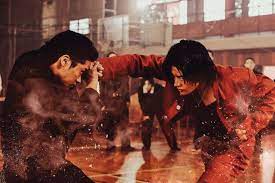

The Japanese Boy Band brawlers “media franchise” “High & Low” may be the craziest thing you ever drop in on as you travel Around the World with Netflix.
It is, in many ways, the classic Japanese “give the people (teen girls especially) what they want” entertainment, attached to an absurdly violent “universe” of high school lads who spend half their time fighting, and the other half getting their hair styled and picking out cool outfits to wear into battle.
“High & Low: The Worst X” is the seventh film in this “franchise,” following TV series that have had half a dozen seasons in assorted incarnations, all of it designed around runway-model lads brawling and bonding with the marketers bragging that “every one is a leading man.”
It’s a film set three years after events in a previous film, with unexplained references to “SWORD” and other entities and alliances of earlier installments. But it’s more or less a stand-alone movie, and it’s pretty much rubbish — shiny, well-shot and edited rubbish, but rubbish none the less.
Some of the set piece fights are reminscent of classic Hong Kong punch-em-ups of the Bruce Lee/Jet Li/Jackie Chan/Donnie Yen variety. But the colorfully-attired “schools” — Oya High, Housen Academy, Senomon Tech — have “The Warriors” vibe.
Unlike the gang bangers fighting their way back home to Coney Island in that 1979 Walter Hill classic, there is no quest for “home,” no allegorical homage to Xenophon’s “Anabasis,” which inspired Sol Yurick’s novel “The Warriors.”
No, this feels like an action franchise produced by a marketing department, cast by a modeling agency and costumed by a fast-fashion clothier. The only thing allegorical about this simplistic tale of “who’s the toughest fighter” tests, factions fighting and allying with each other and a rich kid sort of manipulating the many high school gangs of Taoru City is what the films might be saying about modern Japan.
The world presented here has no cops, no teachers, no classes in these graffiti-covered schools and hideouts, and no girls or adult women.
Yes, it’s occasionally homoerotic. It might seem too violent for high school girls to get into, but maybe girls in the Land of the Rising Son are raised on “A Clockwork Orange.” Still, if you wonder about Japan’s population loss and general, decades-long decline and post-peak malaise, there might be a clue in this nonsensical monoculture where boys will be boys and the fairer sex is never ever seen, only pandered to in the sea of pretty boys cast in the thing.
Fight choreographer/action directors Takahito Ôuchi and Masaki Suzumura do their best to stage and shoot some epic brawls as the brash Fujio (Kazuma Kawamura) of the Oya School gang tries to get a meeting with the legendarily tough Rao, who is absent for most of the film, but who makes a Ryan Reynolds entrance (he even resembles RR) in the third act.
There must be 40 or 50 characters identified by name and school in this movie, many of them getting a credit freeze-frame credit in the “High & Low” opening, but the film’s IMDb page is woefully inadequate, with many the most important characters not listed. Several characters have several different ways of being addressed in the film, adding to the confusion. And the film’s on-screen credits are only available in Japanese (same with the dialogue, which at least has subtitles).
So no, I’m not going to wade through the long list of actors and the archetypes they play — the quiet, bespectacled “smart” fighter, his “fishing buddy,” the deadly dress-alike-duo, the rich punk whose father bought out another man’s company, forcing the bankrupt fellow to become the kid’s driver and the driver’s son, Saboten (Ikuya Naganuma) to be the punk’s insanely-tough high school gang bodyguard.
“Let’s get this brawl started.”
“Dibs on kicking your ass!”
Some performers are great brawlers and others plainly the beneficiaries of “Let’s not show him fighting much” protective editing.
Every fight has its moments where you think, “That haymaker would break every knuckle in that hand” and others that give-away the game (obvious stage punches).
Groups of guys are constantly striking album cover poses or walking into the frame in perfectly aligned slo-mo. It’s all so pretty, even the bloody bits.
But none of the care taken with the visuals and potential poster shots of all the over-styled “stars” trickled down to the screenplay, with only the occasional snappy come-back making us forget the lack of a plot, logic, character motivation (in most cases) or sense that any of this means a damned thing.
“The Worst X?” Let’s hope so.

TV-MA, violence and lots of it
Cast: Kazuma Kawamura, Ikuya Naganuma, and Yuta.
Credits: Directed by Norihisa Hiranuma and Daisuke Ninomiya, scripted by Norihisa Hiranuma, Shôichirô Masumoto and Kei Watanabe. A Netflix release.
Running time: 1:59
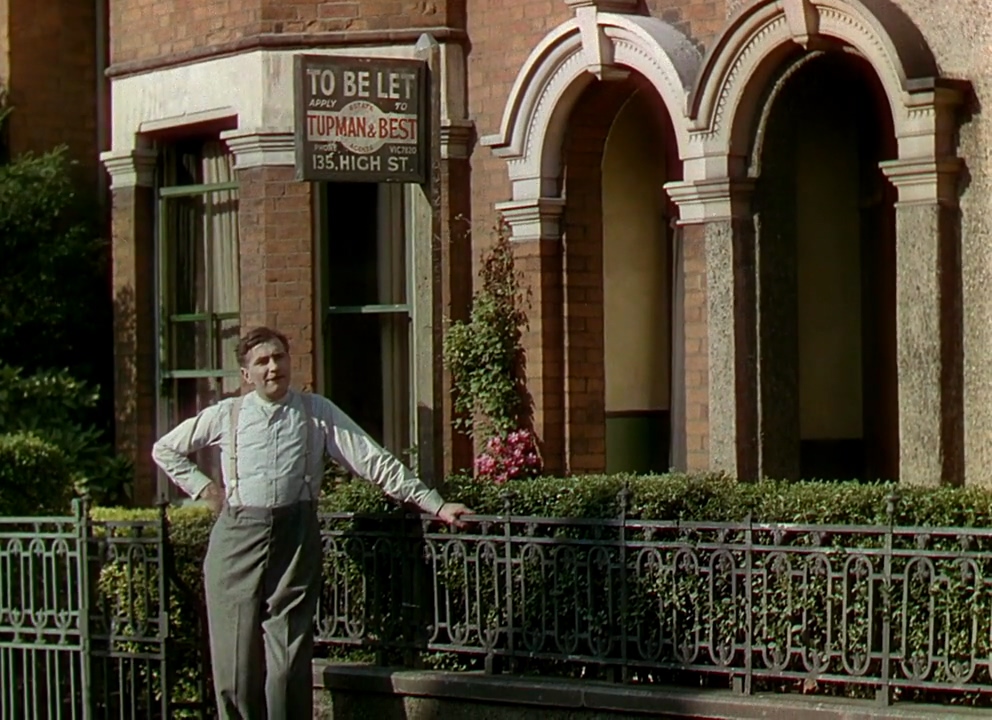
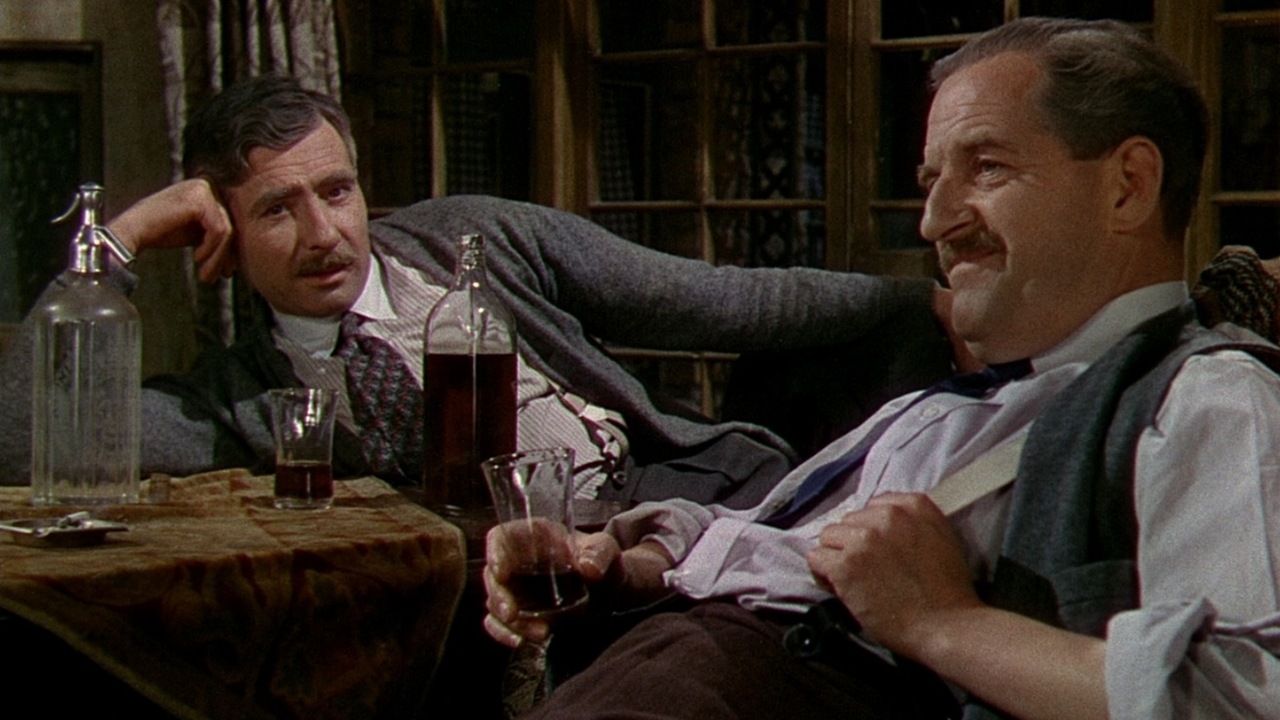
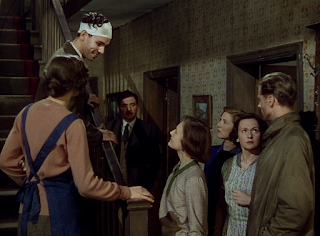
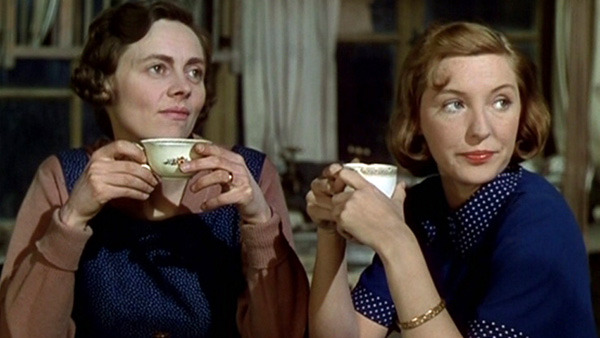
“This Happy Breed” is a middling if affectionate domestic melodrama that spun out of the creative fervor of playwright Noël Coward‘s most productive years, the 1920s and ’30s. It was Coward’s attempt at peeking in on the working class he came from and left behind. Preserved on film with a lavish late-war Technicolor production in 1944, one can only wonder if it didn’t feel a bit bougie even to audiences back then, as if this posh panderer of the upper classes couldn’t help it.
But there’s little sense of his looking down on his subject and his characters in this 1939 play (first produced in ’42) that was filmed just as the World War it prefigures was winding down. Whatever the “family lives through the inter-war years” intent of the work while new, by the time it was released in the UK (making it to the US in 1947), it played like an appeal for a return to normalcy and a celebration of the “ordinary folks” who rode the tides of top-down economics, labor strife and political bungling, keep that stiff upper lip and “Rule Britannia” in their hearts and carry on.
“I wonder when the next war will be?”
“Not in our time, or our son’s time.”
The movie version would turn out to be “Lawrence of Arabia” director David Lean’s solo-directing debut. The editor-turned-director Lean split directing duties with Coward on the playwright/screenwriter’s fine destroyer-at-war drama “In Which We Serve” (1942). Here, he’s given the keys to the toyshop — a colorful, sound-stage and outdoor settings for military parades and the like remembrance of times “While England Slept,” if not a critique of “Why England Slept.”
Newly-restored, “Breed” is well worth a look, and makes a nice companion piece to mid-war “homefront” films like “Mrs. Miniver.”
It’s not Lean’s showiest picture or particularly impressive in any cinematic regard, at least partially owning to the limitations of Technicolor and Lean’s status as a newish director unfamiliar with color. But the script has a fluid throughline, the cast is spot-on and the performances have a life that transcends the affectations of the writing and pre-Method formality of British screen acting of the day.
We follow the Gibbons family through 20 years of modern British history, all of it lived in a High Street townhouse in Clapham, London. In 1919, the former Sgt. Frank Gibbons (Robert Newton) is newly “demobbed,” mustered-out of his army regiment and moving his family into their new home.
Frank has a job in a travel agency, arranging “battlefield tours” for a civilian populace that has no idea of the horrors he and his comrades faced.
Celia Johnson is wife Edith, still unused to not having “that weight” hanging over her, fearing every day’s mail because it might bring news of her husband’s death in the trenches.
They have three children — the spirited Queenie (Kay Walsh), more reserved and traditional Vi (Eileen Erskine) and son Reg (John Blythe).
Wonder of wonders, an old comrade in arms (Stanley Holloway) has already moved in next door. His son Billy (John Mills) is early in a career in the Royal Navy, and takes an instant shine to Queenie.
Some of the film’s tenderest and most Coward-like scenes are built around Queenie’s early realization that she “hates it here,” all this suburban myopia and the limited life it promises. She is the character Coward might have indentified with most, working class with a taste for the finer things, the faster life and high-living refinement. She rebuffs Billy more than once, tearfully arguing that she won’t make much of “a sailor’s wife.”
Son Reg gets mixed up with young political agitator Sam (Guy Vernery), who in between rants about capitalists and workers’ rights, takes up with unassuming Vi.
History marches by these characters — the 1924 British Empire Exhibition, the General Strike of 1926, elections going to Conservatives who reduce the size of the armed forces (by League of Nations arms treaties, the film leaves out), no real mention of the Great Depression, the funeral of King George V, the abdication of Edward VIII dealt with via a premature removal of a calendar, those first photos of Herr Hitler in the newspapers and first mentions of Japanese aggression in the Far East and “Peace for Our Time” a fading hope.
Frank’s politics and attempts to ignore the outside world are based on two simple facts. One, he’s home with his family and two “I belong to a generation of men, most of whom aren’t around any more.”
Through it all, there are weddings and tragedies, Charleston dance contests and bickering between Edith’s aged mother (Amy Veness) and Frank’s spinster sister (Alison Leggatt) all tied together by a general sense of pre-war pub-crawling, tea-drinking and “Keep Calm and Carry On” before it became a World War II motto.
Frank and others have the foresight to note that World War I led to a “tired” Britannia, and remind late-war and post-war audiences of the weight of that mass slaughter informing their refusal to accept that another war could be coming.
Coward, a salesman’s son who became poster boy for upper class wits, gets a few political digs in — sympathizing with labor despite the “down with everything” pronouncements of Sam and his fellows.
“Where they go wrong is trying to get things done too quickly,” Coward/Frank declares, reminding his wife that they’re a patient “nation of gardeners.”
Newton, a notorious alcoholic, gives his usual spirited performance despite whatever he was doing off-set and between takes. Was he really fined the equivalent of his entire salary for holding up the production?
Mills stands out in the supporting cast, giving Billy a lovesick puppy-dog demeanor and hard-edged, rising-through-the-ranks-pragmatism in later scenes when he stands up to mercurial Queenie. For all her “good time” cravings, her “sailor’s wife” qualms are validated when we see the destination sticker on her luggage in one of the film’s last scenes, set in 1939.
“Singapore.”
Its late arrival in cinemas washed away any mid-war propoganda value “This Happy Breed” (a phrase from Shakespeare’s “Richard II”) might have had. One can watch it now and see Coward getting in the first shots of revisionism in selectively reminding “the ordinary people” all the country went through thanks to the shock of World War I and the turmoil of the ’20s and ’30s. But it does give one a sense of context about the history this generation lived through without realizing what was coming, because most people didn’t.
And if we don’t see the future that awaited David Lean in this bland but colorful box office hit, we’d do that soon enough when he returned to black and white and discovered his flair for Charles Dickens adaptations.

Rating: approved
Cast: Robert Newton, Celia Johnson, Kay Walsh, Alison Leggatt, John Mills, Amy Veness, Eileen Erskine, John Blythe, Guy Verney and Stanley Holloway
Credits: Directed by David Lean, scripted by David Lean, Ronald Neame and Anthony Havelock-Allan, based on the play by Noel Coward. An Eagle Lion/Universal release on Tubi, Amazon, Youtube etc.
Running time: 1:50
The summer’s prestige picture, an historical epic hanging on a scientific achievement that was also a great moral and ethical quandary, is a three hour argument for the stardom of Cillian Murphy.
We’re all dying to see this one. I did a college internship at a PBS affiliate one summer that was finishing up a documentary on a couple of atomic scientist veterans of the project, and I got to help out in suggesting classical music (public domain) for segments of the sound track, seeing as how I had been working in public radio all during school. That turned out to be a deep dive into something that few films — “Fat Man and Little Boy” among them — have tried to tackle.
A grand national scientific achievement that can be celebrated and debated until all involved are blue in the face, this is a big canvas and important subject, one worthy of Christopher Nolan’s companion piece to “Dunkirk.”
They’re showing it on a BIG screen, I hope. We’ll see.


 Movie Nation