


Movie Review: Cinematic Crap on a Georgia Cracker –“The In-Law Gang!”

One of the gifts or curses of reviewing films for decades is that ability to spot a fiasco in the first few frames.

Some movies start off with promise and lose it. Some stumble but give you the hope that they’ll settle down. But a “fiasco” is a movie that makes one wonder why it was ever made, why those who made ever thought they were capable of faking “competence” in their script, on a set directing a 20-30 day shoot and in the finished product — 97 minutes of screen time.

“The In-Law Gang!” is bad from the get-go, and only gets worse the more “going” it gets through.

A flatly-acted opening scene shows a holiday meal the abruptly ends when the hostess wields the carving knife in a manner that underscores “This is OVER.” No escalation to that moment, no acting signs of heightened emotions and fury. Just a limp direct insult or two and bam, “knives out.”

The credits that follow are the most banal collection of street signs and ariel shots ever to underscore credits. Is Macon, Georgia, the setting? Atlanta?

The Vegas Elvis impersonator wedding chapel scene that marries Cassie (screenwriter and star Jessie Jaylee) and John (Nashawn Kearse) features the impersonator singing “Love Me Tender,” whose copyright usage might have cost more than the movie, and the rustling sounds of fabric against microphone.

That’s great, because much of the movie sounds off-mike. No, most movies don’t merit release with such amateurish blunders in the finished film.

The story is about that marriage, and the war on it waged by the mother of the groom (LaShonda “Lala” Courtney) and her minions.

“Operation: Broken Marriage is in full effect!”

The insults, by one and all, are right to Cassie’s face — at meals, at meetings, around the Christmas tree.

“Let’s hope John is better at picking presents than he is at picking wives!”

Simple as that plot is, the movie wanders all over the place trying to flesh that big fat nothinburger into something that employs a LOT of actors.

Characters wander into the tale without properly identifying themselves or being identified by others.

“Heated” arguments have no heat. Sets look like something whipped up with no time and no money (a restaurant that looks like what it is, a briefly-rented storefront).

And blown lines abound, a common trait shared by many a film meriting the label “fiasco.”

“You act like I was asked to be born…” “Why argue over something of such less importance?”

Does nobody know the mother tongue well enough to know they’ve blown a line and ask for another take? Was it scripted this way?

Is director J. Jesses Smith deaf? Or was this the best take he could get?

The acting’s bad, with only established player Clifton Powell coming off as “belongs on a movie set.”

Our screenwriter/leading lady, her leading man and the hip hop music video director behind the camera would have been better served burning this misfire rather than letting the world know you don’t know what the hell you’re doing.

Rating: unrated, decorated with F-bombs and songs with F-bombs

Cast: Jessie Jaylee, Nashawn Kearse, LaShonda ‘LaLa’ Courtney, Clifton Powell

Credits: Directed by J. Jesses Smith, scripted by Jessie Jaylee. An Entertainment Squad release.

Running time: 1:37

Posted in Reviews, previews, profiles and movie news | Comments Off on Movie Review: Cinematic Crap on a Georgia Cracker –“The In-Law Gang!”

Movie Review: Pranksters watch a video and the horrors of “Baby Blue” visit them, one by one

There’s always a hint of defiance in mentioning the movie you’re most determined to steal from. It’s a dare, like “Sure, COMPARE our movie to that one.” Usually, it’s a bit misguided.

“You can’t outrun the curse! Haven’t you ever seen ‘The Ring?'”

Why yes, yes I have. And its sequels. And lots of ther movies that have used the “Don’t look at that video/answer that phone or you’ll be CURSED” hook. And a lot of horror movies with a “found footage” element, maybe vloggers who “investigate” this or that phenomena for their streaming show. Oh, and movies with a deadly “Bloody Mary” or the like incantation/nursery rhyme element.

“Baby Blue, Baby Blue, don’t look back, Mama’s behind you”

Yes, we’ve seen it all before. Is it advisable to remind us of that?

“Baby Blue” is a horror tale in which a 20something quartet — some siblings (Aramis Knight, Ally Ioannides), a videographer (Dylan Sprayberry) and a fraidy cat they grew up with nicknamed “Beans” (Cyrus Arnold) — have to up their streaming pranks-for-clicks-game by throwing in some “true crime,” and maybe a little “woo-woo” stuff — horror.

They’ll look into this suicide seemingly caused by the spirit of “the youngest serial killer ever.”

Sure, check out the CCTV footage of an unseen person or force shoving, strangling and menacing hapless Kelvin (Khylin Rambo). Ask around about him, if you want.

But whatever you do, don’t look at this video preserved on his cell phone. You can’t “unsee” it. It’s so gruesome and shocking.

And by the way, it’s “cursed.”

Remember, “You can’t outrun the curse! Haven’t you ever seen ‘The Ring?'”

The fun stuff in Adam Mason’s horror tale has the young entrepreneurs getting into a shouting match with “Mo” (Oliver Cooper) their streamer boss, and the over-the-top ways hapless Beans deals with the stress of being under a curse and facing peril without a lot of grace under fire.

He’s constantly berating their videographer, Hutch (Sprayberry) with “You short INCEL!” insults.

Will he “find solace in death itself?” Maybe.

Other than that, this strictly-formula/wholly-derivative tale of “terror” never quite works up a decent fright, even if it achieves the lower genre aim of “horror movie as streaming timekiller.”

Rating: unrated, graphic violence

Cast: Aramis Knight, Ally Ioannides, Cyrus Arnold, Dylan Sprayberry, Sal Lopez, Oliver Cooper and Khylin Rambo.

Credits: Directed by Adam Mason, scripted by Simon Boyes and Adam Mason. An XYZ Films release on Tubi.

Running time: 1:29

Posted in Reviews, previews, profiles and movie news | Comments Off on Movie Review: Pranksters watch a video and the horrors of “Baby Blue” visit them, one by one

Netflixable? A tale of Drugs, Violence, Ethnic Strife, and making movies in Lebanon — “Very Big Shot

Tense, tight and comically dark, movies like “Very Big Shot” are why you take cinematic journeys Around the World with Netflix.

If not for the streaming service resurrecting this Lebannese gem from 2016, it might have passed unnoticed, save for the film festival circuit and whatever notoriety it gained in the few markets where it played.

It’s a thriller set in the Beirut where “the war” was so long ago it is but background noise, but where economic struggle and ethnic strife live on, and three Christian brothers figure dad’s Royal Pizza bakery is no easy route to happiness.

The armed robbery and “accidental” murder in the opening scene sends the youngest, Jad (Wissam Fares), the one brother with no prior convictions, to prison. But that’s merely a gateway crime.

By the time Jad gets out, they’re all-in on drug smuggling, but with mercurial and violent Ziad (Alain Saadeh) plotting their way out and into legitimacy. Middle brother Joe (Tarek Yaacoub)? He’d like to keep the pizzaria going, with or without “special” additions tucked into the boxes of customers who’d like a little hashish, cocaine or what have you.

Ziad’s plan is to buy a restaurant “for Jad,” as his reward for taking the rap for Ziad in that shooting five years before.

But it’s not until Ziad has to strong-arm one of their “regulars,” the lumpy, nerdy documentary filmmaker Charbel (Fouad Yammine) that Ziad hears the story of an aged Lebanese filmmaker who broke into the business on an Italian film shot in Lebanon. The movie shoot was just a cover for smuggling drugs into Europe in film cannisters. That could be their way “out.”

No, he never uses the phrase (in Arabic with English subtitles) “one last score.” But he could have.

Even though most of the world has gone digital in their movie making, that scheme could still work he figures, sealed exposed film footage in cans that can’t be x-rayed or opened by airport security would be the perfect way to smuggle pills to “cousin Roger in Erbil,” and also points West.

Director Mir-Jean Bou Chaaya and his co-writer/star Saadeh establish Ziad’s impulsiveness in that opening murder and his quick-study cunning in the middle acts. Ziad has the paranoia every career criminal grows into, and it’s what keeps him alive. When the aged big boss of the local drug trade doesn’t want to let him “get out” and start a restaurant for the brother who went to prison on his behalf, Ziad is suspicious.

When he travels to Syria to make one last pick-up, he figures out why he was told to travel “unnarmed.” He’s been set up. Being wary and a man of violence, he shoots his way out of that. Now he’s got drugs he needs to move, a “boss” who wants those drugs back, and maybe his head, and two brothers — Jad is just now getting out of prison — who can’t help him figure a way out of this, the worst jam he’s ever gotten them into.

Enter the cinema-savvy/drug-craving filmmaker Charbel. Ziad’s got acess to cash, and being a brutish, cunning psychotic, is good at getting his way. He’s a born film producer.

“Very Big Shot” begins as a good if somewhat conventional drug-trade thriller, with violence, tense negotiations, interrogations and a “meet” gone wrong. Chaaya and Saadeh’s script then turns, not into an all-out comedy, but certainly into a dark spoof of movie making that’s pitched somewhere between the Vittorio de Sica/Peter Sellers farce “After the Fox” and Ben Affleck’s thriller with a hint of comedy, “Argo.”

Here, the “film shoot” includes trying to turn amateurish locals — including two of the brothers — into actors, “actors” who can’t understand why they should dress like Muslims or kiss an actress or tamp down their religious/ethnic prejudices. There are thuggish goons turned into grips, a bullying producer who cares nothing about the film and everything about getting things done his way and a naive idealist behind the camera who is bullied by the producer and intimidated by the (American?) director of photography in charge of filming this possible debacle.

Charbel is so clueless he can’t see that his lovely girlfriend and leading lady (Alexandra Kahwagi) is cheating on him. No wonder he’s sure he can get his movie out of all this.

Chaaya toys with Beirut’s barely-concealed age-old ethnic strife and the seat-of-the-pants chaos of “I’ll fix it in POST (production)” filmmaking. Near riots break out in the middle of scenes, but hey, that could WORK in the finished cut!

And Chaaya pays tribute to the first Lebanese filmmaker to ever show a movie at Cannes, Georges Nasser, who is the subject of Charbel’s documentary and whose “Italian drug smuggling in film cannisters” memory inspires Ziad. Nasser died a couple of years after “Very Big Shot” was finished.

Saadeh has a seething, inscrutable charisma as Ziad, carrying the narrative along on Ziad’s impulses, his wily instincts and barely-concealed desperation. It’s a great performance.

The shifts in story and ever-evolving plot objectives probably scared major distributors off when “Very Big Shot” was being shopped around for release. Nobody involved has gone on to bigger and better things because of that. Yet.

But it’s suspenseful, culturally immersive, sometimes laugh-out-loud funny and now streaming where anybody can see it thanks to Netflix. Don’t pass this “Very Big Shot” by.

Rating: TV-MA, violence.

Cast: Alain Saadeh, Wissam Fares, Tarek Yaacoub, Alexandra Kahwagi and Fouad Yammine.

Credits:Directed by Mir-Jean Bou Chaaya, scripted by Mir-Jean Bou Chaaya and Alain Saadeh A Netflix release.

Running time:1:47

Posted in Reviews, previews, profiles and movie news | Comments Off on Netflixable? A tale of Drugs, Violence, Ethnic Strife, and making movies in Lebanon — “Very Big Shot

Movie Review: A Pistol-Packing, Punch-tossing Priest “investigates” for the Holy Church — “The Man from Rome”

Richard Armitage gives off Big Liam Neeson energy in “The Man from Rome,” a papal thriller about land grabs, murder and historical church coverups set in that picture postcard in the south of Spain, Seville.

But while casting the veteran of “The Hobbit” franchise as a man of action, a Vatican investigator and “any means necessary” fixer looks like a nice fit, it’s almost all this picture has going for it.

The script is a convoluted, low-stakes affair with weak motivations, half a dozen credited screenwriters and a gaping hole where a proper villain should be.

Directed Sergio Dow (“Hemingway, the Hunter of Death”) and his collaborating screenwriters seem hamstrung by what appears to have been a stodgy source novel, odd considering its author is as infamous for charges of plagiarism as his ultra-conservative political columns in the Spanish press.

You’re adapting, team. Fix plot shortcomings, turn some characters into composites, give it some pace, up the ante and make it a MOVIE for heaven’s sake.

Armitage is an Irish-born military veteran turned priest on a special papal unit — NOT the one Russell Crowe’s motor-scootering around Europe doing exoricisms for, alas. But yes, the great Italian heartthrob Franco Nero plays “Il Papa” in this movie as well as “The Pope’s Exorcist.”

There’s this historic church in Seville slated for deconsecration and demolition, but precious enough that some folks want to save it, especially the heiress to the family that donated the land it is built on way back in the 18th century.

Father Quart (?) is sent by private jet to Seville to sort things out. He brings his laptop and his pistol and his com-links with the Vatican’s situation room control-agent priest (Carlos Cuevas), the tech nerd fending off hackers to the Holy Father’s account. Somehow, somebody got an email through to His Holiness about this church debacle, so Father Cooey isn’t the ace security guy he seems.

Still, he’ll monitor Father Quart’s moves via video uplinks, and point him towards quarries, foes and all the right moves in Spain.

The not-divorced Catholic socialite/heiress (Amaia Salamanca) will fret over the fact that Quart is “too good looking to be a priest” and she tries to save her family’s church.

Backroom finance deals with the usual suspects — oligarchs and Arab oil sheikhs — blackmail over sexual misconduct and a stubborn old priest (“Raiders of the Lost Ark” alumnus Paul Freeman) who doesn’t want to give up the ghost or Our Lady of Tears Cathedral are involved.

Bodies pile up and the more characters show up, from cops ready to pitch Quart a job “if you ever want to trade that collar for a badge,” to scheming priests and monsignors (Paul Guilfoyle is one of them) to the heiress’s regal mother (Fionnula Flanagan) who seems a tad sketchy, to the crusading architectural restoration specialist (Alicia Borrachero) who turns out to be a social activist nun.

Virtually none of them have enough to work with to jolt this picture off the flatline it opens with and tracks through straight to the anti-climactic finale. There are several unnamed heavies, a couple of sketchy characters and one a tad sketchier and more ruthless than others, but not anybody’s idea of a Villain with a capital “V.”

And Armitage isn’t Neesonesque enough to manage that by himself.

It’s enough to bring out the lapsed Irish Catholic in any critic, as in “JAYzus this’is dull.”

Rating: unrated, violence, sexual situation

Cast: Richard Armitage, Amaia Salamanca, Paul Guilfoyle, Alicia Borrachero, Carlos Cuevas, Rodolfo Sancho, Paul Freeman and Franco Nero.

Credits: Directed by Sergio Dow, scripted by Sergio Dow, Adrian Bol, Gretchen Cowan, Carolina López-Rodriguez, Sheila Willis and Luis Zelkowicz, based on a novel by Arturo Pérez-Reverte. A Screen Media release.

Running time: 2:00

Posted in Reviews, previews, profiles and movie news | Comments Off on Movie Review: A Pistol-Packing, Punch-tossing Priest “investigates” for the Holy Church — “The Man from Rome”

Movie Review: Can Bros Evolve to Survive the “Biosphere?”

Submitted for your approval, two men sequestered in a “Biosphere” of their own creation, isolated from civilization, Beckett characters in a Pirandello parable of human evolution in a time of ecological crisis and existential disconnect due to ever-changing pronouns.

It’s a post-COVID, culture-poking satire with a “Twilight Zone” self-seriousness and “the future of the human race” as both food for thought and dangling punchline.

This minimalist dramedy is kind of the logical end game of the “mumblecore” talkathon comedies that the Duplas Brothers (“The Puffy Chair,” “Baghead”) helped pioneer. Sterling K. Brown and Mark Duplass co-star in “Biosphere,” and Mark Duplass co-wrote Mel Eslyn’s feature directing debut. It almost goes without saying that brothers Jay and Mark produced it.

I love those Duplass boys, and I’m a big fan of the esteemed Mister Brown. And as much as this movie serves up food for thought, I have to say I wish it was funnier, deeper and sharper.

It’s about what happens with human survival on the line, and all that’s left are two lifelong friends — one a scientist, the other a Yalie of the George W. Bush variety — in a self-sustaining geodesic dome.

The limits of friendship will be tested. Sort of. The shifting power dynamics of who is “contributing” more to their survival, as one is a multi-degree scientist and the other given to discourses on The Super Mario Bros, will come into play. Maybe.

“Lethal Weapon” will be viewed and “Jurassic Park” will be quoted.

And SOMEbody’s going to go through some changes and find himself grateful that the other fellow thought to keep a copy of “The New Our Bodies, Ourselves” on their bookshelves for this real-life/real-consequences “experiment” in whether humanity has what it takes to survive.

We drop in on Ray (Brown) and Billy (Duplass) mid-routine, their daily jog and chores. There’s not a lot of space in this habitat. And there’s a lot of darkness outside it. The vibe is a little “2001: A Space Odyssey,” a lot “Silent Running.”

Because this tale set in an isolated dome isn’t an isolation “experiment.” A calamity has come and these two — with limited but logical explanation — were here to witness it and endure, at least a while longer.

They joke, reminisce and bicker when the limitations of their living space become obvious.

“Maybe you should’ve built a better dome.” “Maybe if you’d done YOUR JOB we wouldn’t need to live in a dome!”

The death of the last female of their self-sustaining food-fish tank family rings their emotional alarm bells — “This is the end, this is reality time!” Only it isn’t the end.

Fish have figured out adaptation strategies. And when Billy turns sensitive, “stomach ache” prone and busty, they and we wonder if he’s just sick or if it’s Darwinian and if their lifelong conceptions of gender, procreation and the boundaries attached to masculine affection are about to get a work out.

Scientist Ray is ready to work the problem. Emotional Billy isn’t signing off on that.

“I have a DOCTORATE…”

“In bioCHEMISTRY!

The biodome as a dramatic/comic crucible for society and human nature and Earth ecology is older than Pauly Shore. The novelty here is the gender twist on what it takes to ensure human survival, that we EVOLVE, at least in an emotional and psychological sense.

I like what the movie bites off, and its timing seems right. Despite the homophobic outrage by a shrinking minority and the opportunistic politicians who pander to them, societal attitudes have been shifting in a steady cycle of fits and starts since the 1969 Stonewall Riots, whose anniversary is being observed as I write this review.

People have evolved, and the “hope” engendered by “Biosphere” is that there’s inevitability to that, and to human survival in the face of hate, violence and anti-science militancy.

As with any movie, what you get out of “Biosphere” is partly dependent on what you bring to it. But in this case, I think most of us inclined to go see it will be doing all its heavy lifting for it, as what’s here feels slight, incomplete and not nearly as funny, cute and deep as these folks seem to believe.

Rating: unrated, sexual situations, profanity

Cast: Sterling K. Brown, Mark Duplass.

Credits:Directed by Mel Eslyn scripted by Mark Duplass and
Mel Eslyn. An IFC release.

Running time: 1:46

Posted in Reviews, previews, profiles and movie news | Comments Off on Movie Review: Can Bros Evolve to Survive the “Biosphere?”

Netflixable? Vengeance is Mine, Sayeth “The Assistant”

Some decent fight choreography and a couple of well-staged shootouts decorate the Malay thriller “The Assistant,” an action pic for those who like their violence bloody and something close to non-stop.

It takes a very long while to get going, and some of those kick-slice-punchouts pass slowly enough to look like brawls filled with stage-punches thrown at half speed. But it’s gonzo enough for genre fans to check out, even if it isn’t on a par with the best Korean, Chinese, Japanese, Indonesian, Thai or Vietnamese one-man-against-many bloodbaths. Not yet, anyway.

Zafik (Iedil Dzuhrie Alaudin) is fresh out of prison. He makes a beeline for his old house, long-abandoned, and weeps. His wife and son died while he was serving time.

No promises to “help you out” by the old friend Sam (Henley Hii) who has become a tycoon in the intervening years, comfort him. No advice from former cellmake Huan (Kin Wah Chew) eases his pain. Kuan can’t even talk Zafik out of his need for revenge.

“He has to pay for this,” Zafik hisses (in Malay with English subtitles). It’s the “He” that he’s uncertain about.

His wife and child were murdered, and nobody was brought to justice. Sam and Huan are at a loss. The police aren’t even consulted, as it’s accepted wisdom that they’re lazy and corrupt.

But there’s this fellow Zafik keeps stumbling into, a cocky, gangster-groomed giggler name Feroz (Hairul Azreen). As Zafik takes a “collection” job from Sam as his offer of “help,” he’s going to be toting around cash, and sooner or later he’s going to get jumped. That’s when Feroz steps in and kicks ass, giggling all the way.

He’s a “cousin” of Zafik’s late wife, he says, and he’s out for revenge. But while Zafik wants answers and information, Feroz would rather catch, torture and kill his way from junkies to dealers to whoever really did the deed, and their reasons.

Some gangsters see them coming from a long way off. Others never know what hit them. But one by one or two by two, a reckoning is on its way up the ladder.

Martial artist and stuntman turned brawling lead Azreen makes a convincing and amusing badass. Alaudin has the subtler job, reacting to the mayhem, shrieking “You’re CRAZY” every so often and generally requiring rescue from his aggressive “assistant.”

The script’s twists are too obvious to even bother guessing. And that slow start can be discouraging, if you’ve just dropped in on this title at random.

But the action picks up, the sadism spreads, the blood flows and the giggling reaches a higher pitch as we march, car-chase, torture and kill our way towards a climax, sluggishly chased by an anti-climax.

It took a few years for Hong Kong, Thai, Korean and Indonesian action pictures to hit their stride, push the envelope and reset the standard with the “Old Boy,” “Ong Bok,” “The Raid” and so forth.

Adrian Teh’s “The Assistant” shows how Malay melees are beyond their baby steps now and almost ready for the big time.

Rating: TV-MA, violence

Cast: Iedil Dzuhrie Alaudin, Hairul Azreen, Henley Hii, Farali Khan and
Kin Wah Chew

Credits: Directed by Adrian Teh, scripted by Chi-Ren Choong and Adrian Teh. A Netflix release.

Running time:

Posted in Reviews, previews, profiles and movie news | 1 Comment

Movie Review: It’s up to Sgt. “Warhorse One” to Get that Little Girl out of Afghanistan

It’s a testament to the enduring power of cinema that even a bad movie can have something in it that gets to you. And most of the time, that something is a performance, a presence or even just a face.

“Warhorse One” is a slow, sentimental slaughterhouse of a thiller, an “extraction” combat film about fetching Americans from Afghanistan as the country fell. It’s overlong and over-edited, laboring over the most inconsequential sequences, never letting a single shot of a commando checking his gear suffice when a dozen cuts will drag that out.

It plays politics with the war, having some Pentagon war hawk bitch about “this administration” pulling out without mentioning that was scheduled by the “last adminstration,” the one that “negotiated” the release of 5,000 of the guys who took over the minute the U.S. was out the door.

But as our title character, “Warhorse One” — played by co-writer/co-director Johnny Strong, a bit player/supporting player in TV and film since the ‘mid-90s — plucks the lone survivor of a massacred family of American missionaries up, we’re faced with the same thing his codenamed character is.

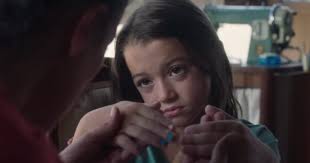
It’s a little girl in mortal peril. Look at that helpless, shocked face. You’ve got to do whatever it takes to save her.

Athena Durner plays Zoe, a child of five who becomes “the objective” in this lumbering, first-person-shooter thriller about a sole surviving “frogman” trying to get this one child chased by scores of glowering, murderous Taliban to a constantly-delayed exfil point.

Neither player has much of a role. The characters aren’t well written and the material doesn’t demand much in the way of performances. But Little Miss Durner gets a lot of pathos and protective empathy out of just a look. Yes, sometimes casting IS everything.

Warhorse One falls out of the plummeting chopper when it’s shot down. But a couple of minutes to collect himself, and maybe 37 edits to show him gearing-up and switching on his coms and “I am on my feet and I am good to go.

The mission? Track down the missionary family fleeing in their Izuzu Trooper. Sure, but only AFTER he’s disobeyed orders and shot a bunch of the Taliban who shot down his chopper.

Only Zoe survived among the missionaries. Most of the trauma of what she saw — her family murdered in front of her while she cowered — will probably show up as PTSD. She’s more timid than shocked and broken-hearted. She’s leery of the SEAL with the silencer on his rifle.

“Papa says guns never solve problems.”

“Yeah? That’s why I always carry a knife.”

Over the course of a day or two, they are hunted, shot at, snatched and grabbed as they struggle through the wilderness on their way to safety.

She’ll have time to let him see her teddy bear. He’ll have a moment or two to teach her how to throw a knife.

The locations look more like Butch and Sundance’s Sierra Nevada stomping grounds than Afghanistan. The Afghan combat film tropes — “eye in the sky” command center direction, the suicidal fanaticism of their foes, that silenced machine gun fired by the omnipotent SEAL who never runs out of ammo — will be almost too familiar to anybody who’s ever seen one of these films.

And passing through that terrain and checking off those combat-genre-boxes seems to take forever, only partly because of the material’s over-familiarity and the whispered dialogue (more accurate than movies that shows hunted American soldiers shouting).

Any time the editing calls this much attention to itself, you know they’re trying to massage some energy and ugrency into a slow slog of a narrative. It rarely works.

But that kid makes things better, just by giving the jaded warrior hauling her out a mission, just by the implied pathos of her presence. Strong doesn’t really “play” this, but we infer it, no matter how one-dimensional his character and performance are. If he was as good as her, then simple genre pic or not, we might have had something here.

As long as Strong’s been in the business, playing soldiers (“Blackhawk Down,” most famously), you’d think he’d have learned that old W.C. Fields maxim, the one about never working “with children or animals.” Because whatever else they demand on the set, they’re sure to upstage you every time.

Rating: R, graphic violence, some profanity

Cast: Johnny Strong, Athena Durner and Raj Kala

Credits: Scripted and directed by Johnny Strong and William Kaufman. A Well Go USA release.

Running time: 2:05

Posted in Reviews, previews, profiles and movie news | Comments Off on Movie Review: It’s up to Sgt. “Warhorse One” to Get that Little Girl out of Afghanistan

Classic Film Review: A “Door-slamming farce” with a “Die Hard” body-count — Hitchcock’s stumbling visit to “Jamaica Inn” (1939)

It’s all-too-telling that “Jamaica Inn” is left out of the summary of the career of “The Master of Suspense” on that font of all crowdsourced knowledge, Wikipedia.

Let’s all skip from “The Lady Vanishes” (1938) to “Rebecca” (1940). Hitch certainly wanted us to.

“Jamaica Inn” (1939) is a rare Alfred Hitchcock period piece and rare misfire, his first-ever adaptation of a Daphne Du Maurier novel and last film before “Going Hollywood,” under contract to David O. Selznick, which would spread his fame even further and ensure his legend through decades of hits and an iconic TV series to boot.

This film has never enjoyed a great reputation, and occasional attempts to paint it as better than its repute are but Hitchcockian clickbait. It’s far from terrible, thanks to the overbearing villainous turn by Charles Laughton, a first-ever starring role for Maureen O’Hara, and reliable support led by Robert Newton.

But it plants its first shipwreck early in the opening act, one of the clumsiest model toy boat effects of its day, intercut with shots of a captain and mate at the wheel, blasted by water plainly emanating from a fire hose.

Things don’t improve markedly during the course of the film, which due to its titular inn, comes to resemble a violent, melodramatic door-slamming farce, with only that fine English ham Laughton providing laughs in between the door-slams.

The spooky real-life Jamaica Inn in coastal Cornwall inspired Du Maurier, destined to be the popular novelist for whom the term “middle-brow” was seemingly invented. Historical fiction based on real history — the Inn was infamous for smugglers — the story concerned the murderous locals, who don’t wait for storms and troubled vessels to founder on their rocky shore. Like their unscrupulous peers in Key West and other dangerous sailing passages, they are “wreckers,” willing to manipulate signal lanterns and navigation aids to lure mariners to their doom.

Those who don’t perish in the wrecks and done in to ensure no witnesses survive.

The newly-renamed O’Hara — she’d appeared as a Maureen Fitzsimmons in a couple of little-seen Irish pictures — stars as Mary Yellan, a young Irish woman who has lost her mother and come to stay with her Aunt Patience (Marie Ney) and her husband, the innkeeper Joss.

We’ve seen what a brute he (Leslie Banks) is, the ringleader of the wreckers, cutthroat ensurer of the “no witnesses” policy. The loutish way he comes on to the strange young Irishwoman who comes to his door doesn’t end even after his loyal but long-suffering wife intervenes.

Mary was warned away from the place by passengers and the driver of the coach she arrived in, who refused to deposit her at such a disreputable establishment. She got there through the good offices of Squire Pelgallan, the spendthrift Sir Humphrey (Laughton) entertaining his fellow poshes at the manor up the road. He gallantly takes her to her destination, but not without a lot of leering.

Mary’s arrival at Jamaica Inn comes as the wreckers are starting to gripe about their shares of the loot they take in for all that treachery and murder. She secretly spies the summary judgment of Joss and the leaders about the “troublemaker” who’s causing that unrest, the newest wrecker, Jem Trehearne, played by the great Robert Newton.

When Mary interferes with his hanging, she and Jem flee the rough justice of the murderous mob. But there’s a leader they don’t know about, a puppetmaster arranging the wrecking. He is the aloof, posh magistrate, Sir Humphrey himself.

Running to him with their news of an awful scandal does them no good at all. They’re trapped between a murderous mob, a violent sea and a “protector” who is nothing of the sort.

This adaptation doesn’t entirely founder on the rocks. But the viewer is a couple of steps ahead of the action, start to finish. The innocents take forever to figure out the obvious.

Sometimes, it seems only the many doors on the many rooms of the multi-floor (split level) inn and the need to stretch the screenplay out to 100 minutes are keeping our intrepid (reluctant) couple from doing the math and outsmarting their pursuers and their sea of troubles.

In adapting the film, the villainous vicar of the novel is folded into the character of the local squire and magistrate, who is renamed here. Apparently, you couldn’t criticize clergy in films intended for the American market pre Monty Python.

The limited settings and time frame make one wonder how all this “action” can be confined to so small a space, with seemingly everyone on the moors in cahoots on the wrecking scam, and willing to kill to keep their secrets.

But this being a middle-brow melodrama, there’s a lot of wholly illogical “tie’em up” until later when he or she or they should be dispatched and dumped over a cliff at one’s earliest convenience.

Still, Laughton is a stitch as Sir Humphrey, a riot of foppish menace and upper class airs delivered in comically contemptuous dialogue.

“All fine fellows,” Sir Humphrey says of his “wrecking crew.” “A trifle dessicated, but one can’t have everything.”

That grandiloquent time Laughton was having apparently ruined the experience and the film for Hitchcock, who described it as miserable shoot, a director overwhelmed by an overbearing star and the producers.

Whatever glory he’d earned with the dark yet comedic “The Lady Vanishes” was a year behind him, and after realizing that tone wasn’t going to work here, that this was never going to be dark door-slamming thriller, Hitch couldn’t wait to be done with “Jamaica” and flee to the arms of the control freak Selznick.

That tells you something. So does the fact that Hitchcock eschewed his already-established cameo for this film.

The novel was adapted for other film versions, and a mini-series, which considering the place’s notoriety, seems its proper medium.

Watching “Jamaica Inn” now, when we no longer have “The prints are in terrible shape” and the like to excuse it, a Hitchcock fan can marvel over the crowded compositions, the sound-stagey look of it all and the performances that can be its saving grace and say, “Oh, it’s not all that bad” with a straight face.

But even declining to consider its source and thus compare it to the rest of the Hitchcock canon, it’s not all that good either.

Rating: “approved”

Cast: Charles Laughton, Maureen O’Hara, Robert Newton, Marie Ney, Leslie Banks, Wylie Watson, Basil Radford and Emlyn Williams

Credits: Directed by Alfred Hitchcock, scripted by Sidney Gilliat and Joan Harrison, based on the novel by Daphne Du Maurier. A Paramount release, a Cohen Media Group restoration now on Tubi, Amazon, youtube etc.

Running time: 1:44

Posted in Reviews, previews, profiles and movie news | Comments Off on Classic Film Review: A “Door-slamming farce” with a “Die Hard” body-count — Hitchcock’s stumbling visit to “Jamaica Inn” (1939)

Netflixable? South African “Bad Boys” go after “Jozi Gold”

“iNumber Number” began life as a South African cop thriller ten years ago, morphed into a single-season cop series and now returns to the screen via Netflix with “iNumber Number: Jozi Gold.”

This genre thriller from Donovan Marsh, who directed by the original film (titled “Avenged” in some countries) manages a few twists and a couple of lighter touches amidst the chases, killings, corrupt cops and CGI hyena scenes. Not enough to wholly recommend it, but it’s not an utter waste of an action fan’s time.

Our Black cop team here is consists of gonzo undercover idealist Chili (S’Dumo Mtshali) who is in his element, all pimped-out in wig (complete with an Afro-pick pistol), garish suit and vintage Dodge Monaco convertible, and his trigger-shy family man partner, Lt. Shoes (Presley Chweneyagae).

We meet them as they fail to bust The Hyena Man, a smuggler of “conflict gold” into the country, a way for Africa’s mineral-backed dictators to launder their blood loot and sell it to unscrupulous jewelers around the world.

It’s all “Jozi Gold” once its been refined in Johannesburg.

The Hyena Man got his nickname because he’s kept a savage hyena as his pet/interrogation tool for years.

“When a hyena laughs, it means the ancestors are not happy!”

Chili and Shoes were paired-up way back in an orphanage, and the frustration of missing that bust (“fool’s gold”) and the fact that their orphanage is running out of money, coupled with the corrupt taunting of their “kickback” prone Brigadier (Brenda Ngxoli) has Chili ready to quit.

But no, they’ll take the demotion to “the basement,” where a 100 percent-success rate all white “Afrikanner graveyard” run by the ancient Van Slys (Deon Lotz) isn’t keen on taking them on.

If the “light skinned” enclave ever wants to catch The Hyena Man and whoever else is mixed up in a big gold smuggling/smelting and trading conspiracy, the streetwise Black guys will have to be a part of it.

Imagine Chili’s conflicted emotions when he stumbles into a family-run gang of Zulu Robin Hoods, stealing ill-gotten gold and spreading cash in the Townships. When push comes to shove, which side will Chili be on?

Marsh stages an epic gasping and Dodge Monaco’ing chase in the opening act, and takes a couple of shots at topping it later. He never does.

The brawls and shoot-outs would pass muster in Britain, Korea, China, Hollywood or Bollywood.

The acting is sharp and more subtle than what you’d see in most African films — Nigeria’s Nollywood fare, for instance. Ngxoli’s brigadier is the most over-the-top character, and she makes this swaggering bully kind of fun.

While I tend to watch films in their original language (Zulu and Tswana here), there’s no reason not to catch the South African-dubbed English tracked onto this import.

But the story is kind of slapdash, with our writer-director not knowing the geological/chemical properties of “fool’s gold” and the whole Robin Hood gand of thieves, gold smelters and activists redistributing wealth is just too on the nose to be plausible or much fun.

Marsh has conjured up a formula action film that could be set anywhere and made it distinctly South African and authentically African, which makes it worth your time even if it isn’t a new touchstone take on the genre.

Rating: TV-MA, violence and oodles of profanity

Cast: S’Dumo Mtshali, Presley Chweneyagae, Noxolo Dlamini, Brenda Ngxoli and Deon Lotz.

Credits: Scripted and directed by Donovan Marsh. A Netflix release.

Running time: 1:53

Posted in Reviews, previews, profiles and movie news | Comments Off on Netflixable? South African “Bad Boys” go after “Jozi Gold”

Movie Review: A Immigrants’ Love Triangle Entangles Different Cultures and Agendas — “Sin La Habana”

Writer-director Kaveh Nabatian’s debut solo feature is a sensual and mystical love triangle tale of self-centered dreams, narcissistic agendas, sex, salsa and Santeria set among the immigrant communities of Montréal.

“Sin La Habana” (Without Havana) is compact and completely immersive, a film that takes us from the impoverished lives and hopes of escape among the accomplished working poor of lovely Old Havana to the limited opportunities and dreams-deferred of French Canadian Montréal.

Thanks to its classical dance subtext and superbly sympathetic performances, it passes before the eyes as a balletic elegy bathed in Santeria ritual and the human foibles that foil the best laid plans.

Leonardo (Yoneh Acosta) is a talented dancer, “the best in the company” in Havana, and damned irked that he didn’t get the lead in his ensemble’s “Romeo & Juliet.” When he’s told “Your lack of humility” and “lack of respect” kept him from the role by the arrogant company director, Leo may be on the money in his translation of that.

“You just want a Romeo who’s white like you,” (in Spanish, with English subtitles).

That gets him fired. And that gets in the way of “our dream,” girlfriend Sara (Evelyn Castroda O’Farrill) lectures him. Hustling salsa lessons and dance tours of the city to tourists won’t get them “out of here.” That’s the “dream.”

Sara is a lawyer, he’s a great dancer and they’re living in a hovel that loses its electricity every time it rains. She’s young and beautiful, and he’s runway gorgeous and accomplished, and Cuban racism and the general poverty of the country will never let them have the lives they feel they deserve.

Sara’s adamant about seducing and marrying a tourist, getting that visa and getting them out — first one and then the other — that way. And if Leo won’t do it, she will.

So he puts the moves on Canadian divorcee Nasim (Aki Yaghoubi). When she flies home to Montréal, Sara coaches Leo on how to email her, what to say that will close the deal.

Yes, that’s every bit as predatory as it sounds.

Leo’s secret edge in all of this is “luck,” something he figures he’s gathering every time he consults with his Santeria shaman. A few beheaded chickens, offered into a jungle river, and a gift of a crystal marble should send him to dance glory, a passport and the money to summon Sara to the capital of French Canada.

But Nasim isn’t just a mark here, someone to be played. She is a Jewish-Iranian immigrant to Canada who fled an abusive marriage over the objections of her “traditional” father. She’s 40ish, her sister has a baby. Nasim is trying her “luck” with a long shot, too.

Nabatian brilliantly bites off just enough of each city to get across its flavor, contrasting the vibrance and sensual pleasures of socialist/impoverished Havana with the chill and haughtiness of classist Montréal, where immigrant communities import their aspirations and their prejudices — racism included — with them.

The story enfolds traditional-jobs-immigrants-take (meat processing, service sector) as they struggle to find a way practice what they’ve trained to do and expect to be able to do in a Land of Opportunity.

Leo rehearses and auditions and puzzles with First World dance ensemble expectations — “improvise.” Nasim is an artist, working in stained glass, house-sitting for a friend and getting handouts from her family to get by.

Every character we meet is looking out for Number One, and nobody is living their dream. Even that’s a common trope of immigrant narratives, lending the entire film a hint of “we’ve seen this before.”

But Nabatian gets an engrossing, involving story out of these familiar themes with artistic interludes via dance, surrealistic flourishes as Santeria flashbacks and en pointe performances.

Rating: unrated, sex

Cast: Yoneh Acosta, Aki Yaghoubi and Evelyn Castroda O’Farrill

Credits: Scripted and directed by Kaveh Nabatian. A Breaking Glass release.

Running time: 1:34

Posted in Reviews, previews, profiles and movie news | Comments Off on Movie Review: A Immigrants’ Love Triangle Entangles Different Cultures and Agendas — “Sin La Habana”