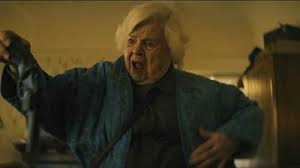
Today’s DVD Donation? The Belgian farce “Employee of the Month” comes to Altamonte Springs, Florida… maybe

“Employee of the Month” is a dark comedy about a woman away under a soul crushing patriarchy only to have fellows who won’t promote her or plan on stealing her raise if she’s ever given one.

And then a Black intern shows up and gives her the spine to fight back, and maybe over up injuries and deaths of repressors.

I liked it. It’s harmless enough, pretty mild mannered in a “Nine to Five” sense.

But when I offered to donate it to this suburban Orlando library, located in an old hotel on the Northside of town, the young librarian looked as if I’d offered her a copy of Mao’s Little Red Book.

Fear driven by a nation wide right wing assault on libraries, science, history and truth, no doubt.

I’ve been donating DVDs and books for years and this is the first time this has happened.

Life under a Nazi regime in The Banana Republic of Florida. Nooo, “It can’t happen here ”

O

Posted in Reviews, previews, profiles and movie news | Comments Off on Today’s DVD Donation? The Belgian farce “Employee of the Month” comes to Altamonte Springs, Florida… maybe

Movie Review: Poker players know better than to bet on a “Dead Man’s Hand”

Genre fans can pretty much tell when a Western is “off” just from a glance, and “Dead Man’s Hand” doesn’t pass that “This looks like a West that’s lived in” test.

But as this horse opera’s from the director of “The 2nd,” “Chokehold” and “Rottentail,” a “genre” specialist whose “genre” is stumbling formula B-and-C movies, one doesn’t get one’s hopes up. One mustn’t.

It’s got lovely, undeveloped Greater Sante Fe settings, some decent displays of horsemanship and amusing if not dazzling gunplay. Director and co-writer (it’s adapted from a comic book) Brian Skiba landed Cole Hauser, Brian Dorff, Costas Mandylor and Skiba’s pal Coren Nemec for his supporting cast.

The dialogue’s laced with anachronisms, the theme song is electrified country rock. But hell, they got the poker hand right. There’s something unexpected in the results when our hero draws a “Dead Man’s Hand,” which as any Western fan remembers is aces over eights.

Jack Kilmer — the son of you-know-her and you-know-who — brings strong (?) Zach Braff energy as a gambler/gunfighter named Reno, just married to the sagebrush sex worker Vegas (Camille Collard). They’e on their way to buy a saloon in Nevada when they’re waylaid by desperados in Confederate jackets, whom Jean-Jacques Renault dispatches with alacrity.

But dragging the gray-uniformed dead to the next town does Reno no favors. The saloon is filled with unconstructed Confederates and adorned with a stars and bars just above the bar. The “mayor” (Stephen Dorff) is former Col. Clancy T. Bishop, CSA.

The phrase, “What the hell, don’t you know the war is over?” pops up once or twice.

Reno’s a dead man, with or without that poker game where they “play for keeps,” with or without the help of the U.S. Marshal (Hauser) who’s come to town to take in Bishop, or aid by the livery stable owner (Vincent E. McDaniel) or the divine intervention of a wry Native American (Mo Brings Plenty).

The laughable elements include Kilmer, young enough to make this guy a pistol packing punk, but again “Zach Braff energy.” So, no. That’s not in the cards.

There’s a moment where Reno’s supposed to be shooting a rope about to hang somebody, and the take “One Take” Skiba uses plainly shows Kilmer discharging his rarely-reloaded six-shooter prematurely, as he’s raising it to aim it.

Vegas is ready for her nude bath with a nubile nude back-scrubber, a courtesy between “dance hall girl” sex workers in the Old West, I guess.

And Hauser and Dorff do what’s required of them, but a tad sheepishly, I must say.

The unintentional laughs pile up like corpses around almost every damned scene in this thing. Robbers refer to a stagecoach as a “wagon,” and considering the “stagecoach” has its canvas side covers rolled up and we can see one and all inside, only an unreconstructed Confederate would be dumb enough to ask “Got any women in there?” when two of them are in plain sight.

Once again, our director has tried his hand at injecting a little flashpoint politics into his tale. But at this point, one has to say that Skiba’s shown his cards in genre after genre after genre, and he’s still drawing nothing but deuces and one-eyed jacks, a loser’s hand every time.

The 2nd, Pursuit, Left for Dead

Rating: R, graphic violence, nudity, profanity

Credits: Directed by Brian Skiba, scripted by Corin Nemec and Brian Skiba, based on a graphic novel by Kevin Minor and Matthew Minor. A Lionsgate release.

Cast: Jack Kilmer, Stephen Dorff, Camille Collard, Costas Mandylor, Vincent E. McDaniel, Mo Brings Plenty, Corin Nemec and Cole Hauser

Running time: 1:35

Posted in Reviews, previews, profiles and movie news | Comments Off on Movie Review: Poker players know better than to bet on a “Dead Man’s Hand”

Series Review: “Last Call: When a Serial Killer Stalked Queer New York” is “true crime” at its most infuriating

Somebody was “picking up,” killing and dismembering gay men and dumping their body parts across rural New Jersey and Pennsylvania in the early 1990s.

And because the victims were gay and the little evidence at hand said they were “pick-up crimes,” commited after these men met their killer in a gay bar, it wasn’t hard to get the sense that the various police jurisdictions involved just didn’t give a damn.

“Last Call: When a Serial Killer Stalked Queer New York” is a quietly-compelling four-part documentary based on the true crime book by Elon Green, a film almost guaranteed to draw you in and just as certain to make you grind your teeth in fury at the missed opportunities, missed-clues and misapplication of justice by judges and juries when it came to punishing crimes against gay men.

Director and series co-creator Antony Caronna interviews lots of policemen who took on the various corners of this case, and a judge and a prosecutor. But he focuses most closely on the surviving family and friends of victims Thomas Mulcahy, Michael Sakara, Frederic Spencer, Anthony Marrero and Peter Stickney Anderson in painting a portrait of a slow-shifting American culture, a slow-footed justice system and the even slower-to-evolve attitudes of police about policing gay bashing.

When Caronna asks, off camera, “if there’s anything I didn’t ask” that should be brought up of two aged Pennsylvania State policemen, their defensive response, decades later, is that “the gay thing wasn’t really relevant to the investigation.” Thus, we “get it” even if they don’t.

With gay bashing on the rise and right wing governors and legislatures passing pro-discrimination and anti LGTBQ legislation folded into their inflamtory, violent rhetoric, we get the sense of what one activist describes as “being hunted” by hostile bigots, some of them moved by the violence of the rhetoric of that day, wasn’t just a fact of life 30, 40 and 50 years ago.

Homophobia feeds a “You deserved it” mindset about assaults and killings that hasn’t been buried to this day, and increasingly “militarized” police can be “indifferent” or downtright “hostile” to investigating crimes against gay and trans people, “Last Call” asserts.

Early episodes of the series give us details of this “closeted” father, that “dapper” banker and the other victims. Lives are fleshed-out beyond simple newspaper coverage. The mourning, for some relatives and friends, goes on.

Police investigators who agreed to appear on camera (and in phone interviews) second-guess themselves on what they missed here, what they NYPD and other jurisdiction compatriots screwed-up there.

And activists who once worked on the New York Gay and Lesbian Anti-Violence Project and hosts of Gay News cable programs offer stats, maps and their take on the atmosphere of the day and the slow-to-change attitudes that alarmed them when the cases were active, and infuriate them still as America’s far right tries to turn the slightly-less-bad-days back to the awful old days of being gay in America.

We learn that the “gay and trans panic defense” can still be trotted out by gay bahsers/killers in more backward corners of the country.

The series’ somewhat excessive (repetition, etc.) length means we’re allowed to ponder the 50 years of history that play out in the milieus of the story’s various chapters, from “just after Stonewall” to AIDS era gay phobia and gay bashing to today.

Pop culture fans might note that this crime spree resembles William Friedkin’s then-scandalous thriller “Cruising,” which came out in 1980, over ten years before New York, Pennsylvania and New Jersey police first realized they had multiple victims chopped up, plastic-bagged and left in dumpsters in multiple states.

But in that fictional and somewhat sensationalized film a dedicated cop goes deep undercover and comes to doggedly pursue the case until he gets his man. The so-called “Last Call” killer never inspired that level of dedication, and as activists complained, then and now, when there’s “no sign of the NYPD taking it seriously,” how can anyone feel safe?

Rating: TV-MA, violence.

Credits: Directed by Anthony Caronna, created by Caronna and Howard Gertler, based on a book by Elon Green. An HBO release.

Running time: Four episodes @:53-:60 minutes each

Posted in Reviews, previews, profiles and movie news | Comments Off on Series Review: “Last Call: When a Serial Killer Stalked Queer New York” is “true crime” at its most infuriating

Documentary Review: “Wham!” Remembered

If the pop powerhouse Wham! didn’t begin, progress to the “Top of the Pops” and end exactly this way — and it almost certainly did — it most certainly should have.

Chris Smith’s engaging, adorably upbeat portrait of the brief, brightest flash in the pan that was Wham! is mainly comprised of just two voices, the late George Michael in the extensive collection of archival interviews he did, and a present day remebrance from his “best mate,” his friend “from the age of 12” and Wham! co-founder, guitarist and fellow songwriter Andrew Ridgeley.

That narrow focus allows the film’s sunny disposition. None of the messiness and trauma of Michael’s later life and untimely death is here. That’s for other documentaries. This is just collaborating, performing, doing joint interviews and having a good time all along the way.

“What!” brings Ridgeley out of Michael’s shadow and into the spotlight where he comes off as a devoted friend, valued collaborator and the member of that group determined to make “a graceful exit” from that exhuberant, rowdy and stunningly successful performing group of their shared youth.

They made their “graceful exit” after a race to the top, with each of them the ripe old age of 23.

The chart-dominating Wham! was only together for four years. But it was a metoiric rize for two North London lads “fated” to to form “a brotherhood” from the moment twelve year old Ridgeley took “the new boy,” Georgios Kyriacos Panayiotou, under his wing to show him the ropes at Bushey Meade School in 1975.

Using home movies, primitive promotional videos (and outtakes) and TV appearances and live concert footage, Smith — who gave us “Tiger King” and the documentary about the symbiosis Jim Carrey achieved playing Andy Kaufman in “Jim & Andy: The Great Beyond” — paints a picture of two devoted determined to make it as a team and the odd, fate-kissed path that brought them success.

“Wham!” paints Ridgeley as the guy Michael credits with coming up with the group’s name and their first song, “Wham Rap,” the inspiration for “Wake Me Up Before You Go-Go,” and their visual style. And most touchingly, it shows Ridgeley — in joint interviews back then and even now — as perfectly willing to take a back seat when it became obvious the pal he always called “Yog” (a shortening of Michael’s real name) was a genius at creating power pop sing-alongs and romantic ballads, writing, singing and producing them.

Ridgeley was also the one who considered their chart-topping group a phenomenon of youth — theirs, and their audience’s. That “bow out gracefully” thing was, he figured, the perfect way to “break up.”

None of this Simon & Garfunkel sturm und drang, none of the bitterness of most every other group — even siblings like the Everly Brothers — that came to an end.

They agreed to do a final Wembley Stadium show at their peak, in 1986. And “The Final” was their finale. Michael’s later death merely ensured they’d never be tempted into doing a “reunion” tour.

The film’s narrow focus — with only their manager, Simon Napier-Bell, appearing here to offer a slightly more objective take on the group dynamic, the psychologies behind their success and their decision to move on — renders it quite myopic.

Little revelations about the “political” climate and nature of their earliest songs, an antidote to Thatcherite Britain, can surprise. The “I’m gay” realization of George and how he told his friend is almost wholly lacking drama, because Ridgeley and Ridgeley’s ex-girlfriend, a singer with the group, were nothing but supportive.

And yes, that ex-girlfriend was there for the whole ride.

I’d have loved to hear from “the girls” they brought into Wham! who became a part of the stage show, the music videos and background vocals at times. If nothing else, they could have provided insights into the true nature of the team at the top.

But Smith has made a film that’s not unlike Wham!’s hits — bouncy, light and frothy, nothing that demands anything of the viewer and listener other than a smile.

Rating: TV-MA, profanity

Cast: George Michael, Andrew Ridgeley, Kyriacos Panayiotou and Simon Napier-Bell

Credits: Directed by Chris Smith. A Netflix release.

Running time: 1:32

Posted in Reviews, previews, profiles and movie news | Comments Off on Documentary Review: “Wham!” Remembered

Classic Film Review: Mitchum gets his Irish Up — “The Night Fighters” aka “A Terrible Beauty” (1960)

The thing about the great film stars of the past is that they’d often as not embrace their screen “persona” and rarely make the effort to “stretch” as an actor. Bette Davis to Tracy, Peck and Wayne to Deborah Kerr and Joan Fontaine, they might fight for chewier, showier awards-bait “better parts.” But by an large, they accepted a form of type casting.

Robert Mitchum, a man’s man, quintessential screen tough guy, a good-looking version of Bogart who played a lot of gumshoes, lawmen in the saddle and the occasional villain (like Bogie) didn’t stretch much. He didn’t need to. He could render archetypal characters layered, conflicted and fascinating to watch.

His over-the-top villainous turn in “Night of the Hunter” might have been his biggest stretch. But a close second might be a role that had him slinging a very convincing Irish accent, singing and throwing the occasional punch as an IRA man who tells his murderous comrades “I’m quittin’ the IRA.”

You know what that means. “Nobody QUITS the IRA!” And there isn’t much of a leap from that to “INFORMER!”

“The Night Fighters,” a 1960 Irish production, has hints of John Ford’s 1935 classic “The Informer,” an Irishman struggling with his conscience, trying to do the right thing and yet have something of a life beyond “the cause.”

“The hell with the cause,” isn’t what triggers Victor McLaglen’s Gypo Nolan to turn “Informer” on 1930s Irish Republicans in that Oscar winning film. Gypo’s trying to get his hooker/girlfriend off the streets and off to America for a fresh start. He does it for the money, and the guilt and fear of discovery tear him apart.

Mitchum’s Dermot O’Neill’s loyalties are deeper, more personal. His wounded comrade (Richard Harris), the fellow he carried to safety, singing old Irish folk duets along the way, is who he’s loyal to. His longtime lady love, the hairdresser Neeve (Anne Heywood), deserves better than an impoverished life in Northern Ireland, better than a 35 year-old beau who drinks and lazes about and joins the IRA pretty much on a dare. He’s loyal to her, too.

The “cause” and the IRA? Not so much.

It’s 1941, and the IRA has allied itself with Nazi Germany, which has trained and equipped operatives to lead a rebellion against Britain that might coincide with fading German hopes of invading the UK. Irish Republicans, desperate to “unite these counties” with the Irish Republic “at last,” make their deal with the devil and hope for the best.

More than a few recruits mutter about linking themselves to Nazis, but they take on a mission — blowing up a hydro power plant. That’s what gets Sean shot and gets Sean caught. And that’s all she wrote for the two fisted fighter, two-fisted “sharing a jar” (drinker) Dermot.

The increasingly fanatical local IRA commandant (Dan O’Herlihy, perfect) can’t dissaude Dermot from complaining about his mate Sean’s imprisonment, can’t inspire him with speeches about the “bigger than one man” cause.

That’s what devolves from a heated argument to mortal threats, with an IRA “trial” and execution in the works.

This isn’t the most satisfying tale of Ireland’s off-and-on-again “troubles.” But the film, also titled “The Conspirators” in some markets, and “A Terrible Beauty,” and based on a novel of that name, is as vividly Irish as “The Quiet Man,” but with grit and grim black and white reality instead of whimsy, folklore and Technicolor.

Harris, very early in his career, is in tip top form, with O’Herlihy impressive as always and Cyril Cusack playing a local sage who sees a better Ireland without violence excellent in support.

And Mitchum is a delight as a tippler slow to anger but handy with his fists, an impulsive younger brother to the even drunker Ned, played by the great Irish character actor Niall MacGinnis. Mitchum adds a light touch to his tough guy persona that he wears as easily as that Irish lilt.

Direct Tay Garnett, who got his start in the silent cinema, manages some splendid action beats on location in Ireland (County Wicklow, etc.) and delivers lovely screen compositions, even in day for night outdoors shots.

“The Night Fighters” is untidy like its many titles, ungainly, and melodramatic at the end. But any Mitchum completist looking for another title to throw out there in “most under-rated leading man EVER” arguments will find a lot to like and a little to love in this outing.

Mitchum leans into his “type,” but stretches, singing and laying on the brogue like Sean O’Casey himself as a man who wonders if the Irish Republican Army is getting himself and his people closer to their dreams of a united Ireland, or pushing those further into the future.

Rating: unrated, violence

Cast: Robert Mitchum, Richard Harris, Anne Heywood, Marianne Benet, Cyril Cusack and Dan O’Herlihy

Credits: Directed by Tay Garnett, scripted by R. Wright Campbell, based on a novel by Arthur Roth. A United Artists release on Tubi, Amazon, Youtube, etc.

Running time: 1″30

Posted in Reviews, previews, profiles and movie news | Comments Off on Classic Film Review: Mitchum gets his Irish Up — “The Night Fighters” aka “A Terrible Beauty” (1960)

Book Review: Dragging Mia down to Woody’s Level — “The Farrows of Hollywood: Their Dark Side of Paradise”

In the introduction to her psychological biography “The Farrows of Hollywood: Their Dark Side of Paradise,” critic and film scholar Marilyn Ann Moss declares “I intend neither accusations nor support of Mia Farrow, the Farrow family or Woody Allen in these pages.”

But within a couple of pages she’s revealed the failure of that “intention,” if indeed she ever had it. She lights into the damning but one-sided HBO documentary “Allen v. Farrow,” which finally drove the holly stake through Woody Allen’s reputation with chilling footage and irrefutable audio evidence of his sinister side and his probable guilt.

“Looking more like a romantic melodrama…heavily armed with weapons of mass conversion.”

Oh? The reason that series had any power was seeing a little girl, filmed shortly after the incident in question, relating what happened, seemingly uncoached if encouraged to open about about what she says and continues to say she experienced. That’s “romantic melodrama?”

Long before Moss reaches her eye-rolling “Husbands and Wives” analysis that “Woody might have also been asking if he could leave his relationship with Mia. And in his own way, he did — by beginning his affair with Soon-Yi,” Moss has given the lie to her initial claim.

Whatever the intention, she’s out to show the damaged and toxic environment Mia Farrow grew up in, her sadistic, alcoholic, womanizing and fanatically (“hypocritically”) Catholic father and remote, uninvolved mother, their impact on a family oft-visited by tragedy and scandal, and let Woody Allen pretty much off the hook.

The book is mainly about Farrow’s father, a classic Hollywood reinvention tale, an Australian seaman and vagabond, abandoned by his parents, handsome enough and with the chutzpah to elbow his way into the movies as a screenwriter, then director, marrying the gorgeous starlet the world lusted over as she was Jane to Johnny Weismuller’s Tarzan in a string of cheap but wildly popular movies of the ’30s and ’40s — Maureen O’Sullivan.

And boy, what a piece of work John Farrow was — widely disliked, high-handed and verbally abusive on sets, physically abusive in his creepy “cutting” sex life, sometimes letting his sadism slip onto the set or into his screenplays.

Moss goes a bit overboard in praising Farrow as an under-appreciated auteur of his era. Of his best known films, only “The Big Clock” is acknowledged as a classic, John Wayne’s “Hondo” has a depth and edge unusual for his Westerns and some of his work with Robert Mitchum holds up. But as Moss has done books on Raoul Walsh and George Stevens, perhaps we should sample Farrow’s film noirs with a bit more respect.

Farrow won an Oscar, apparently undeserved, for his brief bit of work on “Around the World in 80 Days.”

Irish-born actress Maureen O’Sullivan rarely got the lead, outside of her “Tarzan” turns. She was the Catholic wife who declined to divorce her abusive and very public cheat of a husband, turning their house into two separate domains and even forcing him to build a separate entrance so that she wouldn’t have to hear the creep creeping home after his many assignations.

Mia Farrow’s memoir “What Falls Away,” frequently quoted here, was perfectly revealing and offered plenty of invitations to read between the lines about her boarding school/not-the-best-parents childhood, even if it didn’t wholly explain her mania for adopting children with mild or severe disabilities. Moss takes a stab at that, and at putting causes and effects on this or that aspect of the Farrow family and how Mia’s siblings turned out.

Moss is on shakier ground trying to psychoanalyze the lot of them, although on the surface it’s been long assumed that Mia Farrow got “revenge” on her dead father by briefly marrying the abusive Frank Sinatra, whose great love Ava Gardner carried on an affair with John Farrow 15 years before.

And the broad, un-informed swipes at Catholicism — Moss refers to the “crush” O’Sullivan kept over her bed, insisting the kids cross themselves whenever they entered her sanctum ( “Creche” or “crucifix?”) — make one wonder whether she’d have had the nerve to go after Allen on the same grounds and wonder what role Jewish mothers and Jewish upbringing play in creating a Woody (Allen Stuart Konisgberg), a Weinstein, Polanski et al.

The answer is “She wouldn’t.” Nobody else has, either.

And it’s plainly not Allen whom Moss is “going after,” here. There’s a hint of “Farrow brought this on herself” in this lopsided, somewhat salacious and psychologically under-qualified victim-blaming biography. But as anybody wading into this unsavory scandal finds out, there’s no getting through it without soiling yourself in the process.

“The Farrows of Hollywood: Their Dark Side of Paradise,” by Mariyln Ann Moss. Skyhorse Publishing, $32.50, 296 pages including filmographies and index.

Posted in Reviews, previews, profiles and movie news | Comments Off on Book Review: Dragging Mia down to Woody’s Level — “The Farrows of Hollywood: Their Dark Side of Paradise”

Series Review: Idris Elba wants to talk his way out of a “Hijack”

The creators of the series “Hijack” set two priorities for themselves in their “real time” seven part “seven hour flight” thriller.

Priority one, Get Idris Elba. Priority two, try to squeeze a Big Surprise or two in most every episode.

And although the plot’s a bit of a reach, although we’re treated to several of the quietest air traffic control centers ever depicted on film, although the middle acts drag and although there are a number far fetched moments with an eye-rolling logic all their own, Idris and this story give you enough to justify sticking with it.

I watched it all the way through, and — here’s ANOTHER proviso — “although” I wasn’t blown away, it makes for an intiguing and sometimes tense 5-6 hours of television, even if it does feel like a 100 minute movie padded in the modern streaming style.

You know the drill — tense bits, filler, extraneous characters, zinger, more filler, a blast of suspense aaaaannnnnnd…cliffhanger.

Elba’s a guy who boards Kingdom Air flight 29 from Dubai to London with no luggage, just a jewel box in his pocket. But Sam Nelson isn’t the most suspicious guy in the lot.

He’s the sort who notices things, which we notice with him — the pastor passenger who tries to bribe his way to getting his elderly wife into business class, the irritaable woman wrangling two kids along with their father, snapping at other passengers who give her the look or dare to say something, the sickly elderly Arab man who with nephews, the three girls from some athletic team, etc.

And once the plane is airborne, while Sam may not be privy to all that’s being said, somebody finds something, other folks get involved and the next thing we know, five pistol-packing hijackers have taken over the plane.

Their leader (Neil Maskell) is determined to breach the cockpit, and they’ve done the homework necessary to blackmail the pilot (Ben Miles). But they’re in no hurry at all to let the world know that they have the plane. They aren’t making demands. And the passengers have no clue why this is happening or how they should react.

After 9/11, some assume the worst and manfully plot simple, violent resistance. Others cower.

Sam? He’s got “special skills.” His magic power is negotiating, getting clients, buyers/sellers to “yes.”

Next thing the passengers know, he’s cozying up to “the guy in charge,” offering his services, identifying “issues” that may serve their purpose or more likely his.

“I just want to get home” he says in more than one installment. But that fellow behind the wheel?

“The pilot is a problem.”

The series gives us four distinct points of view, with sidebars built around name supporting players (Ruth Sheen and Simon McBurney) in the later acts.

We’re in the plane with Sam, the hijackers and the 210 other passengers and crew. And we’re in air traffic control, first in Dubai, where Abdullah (Mohamed Faisal Mostafa) gets curious about what’s going on with this Airbus. They’ve got “a situation” or “incident” in progress. Then they don’t.

The pilot “sounded calm.” “They ALL do.” “Pilots?” “No, British people!”

“The plane who cried ‘wolf?'”

An always-late single-mum air controller in London (Eve Myles) is also wondering what’s up with this plane long before it approaches Jolly Olde airspace.

A third point of view concerns Sam’s teen son, his moved-on ex-wife (Christine Adams) — the one who insisted, by text, that he not “get on that plane.” She’s taken up with a new bloke. Daniel (Max Beesley) is a cop. A curious and cryptic text to Marsha from Sam gets Daniel involved, calling in cop favors.

Former partner — in more ways than one — Deevia (Zora Bishop) makes an inquiry and shrugs it off, until Alice the air traffic controller rings up her Counter Terrorism department with a few clues about the “message” the plane’s movement is sending to them.

The government response — mostly British, but including air traffic control and scrambled fighter jets in other countries — is the fourth point of view the series tracks.

Through it all, through the ever more complex “motive,” the shifting dynamics of the criminal gang, the whispering, scheming passengers and crew, Sam works the angles, ingratiates himself here and there to the point where the passngers think he’s “a traitor,” and tries to get one or two chess moves ahead of this seemingly well-oiled criminal machine that’s taken them over with purposes unknown.

There are too many characters to do justice to, creating consistency problems even with Elba’s hero, whose “negotiating” seems so weak a hook to hang his “special skills” on that even the filmmakers abandon it for long stretches.

Get attached to this character or that one, and they are abruptly killed. The first actual violence is all the more shocking because it isn’t perpetrated by the hijackers.

I’m on a fence as to whether Apple TV+ has served up something people will be on tenterhooks for each week, waiting for the next installment. Elba’s good, but the plot hits a few walls and the endless sideshows suck away at the series’ foreward motion and narrative drive.

“Hijack,” like all streaming series, has “dawdling” and beating-round-the-bush built in.

If you’re into Idris playing a character who’s a talker not a fighter, he doesn’t disappoint. The series? It leaves us short of our destination.

Rating: TV-MA, violence

Cast: Idris Elba, Neil Maskell, Zora Bishop, Eve Myles, Max Beesley, Ben Miles, Kate Phillips, Christine Adams, Kaisa Hammarlund, Mohamed Faisal Mostafa, Ruth Sheen and Simon McBurney

Credits. Created by George Kay and Tim Field Smith. An Apple TV+ release.

Running time: Seven episodes @44-50 min. each

Posted in Reviews, previews, profiles and movie news | Comments Off on Series Review: Idris Elba wants to talk his way out of a “Hijack”

Classic Film Review: Fritz Lang and “Bert” Brecht’s “Hangman Also Die!” Bad history, good 1943 WWII noir

There is a superbly-detailed, thrillingly-pitched and well-acted film account of the 1942 Czech assassination of “Reichsprotektor” Reinhard Heidrich, the murderous Nazi nicknamed “The Hangman” during his military rule of occupied Czechoslovakia during World War II. It’s titled “Anthropoid,” and it stars Cillian Murphy (the upcoming “Oppenheimer”) and came out a few years back.

Exiles Fritz Lang, the celebrated playwright Bertolt Brecht and composer Hanns Eisler turned the story of the Nazi hunt for the assassin into a film noir, “Hangmen Also Die!” that came out less than a year after the actual events depicted, in the middle of World War II. The director and the screenwriters got almost everything historic wrong in this 1943 thriller.

But the filmmaker who gave us the prototype for the “hunted man” thriller with “M” still gets a stylish, tense and crackling picture out of events no one outside of Nazi Germany, Czechoslovakia, the Czech government in exile or the London planners and trainers of the assassins had any details about at the time. Two trained Czech soldiers were airdropped into the country to kill Heydrich and “prove” Czechoslovakia’s resistance to German domination.

Lang (“Fury,” “The Ministry of Fear”) and Brecht (“The Threepenny Opera”) don’t show us the killing, just the hunt for the man (Brian Donley) who carried it out, an underground made up mostly of communist resisters and a country that does its damnedest to ensure the killer is never caught, even at the cost of the lives of hundreds of their countrymen.

As Nazis chase off the getaway-cab driver (Lionel Stander), a bystander, Mascha (Anna Lee of “How Green Was My Valley,” “Fort Apache” and “The Ghost and Mrs. Muir”) sees the culprit, and misdirects the Nazis in their hot pursuit.

When our assailant can find no safe house in Prague to hide in, he tracks his benefactor down and lays low in the apartment she shares with her family, including her history professor/father (Walter Brennan) who figures out who this stranger his engaged-daughter lets in must be.

“Dont let yourselves be snowed under at Valley Forge,” he advises his family.

A dozen famous character actor faces adorn the cast of Czech patriots (Byron Foulger) or traitors (Gene Lockhart), with Lang showing a real flair for casting mostly expats to play the assorted heinous Nazis, including Tonio Stewart and “The Cabinet of Dr. Caligari” veteran Hans Heinrich von Twardowski as a vulpine and venomous Heidrich.

But the player who stands out here is the Austrian ex-pat Alexander Granach, deftly getting across cunning, efficiency and a comically-Bavarian addiction to beer as the Gestapo Inspector Gruber, who runs informants, reads clues and grills suspects in his pursuit of the man the locals label a heroic “executioner” but whom the German occupiers tar as an “assassin,” with a “blood debt” to be paid by hundreds of Czechs rounded up as hostages for execution if the people don’t turn in the real killer.

Over the course of the narrative, the assassin, Dr. Sovboda (Donlevy, best-known for playing heavies) feels the guilt of a man whose act will cause the deaths of many innocents and Mascha will journey from a woman frantic to save her hostage father to someone who is peer-pressured into understanding that this is bigger than her or her father or any Nazi reprisals

The screenplay, which has come to be thought as more and more the work of Brecht by Brecht scholars and less attributable to his collaborators, has tiny hints and writ-large examples of his communist politics, something that got past studio editing and censorship during World War II, when the Soviet Russians were the West’s allies in the fight to crush fascism.

Group scenes of “the resistence” and street scenes of The People badgering and threatening Mascha as they would anybody who wants to go to “Gestapo Headquarters” of her own free will have a proleterian agitprop feel. And the mobs’ way of flinging the “V-for-victory” salute is a lot more chilling now that we’re far enough removed from that era to see this as Brecht and Lang’s equating one “mob” with another.

Brecht, credited co-writer John Wexley and actor Stander were among those later blacklisted for having communist sympathies during the Hollywood “witch hunt,” and witchhunter Sen. Joseph McCarthy labeled this film subversive in the 1950s, which caused it to disappear from public showings until the mid-70s.

But at the time of release, the film was premiered in mid-America to some fanfare and nominated for a couple of Academy Awards. Composer Hanns Eisler, an expat who often scored Brecht’s plays in Europe, grabbed one of those nominations for his score, which folds Czech composer BedÅ™ich Smetana’s  patriotic tone poem “The Mouldau” into a few scenes.

The best reason for a film buff to dive into “Hangmen Also Die!” is that it’s quintessentially Fritz Lang, first shadow to its “NOT” “The End” finale.

Shadows and silhouttes abound, with a production design that almost seamlessly incorporates stock footage of Prague’s skyline, churches and clock towers into the gloomy, oppressed streets created on studio backlots.

The Austrian Lang wasn’t shy about leaning hard into war-era stereotypes of Germans, the sadistic officer classes empowered by the Swastika to be the beasts the world had come to believe they were in 1914-1918.

But the “heroes” here and the rather lax way the film treats the manhunt in the early acts don’t fall into the normal parameters of film noir, and truthfully, despite jumping right into the immediate aftermath of an assassination, “Hangmen Also Die!” takes a while to get going.

Only Granach’s scenes where he closes the net on the doctor, Mascha and their enablers have much in the way of suspense in them.

“Sorry sir. Once you work for the Gestapo you work for the Gestapo!”

But when the third act kicks in as one trap closes and then opens and another is sprung, Lang’s craft and skill transcend the “look” of a Fritz Lang film and pull us into the the nervous energy of a showdown, a double-cross and “a big frame-up.”

It might not be one of Lang’s very best, but the only script Brecht ever got filmed in Hollywood and the usual Lang flourishes make “Hangman” — which was almost titled “No Surrender,” a running theme of the film and an exclamation point in its finale — a must-see movie for any true cinephile.

Rating: “approved,” violent and “racy.”

Cast: Brian Donlevy, Anna Lee, Walter Brennan, Gene Lockhart, Alexander Granach, Lionel Stander and Hans Heinrich von Twardowski.

Credits: Directed by Fritz Lang, scripted by Bertolt “Bert” Brecht, Fritz Lang and John Wexley. A United Artists release on Tubi, Amazon, Youtube, etc.

Running time: 2:14

Posted in Reviews, previews, profiles and movie news | Comments Off on Classic Film Review: Fritz Lang and “Bert” Brecht’s “Hangman Also Die!” Bad history, good 1943 WWII noir

Netflixable? SerioComic Hijinx among three Mexico City Makeup Artists — “Making it Up?

Well-cast and acted with sympathic warmth and wit, “Making it Up” is an object lesson in the shortcomings of relying on voice-over narration to tell your story on screen.

It’s a dark, maddeningly-manic and almost cute dip into loving someone whose mental illness renders them toxic to be around. And writer-director Guillermo Calderón (“Neurda”) makes the infuriating decision to talk the damned thing to death with that anti-cinematic lazy screenwriter’s crutch, voice-over storytelling.

The story is about a friends/lovers triangle involving Ana (Paulina Gaitán), her childhood pal/recent-ex Alexandra (Ilse Carlos) and the friend Ana falls back on (Regina Blandón) whenever Alex melts down, lashes out, goes off her meds or on a bender.

Rita has a roomie, but takes in Ana when her makeup partner/life partner Alex melts down again. Free spirited, flat-broke Rita narrates our story, mostly a tale of makeup artists in a makeup-obsessed culture — weddings to parties to drag shows — whose customers are many and whose bills are always to be paid “mas tarde.”

Alex and Ana have had their latest split, but as Alex is “green-eyed,” aka “a whitey,” she has access to higher-end clients than the drag queens and other deadbeats Rita does, when she reaches out to Ana again, they’re not in a position to turn her down.

Rita flits around the wedding party, not doing her share of the mass making-up the job calls for, drinking and promising and lying and then declining to pay Ana and Rita their full fee when the job is done.

Alex is toxic, high-maintenance and exhausting. Alex, as we’ve seen in the opening scene, is in the fast lane headed towards a breakdown and a mental hospital.

“Making it Up” discusses — via the constant voice-over narration by Rita — the appeal or lack of appeal in marriage in modern Mexico among modern women, the “covering-up” that goes on in their world and their work and the endless “forgiveness” that goes on when you care about someone who can’t keep themselves from setting fire to this or that corner of your life.

Friends are betrayed, men are grasped at, used and abandoned. And Alexandra’s so casual about it all she can barely remember what this week’s grudge is or who she’s feuding with over it.

The “marriage” thing is introduced time and again in the voice-over, but only enters the narrative in the finale. The toxic relationship unfolds, scene after scene, on the screen. We don’t need that explained to us in voice-over, and despite that, it is.

The script leans on Rita’s myriad observations of the obvious, or inane bits of filling in the blanks.

“The rule is,” she says, in Spanish with English subtitles,” “if you don’t have money, call a friend who works in a club.”

There’s a better movie in this than Calderón’s final cut of “Making It Up” suggests. Cut two-thirds of the narration out and let the characters and the sensitive performances do the heavy lifting they’re so very qualified to do and I dare say we’d see that better movie. We’d certainly hear it.

Rating: TV-MA, sexual situations, profanity

Cast: Paulina Gaitán, Regina Blandón, Ilse Carlos, Tamara Vallarta, Fabrizio Santini and Emmanuel Varela.

Credits: Scripted and directed by Guillermo Calderón. A Netflix release.

Running time: 1:21

Posted in Reviews, previews, profiles and movie news | Comments Off on Netflixable? SerioComic Hijinx among three Mexico City Makeup Artists — “Making it Up?

Classic Film Review: Norman Lear fires the First Shot in the Culture Wars? “Cold Turkey” (1971)

The golden age of big screen satire began, more or less, with 1964’s “Doctor Strangelove, or How I Learned to Stop Worrying and Love the Bomb,” peaked with “Network” (1976) and wrapped up with “Being There” and “Life of Brian” in 1980.

Movies like “M*A*S*H,” “The Loved One,” “The Hospital”and “Nashville” made their marks in a pre-blockbuster era when studios could operate in the black (barely) with more adult fare and mostly modest budgets.

“Cold Turkey” (1971) was one of the lesser lights of that satiric era. But the film satire came out mere months before its writer, director and producer Norman Lear would unleash “All in the Family” and become perhaps the most important voice in American TV, possibly ever.

Lear’s “culture divide” TV comedies are prefigured in this broad, all-star farce. He started the work of taking on sacred cows — “the Silent Majority,” “salt of the Earth” middle America and its generally contradictory values, hypocritical mores and often deranged politics — in “Cold Turkey.”

He sent up American “get mine” greed, science skepticism, a country that paid lip service to small town America while everyone living in small town America was striving to get out.

Lear’s TV work reveals him as an unabashed champion of urban America, its great cities — flawed though they were and remain.

His hook was a country that learned, conclusively, that smoking causes cancer in 1964, with warnings added to tobacco product packaging 1965, and yet the added step of banning tobacco advertising had to be taken in 1970 because damning evidence or not, we weren’t quitting fast enough.

“Cold Turkey” would be about cynical Big Tobacco’s efforts to gild its “public health/humanitarian” image by encouraging American cities and towns to quit, with a $25 million reward for any town able to do it for 30 days.

The one place to have a shot does so by having a local preacher package the message in the form of a dying town’s spiritual and economic revival. Eagle Rock, Iowa desperately needs the money. It’s emptying out, dying.

But the smokers are too addicted and too self-centered to pitch in willingly. Ultra conservatives see the mass abandonment of tobacco as “Big Government” manipulation run amok, until that is, they get to be the “enforcers” of everyone else’s behavior, conservatism’s wet dream.

As the town’s notoriety grows, our flawed, self-dealing preacher — he longs for a promotion to “Dearborn” — sees the local profiteering, the shortening of tempers and the abandonment of a common civic good and common civility. And then Big Tobacco’s operatives show up to “monitor” and if possible, cheat and tempt the town lose lose the “30 days without smoking,”” “Project Cold Turkey contest.

It stars a Who’s Who of American sitcoms to come in the ’70s, many of them produced and/or created by Norman Lear. There’s Jean Stapleton, about to become America’s ditzy mom in “All in the Family,” Barnard Hughes playing another “Doc,” Bob Newhart and his old pal/co-star Tom Poston, Paul Benedict as a hippy hypnotherapist (“The Jeffersons”), Barbara Cason and Graham Jarvis of “Mary Hartman, Mary Hartman” and Vincent Guardenia (“All in the Family,””Maude”).

The great radio and TV comics Bob Elliott and Ray Goulding (Bob & Ray) send up every “newsman” of the day, posting as Hugh Upson (Hugh Downs), Walter Chronic (Cronkite), David Chetley (Brinkley, and Huntley), occasionally framed in a an angelic light, the way America revered its TV anchors back then,

What sticks in the memory is how the comedy is reliant on some amusingly off-color language, the residue of Robert Altman’s sleeper hit “M*A*S*H” spilling over the rest of cinema, opening the door for “Blazing Saddles” and the like.

A string of laughs come from aged character actress Judith Lowry, playing a member of the far right Christopher Mott Society (the movie’s John Birchers), free at last to refer to this action or that idea as “It’s a bull-sh–!” I wonder if her usage was a mistake they left in the final cut?

Newhart, broadly playing the PR guru who comes up with Valiant Tobacco’s “Nobel Prize,” stands out in memories of the film for this being quite unlike most any character Newhart ever played — venal, eye-bugging, amoral and comically cruel.

Poston and Hughes play two memorable versions of the “weakest” smokers in town — Hughes, a stressed-out doctor who “never operated on anybody without a cigarette,” and Poston as the rich tippler who can’t give up smokes without giving up booze. As he even drinks while he drives, that ain’t happening.

“The booze bone is connected to the smoke bone and the smoke bone is connected to the head bone and that’s the word of the Lord!”

Dick Van Dyke and Pippa Scott play the pastor his his bored, addicted wife who at least finds relief in “the physical act of love” pushed on everyone, including her husband, as a means of coping with withdrawal.

But the culture war politics of the picture didn’t hit me in any previous viewing the way it does now. The film literally opens with a shot of the Confederate flag flying over the mansion of a Southern tobacco baron (Edward Everett Horton, in his final screen appearance).

When Big Tobacco makes a push to “police” and force its products on tiny Eagle Rock, population 4006, who do the send as enforcers? The Sons of the Confederacy, riding in a truck and trailer converted to look like a steam locomotive and rail cars.

A comically chilling moment — local white Iowa kids, wearing the paper masks being sold to tourists bearing the images of the white town council, chase a lone Black child through the mobbed street scene, littered with casual Confederate Army reenactors.

Here was Lear, over 50 years ago, tying American backwardness and resistance to common sense and social progress to that font of all bad ideas — Confederate historical revanchism and the racism, conservative Protestantism and general bullheaded ignorance that goes hand in butternut glove with it.

The first musical joke in the movie is a banjo picking out the “Magnificent Seven” theme as Newhart’s “Wren” pushes the elderly tobacco patriarchy Horton around his grounds, selling him on his “biggest idea since creation,” an Alfred Nobel-inspired “change the subject from smoking-causes-cancer” contest.

That’s a reminder that this was the first film score by future Oscar-winner Randy Newman, who also sings “He Gives Us All His Love,” the ironic religious theme song to the film.

Nobody in this cast cost a fortune, and shooting it in tiny Greenfield, Iowa wasn’t the most expensive proposition. It wasn’t a complete bomb upon release, although it only made 1/8th what “M*A*S*H” earned — over $11 million — yet 30 times what Mel Brooks’ spoof-not-satire “The Producers” earned a couple of years before when it bombed on initial release.

Some of the laughs are aging better than others, but the reason to watch “Cold Turkey” today might be in recollecting its Culture Wars significance, its post-tipping point in the struggle with Big Tobacco moment in time, and in the array of talent Lear put on the screen at a bargain price.

There is literally no other movie that packaged Newhart and Poston and Van Dyke and Scott (an underrated comedienne, as evidenced here), the legendary character player Horton and the character actor actor legend in the making M. Emmett Walsh in the same movie.

And watching it anew, we don’t get to act surprised at how crackpot our politics have become, because “Cold Turkey” was stripping the “righteous rural” label right off of Middle America and folksy Iowa, way back in 1971.

Rating: PG-13 for smoking content throughout, innuendo and profanity

Cast: Dick Van Dyke, Bob Newhart, Pippa Scott, Tom Poston, Vincent Guardenia, Barnard Hughes, Barbara Cason, Judith Lowry and Edward Everett Horton.

Credits: Scripted and directed by Norman Lear. An MGM/UA release on Youtube, Amazon, Tubi etc.

Running time: 1:39

Posted in Reviews, previews, profiles and movie news | Comments Off on Classic Film Review: Norman Lear fires the First Shot in the Culture Wars? “Cold Turkey” (1971)