
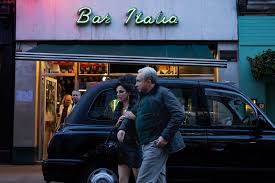
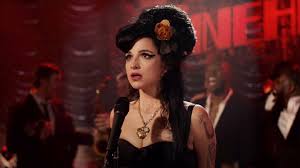
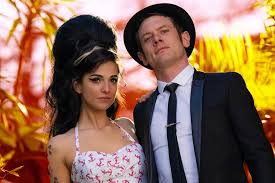
A flawed pop icon earns a flawed but serviceable bio-pic in “Back to Black,” an Amy Winehouse portrait built around a nuanced take on the star and uncanny vocal impersonation by Marisa Abela.
Abela, who was “Teen Talk Barbie” in last summer’s film phenomenon, looks more like Britney Spears (a shortish muscular dancer’s build) but matches Winehouse’s distinct tone and phrasing in song and in her unpolished, working class speech. She vamps up Winehouse’s blowsy personality and lets us see the vulnerability underneath a style icon who brought the “beehive” hairdo back and who transformed on the stage to a confessional, defiant street tough who shamelessly put all her business in her songs.
The film? It leaves a lot to be desired. Matt Greenhalgh’s script doesn’t utterly upend what the Oscar-winning 2015 documentary “Amy” suggested about her life and untimely end. But it does place the blame for her self-destruction at 27 on Winehouse herself, a mercurial personality and addict who never hid that fact, was hounded by the British press for it and paid the ultimate price.
Much respect to documentary filmmaker Asif Kapadia’s reasons for finger pointing at other “villains” in Winehouse’s life. Casting Britain’s best character actor, Eddie Marsan, as her villified father Mitch, pretty much removes the simplistic view of Winehouse’s chief “enabler” narrative and moves him more into a supportive working class dad guise, a character more in the background as she writes her own tragedy. Marsan, like Kapadia, has his reasons.
But “revisionism” aside, Sam Taylor-Johnson’s film frustrates in other ways. Winehouse’s creative process is glimpsed in only a scene or so. We know how she composed “Rehab” and “Back to Black” by “living” them. But they’re introduced abuptly.
We see her transition from singer-songwriter, accompanying herself on guitar, to Billie Holiday of her day, an R-rated, addiction-admitting chanteuse fronting a big band, a singer whose greatest obsession was the addict Blake (Jack O’Connell) she fell for.
She was an alcoholic who boasted about it from the stage before achieving her greatest fame.
“LY-dies don’t SIP,” she cracks onstage at one point. “We GULP.”
And we meet her biggest influence, her ex-jazz singer “nan,” played with heart and great empathy by Lesley Manville.
“You’ve got an eye for ‘bad boys,'” her grandmother scolds. And so she did. Having Amy dismiss the offer of a line of cocaine from the cocky charmer Blake with “Class A drugs are for mugs” seems a reach.
But most of the other characters in Amy’s story — from record execs to managers and bandmates — the enablers of her myopic Camden Town (north London) world, are barely sketched in.
“Back to Black” manages to move us, showing us her triumph and leaning into her unmoored heartbreak at the end of a violent (she was the more violent one, here) marriage. But the biopic skips over much, letting Abela’s wondrous impersonation of Winehouse’s singing and stage presence do the heavy lifting.
There’s joy in these performances, and genuine charm in her “meet cute” with Blake. And the alterations to the accepted narrative of her downfall are challenging and illuminating, if a tad jarring.
But like a lot of musical bio-pics, from maudlin Whitney Houston stories to the overrated Oscar winners “La Vie En Rose” and the much more fun “Bohemian Rhapsody,” the filmmakers limit us to “the greatest hits.” And that’s a far from complete or wholly satisfying immersion in this life and her world.

Rating: R, some violence, drug and alcohol abuse, nudity, sex, smoking
Cast: Marisa Abela, Eddie Marsan, Jack O’Connell and Lesley Manville
Credits: Directed by Sam Taylor-Johnson, scripted by
Matt Greenhalgh. A Focus Features release.
Running time: 2:02



